Who's Who in Gay and Lesbian History: From Antiquity to the Mid-Twentieth Century is a comprehensive and fascinating survey of the key figures in gay and lesbian history from classical times to the mid-twentieth century. Among those included are:
* Classical heroes - Achilles; Aeneas; Ganymede
* Literary giants - Sappho; Christopher Marlowe; Arthur Rimbaud; Oscar Wilde
* Royalty and politicians - Edward II; King James I; Horace Walpole; Michel de Montaigne.
Over the course of some 500 entries, expert contributors provide a complete and vivid picture of gay and lesbian life in the Western world throughout the ages.
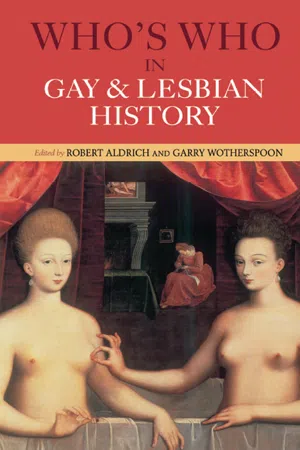
eBook - ePub
Who's Who in Gay and Lesbian History
From Antiquity to the Mid-Twentieth Century
- 524 pages
- English
- ePUB (mobile friendly)
- Available on iOS & Android
eBook - ePub
Who's Who in Gay and Lesbian History
From Antiquity to the Mid-Twentieth Century
About this book
Information
A
Achilles legendary Greek figure. In the first line of the Iliad, Homer announces his poem’s central theme: the wrath of Achilles. This anger arose from the insult suffered by Achilles, leader of the Myrmidons, when Agamemnon, the Greek commander-in-chief, robbed him of his concubine, Briseis. In response, Achilles, the Greeks’ greatest champion (without whom they could not win), withdrew from battle. He sulked in his tent until his friend, Patroclus, fighting in Achilles’ armour, was killed by the Trojan prince, Hector. Only then was Achilles roused to fight – to avenge his friend’s death. He massacred Trojans without mercy, until finally Hector was slain and his corpse dragged into the Greek camp behind Achilles’ chariot.
Achilles is a legendary figure, son of the goddess Thetis and the human Peleus. He had affairs with several women, including the princess Deidamia, who bore him a son, Neoptolemus. His friendship with Patroclus was variously regarded. Homer never says explicitly that they were lovers, though he portrays an emotional bond between them which is far more intense than that between any other pair of heroes. According to XENOPHON, Socrates held that Patroclus was Achilles’ ‘companion’ rather than his ‘lover’. But for others (both ancient and modern), episodes such as the overflowing grief exhibited by Achilles at his friend’s death, and the desire of Patroclus’s ghost for a common tomb, have implied an erotic relationship.
This was the commoner view in classical times. It is movingly expressed in one of the few fragments to survive from Aeschylus’s lost play, The Myrmidons, where Achilles reproaches Patroclus for having deserted him by dying: ‘You showed no regard for [my] pure worship of [your] thighs – so lacking in gratitude for so many kisses!’
It was also disputed whether Achilles or Patroclus was the older. For Aeschylus, it was Achilles. Similarly for Aelian (c. AD 200), the visit of ALEXANDER and Hephaestion to the heroes’ tombs at Troy makes coded reference to the parallel between the relationship of Hephaestion (as the younger beloved) to Alexander and that of Patroclus to Achilles. On the other hand, Phaedrus, a speaker in PLATO’S Symposium, says (using the current terminology) that Homer makes Patroclus the older (‘lover’ – erastes) and Achilles the younger (‘beloved’ – eromenos).
Faced by Homer’s opaqueness, later writers interpreted the legend in terms of their own times, thus providing icons for themselves and their successors. This process is particularly discernible in AESCHINES’ speech Against Timarchus, where the Achilles-Patroclus relationship appears as an example of legitimate eros, though it is viewed rather differently by Aeschines and by his opponents. For the latter, the story provides a precedent for physical intimacy, whereas Aeschines sees Homer ‘concealing’ (but not ‘denying’) the physical passion and emphasises the heroes’ affection and mutual devotion.
W. M. Clarke, ‘Achilles and Patroclus in Love’, Hermes, 106 (1978); D. M. Halperin, ‘Heroes and their Pals’, in One Hundred Years of Homosexuality, New York, 1990: 75–87.
Acosta, Mercedes de (1893–1968), American writer. The youngest daughter of a fashionable family who lived in turn-of-the-century New York City, as a child de Acosta believed that she was a boy. Her mother wanted a son, so she dressed de Acosta in boy’s clothing and encouraged her to play with boys. Axel Madsen notes that an early, unpublished version of de Acosta’s memoirs describes how the 7-year-old learned her biological sex. ‘“You’re deformed”, I shouted. “If you’re a boy and you haven’t got this, you are the one who is deformed”, he shouted back. By this time other boys had joined us, each boy speedily showing me the same strange phenomenon the first boy had exhibited. “Prove you’re not a girl,” they screamed.’
Unlike four of her older sisters, de Acosta spurned debutante balls and grand marriages. She married painter Abram Poole in a small ceremony. As a feminist, writer and lesbian, de Acosta retained her surname, lived apart from her husband while working on productions, and had loving relations with famed artistic women, including dancer Isadora Duncan and actresses Eva Le Gallienne, Alla Nazimova, Greta GARBO and Marlene Dietrich.
Dressed in tailored suits and walking shoes, de Acosta enjoyed the speakeasies, homosexual clubs and theatrical circles in 1920s New York City. She published two books of poems, two novels and the plays Jeanne d’Arc (1924) and Jacob Slovak (1928). Her theatre connections led to RKO hiring her in 1930. Though the Pola Negri movie she was hired to write never appeared, de Acosta quickly integrated herself into the circles of Hollywood actresses and screenwriters who held same-gender sexual interests. Similar to Paris’ salons, these ‘sewing circles’ included actresses such as Constance Collier and Beatrice Lille and socialites Elsa Maxwell and Elsie de Wolfe. De Acosta’s fortunes as a screenwriter did not improve. She battled unsuccessfully with MGM production chief Irving Thalberg to put Garbo in pants for a movie titled Desperate, then watched the star don them in Queen Christina (1933).
Several newspaper and magazine representations of the screenwriter described her masculine attire. Although similar to the ‘mannish lesbian’ image that demonised lesbians in medical textbooks and pulp fiction, the depictions made de Acosta into what historian Carroll Smith-Rosenberg labelled a second-generation New Woman. These women used male language and images to defy gender conventions, and de Acosta’s attire helped her form a persona that one article described as strikingly handsome. This image looks manly and dignified, instead of having the delicate and graceful attractiveness associated with females in the culture. These representations presented de Acosta’s New Woman attitudes and interests. The screenwriter decried marriage, noting that ‘matrimony is out of date. I don’t approve of it at all.’ After questioning the role that society offers women, de Acosta demonstrated her ability in foreign relations, an area that the culture of her time considered a male province. The screenwriter attempted to put her interest into action and tried to serve in the Spanish Civil War during the mid-1930s.
De Acosta returned to the New York theatrical and art worlds in the early 1940s. Her memoirs, Here Lies the Heart, appeared in 1960 to mixed reviews and limited public interest. Years of failing health drained her finances and curtailed her activities by the mid-1960s.
A. Madsen, Forbidden Lovers: Hollywood’s Greatest Secret – Female Stars Who Loved Other Women, New York, 1996; K. Swenson, Greta Garbo: A Life Apart, New York, 1997; H. Vickers, Loving Garbo – The Story of Greta Garbo, Cecil Beaton, and Mercedes de Acosta, New York, 1994.
Acton, Harold (1904–1994), British writer. Acton was born at the Villa La Pietra in Florence, Italy, the son of American Hortense Mitchell, Illinois Bank and Trust heiress, and Englishman Arthur Mario Acton, a failed artist turned avid art collector, by virtue of his wife’s fortune and subsequent investments. A younger brother, William, a gay artist of modest achievement, died an apparent suicide in 1944.
Raised in a household of connoisseurs, young Acton met DIAGHILEV, Jean COCTEAU, Max Beerbohm, Reggie Turner (Oscar WILDE’S friend and disciple) and artist Charles Ricketts while still an adolescent. Already, an avowed aesthete before entering Eton in 1918, he and classmate Brian HOWARD were devotees of Diaghilev and rebels against British philistinism and old-guard ‘manliness’. Champions of RIMBAUD and the French symbolist poets, modern American poetry, Osbert, Satcheverell and Edith SITWELL, jazz and everything connected to the modern aesthetics of the Ballets Russes, Acton and Howard wielded enormous social, artistic and intellectual influence during their years at Eton (1918–1922). Together they promoted modern dandyism and founded the Eton Society of the Arts (whose membership included Anthony Powell and Cyril Connolly), and published the Eton Candle, a literary magazine (1922). Acton’s poetry attracted the attention of the Sitwells and led to the publication of his first two books of poems, Aquarium (1922) and An Indian Ass (1925), works now undeserving of their initial critical acclaim.
Unabashedly gay, Acton entered Christ Church, Oxford, in 1922, succeeding as planned to dictate fashion and taste and to ‘rule’ as he and Howard had at Eton. At Oxford he founded the iconoclastic literary magazine the Oxford Broom. He was immortalised by fellow Oxonian Evelyn WAUGH as the flamboyant and decadent dandy ‘Anthony Blanche’ in Brideshead Revisited (1944), a ‘smear’ which to his disgust followed him throughout most of his life. During his homosexual phase at Oxford, Waugh was one of many students to have an affair with Acton, to whom he dedicated his first novel, Decline and Fall (1929).
With his writing career floundering, and finding Depression-era England inhospitable to his style of dandyism, Acton travelled to Peking in 1932 to lecture, write and translate Chinese poetry. In Peking, he lived like a mandarin, finding a new Buddhist serenity as well as opium and fulfilment with numerous Chinese youths. It was during this period, however, that he met Desmond Parsons, a young Englishman who, according to some friends, was the one true love of his life. After only a brief affair with Acton, Parsons became ill, returned to London and died of Hodgkin’s disease at age 26. In 1939, on the eve of World War II Acton was forced to return to Britain. During the war he served in the Royal Air Force and tried unsuccessfully to return to China, where he felt he would have been of most value, but instead was sent briefly to India.
Despite his youthful brilliance, Acton ultimately lacked the discipline and individuality to apply his literary and scholarly talents to lasting value or acclaim. His contribution to twentieth-century culture was having introduced modernist aestheticism to a generation of British writers and intellectuals, many of whose attainments ultimately were far greater than his own. For more than half his life, Acton remained internationally famous as a brilliant raconteur and devoted time between travels to writing fiction and scholarly studies, and lecturing on art history. But his prime life’s work became the preservation of the five villas, libraries and precious art collection of his 57-acre Florentine estate, where he entertained such notables as Bernard Berenson, Cecil BEATON, Winston Churchill, D. H. LAWRENCE, George Orwell, Aldous Huxley, Graham Greene, Henry Moore and Prince Charles. At his death, he bequeathed La Pietra, along with investments valued at $250-$500 million and $25 million in cash, to New York University.
Acton’s books include works of history, The Last Medici (1932), The Bourbons of Naples, The Last Bourbons of Naples, fiction, Peonies and Ponies (1942), and the multi-volume autobiography, Memoirs of an Aesthete (1948, 1971).
M. Green, Children of the Sun, New York, 1976; J. Lord, Some Remarkable Men, New York, 1996.
Addams, Jane (1860–1935), American social reformer. Addams was born in Cedarville, Illinois, where her father was a mill owner, devoted Quaker and a representative to the state legislature. Her mother died when Jane was young. She was a top student at the Rockford Female Seminary, and after graduating, entered medical school, withdrawing because of back trouble to return to Illinois.
In 1888 she and a close friend, Ellen Gates Starr, went to live in a poor neighbourhood in Chicago to learn more about how they might reduce the suffering created by poverty. In 1889 they purchased a house on the West Side of the city, Hull House, which grew to become the first settlement house in America. It was a focal point for neighbourhood social welfare programmes, advocacy, the arts and education, and a decentralised, anarchistic organisation that later developed a reputation for radicalism.
Hull House provided playgrounds, literary clubs, an art gallery, a chorus, a theatre, a summer school for women, a day nursery, a kindergarten, public baths, a library, a chemist, an employment bureau, a cooperative apartment for young working women and a Juvenile Protective Association working on issues of sexual morality, prostitution and drug abuse.
Addams is the most well known American social reformer and a model for many generations of social workers and advocates for disempowered people. She was the key person to convince the American public that welfare and social programmes were both right and practical, developing a theory and practice of social ethics that said that people are essentially good, but that society has the potential to be corrupt and that it is the collective responsibility of a culture to see that the environment protects and nurtures each individual’s best qualities. Her work with low-income people set a new standard for charitable work and helped create the concept of social welfare.
Throughout her life Addams was close to many women and was very good at eliciting the involvement of women from different classes in Hull House’s programmes. Her closest adult companion, friend and lover was Mary Rozet Smith, who nurtured and supported Addams and her work at Hull House, and with whom she owned a summer house in Bar Harbor, Maine.
Addams also took part in political activities in the Chicago area, nationally and internationally. She authored ten books, and in 1915 became a founding member of the Women’s Peace Party. However, by 1917 she became constantly ill and her activism was somewhat curtailed. By 1926 she was a semi-invalid as a result of a heart attack, but continued to receive numerous commendations for her work. In 1931, along with Nicholas Murray Butler, she won the Nobel Peace Prize. She died of cancer in Chicago.
J. Addams, Twenty Years at Hull House, New York, 1910; J. B. Elshtain, ‘A Return to Hull House: Reflections on Jane Addams’, Feminist Issues, 15, 1/2 (1997): 105–13; K. S. Lundblad, ‘Jane Addams and Social Reform: A Role Model for the 1990s’, Social Work, 40, 5 (1995): 661–9.
Adelswärd-Fersen, Baron Jacques d’ (1880–1923), French author. D’Adelswärd-Fersen became one of the most notorious of Europe’s fin de siècle homosexuals, principally because he was at the centre of a major French pederasty scandal. His family, descended from the Baron Fersen who had been Swedish ambassador to France in the reign of Louis XVI, was wealthy, royalist and socially very well established, and he was originally destined for the diplomatic corps. But a trip to Capri with his mother in 1897, when he may have met Oscar WILDE, seems to have led to his decision to become a writer. He duly published his first work, a book of poems titled Chansons légères, in 1901, and continued to write, mostly novels, for the next twenty years. Although never receiving much critical acclaim or public interest, his writings did have admirers, notably the influential woman novelist and critic Rachilde. A more decisive influence on his life and work than Wilde was probably the poet and novelist Jean LORRAIN, whom he encountered in Venice in 1902, and who describes d’Adelswärd-Fersen’s racy lifestyle in Pelléastres (1910). In July 1903 d’Adelswärd-Fersen was arrested, together with another aristocrat, Hamelin de Warren, and charged with indecent assault and ‘exciting minors to debauchery’. The importance of the scandal derived from the fact that the minors in question were boys of good family from well known Parisian schools: the Lycée Carnot, the Lycée Condorcet and the Lycée Janson-de-Sailly. The occasion of the supposed offence was a series of tableaux vivants organised at his house in which a number of the schoolboys took part, including one to whom he had written indiscreetly passionate letters. The assault charge was thrown out, but he was found guilty of the lesser offence and sentenced to a fine, a six-month prison sentence and ‘forfeiture of family rights’. Consequently, he went to Capri, where he became a central figure in the island’s homosexual expatriate colony until his death in 1923. His writings include a novel, Une Jeunesse (1906), which has a pederastic subplot; he was also founder of the short-lived homoerotic periodical Akadémos (1909), to which he contributed under the pseudonym ‘Sonyeuse’. But his real significance derives from his status as an archetype of the turn-of-the-century aesthete-pederast, an image embodied in the biographical novel L’Exilé de Capri by Roger Peyrefitte.
R. Aldrich, The Seduction of the Mediterranean, London, 1993; P. Cardon, Dossier Jacques d’Adelswärd-Fersen, Lille, 1991; R. Peyrefitte, L’Exilé de Capri, Paris, 1959.
Adrian-Nilsson, Gösta (1884–1965), Swedish painter. Better known as GAN, Adrian-Nilsson was born in a working-class area of the Swedish university town of Lund. In his early poems and pictures, he was obviously influenced by Oscar WILDE and Aubrey Beardsley. He soon came to discover Cub...
Table of contents
- Cover
- Half Title
- Series Page
- Title Page
- Copyright Page
- Contents
- Introduction
- Contributors
- Acknowledgements
- WHO’S WHO IN GAY AND LESBIAN HISTORY: FROM ANTIQUITY TO WORLD WAR II 1
- B
- C
- D
- E
- F
- G
- H
- I
- J
- K
- L
- M
- N
- O
- P
- R
- S
- T
- U
- V
- W
- X
- Y
- Z
Trusted by 375,005 students
Access to over 1.5 million titles for a fair monthly price.
Study more efficiently using our study tools.
Frequently asked questions
Yes, you can cancel anytime from the Subscription tab in your account settings on the Perlego website. Your subscription will stay active until the end of your current billing period. Learn how to cancel your subscription
No, books cannot be downloaded as external files, such as PDFs, for use outside of Perlego. However, you can download books within the Perlego app for offline reading on mobile or tablet. Learn how to download books offline
Perlego offers two plans: Essential and Complete
- Essential is ideal for learners and professionals who enjoy exploring a wide range of subjects. Access the Essential Library with 800,000+ trusted titles and best-sellers across business, personal growth, and the humanities. Includes unlimited reading time and Standard Read Aloud voice.
- Complete: Perfect for advanced learners and researchers needing full, unrestricted access. Unlock 1.5M+ books across hundreds of subjects, including academic and specialized titles. The Complete Plan also includes advanced features like Premium Read Aloud and Research Assistant.
We are an online textbook subscription service, where you can get access to an entire online library for less than the price of a single book per month. With over 1.5 million books across 990+ topics, we’ve got you covered! Learn about our mission
Look out for the read-aloud symbol on your next book to see if you can listen to it. The read-aloud tool reads text aloud for you, highlighting the text as it is being read. You can pause it, speed it up and slow it down. Learn more about Read Aloud
Yes! You can use the Perlego app on both iOS and Android devices to read anytime, anywhere — even offline. Perfect for commutes or when you’re on the go.
Please note we cannot support devices running on iOS 13 and Android 7 or earlier. Learn more about using the app
Please note we cannot support devices running on iOS 13 and Android 7 or earlier. Learn more about using the app
Yes, you can access Who's Who in Gay and Lesbian History by Robert Aldrich, Garry Wotherspoon, Robert Aldrich,Garry Wotherspoon in PDF and/or ePUB format, as well as other popular books in Social Sciences & Social Science Biographies. We have over 1.5 million books available in our catalogue for you to explore.