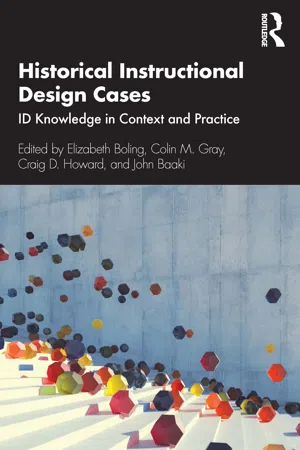
Historical Instructional Design Cases presents a collection of design cases which are historical precedents for the field with utility for practicing designers and implications for contemporary design and delivery. Featuring concrete and detailed views of instructional design materials, programs, and environments, this book's unique curatorial approach situates these cases in the field's broader timeline while facilitating readings from a variety of perspectives and stages of design work. Students, faculty, and researchers will be prepared to build their lexicon of observed designs, understand the real-world outcomes of theory application, and develop cases that are fully accessible to future generations and contexts.
eBook - ePub
Historical Instructional Design Cases
ID Knowledge in Context and Practice
- 336 pages
- English
- ePUB (mobile friendly)
- Available on iOS & Android
eBook - ePub
Historical Instructional Design Cases
ID Knowledge in Context and Practice
About this book
Information
1
SETTING THE CASES IN HISTORICAL CONTEXT
The cases contained in this book span the early 1880s to the early 2010s—a 130-year period that has produced profound changes in connectivity, social relationships, technological capability, equality and the role of citizenship, and the mode and outcomes of education in relation to all of these other shifts. While our goal in this chapter is not to fully describe or determine the historical framing of this lengthy period—indeed, many texts have and could be written on such a subject—we do believe there is value in setting the stage to aid the reader in stepping out of their own positions in time to identify, negotiate, and interact with the historical, social, educational, and technological contexts in which each of the designs described in this book arose. All the cases presented in this book share a US framing, so we will address this period from a US-centric perspective. In the following sections we will use a timeline of the period covered by this book (Figure 1.1) to present these contexts in a way that might support the reader’s capacity for “making strange” their present reality (Bell et al., 2005) so that they can appreciate the social milieu in which many designers of learning materials in our past made decisions, shaped future realities, and adapted to—and even overcame—the technological constraints of their era.
1880 to 1900
Our cases of designs for learning begin at a time when scholars surmised that intelligence might be measured by the relative weight or size of one’s head. And indeed, Darwin’s theory of evolution—published in 1859—shaped numerous perspectives on intelligence and human development that laid the groundwork for movements in the twentieth century focused on eugenics. In the United States, the year 1877 marked the end of the project of reconstruction following the American Civil War, setting into motion a century of failed integration, limited rights for Black Americans, and a desire for Americans of all origins to obtain higher levels of education.

FIGURE 1.1 A historical overview of the time period represented by cases in this book, spanning education, US history, and technology.
This book begins with a case depicting this turbulent period of nation-building, where politicians and settlers alike sought to realize the racist ideology then known as “manifest destiny” which whitewashed violence against indigenous tribes across the plains and onto the west coast of the United States. And indeed, the Plessy v. Ferguson Supreme Court decision in 1896 made explicit the “separate but equal” doctrine that would remain until the 1950s. More than one case in this volume depicts interventions that intended to assimilate learners through prohibition of their native language.
In Chapter 4, Gram describes the implications of this nation-building and the choices made on a national and local level to strip tribes of their identity, culture, and language through the creation of schools as part of the “Carlisle Model” intended to assimilate American Indian children into the broader US population. Problems of assimilation were foregrounded during this period, with the East coast considering what was termed the “Irish problem,” and on the West coast, Chinese immigration that led to the adoption of the Chinese Exclusion Act in 1882. In Chapter 3, Eccarius describes a different kind of exclusionary challenge—in this case, the creation of educational experiences for the deaf and hard-of-hearing community and the rise of bilingual education that could account for both speech and signing as a means of communication. These chapters present a contrast—one where indigenous rights are being systematically stripped away, and the other where the Rochester method is being introduced to encourage the eventual development of a deaf identity and culture. In Chapter 5, Lunga and Howard depict the lived experience of that same decision to ban American Sign Language as a language of instruction through an account of a student at the Tennessee Asylum for the Deaf and Dumb from when that ban was lifted.
At the end of this period, one of the first notable instances of intentional educational experimentation emerged—the formation of the Dewey Lab School in Chicago in 1894. This lab school facilitated the rapid testing of educational innovations which, when employed in similar lab schools across the nation, would inform much of the education developments of the twentieth century. This effort can be viewed in contrast to the social experimentation and hegemony of the Native American and Deaf schools of the era.
1900 to 1920
The first decades of the twentieth century led to many enduring technological and international developments which would define the era—and shape our present. The large-scale production of automobiles started to redefine local and national transportation, with Ford’s Model T—sold from 1908 to 1927—resulting in 16.5 million orders, in a country numbering just over 100 million. Other technological developments related to communication, with the first radio broadcast and first purpose-built movie theater emerging in the first decade of the new century. In 1903, the first powered flight led to the possibility of new transportation speed, both domestically and internationally. However, despite the technological promise of this era, The Great War dominated this period of history, with the unprecedented engagement of troops, coalition-building among the US and European nations, and the use of technology to support wartime activities.
While no design cases in this volume are fully set during this period, it is important to note that Native Americans were not recognized as citizens throughout this period, only gaining the right to vote in 1924. The Carlisle school closed in 1918, and many of the other schools that sought to integrate American Indians into broader society closed before the beginning of World War II. In parallel to this decline in attempts to assimilate Indian tribes, women only gained the right to vote in 1920, after almost a century of organizing. That same year, The Tennessee Asylum for the Deaf and Dumb became the Tennessee School for the Deaf.
1920 to 1940
The post-World War I era resulted in substantial shifts in the status of the United States and its connectedness and role as a growing world power. From a technological perspective, the introduction of television encouraged the development of new kinds of content and foreshadowed the shift from theaters to home viewing that would take place over the latter half of the twentieth century. The implementation and shape of instructional interventions was far more mundane than previously, and slow in growth. While progressives renamed asylums to schools, the actual curriculum of these learning organizations still struggled to empower learners. More substantial strides in designing learning experiences began to appear, but these efforts were disrupted or slowed by an international economic downturn, which resulted in what is now known as the Great Depression. Pressey’s first mechanical teaching machine, developed in the mid-1920s, demonstrated the potential of educational technologies in allowing for learners to progress at their own pace with the use of programmed instruction, and pointed to an era dominated by behaviorism, with the emergence of operant conditioning—developed by Skinner in 1937. Pressey’s teaching machines set the stage for Skinner’s programmed instruction work in the 1950s, discussed in Chapter 7.
1940 to 1960
This 20-year period was defined by war, with World War II, the Korean War, and the start of the Vietnam War framing international relations, the development of technology to support wartime activities and communication, and the role of training in supporting these efforts. Wartime readiness was framed around scaling up the American military, often cited as an early touchstone for the development of systematic instructional design models that could operate at scale (Reiser, 2001; Saettler, 2004). This era was especially impactful for the development of audiovisual communication, with the propaganda of Germany, Japan, and the United States used both as a training tool and a means of motivating participation in the war effort. Towards the end of this period of history, the Supreme Court decision on Brown v. Board of Education laid the groundwork for integration efforts—rejecting the “separate but equal” decision of 50 years before and creating a space for the potential of racial equality.
In Chapter 6, Gray describes the wartime effort through the lens of societal norms and human performance, analyzing and describing a film developed by the US Office of Education to support the onboarding and integration of women into the manufacturing workforce during World War II. This chapter points to the social shifts brought about by war, and in relation to new power gained through women’s suffrage, showing the use of audiovisual communication in addressing complex challenges that are part training, part social engineering. In Chapter 7, McDonald describes the rise of behaviorism in education, showing the natural consequences of Pressey’s mechanical teaching machine in promoting learning, resulting in the famous “Skinner Box” which inspired mass-market “teaching machines.” And indeed, the role of behaviorism in conjunction with the instructional systems work of the US military heralds an era of education and training at scale, with the passage of the GI Bill in 1944 that guaranteed access to education and training for almost 8 million veterans, leading to record enrollments in higher education, and the formation of the Educational Testing Service in 1948 which (perhaps problematically) framed educational achievement in relation to a set of standardized tests. These chapters, taken together, demonstrate the growing dominance of instructional design activities—although instructional design was not yet a defined discipline—in informing education and training experiences. The late 1940s saw the development of the Indiana University instructional film lending library, which then supported the development of audiovisual specialists that would define the next era of instructional design.
1960 to 1980
The post-war period resulted in a rapid expansion of the US population which, when coupled with the continued technological development, set the stage for the mass-market adoption of audiovisual and other communication technologies. This growth in technological capacity is the focus of many of the cases in this book focused on designs that originated during this era—ranging from the “flying satellites” used by the MPATI program to deliver instruction to rural students, to the use of teletype to support computer-assisted instruction in Nicaragua, to the development of home-based instruction through TICCIT that enabled interactive instruction over cable and touch-tone telephone systems.
While the Vietnam War overshadowed much of this period, impacting domestic and international politics, the “space race”—culminating in the first landing of men on the moon in 1969—defined the era. This broad and deep expansion of engineering capacity and technological capability informed the creation and mass-market awareness of many other technologies, such as the first integrated video camera in 1956, the first satellite broadcast in 1962, and the first digital camera in 1975. International concern relating to the development and proliferation of nuclear weapons by the United States and the USSR also led to an interest in developing resilient communication technologies that had no single point of failure—inspiring the development of ARPANET in 1969, the direct parent of the modern Internet. Finally, a growing interest in democratizing access to technologies and expanding their reach informed the development of the first commercial cell phone network in 1979 and the creation of the Apple I in 1976. Meanwhile, Sesame Street aired its first episode in 1969.
Two strands of designing for learning dominate in the cases from this period. First, cases on the SRA Reading toolkit, Bridge program, and Minimalist Instruction approach point towards new ways of engaging learners in controlling their own learning and appealing to learners with a range of backgrounds and previous knowledge. In Chapter 8, Boling describes the development and use of the SRA Reading toolkit, a fixture of many classrooms from the 1960s onward, and still in use in digital form to this day. This toolkit allowed a range of learners to evaluate and build their skills in an independent manner, relying on a set of learning materials which were intentionally scaffolded through a programmed instruction perspective. In Chapter 12, Young describes the creation, use, and eventual failure of an instructional approach that leveraged students’ skill in Black English to engage them in the development of Standard English skills. The Bridge toolkit, while not ultimately successful in its aims due to the sociopolitical climate of the time, reflects the desire to build upon and maximize the lived experience of the learner—pointing towards social constructivist approaches to learning that would rise in prominence in the 1980s and 1990s. In Chapter 13, Carroll describes the development of a new approach to structuring and scaffolding learning, valuing failure and error recovery over traditional modes of sequencing learning experiences. This instructional design approach, born in the era of early software development, informed the development of onboarding experiences that allowed learners more autonomy and agency, while also pointing towards an era when software manuals would no longer be relevant.
Second, cases on the Midwest Program on Airborne Television Instruction (MPATI), learning experiences through radio, teletype, and computers in the United States and in Nicaragua through early computer-assisted instruction, and the home-based learning potential of the TICCIT system show the potential of new remote learning technologies in creating new possibilities for learning experiences. In Chapter 9, Tracey and Stefaniak describe the use of DC-6 aircraft to broadcast instructional content to learners across the midwest, showing the emerging potential of audiovisual instruction and the early attempts to mitigate rural/urban divides in access to educational content. In Chapter 10, Trumbore describes the pioneering work of Patrick Suppes in developing computer-assisted instructional approaches that leveraged a bricolage of technologies available at the time—implementing teletype terminals, early mini-computers for processing, and recorded lessons to allow learners to receive tailored content based on their assessed capabilities the previous day. This targeting of individualized learning experiences points towards the rapid adoption of personal computers in the late 1970s and 1980s, and more broadly to the use of the Internet to create self-paced e-learning content. Finally, in Chapter 11, Gibbons and O’Neal describe the creation of an instructional system that would allow multiple learners to access interactive content through the use of a touch-tone telephone and cable broadcast system, which then managed the delivery of content through a networked mini-computer. This project built on the success of programmed instruction in other contexts, while also allowing the learner almost unprecedented control over the pacing of their learning experience.
1980 to 2000
The post-Vietnam era brought new social, environmental, public health, and technological challenges to the United States. The impacts of integration, including methods such as redlining, caused the collapse of integrated city centers, and precipitated the movement of the affluent White population to the suburbs. However, the growth of technology during this period became a defining aspect of the era—from the domination of cable television (MTV launched in 1981), to the growth of personal media devices such as the Walkman (1979), to the increasingly common ownership of personal computers. This represented a substantial shift from a handful of channels on a family’s single TV to a range of media and connectivity options across many devices, with the expanded promise of personal computers, game consoles, and pre-Internet versions of remote interaction. Educational environments began to take advantage of the technology of the era, with the distillation of constructionism through Papert’s M...
Table of contents
- Cover
- Half Title
- Title Page
- Copyright Page
- Table of Contents
- List of Illustrations
- Notes on Contributors
- 1 Setting the Cases in Historical Context
- 2 Curators’ Notes: Historical Design Cases
- 3 The Rochester Method: An Innovation in its Time (1878–1970)
- 4 Designed for Destruction: The Carlisle Design Model and the Effort to Assimilate American Indian Children (1887–1918)
- 5 A Lived Experience of the Tennessee School for the Deaf (1920–2000)
- 6 Supervising Women Workers: The Rise of Instructional Training Films (1944)
- 7 The Skinnerian Teaching Machine (1953–1968)
- 8 The Original SRA Reading System: Individualized Learning in a Box (1957–1964)
- 9 MPATI: The Midwest Program on Airborne Television Instruction (1959–1971)
- 10 Automated and Amplified: Active Learning with Computers and Radio (1965–1979)
- 11 TICCIT: Building Theory for Practical Purposes (1971–1978)
- 12 Bridge: A Cross Culture African American Reading Program (1975–1977)
- 13 Creating Minimalist Instruction (1979–Present)
- 14 Experts in a Box: Expert Systems and Knowledge-Based Engineering (1984–1991)
- 15 “Making Alcatraz Amazing”: The Alcatraz Cellhouse Tour (1987–1995)
- 16 SimCalc: Democratizing Access to Advanced Mathematics (1992–Present)
- 17 Using Analytics for Activity Awareness in Learning Systems (2003–2013)
- Index
Trusted by 375,005 students
Access to over 1.5 million titles for a fair monthly price.
Study more efficiently using our study tools.
Frequently asked questions
Yes, you can cancel anytime from the Subscription tab in your account settings on the Perlego website. Your subscription will stay active until the end of your current billing period. Learn how to cancel your subscription
No, books cannot be downloaded as external files, such as PDFs, for use outside of Perlego. However, you can download books within the Perlego app for offline reading on mobile or tablet. Learn how to download books offline
Perlego offers two plans: Essential and Complete
- Essential is ideal for learners and professionals who enjoy exploring a wide range of subjects. Access the Essential Library with 800,000+ trusted titles and best-sellers across business, personal growth, and the humanities. Includes unlimited reading time and Standard Read Aloud voice.
- Complete: Perfect for advanced learners and researchers needing full, unrestricted access. Unlock 1.5M+ books across hundreds of subjects, including academic and specialized titles. The Complete Plan also includes advanced features like Premium Read Aloud and Research Assistant.
We are an online textbook subscription service, where you can get access to an entire online library for less than the price of a single book per month. With over 1.5 million books across 990+ topics, we’ve got you covered! Learn about our mission
Look out for the read-aloud symbol on your next book to see if you can listen to it. The read-aloud tool reads text aloud for you, highlighting the text as it is being read. You can pause it, speed it up and slow it down. Learn more about Read Aloud
Yes! You can use the Perlego app on both iOS and Android devices to read anytime, anywhere — even offline. Perfect for commutes or when you’re on the go.
Please note we cannot support devices running on iOS 13 and Android 7 or earlier. Learn more about using the app
Please note we cannot support devices running on iOS 13 and Android 7 or earlier. Learn more about using the app
Yes, you can access Historical Instructional Design Cases by Elizabeth Boling,Colin M. Gray,Craig D. Howard,John Baaki in PDF and/or ePUB format, as well as other popular books in Didattica & Didattica generale. We have over 1.5 million books available in our catalogue for you to explore.