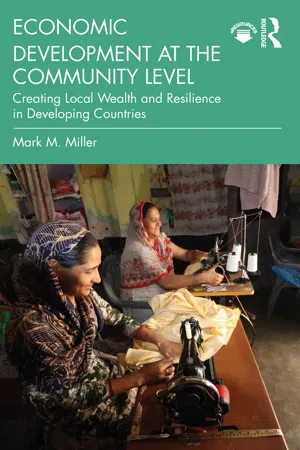
Economic Development at the Community Level
eBook - ePub

Economic Development at the Community Level

Creating Local Wealth and Resilience in Developing Countries

  1. 298 pages
  2. English
  3. ePUB (mobile friendly)
  4. Available on iOS & Android
eBook - ePub

Economic Development at the Community Level

Creating Local Wealth and Resilience in Developing Countries

About this book

How do we create more economic opportunities in the low-income communities of the developing world? How can these communities build greater resilience against economic uncertainties, natural disasters, wars, and the growing threats of climate change? This book reviews the research literature of economic development in low-income communities of the developing world—from rural villages to neighborhoods in the largest cities on earth.

This book is unique in gathering, organizing, and synthesizing research on economic development at the community level, across the developing world, drawing from multiple disciplines, publications, methodologies, regions, and countries. Part I provides an overview and context of the many challenges facing the developing world today, as well as the often-heated debates over what "development" is and how to make it happen. Part II reviews the extensive research literature in major fields of community economic development including education and human capital, overcoming the "curse of natural resources," entrepreneurship and micro-finance, tourism, and sustainability.

The audience includes undergraduate students interested in development and sustainability, graduate students and other young researchers in a wide range of disciplines who are finding their own focuses, and established researchers who wish to expand their agendas. An expanded bibliography accompanies the book as a downloadable supplement.

Trusted by 375,005 students

Access to over 1.5 million titles for a fair monthly price.

Study more efficiently using our study tools.

Information

Publisher
Routledge
Year
2020
Print ISBN
9780367204709
eBook ISBN
9780429537271

PART I

THE CHALLENGES OF CREATING WEALTH AND RESILIENCE FOR COMMUNITIES IN DEVELOPING COUNTRIES

1
WHAT STANDS IN THE WAY OF DEVELOPING COUNTRIES AND COMMUNITIES BECOMING DEVELOPED?

The low-income communities of the developing countries represent broad extremes of human settlements and livelihoods. On one extreme are isolated rural villages. In my Peace Corps service in the 1980s, I lived in the Mopan Mayan village of San Antonio, Toledo District, Belize: with a population of less than 1000, San Antonio was connected to the nearest town of Punta Gorda by 20 miles of dirt road, in turn connected to Belize City by some 200 miles of dirt and roughly paved road. A telephone line had once connected San Antonio with Punta Gorda Town, but the line came down in a storm after one test phone call and was never repaired. Three or four small shops sold basic commodities such as groceries, flashlight batteries, cloth, and rum. A small clinic, staffed with a Peace Corps nurse, provided vaccinations, stitches, and other basic health care services for San Antonio and surrounding smaller villages. Some of those surrounding villages were connected only by foot and horse paths through the tropical rainforests. Mennonite nurses provided vaccinations to the most remote villages by horseback. The villagers were subsistence farmers: they grew their own corn and beans that were the staples of their diet, and they sold whatever small surplus they might have for cash purchases. Houses were constructed from wood and palm fronds harvested from the forest, lashed together with vines. Nearly all the villages in the district had a school, some only a small, thatched building staffed by a single teacher.
At the other extreme are urban communities located within the largest cities ever seen on earth. My dissertation research concerned Mexico City: at the time the largest metropolis in the world, with over 20 million residents (Miller 1988; more recently Zulawska & Zulawska-Sobczyk 2018). One former squatter neighborhood of the Mexico City metropolis alone—Nezahualcóyotl—houses over a million residents. Meanwhile, other megacities of the developing world are overtaking Mexico City’s population—and challenges. (See “Extremes of urbanization and rural settlements” later in this chapter for urban terminology.) Mumbai, India, is on a trajectory to become the next biggest city on earth. Katherine Boo (2012) sketches a carefully researched portrait of a squatter settlement in the center of Mumbai. The neighborhood of Annawadi is built on land adjacent to the city’s airport, abutting a sewage lagoon.
… [T]he place was bedlam most nights: people fighting, cooking, flirting, bathing, tending goats, playing cricket, waiting for water at a public tap, lining up outside a little brothel, or sleeping off the effects of the grave-digging liquor dispensed from a hut….
(Boo 2012, x)
Every morning, thousands of waste-pickers fanned out across the airport area in search of vendible excess—a few pounds of the eight thousand tons of garbage that Mumbai was extruding daily. These scavengers darted after crumpled cigarette packs tossed from cars with tinted windows. They dredged sewers and raided dumpsters for empty bottles of water and beer… (Boo 2012, xii). [O]nly six of the slum’s three thousand residents had permanent jobs. (The rest, like 85 percent of Indian workers, were part of the informal, unorganized economy.)
(Boo 2012, 6)
In between these extremes are a scale of towns and cities ranging from small to large. In turn, these communities are found in a broad global spectrum of cultures, societies, and political systems. Those communities are located in a range of countries from highly industrialized, transitional economies such as those of Mexico and China, to the world’s poorest and least developed countries such as Chad or Haiti....

Table of contents

  1. Cover
  2. Half Title
  3. Title Page
  4. Copyright Page
  5. Dedication
  6. Table of Contents
  7. Introduction
  8. PART I The challenges of creating wealth and resilience for communities in developing countries
  9. PART II The opportunities for creating wealth and resilience for low-income communities in developing countries
  10. Index

Frequently asked questions

Yes, you can cancel anytime from the Subscription tab in your account settings on the Perlego website. Your subscription will stay active until the end of your current billing period. Learn how to cancel your subscription
No, books cannot be downloaded as external files, such as PDFs, for use outside of Perlego. However, you can download books within the Perlego app for offline reading on mobile or tablet. Learn how to download books offline
Perlego offers two plans: Essential and Complete
  • Essential is ideal for learners and professionals who enjoy exploring a wide range of subjects. Access the Essential Library with 800,000+ trusted titles and best-sellers across business, personal growth, and the humanities. Includes unlimited reading time and Standard Read Aloud voice.
  • Complete: Perfect for advanced learners and researchers needing full, unrestricted access. Unlock 1.5M+ books across hundreds of subjects, including academic and specialized titles. The Complete Plan also includes advanced features like Premium Read Aloud and Research Assistant.
Both plans are available with monthly, semester, or annual billing cycles.
We are an online textbook subscription service, where you can get access to an entire online library for less than the price of a single book per month. With over 1.5 million books across 990+ topics, we’ve got you covered! Learn about our mission
Look out for the read-aloud symbol on your next book to see if you can listen to it. The read-aloud tool reads text aloud for you, highlighting the text as it is being read. You can pause it, speed it up and slow it down. Learn more about Read Aloud
Yes! You can use the Perlego app on both iOS and Android devices to read anytime, anywhere — even offline. Perfect for commutes or when you’re on the go.
Please note we cannot support devices running on iOS 13 and Android 7 or earlier. Learn more about using the app
Yes, you can access Economic Development at the Community Level by Mark M. Miller,Mark Miller in PDF and/or ePUB format, as well as other popular books in Economics & Business General. We have over 1.5 million books available in our catalogue for you to explore.