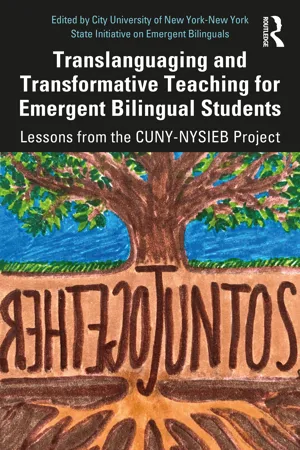
A critical and accessible text, this book provides a foundation for translanguaging theory and practice with educating emergent bilingual students. The product of the internationally renowned and trailblazing City University of New York-New York State Initiative on Emergent Bilinguals (CUNY-NYSIEB), this book draws on a common vision of translanguaging to present different perspectives of its practice and outcomes in real schools. It tells the story of the collaborative project's positive impact on instruction and assessment in different contexts, and explores the potential for transformation in teacher education. Acknowledging oppressive traditions and obstacles facing language minoritized students, this book provides a pathway for combatting racism, monolingualism, classism and colonialism in the classroom and offers narratives, strategies and pedagogical practices to liberate and engage emergent bilingual students. This book is an essential text for all teacher educators, researchers, scholars, and students in TESOL and bilingual education, as well as educators working with language minoritized students.
eBook - ePub
Translanguaging and Transformative Teaching for Emergent Bilingual Students
Lessons from the CUNY-NYSIEB Project
- 264 pages
- English
- ePUB (mobile friendly)
- Available on iOS & Android
eBook - ePub
Translanguaging and Transformative Teaching for Emergent Bilingual Students
Lessons from the CUNY-NYSIEB Project
About this book
Information
SECTION IV
Literacies Juntos: Instruction and Assessment
10
TRANSLANGUAGING AND EMERGENT LITERACY IN EARLY CHILDHOOD EDUCATION
Introduction
Young children learn to read and write within the context of their own families, cultures, and languages (Goodman, 1992). Their first exposures to written symbols in books, handwriting, cereal boxes, environmental print, etc., occur in the deeply familiar settings of their homes and in the languages spoken there. Experiencing the interconnectedness between spoken and written language enables children to grasp the concept of symbolic representation. Even very young children understand how drawings and paintings are representations of objects, not the objects themselves (DeLoache, 2004). This understanding deepens as text accompanies drawings, as in storybooks or recorded narrations, and gives rise to foundational emergent literacy skills (Sulzby, 1992), the precursors to conventional reading and writing. The field of early childhood education (ECE) widely recognizes the role of parents, teachers, and other adults, in supporting a child's emergent literacy skills; we know a lot about the age-appropriate activities and experiences that constitute literacy instruction in the early childhood classroom (NAEYC, 2009).
Promoting emergent literacy in ECE calls for a careful consideration of the multimodal ways in which children use language and symbols to learn, make meaning, and express their ideas. Empowered to manipulate materials and resources in their environment, children are active constructors of their own language competencies (Clay, 2015). The young emergent bilingual child draws from experiences in the home language(s) as well as the language of the early childhood classroom, extending the concept of multimodal learning to include the spontaneous, dynamic use of any and all languages present in the child's world. Translanguaging theory and pedagogy undergird the development of emergent literacy skills for the emergent bilingual child in ECE.
Evolving multilingual practices in ECE
After decades working in the field, we want to first acknowledge what we have observed in ECE and the transformation in emergent literacy instruction brought about by the work of CUNY-NYSIEB (City University of New York-New York State Initiative on Emergent Bilinguals). As bilingual educators in New York, we have always been expected to use our multiple languages as a condition of employment. However, the ability to speak more than one language was always tightly controlled by the school environment. We may have been interpreters or translators as called upon, but the expectation was that we would model for children and families, an inexorable shift toward English. We actually praised emergent bilinguals if they could “say it in English.”
Even in bilingual classrooms, we may have been recognized as bilingual teachers, but our natural, intuitive language practices were controlled by the curriculum that scripted teacher talk, or by coaches and administrators observing our lessons. Other common practices in ECE, such as highlighting student work on bulletin boards, was expected to demonstrate English if it was to be viewed as an exemplar. Our classrooms and hallways may have housed bilingual children, but English was the language of the print in the environment. Personally, we can recall a time when words in any language other than English were strictly forbidden for the Word Wall.
These rules and prohibitions disadvantaged young emergent bilinguals as they disabled the ability to connect spoken and printed language. Making this connection is the very beginning of emergent literacy skills. They also compromised the effectiveness of bilingual educators who may have made those connections for children but were forbidden by the prevailing ideology about language in ECE.
As CUNY-NYSIEB articulated translanguaging practices and translanguaging pedagogy, through the work of Ofelia García, we are living an evolution toward multilingual practices in ECE. This represents a powerful boost to emergent literacy instruction for bilingual children that is in keeping with research identifying gains in literacy where children's home language practices have been integrated and promoted in instruction (Farver, Lonigan, & Eppe, 2009; Lindholm-Leary, 2014; Méndez, Crais, Castro, & Kainz, 2015; Roberts, 2008).
In light of this history and evolution, this chapter focuses on how emergent literacy is promoted in the prekindergarten classroom with three and four-year old bilingual children. In addition, because the preschool population is more culturally and linguistically diverse than any other age group (Frey, 2011), we consider how translanguaging pedagogy is embedded into the emergent literacy work that preschoolers are asked to do.
Using the state of New York as the example, we begin by describing the preschool population and we continue with a discussion of translanguaging and emergent literacy in the early childhood classroom. We then discuss how translanguaging theory can transform our understandings of language and literacy, and the implications it has for play-based instruction, pedagogical practices, and family engagement.
Serving New York's preschool population
Despite the importance of understanding and responding to the needs of three and four-year old preschoolers, there is still very limited demographic information about these young bilingual children. In their national report on bilingual children, the National Academies of Sciences, Engineering, and Medicine (2017) indicate that there are more children in early care and education programs recognized as “English Language Learners” than there are in kindergarten. With shifting demographics and increasing linguistic diversity across the United States, more children are growing up in homes where they are developing a bilingual repertoire—one that includes both language practices associated with English, as well as with one or more other languages.
In 2016, New York's Universal Prekindergarten (UPK)1 served 120,000 three and four-year-olds. This constitutes only 63% of the children actually eligible for these services (New York State Education Department, 2017a). But data on the home language practices represented in this group is nonexistent (Morell, 2017). In order to better plan for instruction and programming, New York State, with the assistance of Zoila Morell, developed a protocol to identify the bi/multilingual preschool population upon entry into UPK programs, adopting the term “Emergent Multilingual Learner” (EMLL) to refer to any child who speaks a language other than English at home (New York State Education Department, 2017b). Slated for full implementation in 2020, the protocol will provide invaluable information about New York's preschoolers.
Guiding instruction in prekindergarten, the New York State Prekindergarten Early Learning Standards (New York State Education Department, 2019) articulate the competencies children should develop, across developmental domains, as part of their learning. Within the play-based environment we describe below, learning standards serve as the “guardrails” that organize instructional planning. In this case, the prekindergarten standards, by design, describe many of the competencies associated with emergent literacy in early childhood (see http://www.p12.nysed.gov/earlylearning/standards/documents/PKStandards2019accessability.pdf). For example, indicators for the domain of Communication, Language, and Literacy (PK.AC.6), lists the following skills for children to develop (p. 16):
PK.AC.6. Demonstrates their ability to represent ideas using a variety of methods Indicators:
- Uses facial expressions, body language, gestures, or sign language to express ideas
- Uses existing objects to represent desired or imagined objects in play or other purposeful way
- Uses visual media to represent an actual experience
- Reviews and reflects on their own representations
- Writes and/or draws to communicate meaning with peers and adults during play
The linguistic diversity of the population in prekindergarten classrooms calls for a specialized understanding of the ways in which a child's language(s) interacts with the development of emergent skills.
Bilingualism, translanguaging, and emergent literacy in early childhood
Language learning is dependent on social interaction. Research with infants and young children indicates that exposure to language through media (for example, video, music, television) does not produce growth in vocabulary, even when the material is age-appropriate and child-friendly. In order to develop language, children are reliant on human interaction to make the crucial connections between a spoken (or signed) word and what it represents (DeLoache et al., 2010). The very nascence of emergent literacy for children then, is the language learning that takes place in an exchange with a more knowledgeable interlocutor.
Consider how a typical prekindergarten student uses emergent literacy abilities. Within a few days into the academic year, she is expected to navigate complex social situations with peers and adults where she must effectively negotiate her preferences for toys, turn-taking, games, following rules, maintaining routines, cooperating with her teachers, expressing her needs, etc., all the while separated from family members and familiar situations. She is further challenged to demonstrate very explicit ways of languaging, such as inventing or narrating a story, retelling a common storybook narrative, responding to direct questions about text or other occurrences, and deciphering the multiple messages presented to her in the environment in the form of pictures, charts, color-coded signs, graphic organizers, and symbols such as letters or numbers. What she has brought with her to this enterprise is her cumulative knowledge of family, culture, and concrete experiences, conveyed through her language.
For the young child, the meaning-making inherent in emergent literacy skills begins with (spoken or signed) language (DeLoache, 2004). When the prekindergarten emergent bilingual child cannot use her home language practices in the classroom, her primary tool for developing emergent literacy skills is essentially disabled. Additionally, many young children growing up in bilingual homes do not simply have one home language, but various home language practices and they engage in translanguaging. This is important to note as most emergent bilinguals in daycares and preschools across the country are simultaneous bilinguals, who are learning and developing two or more languages at the same time, rather than sequential bilinguals who are exposed to one named language first and then another (de Houwer, 2009). This is a strong imperative for her teachers to implement strategies and instructional approaches that maximize the use of home language practices.
Integrating multiple home language practices in the prekindergarten classroom may challenge the monolingual teacher who may have been very well trained for instruction in English only. However, there are increasingly more creative strategies and approaches available to early childhood professionals (we include recommendations below) to inform the teacher's work. In order to understand how and why these language strategies work, we first briefly discuss the nature of bilingual children's language use.
Research with very young children highlights their impressive ability to recognize different languages and to quickly “assess” whether an individual is speaking a new or familiar language (Bialystok, 2007). In fact, young bilinguals demonstrate considerable knowledge about language—its features, its uses, its practices, etc. It is said that their exposure to different language practices provides them with greater metalinguistic awareness (Bialystok & Barac, 2012; García, 2009). But the child herself uses all the linguistic and semiotic features with which she is familiar to make meaning or to make herself unde...
Table of contents
- Cover
- Half Title
- Title
- Copyright
- Contents
- List of Figures
- CUNY-NYSIEB Contributors
- Teacher/Researchers Participants
- Foreword
- Acknowledgments
- Introduction: Overviewing with CUNY-NYSIEB Lentes y Emergent Pasos
- SECTION I Foundations: Translanguaging Theory/Practice and a Project
- SECTION II Evolving Juntos Structures
- SECTION III Shifting Educational Spaces
- SECTION IV Literacies Juntos: Instruction and Assessment
- SECTION V Inquiry en Comunidad
- SECTION VI Transforming Teacher Education
- The CUNY-NYSIEB Team
- Index
Trusted by 375,005 students
Access to over 1.5 million titles for a fair monthly price.
Study more efficiently using our study tools.
Frequently asked questions
Yes, you can cancel anytime from the Subscription tab in your account settings on the Perlego website. Your subscription will stay active until the end of your current billing period. Learn how to cancel your subscription
No, books cannot be downloaded as external files, such as PDFs, for use outside of Perlego. However, you can download books within the Perlego app for offline reading on mobile or tablet. Learn how to download books offline
Perlego offers two plans: Essential and Complete
- Essential is ideal for learners and professionals who enjoy exploring a wide range of subjects. Access the Essential Library with 800,000+ trusted titles and best-sellers across business, personal growth, and the humanities. Includes unlimited reading time and Standard Read Aloud voice.
- Complete: Perfect for advanced learners and researchers needing full, unrestricted access. Unlock 1.5M+ books across hundreds of subjects, including academic and specialized titles. The Complete Plan also includes advanced features like Premium Read Aloud and Research Assistant.
We are an online textbook subscription service, where you can get access to an entire online library for less than the price of a single book per month. With over 1.5 million books across 990+ topics, we’ve got you covered! Learn about our mission
Look out for the read-aloud symbol on your next book to see if you can listen to it. The read-aloud tool reads text aloud for you, highlighting the text as it is being read. You can pause it, speed it up and slow it down. Learn more about Read Aloud
Yes! You can use the Perlego app on both iOS and Android devices to read anytime, anywhere — even offline. Perfect for commutes or when you’re on the go.
Please note we cannot support devices running on iOS 13 and Android 7 or earlier. Learn more about using the app
Please note we cannot support devices running on iOS 13 and Android 7 or earlier. Learn more about using the app
Yes, you can access Translanguaging and Transformative Teaching for Emergent Bilingual Students by City University of New York-New York State Initiative on Emergent Bilinguals in PDF and/or ePUB format, as well as other popular books in Education & Education General. We have over 1.5 million books available in our catalogue for you to explore.