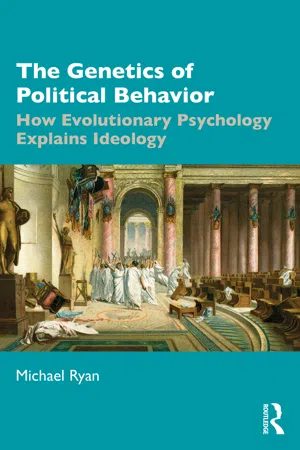
In this unique amalgam of neuroscience, genetics, and evolutionary psychology, Ryan argues that leftists and rightists are biologically distinct versions of the human species that came into being at different moments in human evolution.
The book argues that the varying requirements of survival at different points in history explain why leftists and rightists have anatomically different brains as well as radically distinct behavioral traits. Rightist traits such as callousness and fearfulness emerged early in evolution when violence was pervasive in human life and survival depended on the fearful anticipation of danger. Leftist traits such as pro-sociality and empathy emerged later as environmental adversity made it necessary for humans to live in larger social groups that required new adaptive behavior. The book also explores new evolutionary theories that emphasize the role of the environment in shaping not only human political behavior but also humans' genetic architecture. With implications for the future of politics, the book explores how the niche worlds we build for ourselves through political action can have consequences for the evolution of the species.
Proposing a new way of understanding human politics, this is fascinating reading for students and academics in psychology, the social sciences, and humanities, as well as general readers interested in political behavior.
The terms of Whig and Tory belong to natural as well as to civil history.
—Thomas Jefferson, Letter to John Adams
Rightists and leftists differ biologically as well as ideologically. Each group evidences more or less of certain personality traits such as Openness to Experience or Need for Closure that are due to temperament rather than acculturation. Rightists are by nature more fearful, leftists more experimental. Such trait differences are rooted in biology and governed by genes.1
How did such different traits emerge in the same species?
Traits are the result of adaptation to an environment. Donald Trump is different from most of you reading this book because your ancestors and Trump’s ancestors lived in different environments that posed distinct survival challenges. Each environment prompted the evolution of radically different adaptive behaviors. The evolutionary rule is: geographic isolation plus genetic diversification equals population segregation (and, in some cases, speciation).
For example, over the course of 11,000 years, Tibetan highlanders adapted to a high-altitude environment by acquiring a variant of the EPAS1 gene and evolving an ability to process scarce oxygen more easily than lowlanders. Tibetan women’s bodies evolved to increase blood flow and oxygen delivery to the uterus, lessening the chances of low-weight babies and increasing the chances of survival in the harsh climate.2
Darwin’s finches differ from one another for similar reasons. They populate the Galapagos Islands, sometimes one species to an island. Although descended from a single common ancestor, they evolved distinct beaks over time, and each beak is suited to finding food on a particular island. Some beaks are long for rooting out bugs under rocks, while others are blunt for cracking nuts.
Like Darwin’s finches, your ancestors and Trump’s lived on different islands; only they were islands in evolutionary time, different moments in human history. Rather than evolve different beaks, they evolved different brains and different adaptive behaviors.
Signs suggest Trump Island was a brutal place. To survive, Trump’s ancestors had to be brutal themselves. They competed remorselessly and selfishly with other small kin-based hunting bands, creating a static-filled situation of anxious fear regarding out-group people and a legacy of prejudice and racism in this strain of our species. The ancestral Trumps hoarded resources and denied others access to them—much as Trumps do today. They treated others’ needs with callous indifference because being generous did not pay off in the grand competitive scheme of things. One’s obligations to others extended to the rim of one’s kin band.
The hunting bands of the archaic environment were authoritarian, as Trump and his followers are still. Quick responses to danger got the hunting band to the end of the day, and such fast responses are best mobilized by a clear command structure with a single leader with complete authority. Because the survival of one depended on the survival of all, bonding with fellow band members was essential. In consensus was safety, as also loyalty. Dissidents were a danger to survival and were bullied or ejected and fell in the hierarchy. All had to know their place and stick to it. The rule of life was dominate or submit.
Trump Island came early in human history, and that accounts for why Trump’s behavior seems so archaic at times. It seems so because it is so. The most archaic aspect of Trump is dominance behavior. Trump regularly scowls at adversaries in an attempt to intimidate them. During one debate with Hillary Clinton, he prowled the stage behind her, looming over her physically. Such dominance behavior once served a survival purpose. Those good at dominance stood a better chance of controlling the distribution of resources (one of which was, of course, women) in their hunting band.
Studies show leftists favor smiling to scowling and equality to dominance.3 That is the case because their island in evolutionary time—let’s call it Obama Island—required very different adaptive strategies. Signs suggest Obama Island was a more crowded place than Trump Island. Smiling is a more sociable activity than scowling. It forges links with others and fosters reciprocity.4 Such reciprocity would have been helpful in a world where early humans were forced to live in greater proximity by environmental adversity. In such a novel situation, small kin-based hunting bands had to help one another rather than kill one another to survive. Former enemies on Trump Island had to become friends on Obama Island—or at least not murderous adversaries. The changes in the environment created new survival exigencies that required more cooperation and less competition between hunting groups. Kin and non-kin had to get along for the first time. That would explain the entry of more smiling behavior and greater cooperativeness into the human repertoire of traits—in leftists at least. In studies, rightists score low for smiling behavior and are more competitive than cooperative.5 But not everyone in a population has to acquire a new trait for it to be adaptive. If just one person is inventive enough to figure out how to keep a fire going for weeks rather than hours, all will benefit. If she finds a like-minded mate, a new subpopulation begins to emerge. Something similar occurred on Obama Island. Some of our ancestors evolved traits such as cooperativeness that aided the survival of all even though not everyone acquired the trait. They gravitated to others similar to themselves—using an early version of facial recognition technology to detect each other if recent neuroscience is to be believed.6 Eventually, a new subpopulation or genotype emerged. Leftist traits became a permanent feature of our genome—in some, at least.
Figure 1.1 Hillary Clinton and Donald Trump at the second presidential debate, 2016.
Image Credit: Associated Press
The difference between Trump Island and Obama Island, between rightists and leftists, tells us that our species did not evolve in unison. The same adaptive traits did not emerge in the entire human population at the same time. Instead, different traits were adaptive in different sub-populations at different moments in human history. At one point in time, it paid to hoard resources, to callously deny others access to them, and to treat out-group people with hostility. It paid to be rightist. But at another point, on a different island in evolutionary time, it made more sense for survival if at least some of our ancestors evolved the capacity to share resources and treat out-group people with kindness. It paid to be leftist.
Trump Island came first. Very early human history was harsh, and you had to be harsh to survive in it. Obama Island came later, as new environmental challenges obliged some of our ancestors to evolve behaviors such as experimentation and cooperativeness that were newly beneficial to survival. The result is two distinct sub-populations living in fractious cohabitation, arguing over the future direction of our species. That is the origin of human politics.
Notes
1.Alford, J., Funk, C. & Hibbing, J. Are political orientations genetically transmitted? American Political Science Review, 2005, Issue 99, pp. 153–167; Hatemi, P. et al. Genetic influences on political ideologies: Twin analyses of 19 measures of political ideologies from five democracies and genome-wide findings from three populations. Behavioral Genetics, 2014, Vol. 44, pp. 282–294; Hatemi, P. et al. Genetic and environmental transmission of political attitudes over the life time. Journal of Politics, 2009, Vol. 71, Issue 3, pp. 1141–1156; Hatemi, P. et al. Not by twins alone: Using extended family design to investigate genetic influence on political beliefs. American Journal of Political Science, 2010, Vol. 54, Issue 3, pp. 798–814; Hatemi, P.K. & McDermott, R. The genetics of politics: Discovery, challenges, and progress. Trends in Genetics, October 2012, Vol. 28, Issue 10, pp. 525–533; Benjamin, D. et al. The genetic architecture of economic and political preferences. Proceedings of the National Academy of Sciences, 2012, Vol. 109, Issue 21, pp. 8026–8031; Smith, K.B. et al. Linking genetics and political attitudes: Reconceptualizing political ideology. Political Psychology, 2011, Vol. 32, pp. 369–397; Smith, K. et al. Biology, ideology, and epistemology: How do we know political attitudes are inherited and why should we care? American Journal of Political Science, 2012, Vol. 56, Issue 1, pp. 17–33; Kandler, C. et al. Left or right? Sources of political orientation: The roles of genetic factors, cultural transmission, assortative mating, and personality. Journal of Personality and Social Psychology, 2012, Vol. 102, Issue 3, pp. 633–645; Kandler, C. et al. The structure and sources of right-wing authoritarianism and social dominance orientation. European Journal of Personality, 2016, Vol. 30, Issue 4, pp. 406–415; Funk, C. et al. Genetic and environmental transmission of political orientations. Political Psychology, December 2013, Vol. 34, Issue 6, pp. 805–819.
2.Beall, C.M. Two routes to functional adaptation: Tibetan and Andean high-altitude natives. PNAS, 15 May 2007, Vol. 104, Issue 1, pp. 8655–8660; Yi, X. et al. Sequencing of 50 human exomes reveals adaptation to high altitude. Science, 2010, Issue 209, p. 7578.
3.Kugler, M. et al. Group-based dominance and opposition to equality correspond to different psychological motives. Social Justice Research, September 2010, Vol. 23, Issue 2–3, pp. 117–155.
4.Carney, D.R. et al. The secret lives of liberals and conservatives: Personality profiles, interaction styles, and the things they leave behind. Political Psychology, 2008, Vol. 29, Issue 6, pp. 807–840.
5.Ho, A.K. et al. Social dominance orientation. Personality and Social Psychology Bulletin, 2012, Vol. 38, Issue 5, pp. 583–606; Harnish, R.J. et al. Predicting economic, social, and foreign policy conservatism: The role of right-wing authoritarianism, social dominance orientation, moral foundations orientation, and religious fundamentalism. Current Psychology, 2018, Vol. 37, pp. 668–679.
6.Bonnefon, J-F. et al. Can we detect cooperators by looking at their faces? Current Directions in Psychological Science, 14 June 2017, Vol. 26, Issue 3, pp. 276–281; Rule, N. et al. Democrats and republicans can be differentiated from their faces. PLoS One, 2010, Vol. 5, Issue 1, p. e8733; Gokhman, D. et al. Extensive regulatory changes in genes affecting vocal and facial anatomy separate modern from archaic humans. BioRxiv, Cold Spring Harbor, 24 September 2019.
2 EVOLUTIONARY MODELS
According to the standard model of evolution known as the “evolutionary synthesis,” evolution occurs through accidental changes in the human genome.1 David Reich summarizes the process in the following way:
The genome is a sequence of about three billion paired chemical units that can be thoug...
Table of contents
Cover
Half Title
Title
Copyright
Dedication
Contents
Preface
1 Political Adaptations
2 Evolutionary Models
3 Traits, Brains, Genes
4 Art and the Origin of Civilization
5 The Genetic Geography of Conservatism
6 Religion as Adaptation
7 European History in Light of Evolution
8 Violence Against Others: Torture, Genocide, War
9 The Psychology of Political Correctness
10 Leftist Form and Rightist Substance
11 Dominance and Deception in Economics
12 Is Socialism Adaptive?: The Future of Homo Sapiens
Conclusion
Future Work: The Center for the Study of Conservatism
Index
Trusted by 375,005 students
Access to over 1.5 million titles for a fair monthly price.
Study more efficiently using our study tools.
Frequently asked questions
Yes, you can cancel anytime from the Subscription tab in your account settings on the Perlego website. Your subscription will stay active until the end of your current billing period. Learn how to cancel your subscription
No, books cannot be downloaded as external files, such as PDFs, for use outside of Perlego. However, you can download books within the Perlego app for offline reading on mobile or tablet. Learn how to download books offline
Perlego offers two plans: Essential and Complete
Essential is ideal for learners and professionals who enjoy exploring a wide range of subjects. Access the Essential Library with 800,000+ trusted titles and best-sellers across business, personal growth, and the humanities. Includes unlimited reading time and Standard Read Aloud voice.
Complete: Perfect for advanced learners and researchers needing full, unrestricted access. Unlock 1.5M+ books across hundreds of subjects, including academic and specialized titles. The Complete Plan also includes advanced features like Premium Read Aloud and Research Assistant.
Both plans are available with monthly, semester, or annual billing cycles.
We are an online textbook subscription service, where you can get access to an entire online library for less than the price of a single book per month. With over 1.5 million books across 990+ topics, we’ve got you covered! Learn about our mission
Look out for the read-aloud symbol on your next book to see if you can listen to it. The read-aloud tool reads text aloud for you, highlighting the text as it is being read. You can pause it, speed it up and slow it down. Learn more about Read Aloud
Yes! You can use the Perlego app on both iOS and Android devices to read anytime, anywhere — even offline. Perfect for commutes or when you’re on the go. Please note we cannot support devices running on iOS 13 and Android 7 or earlier. Learn more about using the app
Yes, you can access The Genetics of Political Behavior by Michael Ryan in PDF and/or ePUB format, as well as other popular books in Politica e relazioni internazionali & Conservatorismo e liberalismo. We have over 1.5 million books available in our catalogue for you to explore.