Why the World Needs Anthropologists
  1. 182 pages
  2. English
  3. ePUB (mobile friendly)
  4. Available on iOS & Android
eBook - ePub

About this book

Why does the world need anthropology and anthropologists? This collection of essays written by prominent academic, practising and applied anthropologists aims to answer this provocative question.

In an accessible and appealing style, each author in this volume inquires about the social value and practical application of the discipline of anthropology. Contributors note that the problems the world faces at a global scale are both new and old, unique and universal, and that solving them requires the use of long-proven tools as well as innovative approaches. They highlight that using anthropology in relevant ways outside academia contributes to the development of a new paradigm in anthropology, one where the ability to collaborate across disciplinary and professional boundaries becomes both central and legitimate. Contributors provide specific suggestions to anthropologists and the public at large on practical ways to use anthropology to change the world for the better.

This one-of-a-kind volume will be of interest to fledgling and established anthropologists, social scientists and the general public.
Frequently asked questions

Yes, you can cancel anytime from the Subscription tab in your account settings on the Perlego website. Your subscription will stay active until the end of your current billing period. Learn how to cancel your subscription.
At the moment all of our mobile-responsive ePub books are available to download via the app. Most of our PDFs are also available to download and we're working on making the final remaining ones downloadable now. Learn more here.
Perlego offers two plans: Essential and Complete
  • Essential is ideal for learners and professionals who enjoy exploring a wide range of subjects. Access the Essential Library with 800,000+ trusted titles and best-sellers across business, personal growth, and the humanities. Includes unlimited reading time and Standard Read Aloud voice.
  • Complete: Perfect for advanced learners and researchers needing full, unrestricted access. Unlock 1.4M+ books across hundreds of subjects, including academic and specialized titles. The Complete Plan also includes advanced features like Premium Read Aloud and Research Assistant.
Both plans are available with monthly, semester, or annual billing cycles.
We are an online textbook subscription service, where you can get access to an entire online library for less than the price of a single book per month. With over 1 million books across 1000+ topics, we’ve got you covered! Learn more here.
Look out for the read-aloud symbol on your next book to see if you can listen to it. The read-aloud tool reads text aloud for you, highlighting the text as it is being read. You can pause it, speed it up and slow it down. Learn more here.
Yes! You can use the Perlego app on both iOS or Android devices to read anytime, anywhere — even offline. Perfect for commutes or when you’re on the go.
Please note we cannot support devices running on iOS 13 and Android 7 or earlier. Learn more about using the app.
Yes, you can access Why the World Needs Anthropologists by Dan Podjed, Meta Gorup, Pavel Borecký, Carla Guerrón Montero, Dan Podjed,Meta Gorup,Pavel Borecký,Carla Guerrón Montero in PDF and/or ePUB format, as well as other popular books in Social Sciences & Anthropology. We have over one million books available in our catalogue for you to explore.

Information

Publisher
Routledge
Year
2020
eBook ISBN
9781000182736
Edition
1

1
Ethnography in all the right places
*

Thomas Hylland Eriksen
Anthropology is frequently described as the art of ‘making the familiar exotic and the exotic familiar’ (see e.g. Spindler and Spindler 1982). It has also been described as ‘the most humanistic of the sciences and the most scientific of the humanities’ (Wolf 1974). The standard textbook definition describes it as the comparative study of humans, their societies and their cultural worlds, simultaneously exploring human diversity and what it is that all human beings have in common.
Why should we care about this, in an interconnected, globalized world where virtually anyone can access other people’s worlds through media old and new, and why should it matter? For one thing, we may be both less and more similar than we tend to think, notwithstanding globalization. For another, the kind of knowledge anthropologists have is more important than ever, precisely because globalization brings us closer together.
* This essay has evolved from the EASA position paper ‘Why Anthropology Matters’ (2016), which, as president of EASA, I wrote ‘with a little help from my friends’ in the Executive Committee.
Image
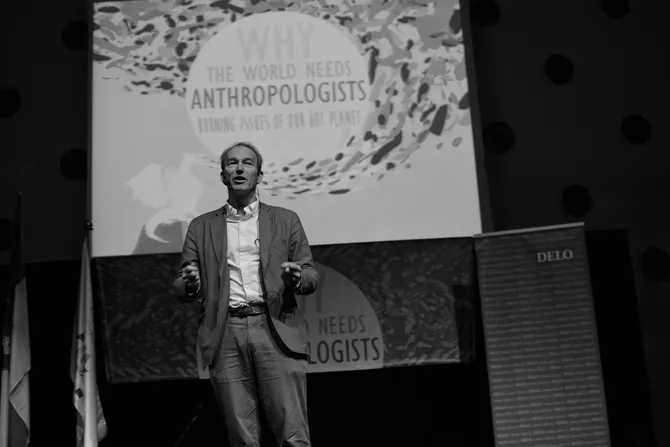
FIGURE 1.1 Thomas Hylland Eriksen at Why the World Needs Anthropologists symposium in Ljubljana, Slovenia, 2015. Courtesy Vishvas Pandey.
For many years, social and cultural anthropology was associated with the study of ‘remote places’ and small-scale societies, many of them unfamiliar with literacy and not incorporated into the institutions of the state. Although the study of human diversity concerns all societies, from the smallest to the largest and from the simplest to the most complex, most anthropologists today recognize that all societies in the contemporary world are involved in processes of enormous complexity, such as migration, climate change, global economic crises and the transnational circulation of ideas. Just as European and American anthropologists of the early twentieth century struggled to understand and describe ‘the native’s point of view’ when they travelled to such then-remote parts of the world as Melanesia or Africa, contemporary anthropologists try to grasp their areas of inquiry as fully as possible wherever they conduct research, be it in their own backyard or in faraway locations. They then report on how the people they are studying perceive the world and act on it, still striving to understand ‘the native’s point of view’, although the focus of their inquiry may now be consumption in a European city or ethnic politics in the Pacific.
Some of the questions that the first generations of anthropologists asked continue to concern today’s generation, albeit in new ways. On a general level, anthropologists ask what it is to be a human being, how a society is put together and what the word ‘we’ means. Just as they did in the past, anthropologists explore the importance of kinship in contemporary societies and raise questions about power and politics, religion and world-views, gender and social class. Today, they also study the impact of capitalism on small-scale societies and the quest for cultural survival among indigenous groups, just to mention a few areas of inquiry.
Although there are different theoretical schools, as well as many special interests both regionally and thematically, the craft of social and cultural anthropology consists in a toolbox, which is shared by all who are trained in the discipline. Anthropology does not in itself profess to solve the problems facing humanity, but it gives its practitioners skills and knowledge that enable them to tackle complex questions in very competent and relevant ways. It therefore helps formulating alternatives by way of understanding the world and indeed oneself better than before. The key terms are cultural relativism, ethno graphy, comparison and context.

Cultural relativism

Anthropology does not entail judgement of other people’s values, nor do its practitioners rank societies on a scale from ‘underdeveloped’ to ‘developed’. This does not mean that anthropologists suspend all judgements about what people do; for example, few would condone violence or inequality, although it may well be perpetrated in the name of ‘culture’. Rather, a professional perspective founded in anthropology emphasizes the need to understand what humans do and how they interpret their own actions and world-views.
This approach, cultural relativism, is an essential methodological tool for studying local life-worlds on their own terms. This is the view that societies are qualitatively different from one another and have their own unique inner logic, and that it is therefore misleading to rank them on a scale. For example, one society may find itself at the bottom of a ladder with respect to literacy and annual income, but this ladder may turn out to be completely irrelevant if members of this society have no interest in books and money. Within a cultural relativist framework, one cannot argue that a society with many cars is ‘better’ than one with fewer, or that the ratio of smartphones to the population is a useful indicator of quality of life.
Cultural relativism is indispensable in anthropological attempts to understand societies in neutral terms. It is not an ethical principle, but a methodological tool. It is perfectly possible to understand other people on their own terms without sharing their outlook and condoning what they do. As the late anthropologist Clifford Geertz (1983: 57) stated, ‘you don’t have to be one to know one’.

The power of ethnography

The second important tool in anthropological research is ethnographic fieldwork as the main venue of data generation. Traditionally designed as a solo endeavour, ethnographic fieldwork is neither capital-intensive nor labour-intensive, but instead, it can be very time-consuming. Even though ever-expanding communication networks render ‘here’ and ‘there’ of the ‘field’ increasingly contested, academic anthropologists typically dedicate approximately one year to the fieldwork. This is necessary because the aim of the ethnographic method is to develop sound knowledge and a proper understanding of a sociocultural world, and for this to be possible, they must learn the local language and take part in as many local activities as they can. Increasingly, however, anthropologists work collaboratively, often in interdisciplinary settings inside or outside the academy. Given the complexity of the world in which we live and the intricacies of the issues often tackled by anthropologists – climate change, global capitalism, mobile communication technologies, etc. – research questions are often dealt with most competently by teams of researchers, ideally with complementary skills (see also Pink’s chapter in this book).
The teaching of methodology has often been a challenge in anthropology, and for years, learning by doing was considered a feasible, if not necessarily superior, alternative. Fortunately, methodology teaching has gradually been professionalized, and one of the most comprehensive and widely used volumes in the area is Handbook of Methods in Cultural Anthropology (Barnard and Gravlee 2015), which covers the nitty-gritty of data collecting as well as subjects such as interpretation, the use of new technologies and anthropology and the media. Indeed, the development of new media and communication technologies in the last few decades has affected and, in many cases, transformed fieldwork. Research on, with or about digital platforms, usually accessed through smartphones, has become a supplement and sometimes a replacement for traditional field methods (Horst and Miller 2012).
Unlike qualitative sociology, which is usually based on intensive interviews, anthropologists do not see interviewing as a main method, although it forms part of their toolbox. Rather, they generate data through participant observation, during which the anthropologist simply spends time with people, sometimes asks questions and learns the local ways of doing things as thoroughly as possible. The method demands that the researcher gets to know others on a personal level, meets them repeatedly and, if possible, lives with them during fieldwork. For this reason, ethnographic data are of very high quality, although they often need to be supplemented by other kinds of data, such as quantitative or historical, as the number of collaborators whose lives anthropologists study through participant observation is necessarily limited.
The ethnographic methodology thus enables anthropologists to learn about aspects of local worlds that are inaccessible to researchers who use other methods. For example, anthropologists have studied the world-views of European neo-Nazis, the functioning of the informal economy in African markets and the reasons why people in Norway throw away more food than they are willing to admit to themselves and others. By combining direct observation, participation and conversations in their in-depth toolkit, anthropologists provide more detailed and nuanced descriptions of such (and other) phenomena than other researchers. This is one of the reasons why ethnographic research is so time-consuming: anthropologists need to build trust with the people they try to understand, who will then, consciously or not, reveal aspects of their lives that they would not speak about to a journalist or a social scientist with a questionnaire, for example.

The challenge of comparison

New insights into the human condition and new theoretical developments in anthropology often grow out of comparison, that is the systematic search for differences and similarities between social and cultural worlds. Although comparison is demanding, difficult and sometimes theoretically problematic, anthropologists always compare, whether explicitly or implicitly. By using general terms such as kinship, gender, inequality, household, ethnicity and religion, anthropologists tacitly assume that these categories have comparable meanings in different societies, yet they rarely mean exactly the same thing. Looking for similarities and differences between social and cultural worlds, anthropologists can develop insights into the nature of society and human existence. However, the objective of comparison is not to rank societies on a ladder of development, human rights or environmental sustainability but to understand and explain local life-worlds. Even if this knowledge does not have an explicit policy dimension, it is essential for anyone wishing to contribute to positive change.
Comparison has the additional quality of stimulating the intellectual and moral imagination. Anthropologists often come up with unexpected insights such as, for example, the fact that the internet can strengthen family ties (rather than isolate people; Miller and Slater 2000), that religious activity can help immigrants to integrate into European societies (rather than alienating them from these societies; Bowen 2011), and that peasants can be more economically rational than plantation owners (rather than being hopelessly backward and conservative; Popkin 1979). In this sense, a detailed, compelling study of a society where there is gender equality, ecological sustainability and little or no violence is interesting in its own right, but it can also serve as an inspiration for policy and reform elsewhere. The cool-headed method of anthropological comparison produces knowledge and offers models for coexistence that can be used as a reliable foundation on which to build social change. As such, both primary and applied research can prove to provide useful knowledge for approaching the problems that the world faces, without necessarily offering unequivocal policy advice.

That which cannot be measured

Anthropologists carry out fieldwork, make comparisons and do so in a spirit of cultural relativism, but all along they are concerned with context, relationships and connections. The smallest unit that anthropologists study is not the isolated individual but the relationship between two people and their environment. Whereas the society is a web of relationships, culture, as activated between sentient bodies, not inside them, is what makes communication possible. To a great extent, we are constituted by our relationships with others, which produces us and gives us sustenance, and which confirms or challenges our values and opinions. This is why we have to engage with human beings in their full social context. In order to understand people, anthropologists follow them around in a variety of situations and, as they often point out, it is not sufficient to listen to what people say. We also have to observe what they do, and to analyse the wider implications of their actions.
Because of the fine-grained methodology anthropologists employ, we are also capable of making the invisible visible – be it voices which are otherwise not heard, from marginal or precarious groups, or informal networks between high-status people. In fact, one writer who predicted the financial crisis before it began to unravel was Gillian Tett (2009), a Financial Times journalist and editor who, thanks to her training in anthropology, understood what the financial elite was actually doing, not just what they told the public. It should also be kept in mind that not only the methods of anthropology but also its subject-matter evolves rapidly. The World Wide Web appeared in 1992, the smartphone in 2007, and these platforms for communication and dissemination have created new challenges and opportunities for anthropologists. Indeed, a handful of smartphone apps now exist dedicated to ethnographic data collecting. At the same time, web-based publishing and academic discussion have contributed to shifting the conditions for communication within the discipline.
As anthropologists tend to agree, some of the most important things in life, culture and society are those that are hard to measure. Yet, as societies are becoming increasingly entangled in the information age, there is often a strong temptation to simplify complex issues. Whereas a few would doubt the existential value of love, the social importance of trust or the power of Dostoyevsky’s novels, in knowledge production and dissemination, clarity and lucidity are virtues. As Einstein is believed to have said, ‘Make it as simple as possible. But not simpler’. Accordingly, anthropologists resist simplistic accounts of human nature and accept that complex realities tend to have complex causes. In other words, to understand human worlds, qualitative research and interpretation are necessary.

The need for anthropology

The kind of knowledge anthropology teaches is invaluable, not least in our turbulent, globalized age, in which people of different backgrounds come into contact with each other in unprecedented ways and in a multitude of settings, from tourism and trade, to migration and organizational work.
Unlike training in engineering or psychology, an education in anthropology is not strictly vocational. ...

Table of contents

  1. Cover
  2. Half Title
  3. Title Page
  4. Copyright Page
  5. Table of Contents
  6. List of figures
  7. List of contributors
  8. Acknowledgements
  9. Introduction: why does the world need anthropologists?
  10. 1 Ethnography in all the right places
  11. 2 Living in and researching a diverse world
  12. 3 What is it like to be an anthropologist?
  13. 4 Anthropology in an uncertain world
  14. 5 Making anthropology relevant to other people’s problems
  15. 6 Searching for variation and complexity
  16. 7 An anthropologist’s journey from the rainforest to solar fields
  17. 8 Anthropologists make sense, provide insight and co-create change
  18. 9 Open up the treasure of anthropology to the world
  19. 10 The practitioner’s role of facilitating change
  20. 11 Do we really need more anthropologists?
  21. Conclusion: back to the future of applied anthropology
  22. Index