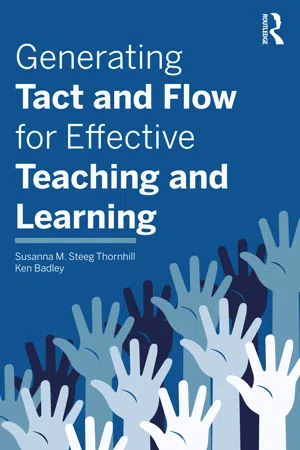
This book draws from and analyzes teachers' and students' stories of great classes in order to promote teachers' development of pedagogical tact and to encourage flow states for students. Taken together, these theoretical lenses—pedagogical tact and flow—provide a valuable framework for understanding and motivating classroom engagement. As the authors suggest, tactful teachers are more likely to see their students in flow than teachers who struggle with basic classroom routines and practices. Grounded in narrative research, and written for pre-service teachers, the book offers strategies for replicating these first-hand accounts of peak classroom teaching and learning.
eBook - ePub
Generating Tact and Flow for Effective Teaching and Learning
- 150 pages
- English
- ePUB (mobile friendly)
- Available on iOS & Android
eBook - ePub
Generating Tact and Flow for Effective Teaching and Learning
About this book
Information
1
Introduction and Invitation
This book is for teachers, written by teachers, about the magic days. The days when things go so well you imagine that although teaching is a severely underpaid gig, you loved your work so much you might consider teaching for free. Maybe your most challenging students joined you on the learning journey in a new way, or a slightly under-planned lesson went much better than you anticipated, generating clear direction for the following week. Maybe things took a completely unexpected turn, and a teachable moment turned into a power hour fueled by excited and engaged students. These are the moments when teaching seems to flow effortlessly, when we know what to do and move seamlessly from task to task. Sometimes, early in a teaching career, these moments happen only occasionally. A year or two in, teachers might start having more of those moments, stringing the moments together into hours or even days. And with time, reflection, and experience, teachers move easily into the flow of teaching, subsequently gaining more joy in their professional lives. It is these flow experiences and the ways teachers create them through tactful action that we focus on in this book.
We write with the conviction that these sorts of teaching experiences can inspire and sustain teachers. Because we believe that story is a key way that humans make sense of their lives and work, we have built this book on teachers' stories. These educators work all over the world, teach in a variety of educational settings, and have shared narratives of teaching experiences that amazed and inspired them. Our teacher-contributors responded to these situations in amazing ways, reflexively sharing with us—and with you—their excitement about the serendipitous and successful moments that highlight the daily work of teaching. We took these stories and analyzed them through the theoretical lenses of tact and flow so that we could find ways to see theory in action. We did this because we wanted to offer ways forward for educators working to deepen and enrich their practice.
We understand that we teach at a time when educators are discouraged, and for good reason. Most teachers enter the profession out of humanistic motives to help make the world a better place. Teachers complete a course of study, learning pedagogical theory embedded in hands-on practice; they graduate and begin teaching in a school, a humanistic organization with moral goals. But not far into their new career, reality hits. They become weighed down with an ever-increasing list of duties and come to see how encumbered the profession is with societal expectations. It is common to hear the language of business as school boards and districts seek new ways to allocate limited funds. Sometimes teachers even hear coercive language: if your school does not perform well, we will take it over or even close it.
With this increase in monetary and coercive language, the moral rewards for which most educators teach seem to fall increasingly out of reach. We take this distinction between the moral rewards of teaching and the increasingly monetary and bullying tones of educational contexts from the work of Etzioni (1961, 1964). We do so because we believe his distinction is perhaps more applicable now than when he first suggested it decades ago. A more contemporary writer, Doris Santoro (2011), has named the state in which some educators now find themselves as moral depression. Thus, while we write in the book about magical classroom moments, we do so well-aware of the challenges facing today's teachers.
In this book we do not go into detail about the roots, symptoms, or results of teacher demoralization, although we believe deeply that educators need such research, and we are grateful for the many researchers and teachers who have engaged in that work. Rather, we focus on one possible antidote to teacher discouragement and demoralization: understanding what happens in flow moments for teachers who are tactfully and thoughtfully engaged. Because we believe that all teachers have these moments, hours, and days, we want to help teachers remember them. We want to understand what factors are at work—or at play—when those experiences happen. We want to understand the antecedent causes of such experiences. Under what conditions do they happen? Can teachers intentionally make such experiences happen? And what might a deep study of these moments offer us? In short, we want to offer teachers stories to lift their spirits and celebrate the good work happening every day in classrooms all over the world. We believe there are other antidotes to moral depression and ways to lift teachers' spirits, but in this book, we focus only on the magical moments. By doing so, we want to offer words that will bring teachers hope and courage.
The stories come mainly from teachers but also from students, and we believe that by poking around inside those stories and the classrooms where they originated, we might gain new insights into how we can create the conditions where students become intensely engaged in the great work of learning. We also hope that the stories we explore here will help you remember your own learning experiences where the magic happened. Such remembering has the power to restore hope and courage. If this book enlarges your vision for your classroom or helps you regain your vision for going back to your classroom, then we will know we have succeeded.
In the rest of this chapter, we briefly introduce the framework within which we analyze and attempt to understand our contributors' stories. That framework is simple. We explore these stories in a kind of space between two concepts: flow and tact. As we write this, in 2020, Mihaly Csikszentmihalyi (pronounced chick-sent-mah-hi) has worked on the concept of flow for almost four decades. We use his work to understand those moments when students (and sometimes teachers) get completely lost in their work. The concept of tact comes from Max Van Manen, who has also worked for decades to understand how teachers respond to all that teaching requires. He has asked to what degree teachers reflect on what they do and if, sometimes, they simply act—tactfully—without taking time to reflect. We introduce Csikszentmihalyi's concept of flow and Van Manen's concept of tact briefly in this chapter before offering a more extensive review of their work in chapter 2. We find Csikszentmihalyi's and Van Manen's concepts powerful tools for understanding classrooms and teaching.
What is flow?
We start with Csikszentmihalyi's concept of flow, which may be easier to understand with reference to the idea of being in the zone in sports. Athletes who describe this feeling mean that they were performing at the peak of their abilities. Athletes and coaches were the first to speak about the zone in the sense that we now connect to flow. Over several decades, the concept moved from its original home in athletics to a wider usage. Just as being in the groove, another semantic cousin, emigrated from its original musical context some decades earlier, being in the zone found its place in the wider lexicon. We do not need to give more space here to the history or the meanings of these terms; we simply want to point to the similarities in meaning to Csikszentmihalyi's concept of flow. To Csikszentmihalyi's credit, the word flow—like the word zone—has achieved acceptance in a much wider circle than psychology, its circle of origin; it has entered general usage.
Csikszentmihalyi has named several pre-conditions for flow states and qualities of flow experiences. We follow his lead in distinguishing conditions from qualities, in part because a driving question in this project has been whether teachers can actually create the necessary pre-conditions for students to experience flow in their learning. We have come to an affirmative answer to that question and focus on it specifically in chapters 8 and 9, where we suggest steps teachers can take and identify meta-themes across the stories pointing to teacher knowledge and expertise. We believe strongly that flow states are not a matter of blind luck. Our careful and repeated reading of these stories has convinced us that we can learn from these stories how to create classroom conditions that help our students get into learning flow. Among other conclusions, we believe that most of the stories our contributors shared with us reveal their high levels of pedagogical tact, and so we draw a strong link between Csikszentmihalyi's and Van Manen's work.
The first pre-condition of flow is goal clarity. The sarcastic English sentence, “Remind me again why I'm doing this,” captures the need to meet this condition. Teachers expect clear rationales for new policies and practices handed down from school jurisdictions. In this regard, students are quite like us—they want to know why we insist they complete their school work—and, as most teachers know, the older the student, the more important it is to make the purposes of curriculum and instruction clear. Csikszentmihalyi sometimes lists goal clarity and goal buy-in as one pre-condition and sometimes he separates the two. We treat both in more detail in chapter 2 but will note here the immediately obvious connection of goal buy-in for educators: given that most K-12 students come to our classrooms because they are required to do so, how do we get them to buy in?
The next pre-condition Csikszentmihalyi lists is feedback clarity; to get into a flow state, people need to know how they are doing. In Notes from Underground, Dostoevsky (1994) presents an anonymous and agonizingly self-conscious protagonist who never gets into a flow state (or even seems to enjoy life) because he constantly worries about what other characters in the book and even his readers think of him and of what he is saying. On the other hand, the student who never has her work graded or returned by a disorganized teacher will also be denied entering flow because she literally does not know how well she is doing in class. These extremes—obsession with feedback and absence of feedback—help us understand Csikszentmihalyi's point: we need enough feedback to focus on the task at hand, but even so, we cannot focus only on the feedback.
The fourth pre-condition Csikszentmihalyi specifies is concentration or absorption in the task. He uses this term in its ordinary sense. The Dostoevsky character we named above concentrated, but because of his debilitating insecurity, he concentrated on feedback rather than on living. The student who never again sees the assignments she submitted cannot concentrate effectively on upcoming tasks because she has no feedback. The stories throughout this book demonstrate how students can become absorbed in classroom activities and assignments, usually because they were fun and almost always, by definition, because they were engaging. We return to concentration and absorption in chapter 2.
Csikszentmihalyi's final pre-condition—the balance between challenge and skill—implies that the task at hand cannot be too simple or it will not engage us. We experience doing dishes as too easy; clean dishes are necessary but we are both capable of much more. But the task cannot be too difficult or the individual will become anxious. We are most likely to enter flow when engaged in tasks where we are capable of success but that also demand most or all our skill, tasks like facilitating a cooperative learning task for teachers or analyzing data or revising a book chapter.
Those are the main pre-conditions; Csikszentmihalyi also lists the qualities of flow. First, a person in a flow state typically has a sense of control. Self-talk language such as “I've got this,” catches this sense. We are less certain about the T-shirt that reads “No Fear.” One of us (KB) always has a sense of high control (of self-efficacy, from Bandura, 1997) in the woodshop but never has it when looking under the hood of the car. We all have such areas where we feel in control, and areas where we do not.
Second, the activity yielding a flow state is inherently rewarding or worthwhile. Csikszentmihalyi uses the word autotelic to name this condition. We explore this idea at greater length in chapter 2, and we note there that the athlete may want to win and the teacher may need the salary, but that autotelic activities, by definition, are their own reward. Joggers, climbers, backpackers, New Year's Day polar bear dip swimmers, and others often find themselves answering the question, “Tell me how this is fun!?” Whether they have heard of Csikszentmihalyi's work or not, answers like, “It just is” probably echo this quality.
The third and fourth qualities of flow are related: loss of self-consciousness and loss of awareness of the passage of time. Several stories in this book recount classes where students experienced these qualities that Csikszentmihalyi described. A few stories even tell of teachers who, while remaining professional in every way, were able to enter into that flow moment with their students, sometimes because of on-the-spot decisions about the direction to take the class (or let the class go). We examine several such stories of good decisions in chapter 5, but for now we will leave off with Csikszentmihalyi and turn to Van Manen's conceptualization of tact.
What is tact?
It is important to note that Van Manen's conception of teacher tact varies somewhat from the ordinary English sense of the word tact, where we might consider the most tactful way to tell someone about the hole in their pants or the spinach lurking in their teeth. We use tact when we explain to our family that, despite their expectations, “No, we are not actually coming over for Christmas this year.” These paradigmatic examples of tact connote politeness and finding the best way to approach sensitive topics. By way of contrast, Van Manen conceptualizes tact as comprising skill and ease or effortlessness, meanings obviously related to but still different from our normal use of the term. Tact is a keen and observable sense that experts act without even thinking about what they are doing. They just move.
We have all watched cooks, athletes, carpenters, gardeners, or teachers who made excellent work look effortless. Of course, hundreds of researchers and writers have tried to describe or explain this kind of expertise (including Csikszentmihalyi). Outliers, Malcolm Gladwell's (2008) assessment of how people become experts, by practicing for 10,000 hours, even became a bestseller. By tact, Max Van Manen means that teachers possess something like expertise, but more like quiet competence. It is the sense one gets in the presence of teachers who know what is happening in their classrooms and can handle with graceful ease any situations that arise. We think of tact in relation to teachers who both deeply know and are known by their students; they are connected. And they are confident, flexible, and capable.
Teachers have been likened to performers for their improvisational abilities; it is a performer's uncanny sense of his audience's mood and his ability, without apparent confusion or effort, to make moment-by-moment adjustments to his material or tone. The highly tactful teacher seems to know not only what is happening in the room at any given moment but also how to shape what is going to happen next. This means tact is a kind of embodied knowing and acting in the moment that is rooted in a deep understanding of pedagogy and students. It is authentic action, rather than artificial or borrowed. Tactful teachers are sensitive, thoughtful, and responsive to the needs of students because they understand how students act, and they bring that understanding to bear with sensitivity and purpose as they keep in mind the bigger picture of where the class is going. From this perspective, tactful teachers work from a complex knowledge base and a fully stocked pedagogical toolbox to bring their understanding of students, their attentiveness, their views of the world, and their interpretive sensibilities to every moment. Tact is comprised of both feeling and knowing what to do that is unique to the personality and character of whatever adult might be in charge, be it teacher, mother, counselor, or principal.
The past few years of conceptualizing and composing this book have convinced me (ST) that we can, in fact, see and sense tact in teachers, even in the first few moments of stepping into their classrooms. It is a quality of calm, the sense that nothing bad is going to happen in this place, as long as this teacher is at the helm. It is a sense of leadership that the adult knows what to do next or at least can be honest about needing a moment to figure it out or readjust if things are not working. Exper...
Table of contents
- Cover
- Endorsements
- Half Title
- Title
- Copyright
- Dedication
- Contents
- Preface
- Acknowledgments
- 1 Introduction and Invitation
- 2 Theoretical Framework and Methodology
- 3 Stories of Pure Enjoyment
- 4 Stories of Forgetful Attention
- 5 Stories of Teachers' Decision-Making
- 6 Stories of Time Flying
- 7 Stories of Student Feedback
- 8 Stories About Steps Teachers Take
- 9 Big Ideas From Short Stories
- Index
Trusted by 375,005 students
Access to over 1.5 million titles for a fair monthly price.
Study more efficiently using our study tools.
Frequently asked questions
Yes, you can cancel anytime from the Subscription tab in your account settings on the Perlego website. Your subscription will stay active until the end of your current billing period. Learn how to cancel your subscription
No, books cannot be downloaded as external files, such as PDFs, for use outside of Perlego. However, you can download books within the Perlego app for offline reading on mobile or tablet. Learn how to download books offline
Perlego offers two plans: Essential and Complete
- Essential is ideal for learners and professionals who enjoy exploring a wide range of subjects. Access the Essential Library with 800,000+ trusted titles and best-sellers across business, personal growth, and the humanities. Includes unlimited reading time and Standard Read Aloud voice.
- Complete: Perfect for advanced learners and researchers needing full, unrestricted access. Unlock 1.5M+ books across hundreds of subjects, including academic and specialized titles. The Complete Plan also includes advanced features like Premium Read Aloud and Research Assistant.
We are an online textbook subscription service, where you can get access to an entire online library for less than the price of a single book per month. With over 1.5 million books across 990+ topics, we’ve got you covered! Learn about our mission
Look out for the read-aloud symbol on your next book to see if you can listen to it. The read-aloud tool reads text aloud for you, highlighting the text as it is being read. You can pause it, speed it up and slow it down. Learn more about Read Aloud
Yes! You can use the Perlego app on both iOS and Android devices to read anytime, anywhere — even offline. Perfect for commutes or when you’re on the go.
Please note we cannot support devices running on iOS 13 and Android 7 or earlier. Learn more about using the app
Please note we cannot support devices running on iOS 13 and Android 7 or earlier. Learn more about using the app
Yes, you can access Generating Tact and Flow for Effective Teaching and Learning by Susanna M. Steeg Thornhill,Ken Badley in PDF and/or ePUB format, as well as other popular books in Education & Education General. We have over 1.5 million books available in our catalogue for you to explore.