Disturbing the Nest
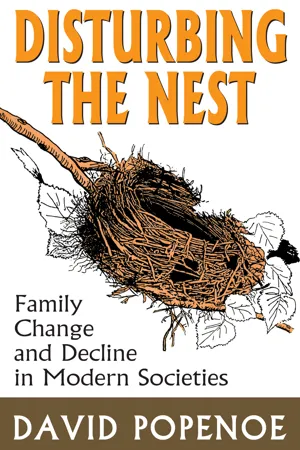
- 410 pages
- English
- ePUB (mobile friendly)
- Available on iOS & Android
eBook - ePub
About this book
Information
Subtopic
Social PolicyIndex
Social SciencesPart I Family Change in History and Theory
Chapter 1 What Is Family Decline?
"Few popular ideas are more widespread than the belief that the importance of the family in human affairs has been weakening, that the family as an institution is under great strain. . ."1 So said sociologist Alex Inkeles, echoing a familiar and probably accurate perception. This postulation of a decline in the institution of the family is buttressed by compelling evidence that the family in advanced societies has undergone greater change, and at a faster rate, in the past several decades than in any previous period of similar length in human history, except after some major catastrophes.
A belief in the reality of family decline, however, is by no means widespread among sociologists of the family, the experts who presumably have the facts. goes on to state, for example, that "one cannot make a convincing case that in modern society the family has suffered a substantial decline in its human importance relative to the other institutions and relations in which individuals invest their emotions, their loyalites, and their time."2 Many sociologists have put this no-family^decli-e view in stronger terms. Glen Elder referred to the idea of family decline as "a fictional image of family change that had managed to survive from the 1920's."3 In a recent pathbreaking family textbook Randall Collins concludes that "although it lives with strains, nevertheless the family seems to be in better shape than ever."4 Theodore Caplow, discussing family change in "Middletown, U.S.A.," asserted in a chapter entitled "The Myth of the Declining Family": "Insofar as changes in the institution can be measured, they seem to reflect a strengthening of the institutional form."5
Labeling the idea a myth has become one of the most common devices adopted by sociologists who appear to be vigorously engaged in a battle against the idea of family decline. Thus a widely read book on the family decries the fact that "the myth of the decaying American family is often publicly used to bolster arguments for legislative action."6 A book of marriage and the family readings for undergraduates has sections on "the marriagebreakdown myth" and "the family-breakdown myth."7
The sociological thesis that the family is not in decline is of relatively recent origin, and has been put forth with intensity only in the last few decades. Family decline is one of the oldest ideas in the social sciences, having been promulgated in one form or another by many of the prominent sociologists of the past. Contradictions between the views of today's sociologists and those of the past, and between sociological and popular opinion, give rise to some interesting questions that are explored in Chapter 2. What has happened to modify the perspective of sociologists? Has newly uncovered evidence shown the sociologists of the past, as well as the general public, to have been wrong in their views? Have recent family events required a reshaping of sociological opinion?
A central problem in discussing family decline is confusion over the meaning of the idea. Few in the current debate ever take the trouble to define exactly what they mean by either family or decline. It is important, therefore, to begin with an attempt to develop conceptual clarification in this area. I admit to some trepidation at starting a book with sociological definitions, and running the risk of providing more grounds for the common criticism of sociology that "it tells us in bad English things we already know." My fears are overridden, however, by the knowledge that definitions are fundamental in giving clarity and significance to ideas; and by the realization that for a topic such as the family, which is so embedded in our personal experiences, extra efforts must be made to refine meanings if we are to rise above those experiences into the realm of objective analysis.
"Family" and "decline' have multiple meanings, and trying to define "the family" has long posed a difficult task; scholars have never been able to agree on a single definition. My goal, however, is not to provide a scholarly arbitration of definitional problems. It is, rather, to explore the common sociological meanings of "family" by examining the components of definitions, and to put forth the definitions of family and decline that guide the analysis of family change in this book.
Defining the Family
The term "family", simple and straightforward though it may seem, refers to a complex social reality. In the dictionary I use, 15 definitions are listed. Certain meanings of the family are better suited for some purposes than for others, and the definition one selects has serious implications for scholarly analysis. Take, for example, the definition of the family used by The U.S. Bureau of the Census: "two or more persons living together and related by blood, marriage or adoption." This is useful for the collection and aggregation of census data, but it presents problems for the type of analysis of the family presented here. Among other things, it seems to rule out all families in which the adults are "cohabiting outside of marriage." Moreover, it includes two or more adult brothers or sisters living together, a group not normally thought of as a family. Another definition of family, one gaining currency, is "anyone living in a household." By this definition the family manifestly has not declined, for there are more households per capita today than ever before.
As is the case with other complex concepts, no single set of features can define all families at all times in all places. There is one approach that helps in developing a definition of the family suitable for sociological analysis. A prototype set of features that is recognized widely as making up a "true" family is put forth. The more of these features that are taken away, the less likely it is that one is talking about a family. At some point, when enough features are taken away, a unit may no longer be considered a family.
But the point at which something ceases to be a family is a matter of controversy. So, too, is the original prototype. The prototype family most commonly used today is "a married couple who live together with their children." With this prototype, much of the debate about defining the family revolves around the question of whether one still has a family if (to cite some examples) one half of the couple is taken away, the couple is not married, the children are removed, or some members do not live together. Because so many actual families today are not married couples who live together with their children, a number of social scientists no longer consider this prototype to be very useful.
Another prototypical family used in scholarly analyses, one more suitable for our purposes, is as follows: The family is a relatively small domestic group consisting of at least one adult and one person dependent on that adult. Thus the family is defined, first, as a domestic group (a group of people who live together and perform domestic activities), to distinguish it from other groups that may carry out some of the family's traditional functions. Second, the family is a group that includes dependent persons, usually children, to distinguish it from merely an "intimate relationship" between two adults (whether married or not).
The family as a domestic group must also be differentiated (although there is often great overlap) from the broader kinship group that is typically concerned not with domestic activities, but with the structuring of kinship relations. A problem here is that the English term "family" is typically used to refer both to the domestic and to the kin group. In a common definition that combines the ideas of kinship and domestic group, the family is "a group of kin (or people in a kinlike relationship) who live together and function as a cooperative unit."
Note that such terms as "domestic activities" and "function as a cooperative unit" refer to what a family does, not what it is. This, too, is a necessary part of a family definition for purposes of scholarly analysis. To look at a family with regard to what it does is to see it as a social institution. In sociological terms, a social institution is a relatively stable cluster of social structures (roles and norms) organized to meet some basic needs of a society. Such a meaning denotes a cultural frame of reference (roles and norms) and emphasizes that lynchpin of functionalism—a society's "basic needs."8
Social scientists generally agree that the basic needs the family as an institution is intended to meet (functions or activities of the family) are as follows: the procreation (reproduction) and socialization of children; the provision to its members of care, affection, and companionship; sexual regulation (so that sexual activity in a society is not completely permissive and people are made responsible for the consequences of their sexuality); and economic cooperation (the sharing of economic resources, especially shelter, food, and clothing). Other minor activities could be added, but these are the main social functions performed by families for advanced societies. These functions, then, should consitute another important part of a definition of the family.
Combining these definitional pieces, one comes up with a general, albeit cumbersome, definition of the prototypical family: a relatively small domestic group of kin (or people in a kinlike relationship) consisting of at least one adult and one dependent person, the adult (or adults) being charged by society with carrying out (although not necessarily exclusively) the social functions of procreation and socialization of children; provision of care, affection, and companionship; sexual regulation; and economic cooperation.
A "domestic group" is one in which people typically live together in a household and function as a cooperative unit in the pursuit of domestic activities, particularly by sharing economic resources. The term "socialization" is intended to include the upbringing, economic support, and regulation of the conduct of dependent children. Finally, "kin" refers to people "related" through blood, marriage, adoption, or their equivalents (including informal pledges and vows). This definition signifies the family not just as a type of social group but as a social institution. To speak of the social institution of the family, or more simply the family, is to refer collectively to all such domestic groups in a society and the functions they are intended to perform.
This meaning of family still poses many problems, but I am not going to bore you with a long definition when I have already done so with a shorter one. As a prototype, this definition cannot cover all family situations. There will be those who object to the inclusion of dependents, wishing the term "family" to have a wider application. For academic studies like this one, however, it is important to distinguish mere "intimate relationships between adults," no matter how permanent, from the group that results when children are present. Both psychologically and institutionally the group with children is significantly different.9 Others may point out that the definition makes no reference to the fact that a family does not dissolve me...
Table of contents
- Cover
- Half Title
- Title Page
- Copyright Page
- Contents
- Preface
- Introduction
- Part I. Family Change in History and Theory
- Part II. The Case of Sweden
- Part III. The Family in Other Advanced Societies
- Part IV. Conclusions
- Bibliography
- Index
Trusted by 375,005 students
Access to over 1.5 million titles for a fair monthly price.
Study more efficiently using our study tools.
Frequently asked questions
Yes, you can cancel anytime from the Subscription tab in your account settings on the Perlego website. Your subscription will stay active until the end of your current billing period. Learn how to cancel your subscription
No, books cannot be downloaded as external files, such as PDFs, for use outside of Perlego. However, you can download books within the Perlego app for offline reading on mobile or tablet. Learn how to download books offline
Perlego offers two plans: Essential and Complete
- Essential is ideal for learners and professionals who enjoy exploring a wide range of subjects. Access the Essential Library with 800,000+ trusted titles and best-sellers across business, personal growth, and the humanities. Includes unlimited reading time and Standard Read Aloud voice.
- Complete: Perfect for advanced learners and researchers needing full, unrestricted access. Unlock 1.5M+ books across hundreds of subjects, including academic and specialized titles. The Complete Plan also includes advanced features like Premium Read Aloud and Research Assistant.
We are an online textbook subscription service, where you can get access to an entire online library for less than the price of a single book per month. With over 1.5 million books across 990+ topics, we’ve got you covered! Learn about our mission
Look out for the read-aloud symbol on your next book to see if you can listen to it. The read-aloud tool reads text aloud for you, highlighting the text as it is being read. You can pause it, speed it up and slow it down. Learn more about Read Aloud
Yes! You can use the Perlego app on both iOS and Android devices to read anytime, anywhere — even offline. Perfect for commutes or when you’re on the go.
Please note we cannot support devices running on iOS 13 and Android 7 or earlier. Learn more about using the app
Please note we cannot support devices running on iOS 13 and Android 7 or earlier. Learn more about using the app
Yes, you can access Disturbing the Nest by David Popenoe in PDF and/or ePUB format, as well as other popular books in Social Sciences & Social Policy. We have over 1.5 million books available in our catalogue for you to explore.