- 228 pages
- English
- ePUB (mobile friendly)
- Available on iOS & Android
eBook - ePub
Delta Urbanism: New Orleans
About this book
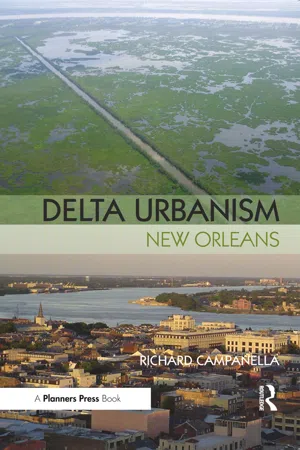
This volume of APA's Delta Urbanism series traces the development of New Orleans from precolonial times to post-Katrina realities, in the context of the deltaic plain on which it lies. The book describes the underlying physical terrain and covers the various transformations humans have made to it: site selection, settlement, urbanization, population, expansion, drainage, protection, exploitation, devastation, and recovery. What New Orleans has experienced foretells what similar cities will be tackling in years to come.
Information
Chapter 1 Delta Formation
New Orleans lies not on the ancient, solid North American lithosphere but on a thin, soft alluvial deposit cast out recently upon the continent’s margin.1 The city has occupied this semi-earthen surface for roughly 6 percent of the lifespan of its underlying geology, something few other major cities can claim. Certain oak trees in City Park today have been growing for about one-tenth of the age of their underlying soil; some aged citizens have personally witnessed fully one-fiftieth of the region’s geological existence. New Orleans’s terrain ranks as the youngest beneath any major American city, while southeastern Louisiana forms, as Mark Twain put it, “the youthfulest batch of country that lies around there anywhere.”2 The entire lower Mississippi Valley, from Cairo, Illinois, to the Gulf of Mexico, constitutes the continent’s youngest surface soils.
For millennia, what is now southern Louisiana altered between terrestrial and aquatic states. Cooling global temperatures locked up water in ice sheets, thus lowering sea level and rendering the shallow coastal waters into terrestrial areas. Warming temperatures transferred water from the glaciers back into the world’s oceans and returned coastal lowlands to the hydrosphere.
Eighteen thousand years ago, at the peak of the Ice Age, vast quantities of water lay frozen upon earthen surfaces, at the expense of the world’s oceans. In North America, those ice sheets stretched as far south as present-day Cairo and radically changed the continent’s topography and hydrology, resculpting the Missouri River drainage system to the west and the Ohio River system to the east such that the two rivers joined at Cairo. Rising global temperatures then melted the glaciers and sent increasing amounts of water and sediment toward that confluence. There, at the apex of an immense down-warping of the Earth’s crust known as the Mississippi Embayment (forerunner of the lower Mississippi Valley), a dramatically augmented Mississippi River delivered increasing quantities of sediment-laden water toward the Gulf of Mexico. Minor bluffs and terraces constrained the river to meander within a wide, flat alluvial valley until it passed below a line roughly between modern-day Lafayette and Baton Rouge, Louisiana, beyond which gulf waters lay.

The 1,243,700-square-mile Mississippi River Basin (yellow line) drains 41 percent of the continental United States and 15 percent of the North American continent. Thirty-one states and two Canadian provinces partially or fully drain into the Mississippi. The river discharges entirely along coastal Louisiana—70 percent via the Mississippi River, 30 percent via the Atchafalaya— forming the Mississippi deltaic plain. The Mississippi Delta ranks as one of the best examples of a river-dominated, multi-lobe delta protruding into a sea, and New Orleans represents one of the very few metropolises to occupy such a dynamic young feature. What happened here in the past 300 years represents the continent’s purest case study of delta urbanism. Map by Richard Campanella.
When moving water laden with sediment suddenly hits a slack water body such as the Gulf of Mexico, it loses its kinetic energy and dumps its sediment load. Alluvium began accumulating upon the hard compacted clays—that is, the delta’s sub-alluvial surface, formed during Pleistocene Epoch two million years ago—that lay beneath coastal waters. In time, open saltwater transformed into saline marshes and then into freshwater swamps laced with ridges. Because of the Mississippi’s immense water volume and sediment load vis-à-vis relatively weak tides and currents in the Gulf of Mexico, the river’s dynamics overpowered those of the gulf and extended the coastline farther into the Gulf of Mexico. Southeastern Louisiana began to form, starting approximately seven millennia ago. Longshore currents along the Gulf Coast swept some river alluvium westward, creating the modern-day south-central and southwestern Louisiana coast.

Southeastern Louisiana formed over the past 7,200 years as the Mississippi River emerged from its alluvial valley, shifted channels, and deposited sand, silt, and clay throughout shallow coastal waters. In this map, shades of white-to-red indicate where and when those lobes formed. The New Orleans area is mostly a product of the St. Bernard and Plaque-mines deltas, which started to form roughly 5,000 years ago. Map by Richard Campanella based on Frazier, Russel, Fisk, Kolb, and Van Lopik.
As that alluvial deposit rose in elevation, the Mississippi sought paths of less resistance around it, and in doing so formed new channels and enlarged the coastline outwardly in new directions. If no longer replenished with soil and freshwater, the original deltaic “lobe” would subside and erode back into the sea, while the new active lobe or lobes grew nearby. Seasonal floods spilled muddy water beyond the banks of the river, depositing more sediment along its inundated flanks and raising still higher the emerging landscape.
Occasionally a crevasse—a breach—would open in the bank, allowing a trickle or a torrent or even the entire water column to divert from the main channel into adjacent wetlands, instigating the same land-building processes in yet another area. The mouth of the Mississippi River in this manner extended farther and wider into the Gulf of Mexico, creating a network of active and abandoned deltaic complexes—a deltaic plain— that would eventually become southeastern Louisiana and home to New Orleans.
One visitor arriving to New Orleans in 1828 observed delta-building processes forming the marshy eastern flanks of the city. “We coasted along, past numerous small, sandy islands,” he wrote, “over shallow banks of mud, and through several immense basins, such as Lake Borgne and Lake Pontchartrain, half fresh, half salt, and filled with bars, spits, keys, and . . . shoals [typical of areas] whose Deltas are silently pushing themselves into the sea[,] raising the bottom to the surface.”3 To the French geographer Elisée Réclus, who sailed up the Mississippi in 1853, those processes created a deltaic plain that resembled “a gigantic arm projecting into the sea and spreading its fingers on the surface of the water.”4 American geographer John McPhee described the lowermost river as jumping “here and there within an arc about two hundred miles wide, like a pianist playing with one hand—frequently and radically changing course, surging over the left or the right bank to go off in utterly new directions.”5
That all of coastal Louisiana, including New Orleans, protrudes so broadly beyond the ancient continental coastline attests to the magnitude of the Mississippi River. Either for lack of water volume or sediment load, most rivers do not form deltas at all but rather admixtures of fresh and saltwater—estuaries—as they discharge into the sea. Two-thirds of the world’s 32 most populous cities abut estuaries, including New York City, on the Hudson.6 Larger sediment-bearing rivers that do form deltas are still usually at the mercy of wave or tidal action in influencing the shape and size of their alluvial deposits. These formations protrude modestly from the coastline, usually in the triangular form of the Greek letter Δ (hence the term delta). Others blend in smoothly with adjacent coasts. A number of great cities adjoin or occupy these types of deltas, which are termed wave-dominated and tide-dominated deltas. Alexandria, for example, sits on Egypt’s Nile River Delta, which is dominated by waves. Tides dominate China’s Yangtze Delta, home to 80 million people, one-quarter of them living in Shanghai. Dhaka, in Bangladesh, abuts the immense Ganges River Delta, also dominated by tides, with well over 100 million residents.
River-dominated deltas, on the other hand, occur in those rare circumstances when rivers bear enough water and sediment to overpower the dynamics of the receiving lake or sea, enabling the channel to meander, jump, send off distributaries, and build land faster than waves or tides can sweep it away. The resultant formations jut out dramatically into the receiving water body, often with multiple lobes spanning a broad area. River-dominated—or fluvial—deltas are more common in lakes than in seas because few of the world’s rivers are large enough to overpower coastal currents. The


As opposed to those deltas dominated by tides or waves, river-dominated systems such as the Mississippi Delta (shown here in oblique views dating from 1861 and 2002) occur when rivers discharge enough water and sediment to overpower the dynamics of the receiving lake or sea, enabling the channel to meander, jump, send off distributaries, and build land at their mouths faster than waves, currents, or tides can sweep it away. The resultant deltas jut out dramatically into the receiving water body, often with multiple lobes spanning a broad area. Bird’s-eye view of Louisiana, Mississippi, Alabama, and part of Florida, drawn (1861) by John Bachmann, courtesy Library of Congress; Landsat satellite image (2002) courtesy LSU.
Mississippi Delta ranks as one of the best examples of exactly that: a river-dominated, multi-lobe delta protruding into a sea. New Orleans represents one of the very few metropolises to occupy such a dynamic young feature. What happened here in the past 300 years presents the continent’s purest case study of delta urbanism.
Since the 1930s, geologists have generally agreed on where the Mississippi’s deltaic complexes have landed over the millennia, although their exact footprints and chronologies have been debated and refined. In the 1940s, geologists R. J. Russel and H. N. Fisk identified six historical delta complexes and subdivided them into a number of sub-deltas. In 1958, C. R. Kolb and J. R. Van Lopik updated these findings to recognize seven deltas, assigned some new names, and mapped them as distinctive lollipop-shaped lobes. In 1967, David E. Frazier advanced the science with radiocarbon dating and other new technologies. Frazier identified five deltaic complexes, subdivided them into 16 lobes, determined that many functioned contemporaneously, and estimated that the entire land-building event transpired over 7,200 years. Other scientists have since added to the body of knowledge on the origins of southeastern Louisiana, but, according to geologist Roger Saucier, “Frazier’s work remains the most definitive to date.”7 That research found that the New Orleans region is mostly a product of the St. Bernard and Plaquemines deltaic complexes, which started forming at least 4,300 years ago—a time frame that aligns with earlier investigations.
By 1700, most of the delta’s landscape features had reached a developmental stage that would be recognizable today. But these features, at the dawn of the colonial era, were still geologically alive and shifting, driven by gravity and controlled only by the forces of nature. The Mississippi River periodically swelled over its banks and replenished the backswamp with freshwater and new sediment. Enough river water flowed toward the old Lafourche Delta to inspire early French explorers to name it “the fork,” and the Bayou Manchac distributary still injected fresh, muddy river water into the Maurepas Swamp.
All this geological dynamism is anathema to European notions of settlement and urbanization. Over the next 300 years, human occupants of the deltaic plain would seize this malleable geography and rework it to improve their safety and circumstances within the time frame in which they lived: the moment and the foreseeable future. New Orleans as an urban system has since become one of the world’s great engineering challenges, and southeastern Louisiana and the lowermost Mississippi River rank as one of the most anthropogenically altered regions in the hemisphere. Every blessing seems to be accompanied by a curse; every solution seems to spawn a future problem. The historical geography of New Orleans is, in large part, the story of the benefits, costs, and constant dilemmas associated with this geological tinkering.
Chapter 2 Delta Topography
The highest lands of the deltaic plain lie closest to moving freshwater—precisely the opposite of undulating landscapes, in which water carves downward and flows in the lowest areas.1 Springtime overflows of the Mississippi River and its distributaries explain this phenomenon, as sediment particles borne by the floodwaters settle on the landscape according to their size and weight. Anything coarser than two millimeters in diameter (gravel, stones, or larger) weighs too much to make it all the way down the vast Mississippi River system. (For this reason, as a visitor in 1750 put i...
Table of contents
- Cover
- Title
- Acknowledgments
- Copyright
- Contents
- Introduction
- Chapter 1 Delta Formation
- Chapter 2 Delta Topography
- Chapter 3 Settling the Delta
- Chapter 4 Urbanizing the Delta
- Chapter 5 Why There?
- Chapter 6 Colonial-Era Flood Control
- Chapter 7 A Radical Change of Destiny
- Chapter 8 Unwritten Rules of Urban Expansion
- Chapter 9 The Unplanned Street Plan
- Chapter 10 Antebellum Flood Control
- Chapter 11 Populating the Antebellum City
- Chapter 12 Populating the Postbellum City
- Chapter 13 Draining the Deltaic City
- Chapter 14 Turn-of-the-Century Flood Control
- Chapter 15 Buffering the Deltaic City
- Chapter 16 Twentieth-Century Delta Urbanism
- Chapter 17 Perceiving the Delta City
- Chapter 18 Environmental Consequences of Delta Urbanism
- Chapter 19 Devastating the Deltaic City
- Chapter 20 “Plandemonium”
- Chapter 21 Repopulating the Deltaic City
- Chapter 22 Delta Urbanism: Lessons from New Orleans
- Endnotes
- Bibliography
- Index
Trusted by 375,005 students
Access to over 1.5 million titles for a fair monthly price.
Study more efficiently using our study tools.
Frequently asked questions
Yes, you can cancel anytime from the Subscription tab in your account settings on the Perlego website. Your subscription will stay active until the end of your current billing period. Learn how to cancel your subscription
No, books cannot be downloaded as external files, such as PDFs, for use outside of Perlego. However, you can download books within the Perlego app for offline reading on mobile or tablet. Learn how to download books offline
We are an online textbook subscription service, where you can get access to an entire online library for less than the price of a single book per month. With over 1.5 million books across 990+ topics, we’ve got you covered! Learn about our mission
Look out for the read-aloud symbol on your next book to see if you can listen to it. The read-aloud tool reads text aloud for you, highlighting the text as it is being read. You can pause it, speed it up and slow it down. Learn more about Read Aloud
Yes! You can use the Perlego app on both iOS and Android devices to read anytime, anywhere — even offline. Perfect for commutes or when you’re on the go.
Please note we cannot support devices running on iOS 13 and Android 7 or earlier. Learn more about using the app
Please note we cannot support devices running on iOS 13 and Android 7 or earlier. Learn more about using the app
Yes, you can access Delta Urbanism: New Orleans by Richard Campanella in PDF and/or ePUB format, as well as other popular books in Architecture & Urban Planning & Landscaping. We have over 1.5 million books available in our catalogue for you to explore.