Paediatric Radiology for MRCPCH and FRCR, Second Edition
  1. 310 pages
  2. English
  3. ePUB (mobile friendly)
  4. Available on iOS & Android
eBook - ePub

About this book

Radiology plays a fundamental role in the diagnosis and management of childhood diseases. This is reflected in both paediatric and radiology post graduate exams, where candidates are expected to have a working knowledge of paediatric pathology, clinical manifestations and appropriate radiological investigations. Building on the great success of the first edition, Paediatric Radiology for MRCPCH and FRCR retains the popular preexisting structure of the book, but presents an improved variety of clinical cases as well as updated text in-keeping with advances in medical practice and technology. There is more emphasis on cross-sectional imaging, as candidates are increasingly encountering these sophisticated imaging tests in postgraduate exams. Images have been updated, and all the clinical information has been reviewed and revised accordingly.

  • Contains over 100 clinical cases, presented in exam format, with answers overleaf
  • Includes a wide range of common and rare paediatric conditions with supplementary images to illustrate additional points
  • Uses classic examination images, with salient radiological and clinical summaries of each condition - the "hot lists"
  • Carries specific information for paediatricians and radiologists for each case
  • An introductory chapter on the basic concepts of imaging aims to provide the reader with an approach to radiological imaging and an awareness of the different modalities available, with new sections on non-accidental injury and radiation protection.
Frequently asked questions

Yes, you can cancel anytime from the Subscription tab in your account settings on the Perlego website. Your subscription will stay active until the end of your current billing period. Learn how to cancel your subscription.
At the moment all of our mobile-responsive ePub books are available to download via the app. Most of our PDFs are also available to download and we're working on making the final remaining ones downloadable now. Learn more here.
Perlego offers two plans: Essential and Complete
  • Essential is ideal for learners and professionals who enjoy exploring a wide range of subjects. Access the Essential Library with 800,000+ trusted titles and best-sellers across business, personal growth, and the humanities. Includes unlimited reading time and Standard Read Aloud voice.
  • Complete: Perfect for advanced learners and researchers needing full, unrestricted access. Unlock 1.4M+ books across hundreds of subjects, including academic and specialized titles. The Complete Plan also includes advanced features like Premium Read Aloud and Research Assistant.
Both plans are available with monthly, semester, or annual billing cycles.
We are an online textbook subscription service, where you can get access to an entire online library for less than the price of a single book per month. With over 1 million books across 1000+ topics, we’ve got you covered! Learn more here.
Look out for the read-aloud symbol on your next book to see if you can listen to it. The read-aloud tool reads text aloud for you, highlighting the text as it is being read. You can pause it, speed it up and slow it down. Learn more here.
Yes! You can use the Perlego app on both iOS or Android devices to read anytime, anywhere — even offline. Perfect for commutes or when you’re on the go.
Please note we cannot support devices running on iOS 13 and Android 7 or earlier. Learn more about using the app.
Yes, you can access Paediatric Radiology for MRCPCH and FRCR, Second Edition by Christopher Schelvan,Copeman Copeman, Christopher Schelvan,Annabel Copeman,Jacqueline Davis,Annmarie Jeanes,Jane Young, Christopher Schelvan, Annabel Copeman, Jacqueline Davis, Annmarie Jeanes, Jane Young in PDF and/or ePUB format, as well as other popular books in Medicine & Medical Technology & Supplies. We have over one million books available in our catalogue for you to explore.

Information

Publisher
CRC Press
Year
2020
Print ISBN
9781853157028
eBook ISBN
9781000153156

The cases

Case 1

Image
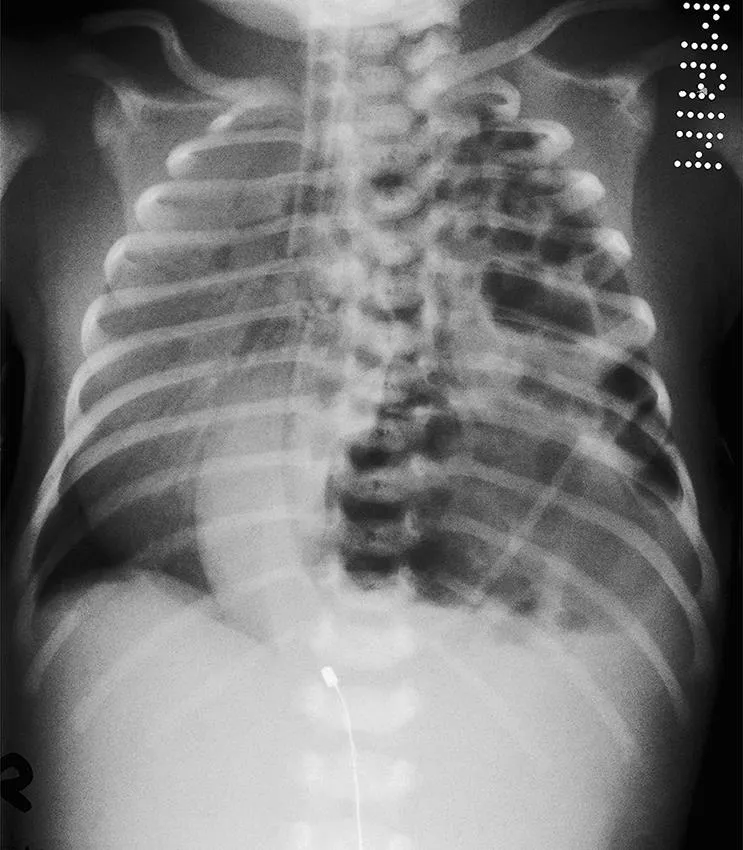
This term baby was admitted to the neonatal unit with respiratory distress.
1 What abnormalities are seen on the frontal chest radiograph?
2 What is the diagnosis?

ANSWERS

1 There are multiple lucencies in the left hemithorax, mediastinal shift to the right and there is little aeration of the right lung. The gastric bubble is not seen in the normal position and there is no bowel gas seen below the diaphragm. The tip of the nasogastric tube is in the left chest.
2 Left congenital diaphragmatic hernia, with multiple loops of bowel within the left hemithorax.

RADIOLOGY HOT LIST

• Initial radiographs may show an opaque hemithorax, as the bowel loops are fluid filled. As the baby swallows air, the characteristic gas-filled bowel loops appear in the thorax.
• Placement of a nasogastric tube verifies that the stomach is in the chest.
• The differential diagnosis of cystic intrathoracic lesions is congenital cystic adenomatoid malformation, where there is a normal abdominal bowel gas pattern and the NG tube is normally sited.
• Ultrasound can be helpful to confirm the presence of bowel loops within the chest and demonstrate the diaphragmatic defect. In doubtful cases, an upper GI contrast study can be performed.

CLINICAL HOT LIST

• Incidence 1 : 2500 live births, most diagnosed antenatally.
• 80% of herniations are left posterolateral (Bochdalek).
• Embryology: the pleuroperitoneal opening (foramen of Bochdalek) fails to close. Abdominal viscera herniate into the thorax, compromising pulmonary development.
• Morbidity depends on the degree of pulmonary hypoplasia and associated pulmonary hypertension: the presence of aerated lung on both sides is a good prognostic indicator.

Case 2

Image
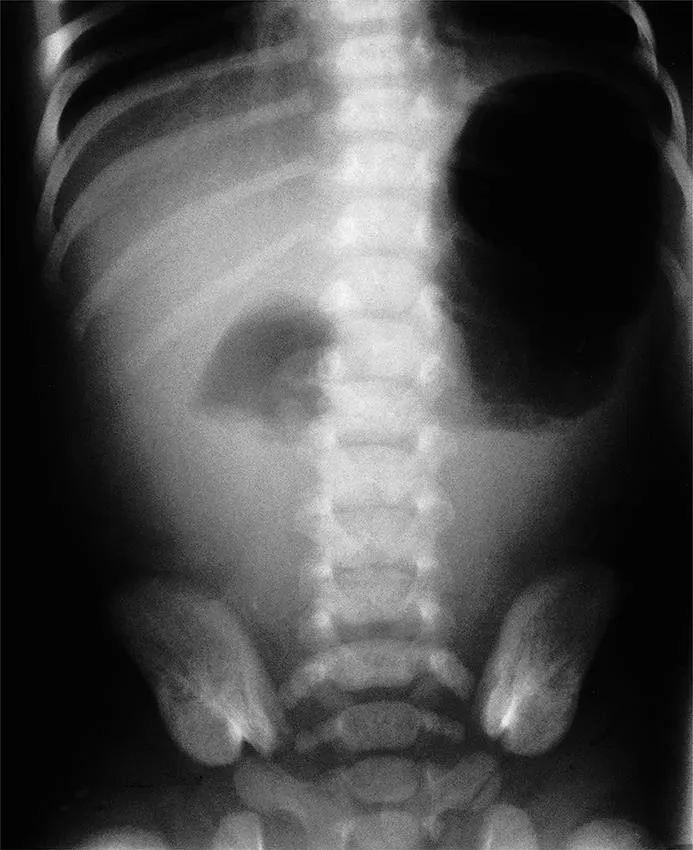
This baby was reviewed on the postnatal ward for poor feeding and bilious vomiting.
1 What abnormality is seen on the plain abdominal radiograph?
2 What is the most likely diagnosis?
3 With what condition is this associated?

ANSWERS

1 There is gas in the stomach and proximal duodenum but none elsewhere, giving the ‘double-bubble’ sign.
2 Duodenal atresia.
3 Down’s syndrome.

RADIOLOGY HOT LIST

• Duodenal atresia represents a complete obstruction, with no gas seen beyond the duodenum. The abdominal X-ray is diagnostic and a contrast study is not required.
• If the abdominal radiograph suggests incomplete obstruction (with a small amount of gas in the distal bowel), a careful upper gastrointestinal (GI) contrast study should be performed to assess the site of obstruction, and exclude a malrotation/midgut volvulus, which is a surgical emergency.
• Other causes of neonatal duodenal obstruction include duodenal stenosis, duodenal web, annular pancreas, Ladd’s bands and midgut volvulus, which all show gas in the distal bowel.

CLINICAL HOT LIST

• Incidence 1 : 1000 live births.
• The cause appears to be a failure in canalization of the fetal duodenum due to early developmental insult. There is a strong association with other abnormalities of the GI and biliary tracts, e.g. malrotation, oesophageal atresia and anal anomalies. Cardiac and renal abnormalities are sometimes seen.
• Up to 30% have Down’s syndrome.
• Most atresias occur distal to the ampulla of Vater, presenting with bilious vomiting in the first few hours of life. An incomplete obstruction may present later.
• Antenatal diagnosis is possible; 40% will have maternal polyhydramnios.

Case 3

Image
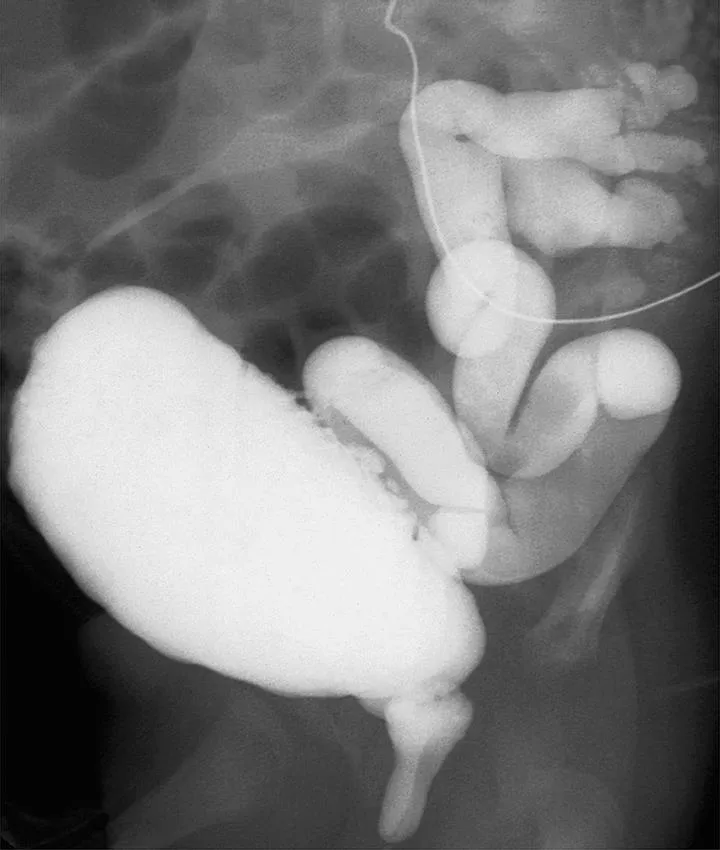
This 4-day-old boy is in renal failure. Antenatal ultrasound had shown bilateral hydronephrosis.
1 What investigation is this?
2 What does it show?
3 What is the diagnosis?

ANSWERS

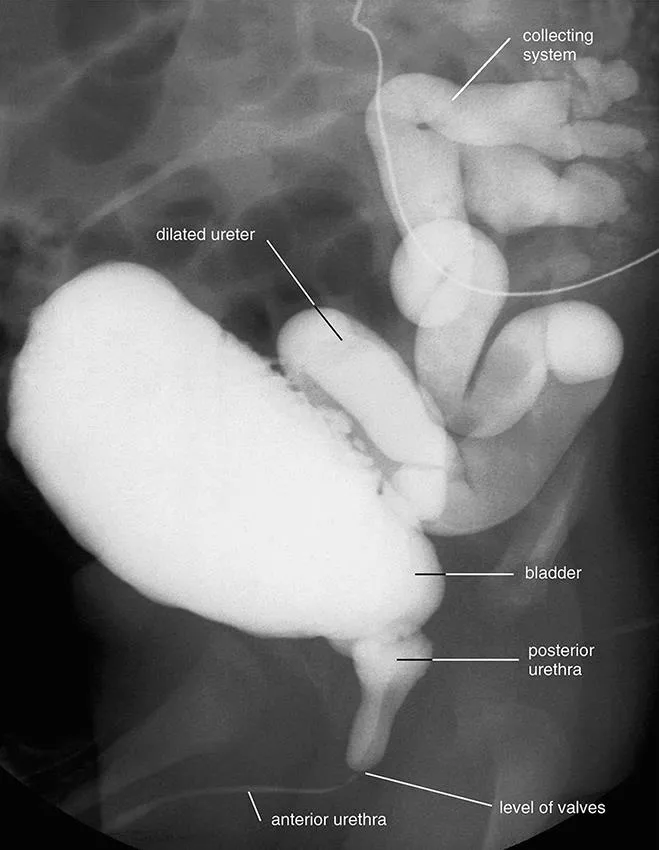
1 A micturating cysto-urethrogram (MCUG).
2 There is an abrupt change in calibre of the urethra, with dilatation of the posterior urethra. The bladder wall is trabeculated. There is bilateral vesicoureteric reflux into dilated and tortuous ureters.
3 Posterior urethral valves.
Image

RADIOLOGY HOT LIST

• The diagnosis of posterior urethral valves is usually made on an MCUG. This will show dilatation of the posterior urethra, a transverse filling defect (valves) and reduction of the urethral calibre distal to the obstruction.
• The bladder may be large or small volume, with trabeculation of the bladder wall.
• Vesicoureteric reflux is common and associated with a worse prognosis. It occurs in approximately 50% and is bilateral in 15%.
• Antenatal ultrasound may suggest the diagnosis, showing dilatation of the ureters and pelvicalyceal systems and a thick-walled bladder. There may be oligohydraminios, which is associated with a worse prognosis.
• All children should receive antibiotic cover at the time of the MCUG. The investigation should not be performed in the presence of a urinary tract infection (UTI).

CLINICAL HOT LIST

• Valves are mucosal folds that close on voiding, leading to obstruction.
• It is rare, but remains the commonest obstructive uropathy in boys.
• There is a spectrum of severity from mild to severe. The...

Table of contents

  1. Cover
  2. Half Title
  3. Dedication
  4. Title Page
  5. Copyright Page
  6. Contents
  7. Foreword
  8. Foreword from first edition
  9. Preface
  10. Acknowledgement
  11. Rules and tools
  12. Cases
  13. Bibliography
  14. Index