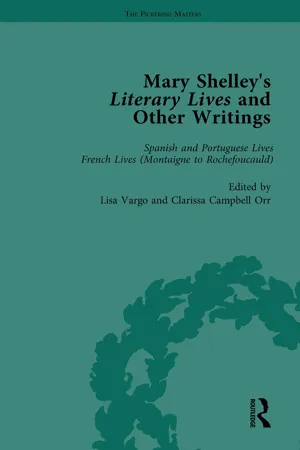
eBook - ePub
Mary Shelley's Literary Lives and Other Writings, Volume 2
- 1,912 pages
- English
- ePUB (mobile friendly)
- Available on iOS & Android
eBook - ePub
Mary Shelley's Literary Lives and Other Writings, Volume 2
About this book
This collection covers the lyrical poetry of Mary Shelley, as well as her writings for Lardner's "Cabinet Cyclopaedia of Biography" and some other materials only recently attributed to her.
Information
LITERARY LIVES
FRENCH LIVES
VOLUME ONE
THE CABINET CYCLOPÆDIA.
CONDUCTED BY THE
REV. DIONYSIUS LARDNER, LL.D. F.R.S.L. & E.
M.R.I.A. F.R.A.S. F.L..S. F.Z.S. Hon. F.C.P.S. &c. &c.
M.R.I.A. F.R.A.S. F.L..S. F.Z.S. Hon. F.C.P.S. &c. &c.
ASSISTED BY
EMINENT LITERARY AND SCIENTIFIC MEN
Biography.
EMINENT
LITERARY AND SCIENTIFIC [illegible text] OF FRANCE.
VOL. I.
LITERARY AND SCIENTIFIC [illegible text] OF FRANCE.
VOL. I.
LONDON:
PRINTED FOR
LONGMAN, ORME, BROWN, GREEN, & LONGMANS, PATERNOSTER-ROW;
AND JOHN TAYLOR, UPPER GOWBR STREET.
1838.
PRINTED FOR
LONGMAN, ORME, BROWN, GREEN, & LONGMANS, PATERNOSTER-ROW;
AND JOHN TAYLOR, UPPER GOWBR STREET.
1838.
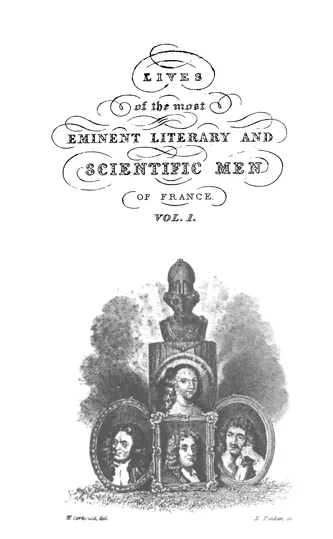
Title Page Vignette: Designed and engraved, as with the Italian Lives and the Spanish Lives, by H. Corbould and E. Finden. The date has not been altered. Clockwise starting from the top portraits are of Madame de Sévigné, Molière, Racine and La Fontaine.
London:
CONTENTS.
| Page | ||
| MONTAIGNE | [1] | 301 |
| RABELAIS [Not by Mary Shelley] | [23] | 319 |
| CORNEILLE | [40] | 330 |
| ROCHEFOUCAULD | [63] | 350 |
[MOLIÈRE, LA FONTAINE, PASCAL, SÉVIGNÉ, BOILEAU, RACINE and FÉNÉLON, together with French Lives II, are in volume 3 of this edition]
LIVES OF EMINENT LITERARY AND SCIENTIFIC MEN.
MONTAIGNE. 1533–1592.
THERE is scarcely any man into whose character we have more insight than that of Montaigne. He has written four volumes of “Essays,”a which are principally taken up by narrations of what happened to himself, or dissertations on his own nature, and this in an enlightened and philosophical, though quaint and naïve style, which renders him one of the most delightful authors in the world. It were easy to fabricate a long biography, by drawing from this source, and placing in a consecutive view, the various information he affords. We must abridge, however, into a few pages several volumes; while, by seizing on the main topics, a faithful and interesting picture will be presented.
a Montaigne published only three books of essays; Mary Shelley appears to be confusing books (livres) with the number of volumes (tomes) in the edition she was using, possibly the same 4-volume set owned in 1819–20. Editions after 1724 were usually issued in sets of more than 3 volumes because of ancillary material. A landmark edition, the 1739 Essais de Michel, Seigneur de Montaigne, ed. Pierre Coste, 4th edn, 6 vols (London: Jean Nourse, 1739), hereafter Coste, contained 9 letters of Montaigne, de la Boétie’s De la servitude volontaire, Marie de Gour-nay’s Epître dedicatoire au Cardinal Richelieu, her Préface of 1635, two brief Vies, critical notices and other apparatus. The only pre-1838 4-volume edition, however, appears to have been Naigeon’s admired stereotyped edition (Paris: Firmin Didot, 1802; copy not seen, but it is said to present Montaigne as a deist rather than as a devout Catholic). Citations here in French are taken from Montaigne, Essais (1969) ed. Alexandre Micha, hereafter Essais, and English translations and essay titles from The Essays of Michel Yquem de Montaigne, trans. Charles Cotton, ed. W. Carew Hazlitt (1952 edn), hereafter Essays. Mary Shelley appears to have bypassed Cotton’s famous translation, as she earlier bypassed L’Estrange’s translation of Quevedo. Her text would have differed a little from post-1920 texts, which are based on the so-called Bordeaux MS.
Michel de Montaigne was born at his paternal castle of that name*, in Perigord, on the 8th of February, 1533.a He was the son of Pierre Eyquem, esquire – seigneur of Montaigne, and at one time elected mayor of Bordeaux. This portion of France, Gascony and Guienne, gives birth to a race peculiar to itself; vivacious, warm-hearted, and / vain – they are sometimes boastful, but never false; often rash, but never disloyal; and Montaigne evidently inherited much of the disposition peculiar to his province. He speaks of his family as honourable and virtuous:– “We are a race noted as good parents, good brothers, good relations,”b he says, – and his father himself seems eminently to deserve the gratitude and praise which his son bestows. His description of him is an interesting specimen of a French noble of those days: – “He spoke little and well, and mixed his discourse with allusions to modern books, mostly Spanish; his demeanour was grave, tempered by gentleness, modesty, and humility; he took peculiar care of the neatness and cleanliness of his dress, whether on horseback or on foot; singularly true in his conversation, and conscientious and pious, almost even to superstition. For a short slight man he was very strong; his figure was upright and well proportioned; he was dexterous and graceful in all noble exercises; his agility was almost miraculous; and I have seen him, at more than sixty years of age, throw himself on a horse, leap over the table, with only his thumb on it, and never going to his room without springing up three or four stairs at a time.”c Michel was the eldest of five sons. His father was eager to give him a good education, and even before his birth consulted learned and clever men on the subject. On these consultations and on his own admirable judgment he formed a system, such as may in some sort be considered the basis of Rousseau’s; and which shows that, however we may consider one age more enlightened than another, the natural reason of men of talent leads them to the same conclusions, whether living in an age when warfare, struggle, and the concomitant ignorance were rife, or when philosophers set the fashion of the day. “The good father whom God gave me,” says Montaigne, “sent me, while in my cradle, to one of his poor villages, and kept me there while I was at nurse and longer, bringing me up to the hardest and commonest habits of life. He had another notion, also, which was to ally me with the / people, and that class of men who need our assistance; desiring that I should rather give my attention to those who should stretch out their arms to me, than those who would turn their backs; and for this reason he selected people of the lowest condition for my baptismal sponsors, that I might attach myself to them.”a He was taught, also, in his infancy directness of conduct, and never to mingle any artifice or trickery with his games. With regard to learning, his good father meditated long on the received modes of initiating his son in the rudiments of knowledge. He was struck by the time given to, and the annoyance a child suffers in, the acquirement of the dead languages; this was exaggerated to him as a cause why the moderns were so inferior to the ancients in greatness of soul and wisdom. He hit, therefore, on the expedient of causing Latin to be the first language that his son should hear and speak. He engaged the services of a German, well versed in Latin, and wholly ignorant of French. “This man,” continues Montaigne, “whom he s...
Table of contents
- Cover
- Half Title
- Title Page
- Copyright Page
- Contents
- Acknowledgements
- Abbreviations
- Editor's Introduction, Spanish and Portuguese Lives
- Editor's Introduction, French Lives
- SPANISH AND PORTUGUESE LIVES
- Introduction
- Boscan
- Garcilaso de la Vega
- Diego Hurtado de Mendoza
- Luis de Leon
- Herrera
- Saa de Miranda
- Jorge de Montemayor
- Castillejo
- The Early Dramatists
- Ercilla [Not by Mary Shelley]
- Cervantes
- Lope de Vega
- Vicente Espinel ' Esteban de Villegas
- Gongora
- Quevedo
- Calderon
- Early Poets of Portugal
- Camo'ns
- FRENCH LIVES VOLUME I
- Montaigne
- Rabelais [not by Mary Shelley]
- Corneille
- Rochefoucauld
- Editorial Corrections:
Trusted by 375,005 students
Access to over 1.5 million titles for a fair monthly price.
Study more efficiently using our study tools.
Frequently asked questions
Yes, you can cancel anytime from the Subscription tab in your account settings on the Perlego website. Your subscription will stay active until the end of your current billing period. Learn how to cancel your subscription
No, books cannot be downloaded as external files, such as PDFs, for use outside of Perlego. However, you can download books within the Perlego app for offline reading on mobile or tablet. Learn how to download books offline
Perlego offers two plans: Essential and Complete
- Essential is ideal for learners and professionals who enjoy exploring a wide range of subjects. Access the Essential Library with 800,000+ trusted titles and best-sellers across business, personal growth, and the humanities. Includes unlimited reading time and Standard Read Aloud voice.
- Complete: Perfect for advanced learners and researchers needing full, unrestricted access. Unlock 1.5M+ books across hundreds of subjects, including academic and specialized titles. The Complete Plan also includes advanced features like Premium Read Aloud and Research Assistant.
We are an online textbook subscription service, where you can get access to an entire online library for less than the price of a single book per month. With over 1.5 million books across 990+ topics, we’ve got you covered! Learn about our mission
Look out for the read-aloud symbol on your next book to see if you can listen to it. The read-aloud tool reads text aloud for you, highlighting the text as it is being read. You can pause it, speed it up and slow it down. Learn more about Read Aloud
Yes! You can use the Perlego app on both iOS and Android devices to read anytime, anywhere — even offline. Perfect for commutes or when you’re on the go.
Please note we cannot support devices running on iOS 13 and Android 7 or earlier. Learn more about using the app
Please note we cannot support devices running on iOS 13 and Android 7 or earlier. Learn more about using the app
Yes, you can access Mary Shelley's Literary Lives and Other Writings, Volume 2 by Lisa Vargo,Nora Crook, Clarissa Campbell Orr in PDF and/or ePUB format, as well as other popular books in Social Sciences & Social Science Biographies. We have over 1.5 million books available in our catalogue for you to explore.