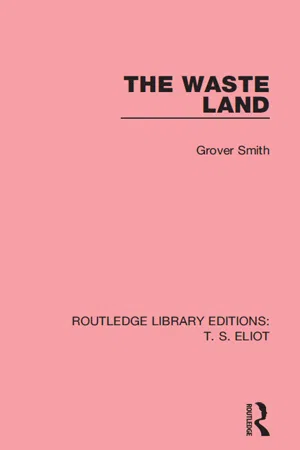
In this study, first published in 1983, Professor Smith makes the argument that although The Waste Land is analogous in form to a musical composition that it is actually made of its literary echoes. He calls these a 'music of allusions' and shows the resemblance of this music in its evocativeness to the technique of Mallarmé and the French symbolists. Smith also comments extensively on Eliot's critical theories as they bear on The Waste Land and traces the development of Eliot's allusive and transformational poetic form from its genesis in early work. This title will be of interest to students of literature.
- 170 pages
- English
- ePUB (mobile friendly)
- Available on iOS & Android
eBook - ePub
The Waste Land
About this book
Information
CHAPTER 1
Eliot’s World before The Waste Land
Eliot found … disgusting
images in Baudelaire, but he
missed as completely as Symons
had the compassion behind disgust.William York Tindall, Forces
in Modern British Literature
The Waste Land has two kinds of importance, the historical and the poetical. In the first instance, quite simply, it was nothing but poetry, having been made out of the feelings of an expatriate American living in London just after the First World War; a sensitive, hard, clever and highly individuated man, unhappily married, classically educated and trained as a linguist, philosopher and logician; by day conducting vital business negotiations for his banker employers and by night writing shrewd and irritable literary criticism; who had published volumes of verse and also of prose, and who cherished the ambition, even while emotionally distressed, of enriching modern culture with a masterpiece of poetry. In the memories of readers, who pored over it, analysed and criticised it, traced its plagiarisms, interpreted and (sometimes creatively) misinterpreted it, this poem became no longer poetry only but a historical event, a fact in the 1920s segment of the long time scale, apt like other social facts to be evaluated as a cultural monument; though they or many of them knew it also as poetry and loved some magical phrases from it. Another cultural monument is T.S. Eliot himself, among whose writings The Waste Land is jostled by works no less likely to be remembered a century from now. It is in the setting of Eliot’s personality that I shall examine this representative specimen of his art.
Eliot conceived of originality in art as manifesting a unique point of view. The common ground for poet and reader is their shared culture, and more than this none ought to require. But there are few readers who stick to this rule; and to learn to get an expected emotional satisfaction (which is how all but learned readers proceed) without poetic texture designed to this end, is not within the grasp of most. The Waste Land was not composed with a view to the emotions of an audience. It is famous for two reasons, that it is a good poem though not for all tastes, for it is not captivating; and that it challenges the curiosity of academic readers, who have kept it going. On the whole their sometimes ill-informed intercession between the poet and the literate public has had benign cultural effects. It has made slack poetry harder to tolerate. When first published, The Waste Land was popularly seen as a hoax or a meaningless confusion, or as having a social meaning that made it detestable; for many, its ugly images and foreign languages combined into a double offensiveness. Possibly some of its severe critics had never read a poem before. It was not primarily social but it was disturbingly topical; one proof was the emotional stir it aroused. In time, the poem gained adherents who in some way assimilated its point of view – meaning that they believed its emotions their own. Conservatives held back, Marxists rumbled; many others embraced its novelty, some its pessimism, iconoclasm or hints of prevenient grace. Believers in a vision of cultural sterility learned their text from it and admired it for anticipating their revelation. When Eliot became an Anglican, they raged that he had betrayed their cause; but Christians said The Waste Land represented his dark night of spiritual tribulation before conversion. And indeed this event followed by only six years the writing of the poem in 1921. The dark night was his, not the culture’s; but I see no prophecy of conversion in the poem.
Friends of The Waste Land in 1923, as soon as it began to attract great attention, hailed a vital style and a tragic intensity. In the manner of avant-garde people, moreover, they were responsive to trends. Eliot seemed to have absorbed the currents of modern thinking on the arts, urban society, sex and the unconscious, and the future of Western civilisation. People were therefore stimulated by the poem as by Freud, Spengler or Einstein. Its début was neither obscure nor humble: the fame of The Waste Land began as that of a literary ‘happening’ in the mode of Futurism or Dada. A small inner public could read it as a poem and knew it to be an intimate testament of its author. The loyal larger public fulfilled a condition described by Eliot when he said that a poet in writing himself writes his time. This truth came rather hard to him. In the years after, he would complain, quite illogically, because people interpreted the poem in their terms rather than his, which they did not know; and he could speak of his ‘intention’ when he had taken pains to conceal it. In 1931, in a disquisition on the Church of England, he paused to grumble at a phrase employed by I.A. Richards:
I dislike the word ‘generation’, which has been a talisman for the last ten years; when I wrote a poem called The Waste Land some of the more approving critics said that I had expressed the ‘disillusionment of a generation’, which is nonsense. I may have expressed for them their own illusion of being disillusioned, but that did not form part of my intention. (‘Thoughts after Lambeth’, Selected Essays, p. 368)
Twenty years later, setting aside his quibbles, he renewed the discussion on a hypothetical level but, in effect, with a retraction:
A poet may believe that he is expressing only his private experience; his lines may be for him only a means of talking about himself without giving himself away; yet for his readers what he has written may come to be the expression both of their own secret feelings and of the exultation or despair of a generation. (‘Virgil and the Christian World’, On Poetry and Poets, pp. 122–3)
In the technical language adopted by Eliot in his youth from the philosopher F.H. Bradley, ‘feelings’ as used in the second passage connotes the subjective side of experience, which also of course involves, more or less, an objective side – the objects which the feelings, equivalent in this case to emotion, refer to. Though Eliot, when he used Bradley’s language, generally meant by it something different from Bradley, he did keep the ‘feeling’–‘experience’ relation for his own purposes. The passage contrasts the poet’s feelings, which refer to objects known to him, with the readers’ feelings, which refer to objects known to them. Nothing could more distinctly separate the poet’s point of view from that of his audience. What readers get from a poem may benefit them, and may lead to fame for the poet, but it is not the poem and it is not the poet’s strategy in the poem. Indeed, however, it may be foreseen by the poet and may become a strategy for the poem; but I doubt whether that was true of The Waste Land.
Eliot said in a lecture in 1947 (On Poetry, p. 10) that he had written the poem ‘simply to relieve’ his feelings – as if The Waste Land had served him for therapy, catharsis. Well and good – but in his early critical writings he usually defined the poetic act in formal terms, as a making. When the poet expresses his private experience, according to Eliot, he transforms. He transforms feelings; he transforms his outer world, for experience is a meeting of a self with something not itself; and, most crucial to his identity as a poet, he transforms both world and feelings through the medium of language into a new object concentrating his point of view, so that it endures. Like ‘experience’, ‘point of view’ was a technical term. Later I shall show how Eliot varied it with other terms. It always connoted uniqueness, as ordinarily it has done in common use. It means above all an active individuality revealed objectively as creative mind. The poem in the aspect of point of view marks not only the end of a certain experience but the beginning of a lasting selfhood for the poet, and indeed is his means to this.
The most valuable contribution to knowledge of The Waste Land after its first appearance was the disclosure, in 1968, of the long-guarded materials, typescripts and holographs, from which the published shorter poem of 1922 had derived. These appeared in due course as The Waste Land: a Facsimile and Transcript of the Original Drafts Including the Annotations of Ezra Pound (1971), edited by Eliot’s widow, Valerie Eliot (and henceforth referred to in this text as the Facsimile). The composition of the poem will be surveyed in Chapter 3 (below, pp. 64–83); it suffices here to note that the drafts include the texts of several minor poems from which Eliot reworked lines for The Waste Land, and also passages suppressed in his typescript before publication, such as the scene in Fresca’s boudoir and the sea-voyage episode. Especially illuminating was the biographical information presented by Mrs Eliot in the volume, establishing a great many new facts about the personal background of the poem; but by far the most exciting exhibits were the texts themselves, wanting only chronological handling to show the poem in process of development. The Waste Land as artefact remains the truncated work produced by Eliot with the help of Ezra Pound’s ‘midwifery’, and afterwards enlarged with a series of ‘Notes’ by Eliot. As an object of study, thanks to the Facsimile, it became more, a whole ontogeny traceable back to the creative point of view in which it was conceived. It would be foolishness to dismiss either the first inspirations or the final improvements and sacrifices. Some people regard editorial solicitude for foul copies and cancelled passages as pedantry. Their notion has always seemed to me a kind of philistinism, though it occurs in defence of ‘perfected’ art. Certainly it is unjust to the finished work not to celebrate its superiority to discards unworthy of it. As to Eliot’s ‘Notes’, they constitute a last stage in elaborating the poem and so they form part of it. Eliot, though dubious about them, never deleted them from editions; and it can only be argued that the poem is better or worse without them, not that they can be made invisible.
Drawing upon Eliot’s memories, the poem organises them into an image of him – his extended point of view. It presents to the reader’s scrutiny the state of a consciousness in self-contained isolation, its timeline coiled within it. Eliot’s ‘Notes’ identify this consciousness by the name and with the mythological attributes of the personage Tiresias, and assign to it the function of uniting the characters. (One critic has objected that it is the poet who sees the world of his poem, and not Tiresias. But Tiresias is the poet as he functions in the poem. cf. Bolgan, 1973, pp. 32–4.) Eliot’s innovations in this structure belong to the climate of modernist experiment. They have precedents. The spectator consciousness has occurred immemorially as a narrator in the first person, and the modern difference arises when the time sequence is dislocated by one device or another. Narrative apart, the idea of presiding consciousness is in the tradition of the medieval Dream Vision and variations of that.
The personages external to this persona sustain an existence too stunted to be quickened by transient joys, and at worst condemned to squalor and cruelty; but they are no more viewed with compassion than he is expressed with self-pity. They remain at a distance. They match his isolation with their own. It is important for readers of The Waste Land to absorb the brief citation from F.H. Bradley included in Eliot’s ‘Notes’ (note to line 411), and to take it not in the context of Bradley’s philosophy or with meanings special to it there, which are quite superfluous, but in connection with the line it annotates and with the attendant quotation from Dante on Ugolino’s imprisonment. The essence of the citation occurs in the sentence, ‘In brief, regarded as an existence which appears in a soul, the whole world for each is peculiar and private to that soul’. The Waste Land depicts a point of view, not an actual world but an ideal world and therefore a private one. There are no shared experiences, for the actual world becomes private in the experiencing. Furthermore the only way it can be experienced is by becoming private: ‘My external sensations are no less private to myself than are my thoughts and feelings’. A good deal of worry has been generated over Eliot’s use of the passage, especially concerning the ‘solipsistic’ question. Some argue that because Bradley was not a solipsist, the citation is not solipsistic; others that because, out of context, the citation sounds solipsistic it must be so. Few observe that Eliot fails to say, from which it might be inferred that, for this context, the question remains not only open but unasked. (Obviously it can make a great difference to one’s feelings whether one thinks the world subjectively ideal, that is, solipsistic, or objectively ideal, that is, existent in a greater mind – the difference, for some people, between despair and hope or between hope and despair.) Eliot had written his doctoral dissertation on Bradley, and knew when philosophy was philosophy and when it was poetic annotation. Here it is the latter, but, being supplied by the poet at the tail of the poem, it is part of the poetry, one of the numerous stolen passages. Whatever Eliot ‘really’ thought about the Absolute, his poetry embodies a theoretical scepticism as honest as that of Montaigne; as Eliot said of Henry James, no idea can ‘violate’ his mind (‘In Memory of Henry James’, Egoist, vol. 5, p. 2).
The basic technique of Eliot’s poetry is the contemplation and manipulation of objects. It cannot be explained as different from what any other poet of images employs, except in the degree to which it excludes acceptance of beauty and joy on their own terms. Eliot was at once as sensuous as Keats and as suspicious as Swift. He combined longing and disdain in almost every poem of his youth, and the technique might have been tailored to the requirements of a sardonic temperament. Even in early poems, such as ‘Prufrock’ (1910–11), written before he was involved in his study of Bradley, the objective method (the transaction with the world as an assemblage of objects in presentation) had taken hold of his imagination. It is difficult to see what Bradley could have added to this instinctive way of seeing – perhaps the formulation of the concept of philosophical ‘object’, not in the layman’s sense but in that of the idealist holding that all experience reduces to an abstraction, an object in the mind. At best this for Eliot would have amounted to reinforcement, of an emotional distance not an emotional judgement. Bradley’s philosophy, deeply admitted into the mind, tends to erode belief in every conventional notion of the self and the world around it. One has feeling, but feeling may not be valid; it is all that reports the world, but the world cannot confirm it. Yet the very point of view to which the supposed ‘self’ is stripped depends upon this encounter. So the individual is left with feeling and experience alone. I think it was temperament that prodded Eliot into writing a dissertation on Bradley (1916), ultimately published in 1964 as Knowledge and Experience. But the same temperament both then and afterwards limited him to a poetry as sceptical as Bradley but devoid of Bradley’s equanimity.
In the poetry there is a great range of objects, and, as has been seen, those proper to the self are no less ruthlessly dealt with than those outside it. But the poetry has much more to show of the outside than of the inside. Eliot makes the self into an outside instead of talking about it. Even more he shows the ‘others’ and the dismal world they form and inhabit. In the process they become all sorts of objects but seldom attractive ones. This is because, like an adolescent, Eliot had more interest in the way they seemed than in what they might be in themselves, in their own worlds. When in Part II of The Waste Land the neurotic woman (originating in the unfortunate personality of Eliot’s first wife, Vivien) is posed in her isolation before her unspeaking husband, she sounds real enough; but what the reader knows of her comes to little by comparison with the strong impression of misery conveyed by the husband’s asides. Eliot ventriloquised her simply to objectify his own feelings, and the passage shows it. This is a dramatic effect, but like many of Eliot’s dramatic attempts, it is one-sided.
The blank psychological features worn by the characters in The Waste Land represent the extreme development of a long schooling, on Eliot’s part, in handling human beings as poetic objects amenable to his mere will. Poems exhibiting personae and confined to self-projection do their own variation on this technique; they too are objective, as a rule with intense irony. The portrayals of people outside the poet evolve through his poetry in a different way, by transformations of the usual into the astonishing, in the course of which human kind takes hard knocks. The premise that in such work Eliot was having ‘fun’ cannot be rejected, nor is that inconsistent with earnestness or zeal.
The poems antedating The Waste Land, mentioned in the next pages, will be found in Eliot’s Complete Poems and Plays (1969), which also includes the pieces from Poems Written in Early Youth (1950), omitted from the earlier edition. Apart from these latter pieces, they fall into two groups, the first of which comprises the poems of 1909–15 originally collected as Prufrock and Other Observations (1917); the second, the poems of 1917–19 contained in the volume Poems (1920). The second group is made up of ‘Gerontion’, the poems in French, and seven poems in quatrains – among these last the so-called Sweeney poems. The contents of Poems Written in Early Youth date from 1905–15.
The vacant eye in Eliot’s ‘Rhapsody on a Windy Night’ (1911) symbolically sums up the unreal, depthless quality of Eliot’s perceived world:
‘Remark the cat which flattens itself in the gutter,
Slips out its tongue
And devours a morsel of rancid butter.’
So the hand of the child, automatic,
Slipped out and pocketed a toy that was running along the quay.
I could see nothing behind that child’s eye.
I have seen eyes in the street
Trying to peer through lighted shutters,
And a crab one afternoon in a pool,
An old crab with barnacles on his back,
Gripped the end of a stick which I held him.
(lines 33–45)
The reflexes of the cat and the crab are matched with the movement of the child’s automatic hand, which is peculiarly dehumanised because mechanical. This condition, as Eliot realised from reading Henri Bergson, was degrading and ridiculous. (Yet the pronoun ‘him’ dignifies the crab with human personality up to a point, and this effect blurs the human difference of the child.) To depict someone as an object for poetry captures for the art a flatness of conception discovered not by philosophers but by film-makers. Objectivity even in snapshots is a photographic extreme, not a norm; but in retrospect the early cinema pictures in black and white, with their voiceless reduction...
Table of contents
- Cover
- Half Title
- Title Page
- Copyright Page
- Original Copyright
- Acknowledgements
- Preface
- Table of Contents
- Dedication
- 1 Eliot’s World before The Waste Land
- 2 The Chemistry of Poetry: Eliot’s Aesthetic
- 3 The Waste Land in the Making
- 4 The Poetic Means: Eliot and his Sources
- 5 The Lengthened Shadow of a Man: The Waste Land since 1922
- Bibliography
- Index
Trusted by 375,005 students
Access to over 1.5 million titles for a fair monthly price.
Study more efficiently using our study tools.
Frequently asked questions
Yes, you can cancel anytime from the Subscription tab in your account settings on the Perlego website. Your subscription will stay active until the end of your current billing period. Learn how to cancel your subscription
No, books cannot be downloaded as external files, such as PDFs, for use outside of Perlego. However, you can download books within the Perlego app for offline reading on mobile or tablet. Learn how to download books offline
Perlego offers two plans: Essential and Complete
- Essential is ideal for learners and professionals who enjoy exploring a wide range of subjects. Access the Essential Library with 800,000+ trusted titles and best-sellers across business, personal growth, and the humanities. Includes unlimited reading time and Standard Read Aloud voice.
- Complete: Perfect for advanced learners and researchers needing full, unrestricted access. Unlock 1.5M+ books across hundreds of subjects, including academic and specialized titles. The Complete Plan also includes advanced features like Premium Read Aloud and Research Assistant.
We are an online textbook subscription service, where you can get access to an entire online library for less than the price of a single book per month. With over 1.5 million books across 990+ topics, we’ve got you covered! Learn about our mission
Look out for the read-aloud symbol on your next book to see if you can listen to it. The read-aloud tool reads text aloud for you, highlighting the text as it is being read. You can pause it, speed it up and slow it down. Learn more about Read Aloud
Yes! You can use the Perlego app on both iOS and Android devices to read anytime, anywhere — even offline. Perfect for commutes or when you’re on the go.
Please note we cannot support devices running on iOS 13 and Android 7 or earlier. Learn more about using the app
Please note we cannot support devices running on iOS 13 and Android 7 or earlier. Learn more about using the app
Yes, you can access The Waste Land by Grover Smith in PDF and/or ePUB format, as well as other popular books in Literature & Literary Criticism. We have over 1.5 million books available in our catalogue for you to explore.