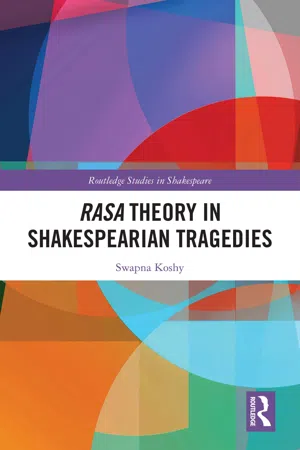
This book adds a unique eastern perspective to the ever growing corpus of Shakespeare criticism. The ancient Sanskrit theory of Rasa – the aesthete's emotional response to performing arts – is explicated in detail and applied to Shakespeare's tragic masterpieces. Bharata, who wrote about Rasa in the Natyasastra, developed detailed guidelines for the communication of emotion from author to actor and then to the audience culminating in a sublime aesthetic experience. Though chronologically Bharata is as ancient as Aristotle, thematically, his ideas are as relevant today as Aristotle's is and often echo those of the Greek master. This cross–cultural study on the communication of emotions in art establishes that emotions are universal and their communication follows similar patterns in all climes. The Rasa theory is today applied to modern media like film and has found a place among audience centric communication theories. This volume extends the East-West dialogue in aesthetic theory by identifying parallels and points of deviation and delights both aesthete and critic alike.
- 166 pages
- English
- ePUB (mobile friendly)
- Available on iOS & Android
eBook - ePub
Rasa Theory in Shakespearian Tragedies
About this book
Information
1 The Universality of Indian Aesthetic Theories
Indian aesthetic theory is an offshoot of the religious, philosophical, cultural and literary dynamism of the subcontinent. In primeval times, these were inseparably linked with and confined to an elitist class of Brahmin scholars who thought and wrote in the deva bhāṣa (language of the gods) – Sanskrit. The fate of Indian poetics thus came to be intricately connected with that of the Sanskrit language. When the language, for historical reasons, became more obscure and remote, poetic theories also grew more and more distanced from the mainstream.
Resurgence of the language was facilitated by the British who occupied India for close to four centuries. Aided by local educationists, they took momentous measures to educate the people not only in English but also in their own, obsolescent, Sanskrit language. Sanskrit colleges were started which helped to revive and promote the language giving it a pan-Indian status. The almost parallel popularisation of the English language introduced Indian scholars to the world of Western ideas. This provided them the opportunity to promulgate native theories on the international stage, paving the way for an active East–West dialogue. The growth of nationalism, accompanied by a spirit of self-assertion and glorification of the past, also had consequential results. Classical Indian aesthetic theory naturally received prime attention at this point of time and became an exciting area of discourse for scholars in the field. This interest continued in the post-independence period too, although marginalised considerably by the enthusiasm for Western ideas and parameters. Postulates in Indian theory were sought to be examined in relation to the insights in Western aesthetics; at the same time, critical endeavours for the interpretation of the literary text using Indian poetics also began to take shape. Today, Indian literary criticism sees abundant critical activity in both these directions.
The uniqueness of Indian aesthetics can be attributed to the richness of the milieu that nurtured it. Though stylised and rigid, probably due to its ethnocentric origin, Indian aesthetics on the whole offers a mature, comprehensive and universally applicable critical system. Contemporary studies in comparative aesthetics have revealed that there are close parallels between Indian and Western critical theories. For instance, the functional principles behind the theory of rasa and the postmodern ‘Reader Response’ theory bear close resemblances. Sādhāranīkaraṇaand ‘universalisation’ in art, dhvani and ‘suggestion’ in symbolist theory, vibhāvas, anubhāvas and ‘objective correlatives’ share common denominators. It is possible to identify many such critical tenets from the East and West that mirror each other. The acumen of the ṛṣis (sages) has been naturally marvelled at as their precepts often anticipate the ‘revolutionary’ thoughts of modern critics.
The Vedas are one of the earliest pieces of recorded literature that have come down to us. As these were considered sacrosanct, the lower castes were denied access to them and a fifth Veda was created for their enjoyment with elements taken from the other four – the text from the Ṛig Veda, songs from the Sāma Veda, acting from the Yajur and rasa from the Atharva Veda. This pañcama (fifth) Veda – Nāṭya (drama) Veda – is explicated in Bharata’s Nāṭyaśāstram which deals with the rules relating to theatrical performance or the science of the stage. The treatise is a guide to poet and playgoer alike.
The dictum rasālaṇkṛti vakṛokti dhvani aucitikrama sāhitya śāstra etasmin sampradāya iti smṛta sums up that the basic theories in Indian poetics are those of rasa (aesthetic emotion), alaṇkāra (embellishment), rīti (style), vakṛokti (indirect expression), dhvani (suggested meaning) and aucitya (propriety). Bharata gave supreme importance to rasa. His maxim – vibhāvānubhāva vyabhicārī samyogād rasa niṣpattiḥ – explains that rasa is a combination of vibhāva (determinants), anubhāva (consequents) and vyabhicāri (transitory states).
The literal meaning of ‘rasa’ is taste, relish, sentiment, aesthetic emotion, etc. The word has been in use from as early as 200 BC. The Vedas and Upaniṣads explain the term in different yet congruous ways. In drama, rasa signifies the aesthetic pleasure that the audience enjoys while witnessing the successful enactment of a play. It is thus the favourable response to art. The prominent rasas are nine in number, and they originate from their respective sthāyis or innate emotional states. Sthāyis are found in all men giving them the potential for rasa realisation. Rasa is in the Nāṭya only and is not a part of worldly experience. Only the sahṛdaya or rasika – a man of inborn or trained sensibility – can realise rasa. Bharata maintains that the soul of poetry lies in the rasa that it embodies. It applies equally to the text and the performance of drama. For the sahṛdaya, rasa is the realisation of brahmānanda sahodarānandam. Brahmānanda is the bliss of Brahma the creator or the joy of being one with god. It is the bliss which ensues when one negates worldly pleasures and becomes one with supreme joy. The bliss derived from rasa is akin to that. The nine sthāyi bhāvas or inherent moods in every sahṛdaya are translated into the corresponding rasa or aesthetic emotion at the perception of the drama. These are described in detail in the next chapter.
The rasa theory was popularised by the dhvani theorists who linked it to the principle of dhvani. The dhvani theory was first stated by Ānandavardhana in the ninth century in the Sanskrit treatise Dhvanyāloka. Generations of poets and critics who contributed to the theory of rasa lived between Bharata and Ānandavardhana, but they failed to creatively and dynamically modify the tenets laid down by the muni. Ānandavardhana gives us extensive examples of practical criticism in the form of literary analysis. His principle of dhvani states that if there is more suggestion (vyañjanā) than statement (vācya) in a literary piece, it contains dhvani. The quality of creative writing increases in direct proportion to the dhvani involved. Dhvani is what one overhears in good poetry; the meanings that echo after a statement has been made. The term was borrowed from the grammarians who believed that sound in its real or eternal form – sphoṭa – cannot be expressed but is always suggested. Sphoṭa is suggested by the last letter in a word but as conditioned by a sequential mental impression of the earlier ones. It is the bursting forth or sphoṭa of meaning after speech. Ānandavardhana, an advocate of rasa, was also the greatest exponent of dhvani. He concluded that rasa was expressed only through dhvani. His commentator Abhinavagupta (tenth century) lays down that dhvani can be employed in the whole work or in just the meaning or only in a word. He mentions dhvanatīti dhvani or that which suggests including both word and meaning; dhvanyata iti dhvani or that which is suggested, only meaning comes in this category; dhvananam dhvani or the very process of suggestion and dhvani samudaya dhyāna kāvyam or the whole work of literature formed out of these elements of dhvani. Pada or word, vākya or sentence, prabandha or the whole work can serve as ‘suggesters’. Feeling cannot be expressed directly but has to be indirectly expressed to evoke the desired reaction. Literal expression found in prose is not enough for poetry. The beauty of poetry does not lie in the obvious meaning but in pratīyamānārtha – the flash that follows direct mention of a word. This system of thought dominated Indian poetics from the ninth to the eleventh century.
Another major concept of Indian aesthetics that is linked to rasa is alaṇkāra. The literal meaning of alaṇkāra being embellishment, it can be equated with the Western ‘metaphor’. Alaṇkāras are like beautiful jewels on a pretty woman; they enhance the beauty of a literary piece. They also help to draw a line of demarcation between prose and poetry. Alaṇkāras must be appropriate to the meaning and situation and must blend well with the context. It is in this connection that Bharata says that they must be spontaneous like pleasant emotional reactions and should not be an addition like bracelets or armlets. Alaṇkāra must be rasabhāvapara; that is, they must aid the realisation of rasa and bhāva. Bhāmaha in his Kāvyālaṇkāra (seventh century) accepts two kinds of alaṇkāra – śabdālaṇkāra and arthālaṇkāra – which arise from the word and the meaning, respectively. While Bharata mentions only 4 alaṇkāras, Bhāmaha presents 30; Daṇḍin, 37; Udbhaṭa, 41; Bhojarāja, 72; Viśvanātha, 78; and Appayya Dīkṣitar, 125.
The poetic theory of vakṛokti (indirect expression) deals with syntax. Kuntaka, the eleventh-century Kashmiri rhetorician, a contemporary of Abhinavagupta, is the main proponent of this theory. In Vakṛoktijīvitam, he explains vakṛokti as the elliptical way of presentation. It is a comprehensive term that signifies the basic obliquity and figurativeness of poetic expression. Ukti (utterance) which is vakra (deviant) constitutes vāk (word). Vakṛokti can be achieved through changes made in the incidents and construction of the plot. It is close to what modern stylistics conceive of the language of poetry as ‘deviation from the norm’. Yet the spirit behind vakṛokti is to increase rasa by a skilful arrangement of the parts of a work. Vakṛokti through its suppressed expression gives the reader the imaginative freedom which makes a work more interesting. It has been criticised that vakṛokti is but dhvani under a different name.
Another poetic theory – rīti – stands for the different styles of writing each of which portrays a divergent emotion. It is viśiṣṭapadaracana or a special arrangement of words. Vāmana believed that rīti was the soul of poetry – rītirātma kāvyasya. A pleasant and easy flow of consonants, sweet as the lisping of children, is called the Vaidarbhī rīti. It does not have compound words and it can be found in the presentation of all rasas. The Gauḍi is a bolder form containing long compounds and aspirated consonants and is associated with raudra (anger), vīra (heroic), bhayānaka (terrific) and bībhatsa (odious) rasas. It causes vistāra or expansion of the mind. The Pāñcālī, which stands midway between the two, consists mainly of liquid sounds. It causes druti or melting of the heart and is associated with śṛṅgāra (erotic), karuṇa (pathos) and śānta (serenity). The names correspond with different geographical localities where these forms were practised.
The poetic theory of Guṇa is about quality or fixed excellences of composition like mādhurya (sweetness), ojas (vitality), kānti (lustre), saukumārya (tenderness), śleṣa (well joined), prasāda (clarity), samata (smooth), samādhi (concentration), artha-vyakti (direct expression) and udāra (exalted) employed in evolving the desired rīti. Vāmana classifies the guṇas as śabda (word) and artha (meaning) almost multiplying their number. Ānandavardhana, and Mammaṭa after him, reduced the number to three including only mādhurya, ojas and prasāda. Abhinavagupta and other scholars did not consider the rīti system as divorced from guṇa and alaṇkāra. The theory suffered a setback as there was no champion like Vāmana after him to promote it. The dhvani school was interested in it only as far as it promoted rasadhvani. The rīti theory is important because it is the style that makes statements poetic.
The theory of aucitya refers to the application of all the concepts mentioned, the breach of which causes anaucitya (lack of propriety). It is a creative principle that allows the dramatist to achieve the required rasa and denotes the sense of discrimination that must be exhibited in any work. The extent of rasa in a work can be gauged by assessing the propriety in each part. Later, this theory was extended to include the harmony or integrity of all the constituents of a poetic piece. Aucitya formulates a practical way to measure rasa which had the stigma of a subjective theory. Kṣemendra in his Aucityavicāracarca (discussions of aucitya) comments that aucitya is the life of rasa. The test of aucitya, its proof, is the suggestion of rasa. Kṣemendra discusses in detail the propriety of each sentiment and the rightness in combining various sentiments. The earliest mention of this tenet is in Daṇḍin though he does not call it aucitya.
One cannot classify these components of Indian aesthetics into watertight compartments. They are interrelated and complementary in nature. But rasa seems to be the most comprehensive, and dhvani has its own importance being the factor that leads the sahṛdaya to rasānubhava (experience of rasa).
The theory of rasa is unique in that it is a combination of many precepts all of which work together to enhance the rasa of a literary text. Rasa is the response of the reader/spectator and is therefore reflective and subjective in nature which makes the theory flexible and adaptable. It is found in every genre of literature but it is best applied in the medium of drama where the theoretical tenets have direct application. It has close resemblance to the school of Reader Response in modern literary theory which has, in a revolutionary way, shifted the centre of literary criticism from the author/critic to the reader for whom primarily the work of art is created. Rasa is thus modern and ancient, local and universal, applicable to any period of time and clime. It has a sound theoretical framework that gives it the correctness and precision of a scientific formulation. However, rasa is not just the response of the reader. It contains guidelines necessary for successful authorship and aids the critic in evaluating a work.
In ancient times, assessing the success/merit of a work was the sahṛdaya’s (cultured reader) responsibility and there was no dedicated class of critics. Thus, there is very little practical criticism in Indian poetic theory. Questions have been repeatedly raised as to why Indian poetics has not yet generated a considerable corpus of practical criticism. The theory has grown into a rich, complex system of intricate formulations and abstract speculations, but the underlying principles and insights of the theory have not given rise to an adequate body of applied criticism. The question of the feasibility or desirability of a practical application of the theory, therefore, should be a matter for detailed co...
Table of contents
- Cover
- Half Title
- Series Page
- Title Page
- Copyright Page
- Dedication
- Table of Contents
- Preface
- 1 The Universality of Indian Aesthetic Theories
- 2 The Concept of Rasa
- 3 Hamlet: Jugupsa Intensifying Karuṇa
- 4 Othello: Uttamaprakṛti Transformed by Śanka to Adhamaprakṛti
- 5 King Lear: Redeemed From Raudra to Śānta
- 6 Macbeth: Bhaya Unfolding Karuṇa
- 7 Conclusion
- Bibliography
- Index
Trusted by 375,005 students
Access to over 1.5 million titles for a fair monthly price.
Study more efficiently using our study tools.
Frequently asked questions
Yes, you can cancel anytime from the Subscription tab in your account settings on the Perlego website. Your subscription will stay active until the end of your current billing period. Learn how to cancel your subscription
No, books cannot be downloaded as external files, such as PDFs, for use outside of Perlego. However, you can download books within the Perlego app for offline reading on mobile or tablet. Learn how to download books offline
We are an online textbook subscription service, where you can get access to an entire online library for less than the price of a single book per month. With over 1.5 million books across 990+ topics, we’ve got you covered! Learn about our mission
Look out for the read-aloud symbol on your next book to see if you can listen to it. The read-aloud tool reads text aloud for you, highlighting the text as it is being read. You can pause it, speed it up and slow it down. Learn more about Read Aloud
Yes! You can use the Perlego app on both iOS and Android devices to read anytime, anywhere — even offline. Perfect for commutes or when you’re on the go.
Please note we cannot support devices running on iOS 13 and Android 7 or earlier. Learn more about using the app
Please note we cannot support devices running on iOS 13 and Android 7 or earlier. Learn more about using the app
Yes, you can access Rasa Theory in Shakespearian Tragedies by Swapna Koshy in PDF and/or ePUB format, as well as other popular books in Literature & Shakespeare Drama. We have over 1.5 million books available in our catalogue for you to explore.