The Material Subject
eBook - ePub

The Material Subject

Rethinking Bodies and Objects in Motion

  1. 224 pages
  2. English
  3. ePUB (mobile friendly)
  4. Available on iOS & Android
eBook - ePub

The Material Subject

Rethinking Bodies and Objects in Motion

About this book

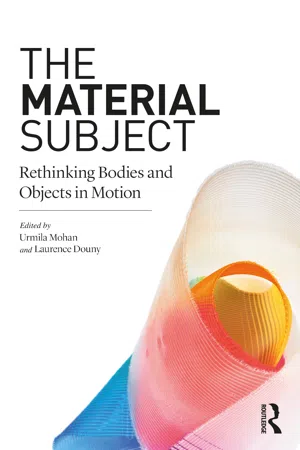
The Material Subject emphasises how bodily and material cultures combine to make and transform subjects dynamically. The book is based on the French Matière à Penser (MaP) school of thought, which draws upon the ideas of Mauss, Schilder, Foucault and Bourdieu, among others, to enhance the anthropological study of embodiment, practices, techniques, materiality and power.

Through theoretical sophistication and empirical field research, case studies from Europe, Africa and Asia bring MaP's ideas into dialogue with other strands of material culture studies in the English-speaking world. These studies mediate different scales of engagement through a sensori-motor, affective and cognitive focus on practices of making and doing. Examples range from the precarity of professional divers in French public works to the gendered subjectivity of female carpet weavers in Morocco, from the ways Swiss watchmakers transmit craft knowledge to how Hindu devotees in India make efficacious use of altars, and from the enskilment of Paiwan indigenous people in Taiwan to the prestige of women's wild silk wrappers in Burkina Faso. The chapters are organised according to domains of practice, defined as 'matter of' work and technology, heritage, politics, religion and knowledge.

Scholars and students with an interest in material culture will gain valuable access to global research, rooted in a specific intellectual tradition.

Frequently asked questions

Yes, you can cancel anytime from the Subscription tab in your account settings on the Perlego website. Your subscription will stay active until the end of your current billing period. Learn how to cancel your subscription.
No, books cannot be downloaded as external files, such as PDFs, for use outside of Perlego. However, you can download books within the Perlego app for offline reading on mobile or tablet. Learn more here.
Perlego offers two plans: Essential and Complete
  • Essential is ideal for learners and professionals who enjoy exploring a wide range of subjects. Access the Essential Library with 800,000+ trusted titles and best-sellers across business, personal growth, and the humanities. Includes unlimited reading time and Standard Read Aloud voice.
  • Complete: Perfect for advanced learners and researchers needing full, unrestricted access. Unlock 1.4M+ books across hundreds of subjects, including academic and specialized titles. The Complete Plan also includes advanced features like Premium Read Aloud and Research Assistant.
Both plans are available with monthly, semester, or annual billing cycles.
We are an online textbook subscription service, where you can get access to an entire online library for less than the price of a single book per month. With over 1 million books across 1000+ topics, we’ve got you covered! Learn more here.
Look out for the read-aloud symbol on your next book to see if you can listen to it. The read-aloud tool reads text aloud for you, highlighting the text as it is being read. You can pause it, speed it up and slow it down. Learn more here.
Yes! You can use the Perlego app on both iOS or Android devices to read anytime, anywhere — even offline. Perfect for commutes or when you’re on the go.
Please note we cannot support devices running on iOS 13 and Android 7 or earlier. Learn more about using the app.
Yes, you can access The Material Subject by Urmila Mohan, Laurence Douny, Urmila Mohan,Laurence Douny in PDF and/or ePUB format, as well as other popular books in Social Sciences & Anthropology. We have over one million books available in our catalogue for you to explore.

Information

Index

Italicized pages refer to figures and page numbers followed by “n” refer to notes.
absorption/absorb 87, 88, 113, 143, 147; see also appropriation
academic knowledge: practical vs. 169, 180; vocational vs. 170172
actions: action of matter 51, 52, 56; actions-on-objects 77, 84; bodies-in-action 83; bodily actions 4849, 98; catalogue of actions 35; continuous 12; daily 17; doing action 17; dynamics 171; efficacious xix, 3, 22, 111, 152; embodied 8283, 108; human 21, 153; interaction 6, 8, 15, 17, 19, 22, 39, 83, 137, 170, 172, 174, 178, 180; logics 179; of making do 3940; materiality of 70; on materials 90; moral 148; motor 17; network of 20, 34, 37, 42, 43, 6263, 6772, 83; networks on others actions 4243, 67, 6869; objects-in-actions 6, 34, 77, 82, 84; performed actions 36; power of 95, 98, 100, 101, 102; as practice 95; reciprocal 13, 21, 50, 98, 102, 142, 146; science of 17; sequence 8; social 95; socialised 71; on the subjects 99; technical actions 50, 57; traditional 152; upon action 6263, 67, 85; upon materials 21; value 153; see also Mauss
actor 172; human vs. non-human 11; pace Lemonnier vs. Latour 10
Actor Network Theory 11
adaptability 3940
ad interim workers 35, 38, 39, 43
adolescence 61, 70
adults 1, 62, 68, 109; grown-ups 200
aesthetics: bathing 157158; built surfaces in Paiwan 192; deity images and 153; female beauty in Iran 116; of gestures 53; Hindu devotion 154, 155, 160; Marka-Dafing image 96; of Musée du Quai Branly 8889; of Paiwan 194; pattern-making 160162; perception of 204205; of priyayi 126; of shifu 190; sheen as value 98; as taste 54; of weaving 194, 206; of workers’ art 57; see also agency; art
Africa 18; Burkina-Faso 20, 93; Cameroon 13, 15, 2021, 108110, 113, 117; Morocco 21, 49, 137; territorialisation in 109114
African artefacts 81
African undocumented strikers 8...

Table of contents

  1. Cover
  2. Affective Architectures
  3. Title
  4. Copyright
  5. Dedication
  6. Contents
  7. List of figures
  8. Notes on contributors
  9. Acknowledgements
  10. Foreword by Jean-Pierre Warnier
  11. Introduction
  12. Matter of work and technology
  13. Matter of heritage
  14. Matter of politics
  15. Matter of religion
  16. Matter of knowledge
  17. Index