Biopolymers represent a carbon emission solution: they are green and eco-friendly with a variety of uses in biomedical engineering, the automotive industry, the packaging and paper industries, and for the development of new building materials. This book describes the various raw materials of biopolymers and their chemical and physical properties, the polymerization process, and the chemical structure and properties of biopolymers. Furthermore, this book identifies the drawbacks of biopolymers and how to overcome them through modification methods to enhance the compatibility, flexibility, physicochemical properties, thermal stability, impact response, and rigidity.
eBook - ePub
Industrial Applications of Biopolymers and their Environmental Impact
- 306 pages
- English
- ePUB (mobile friendly)
- Available on iOS & Android
eBook - ePub
Industrial Applications of Biopolymers and their Environmental Impact
About this book
Information
Chapter 1
Modification of Polylactic Acid (PLA) and its Industrial Applications
1 Corporate Material Development, Adler Pelzer Group, Hagen, Germany
2 Plastic Engineering, University of Kassel, Germany
* Corresponding author: Email: [email protected]
1.1 INTRODUCTION
Since industrialization, the demand for fossil fuels, such as oil, natural gas, and coal have increased. This increased prices and greenhouse gases in the atmosphere. One of the most important tasks of climate protection is to reduce CO2 emissions. Existing and future technologies could reduce CO2 emissions through new sources and efficient use of energy. This could at least stabilize the climate and slow down the pace of climate change. Renewable resources are effective and interesting alternatives to fossil fuels and resulting products. Energy forms, processes, and services enhance the value-added potential of agriculture and industry. The development of new plastics, especially biodegradable biopolymers, may be the only solution to environmental damage caused by non-degradable plastics. With bio-based polymers new functionalities are achieved. These include biodegradability, compostability, and carbon footprint. The use of bioplastics can create a natural cycle (see Fig. 1.1), in which plastics produced from renewable raw materials can later be recycled or returned to nature.
![Figure 1.1 Life cycle of biodegradable plastics [1].](https://book-extracts.perlego.com/1900064/images/fig1_1-plgo-compressed.webp)
Figure 1.1 Life cycle of biodegradable plastics [1].
This creates a natural balance. The degradability of bio-plastics saves the big costs of waste disposal. Figure 1.1 shows that the associated reduction in CO2 emissions can also contribute to climate protection [1, 2].
From the beginning of the plastics age, additives have been used primarily to improve or extend polymer properties or to make the plastics more resistant to heat treatment during the forming process. The extension of the properties of the polymer by additives has played a significant role in the growth of plastics. Another reason for using the new additives is the increasing awareness of environmental protection to use more biopolymers [3].
PLA can crystallize in various forms as α-, β-, γ-, and sc (stereo-complex). It has been found experimentally that the stereo-complex structure between PLLA and PDLA shows a significant improvement in thermal stability and mechanical properties [4]. For this purpose, various mixtures of different PLLAs and PDLA were prepared and investigated in order to produce a complete stereo-complex structure by optimizing the parameters in a twin-screw extruder. The different batches of stereo-complex mixers were then further processed in a hot press machine to produce square plates with a thickness of 4 mm. Test specimens were obtained from these plates. Subsequently, the specimens were examined in various thermal and morphological experiments. By morphological examination, the crystal structure and the crystallization were evaluated in the stereo-complex.
Furthermore, PLA properties were to improve the properties of PLA by using the impact modifier. Various mixtures of the PLA granules were mixed manually with different additives and then compounded in a twin-screw extruder. The test sample was produced by injection molding. Subsequently, the prepared specimens were examined for various mechanical and thermal properties.
1.1.1 Fundamental of Biopolymers
Today’s conventional polymers are produced from petrochemicals. Due to limited oil resources, conventional polymers should gradually be replaced by biopolymers based on renewable sources. The term biopolymer often leads to misunderstandings. The best general definition of biopolymers today is: a polymer material consisting of bio-based (natural renewable) raw materials or/and biodegradable [5, 6]. Principally, there are three following biopolymer groups:
- Degradable biopolymers based on petrochemicals
- Degradable biopolymers based on renewable resources
- Non-degradable biopolymers based on renewable resources
That means biodegradable plastics on both petrochemical raw materials as well as renewable resources, as shown in Fig. 1.2. However, not all polymers that are based on renewable raw materials are biodegradable [6], which means that parts of the biopolymers are not biodegradable. It should be noted that there are different degradation mechanisms for degradable biopolymers, such as the different terms of degradability and compostability, which are already more suggestive. Biodegradability has no dependence on the raw materials used, but depends solely on the chemical structure and molecular structures. It is independent of the origin of the monomers. Figure 1.3 shows a connection between biodegradable biopolymers from fossil and renewable raw materials [7].
![Figure 1.2 Three fundamentally different biopolymer groups [6].](https://book-extracts.perlego.com/1900064/images/fig1_2-plgo-compressed.webp)
Figure 1.2 Three fundamentally different biopolymer groups [6].
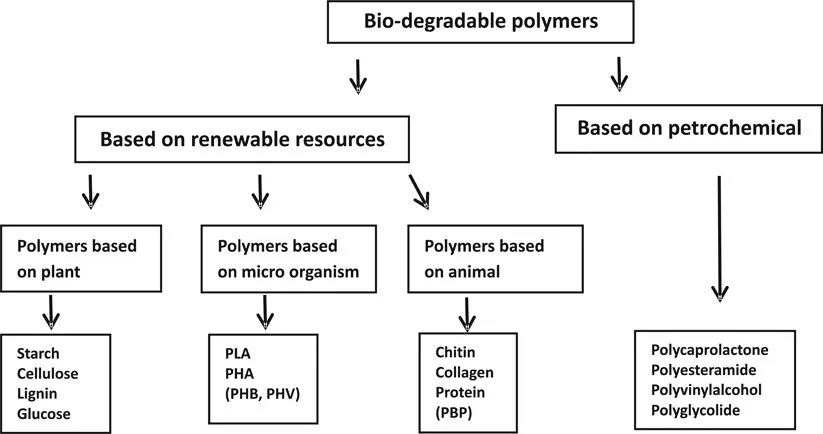
Figure 1.3 Classification of biodegradable polymers.
Biopolymers based on different raw materials are shown in Fig. 1.2. Polymers that are based on renewable raw materials are not all biodegradable [5], which means all biopolymers are not biodegradable. It should be noted that there are different degradation mechanisms for degradable biopolymers, such as the different terms of degradability and compostability. Biodegradability has no dependence on the raw materials used, but depends solely on the chemical structure and molecular structures. It is independent of the origin of the monomers. Figure 1.3 shows a connection between biodegradable biopolymers from fossil and renewable raw materials [6].
As renewable raw materials for biopolymers, cellulose, starch, sugar, vegetable oils and their derivatives, and in some cases lignins and proteins, can also be used as material components [6, 7].
Biodegradable plastics are most used in the packaging and catering sector. In addition, they are also used in agriculture, horticulture, medical sector, and in pharmaceuticals. The broadly introduced products are garbage bags, shopping bags, disposable tableware (cups, plates, cutlery), packaging films, bottles, fruit and vegetable trays, packaging aids, expandable foams, protection films, flowerpots, etc. [8].
The potential demand of the biopolymer is expanding day by day. The total biopolymer consumption in Western Europe is about 50 million tons per year [9]. Among them, about 42 million tons of this demand (85%) could be biopolymers. The production of bioplastics is expected to increase from approximately 890,000 tons in 2013 to over 2.22 million tons in 2020 [9].
1.2 POLYLACTIC ACID
Polylactide (PLA or polylactic acid) or polylactic acid is biodegradable, bioresorbable, and thermoplastic linear aliphatic polyester that can be produced from renewable resources. PLA is made from renewable and degradable resources, such as corn and rice, which can be good alternatives in the energy crisis and at the same time, it will reduce dependence on fossil fuels. Figure 1.4 discusses the cycle of PLA in nature.
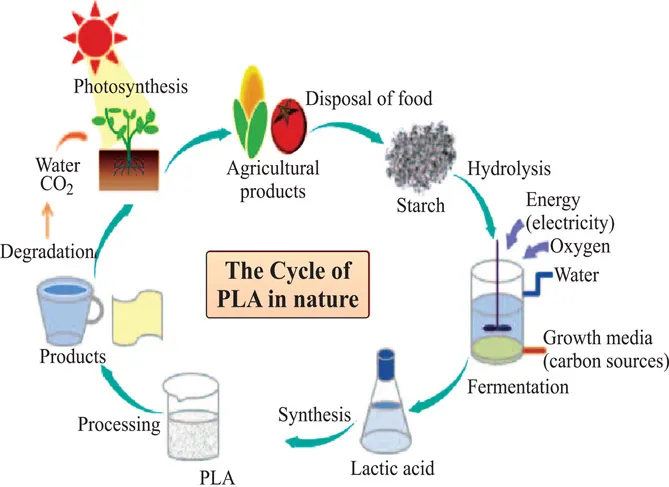
Figure 1.4 The cycle of PLA in nature.
PLA is neither toxic nor carcinogenic to the human body. Therefore, it is an excellent material for biomedical applications [10]. PLA is not only compostable and biocompatible, but can also be processed by most standard processes, such as film casting, extrusion, and blow molding or fiber manufacturing process. Due to the greater thermal processability compared with other biomaterials, the use of PLA as an environmentally friendly biomaterial with excellent properties in industrial areas, such as textiles and food packaging, might be beneficial [10, 5].
Lactic Acid (lactic acid) or 2-hydroxypropionic acid is an ubiquitary, natural, organic acid found in the two optically active forms of L (+) and D (–) lactic acid. Lact...
Table of contents
- Cover
- Title Page
- Copyright Page
- Preface
- Contents
- 1. Modification of Polylactic Acid (PLA) and its Industrial Applications
- 2. Grain Waste Product as Potential Bio-fiber Resources
- 3. Bio-based Polyamides
- 4. PHB Production, Properties, and Applications
- 5. Polyvinyl Alcohol and Polyvinyl Acetate
- 6. Starch and Starch-based Polymers
- 7. Chemistry of Cellulose
- 8. Chitin and Chitosan and Their Polymers
- 9. Carrageenan: A Novel and Future Biopolymer
- 10. Natural Rubber and Bio-based Thermoplastic Elastomer
- 11. A Life Cycle Assessment of Protein-based Bioplastics for Food Packaging Applications
- 12. Bio-polyurethane and Others
- 13. Keratin-based Bioplastic from Chicken Feathers: Synthesis, Properties, and Applications
- Index
Trusted by 375,005 students
Access to over 1.5 million titles for a fair monthly price.
Study more efficiently using our study tools.
Frequently asked questions
Yes, you can cancel anytime from the Subscription tab in your account settings on the Perlego website. Your subscription will stay active until the end of your current billing period. Learn how to cancel your subscription
No, books cannot be downloaded as external files, such as PDFs, for use outside of Perlego. However, you can download books within the Perlego app for offline reading on mobile or tablet. Learn how to download books offline
Perlego offers two plans: Essential and Complete
- Essential is ideal for learners and professionals who enjoy exploring a wide range of subjects. Access the Essential Library with 800,000+ trusted titles and best-sellers across business, personal growth, and the humanities. Includes unlimited reading time and Standard Read Aloud voice.
- Complete: Perfect for advanced learners and researchers needing full, unrestricted access. Unlock 1.5M+ books across hundreds of subjects, including academic and specialized titles. The Complete Plan also includes advanced features like Premium Read Aloud and Research Assistant.
We are an online textbook subscription service, where you can get access to an entire online library for less than the price of a single book per month. With over 1.5 million books across 990+ topics, we’ve got you covered! Learn about our mission
Look out for the read-aloud symbol on your next book to see if you can listen to it. The read-aloud tool reads text aloud for you, highlighting the text as it is being read. You can pause it, speed it up and slow it down. Learn more about Read Aloud
Yes! You can use the Perlego app on both iOS and Android devices to read anytime, anywhere — even offline. Perfect for commutes or when you’re on the go.
Please note we cannot support devices running on iOS 13 and Android 7 or earlier. Learn more about using the app
Please note we cannot support devices running on iOS 13 and Android 7 or earlier. Learn more about using the app
Yes, you can access Industrial Applications of Biopolymers and their Environmental Impact by Abdullah Al Mamun, Jonathan Y. Chen, Abdullah Al Mamun,Jonathan Y. Chen in PDF and/or ePUB format, as well as other popular books in Technology & Engineering & Biology. We have over 1.5 million books available in our catalogue for you to explore.