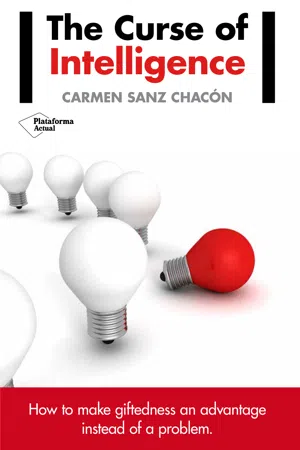
This is the first book to address the problems faced by this cohort written in simple language and containing completely new ideas.The author, a clinical psychologist specialising in the extremely gifted, explains in this book why being intelligent is a curse for many children and adults. Being extremely intelligent can lead to rejection by those around you, affecting self-esteem, motivation and social development, with possible life-long traumas creating depression or aggression. Using simple, direct language, this book will help parents, teachers, counsellors, psychologists, psychiatrists, neurologists and highly-gifted individuals themselves to fully understand their needs and improve the attention they currently recieve.
eBook - ePub
The curse of intelligence
How to make giftedness an advantage instead of a problem
- 204 pages
- English
- ePUB (mobile friendly)
- Available on iOS & Android
eBook - ePub
The curse of intelligence
How to make giftedness an advantage instead of a problem
About this book
Information
Topic
EducationSubtopic
Inclusive Education1. Them
Juan
Juan is exceptionally bright. He’s much more intelligent than most people. In fact, he’s in the top 1% of highly intelligent people in the country.
Juan has a great sense of humour and is able to find the funny side of nearly everything and even might say something cheeky while his boss is making a serious speech. Fortunately, he refrains, and keeps quiet, this time. This is his third job in the last ten years and he can’t afford to mess this one up.
Juan is also extremely absent-minded. He says that he’s the only person who is able to bump into the same glass door three times in a row while his astonished workmates look on. In the last meeting he had, he heard a resounding chorus of “THE DOOR!” thirty seconds before hitting it. He turned around and said, “I know, I know…” with a smile on his face.
You can often see him with a different colour sock on each foot, or with his sweater on back to front. It’s no big deal, it’s not important. When he was getting dressed his mind was elsewhere. Like when he’s reading a book that he likes or working on something that fascinates him on his computer. You could be standing right next to him telling him you’re going to give him a couple of million euros and he’ll just say, “Great” without every hearing you at all. Then come the problems, “I told you that yesterday and you said it was ok.”
His absent-mindedness and lack of attention started long ago. Even as a kid he left his backpack at school or his books at home and was always getting in trouble with his teachers. When the teacher spoke to him in class, he was staring at a stain on the ceiling, or at the clouds, or daydreaming about faraway places. He’s had more than one clipping of his ears and been told to leave the classroom due to his daydreaming. Even so, he thought that was better than having to listen carefully to the teacher and then give sensible answers to the questions. So he became the black sheep and gained the animosity of the teachers. It was better to keep his mouth shut and to mind his own business.
Then, in secondary school, he began to have serious problems due to never paying attention, for not doing school work which he’d been assigned and for missing classes with imaginative excuses. In spite of everything, he got decent grades by flicking through the book the day before the exam. And, this way, stayed out of trouble at home.
His last years in secondary school were really tough since he didn’t have good study habits and he simply wasn’t interested in what the subjects. He just wanted to be left alone, to find things out and learn on his own. He didn’t want to submit to school discipline and he didn’t believe in anything they told him. He’d decided not to argue but to keep everything to himself and do whatever he felt like. At the end of the school year the bad results were inevitable. Things got nasty both at home and at school.
He was taken to a psychologist who wrongly diagnosed ADHD and suggested medicating him. He wouldn’t take the pills or continue studying, giving up his idea of going on to university. He began to do odd jobs so he could leave home and live however he wanted to. Nobody understood him.
Julián
Julián showed up on a bleak day in February. When he entered the office his physical appearance was well-defined by the light: a tall, rather obese man of around forty. He dressed casually in jeans and a t-shirt which didn’t look good on him because he was so overweight.
He avoided eye contact, constantly looking from side to side, never at the face. When he spoke he put his hand in front of his mouth involuntarily. These are the gestures of someone who wishes to protect himself.
He told me that he feels awful and thinks he is suffering depression. He’s fed up with being a “weirdo”. At university his girlfriend told him this when she broke up with him before they’d even had any real relationship. He was in love with her. He’s never managed to approach another woman.
He keeps telling me all about his life. He’s a graduate, has a good job in a big company, earns a decent salary but lives with his mum and hasn’t got a driving licence. He can’t seem to pass the test although he’s tried many times. His nerves let him down.
The same thing happens when he’s near a woman that he likes. He starts to tremble, gets cold sweats and palpitations and is unable to say a word. He runs away.
He comes from a middle-class family and has had a strict and rather puritanical education. He gets on very well with his family, especially his siblings. In a way this saves him from feeling completely isolated as he has no friends.
He did have friends when he was a student but little by little they’d gone on to build their own lives and start families. He hasn’t been able to. He avoids parties and meeting new people. He doesn’t feel relaxed around others. He prefers to be alone, although that doesn’t make him happy either.
Things got worse when his dad died, who had been his main suport. When he died, Julián broke down. There are areas of his life he cannot speak about. These are no-go areas and he only refers to them when absolutely necessary (always in passing).
He starts to feel more confident and talks about his childhood. He was a chubby boy and wore glasses. They made fun of him at school and mistreated him both physically and mentally, almost every day.
He’d never told anyone about this; in fact, after two years work on his memories he’d only spoken about this with a brother.
At some time in his life they had given him an IQ Test and told him that he was exceptionally gifted. But he didn’t understand why he couldn’t be like everybody else.
He only wants to have a laugh, joke, go out with women, get married, have kids and a family to love. To be normal. He’s fed up with everyone telling him that he’s “strange” and not finding anyone who can understand him. He feels really miserable.
Alberto
Alberto is 23 years old. He’s tall and has a slim build although he’s a little overweight. He hasn’t cut his hair for many months and he’s shabbily dressed. He usually wears a tracksuit and short sleeve t-shirt all year long.
His mum is desperate because she just doesn’t know what to do with him. He started two degree courses and then dropped out of both. He’s stopped going to university, sleeps till midday and just spends his days glued to his computer screen.
He doesn’t practise any sport, doesn’t go out with friends and speaks to no one (not even to his mum or his sister).
When they start bothering him, he agrees to whatever they say but then doesn’t carry out any of his promises and lies to cover this up.
When I try to speak with him his face goes blank. I ask him about his life, about how he sees things and I ask him what his goals in life are but all I get out of him are one or two word answers. Never a real conversation.
Alberto is undergoing treatment for depression. He has no friends and has never had a girlfriend and feels extremely unhappy. He spends hours on the computer, but he hardly ever connects to social networks. He entertains himself playing online videogames with strangers.
He doesn’t go to university as he feels bad and he also doesn’t know anybody well even though he’s been studying the same degree course for nearly two years.
He hasn’t got a clue what to do with his life or his future (not even in the short-term). He simply feels depressed and annoyed that his mum won’t leave him in peace.
Miguel
Miguel is 8 years old. He’s a fair-haired boy, with blue eyes and a very sweet face. He’s a nice boy and fun to be around.
He’s come to see me because at school he feels sad and doesn’t play with the other kids in the playground. His teacher believes he could have sociability problems.
She says that there’s nothing wrong with him, that everything’s ok.
He tries to make friends but he doesn’t manage to and doesn’t understand why.
Some of the kids called him “stupid” but he prefers to keep his mouth shut than respond.
His mum is worried because every day he appears to be more depressed and doesn’t want to go to school.
Luis
Luis is a very strong, active child who has both a daring and mistrustful look in his eyes. He’s 9 years old and has already been to three different schools.
His mum tells me that they’ve always had problems with both the teachers and the other kids, and that Luis is a very good boy but that things happen to him.
Luis starts to tell me an anecdote; a girl has tried to jump the queue at the school canteen and that’s not right. “I told her but she wouldn’t listen. I told her again and she shouted at me and told me to leave her alone. I grabbed hold of her arm, she pushed me and then I kicked her. Then the others all ganged up on me and insulted me.” He continues, “If I tell the teacher, either he doesn’t listen to me or punishes me. It’s unfair.”
“No one listens to me. I’m fed up …”
Alejandra
Alejandra is 10 years old. She’s a strong, quick-witted girl. She’s had loads of problems on the playground. She wins respect by fighting, if necessary.
Her parents have brought her to me because she has started to feel demotivated, she doesn’t study and doesn’t want to go back to class. She has severe anxiety symptoms, cannot sleep, doesn’t eat properly and cries a lot.
In the school canteen she is bullied; they hide her plate and her napkin.The last time this happened she got angry and poured a jug full of water over an other girl’s head.
The teachers are very concerned about her aggresive behaviour.
Nobody seems to understand her.
Lucía
Lucía is six and she’s always been exceptionally well-behaved. As the first-born and only child, her parents never found this odd. Ever since she was very young they enjoyed conversations with her and they loved to answer her unusual and imaginative questions. Her way of thinking surprised them.
However, from her fourth birthday onwards she has begun to feel she is different and that she doesn’t want to live any more. She feels that life is boring and doesn’t understand why we have to be born. She says she doesn’t wish to be a person and would prefer to be invisible so she could see what other people do.
She appears to be very sociable but her attitude undergoes a radical change the moment she says goodbye to her friends and is alone with her mum. She turns serious and starts to criticise their attitudes. She can’t handle that they are all happier than her and they can do whatever they want and she can’t. And at that point she breaks down and cries and shouts out loud asking why she had to be born.
Her parents are worried about her aggresivity and her continual sense of frustration. They’ve taken her to both a psychiatrist and a psychologist recommended by her paediatrician, but they weren’t able to help her. The psychologist pointed out that perhaps she was an except...
Table of contents
- Cover
- Title Page
- Copyright Page
- Dedication
- Acknowledgments
- Index
- Introduction
- 1. Them
- 2. Personality traits of exceptionally bright kids
- 3. Emotional dyssynchrony or bullying
- 4. The gifted at school
- 5. Mistaken diagnoses of the gifted
- 6. Gifted girls
- 7. Gifted adults
- 8. Intelligence and the gifted
- 9. Intelligence and happiness
- Bibliography
- Colophon
Trusted by 375,005 students
Access to over 1.5 million titles for a fair monthly price.
Study more efficiently using our study tools.
Frequently asked questions
Yes, you can cancel anytime from the Subscription tab in your account settings on the Perlego website. Your subscription will stay active until the end of your current billing period. Learn how to cancel your subscription
No, books cannot be downloaded as external files, such as PDFs, for use outside of Perlego. However, you can download books within the Perlego app for offline reading on mobile or tablet. Learn how to download books offline
Perlego offers two plans: Essential and Complete
- Essential is ideal for learners and professionals who enjoy exploring a wide range of subjects. Access the Essential Library with 800,000+ trusted titles and best-sellers across business, personal growth, and the humanities. Includes unlimited reading time and Standard Read Aloud voice.
- Complete: Perfect for advanced learners and researchers needing full, unrestricted access. Unlock 1.5M+ books across hundreds of subjects, including academic and specialized titles. The Complete Plan also includes advanced features like Premium Read Aloud and Research Assistant.
We are an online textbook subscription service, where you can get access to an entire online library for less than the price of a single book per month. With over 1.5 million books across 990+ topics, we’ve got you covered! Learn about our mission
Look out for the read-aloud symbol on your next book to see if you can listen to it. The read-aloud tool reads text aloud for you, highlighting the text as it is being read. You can pause it, speed it up and slow it down. Learn more about Read Aloud
Yes! You can use the Perlego app on both iOS and Android devices to read anytime, anywhere — even offline. Perfect for commutes or when you’re on the go.
Please note we cannot support devices running on iOS 13 and Android 7 or earlier. Learn more about using the app
Please note we cannot support devices running on iOS 13 and Android 7 or earlier. Learn more about using the app
Yes, you can access The curse of intelligence by Carmen Sanz Chacón in PDF and/or ePUB format, as well as other popular books in Education & Inclusive Education. We have over 1.5 million books available in our catalogue for you to explore.