eBook - ePub
Ovid, Metamorphoses (3.511–733)
Latin Text with Introduction, Commentary, Glossary of Terms, Vocabulary Aid and Study Questions
- 242 pages
- English
- ePUB (mobile friendly)
- Available on iOS & Android
eBook - ePub
Ovid, Metamorphoses (3.511–733)
Latin Text with Introduction, Commentary, Glossary of Terms, Vocabulary Aid and Study Questions
About this book
This part of Ovid's 'Theban History' recounts the confrontation of Pentheus, king of Thebes, with his divine cousin, Bacchus, the god of wine. Notwithstanding the warnings of the seer Tiresias and the cautionary tale of a character Acoetes (perhaps Bacchus in disguise), who tells of how the god once transformed a group of blasphemous sailors into dolphins, Pentheus refuses to acknowledge the divinity of Bacchus or allow his worship at Thebes. Enraged, yet curious to witness the orgiastic rites of the nascent cult, Pentheus conceals himself in a grove on Mt. Cithaeron near the locus of the ceremonies. But in the course of the rites he is spotted by the female participants who rush upon him in a delusional frenzy, his mother and sisters in the vanguard, and tear him limb from limb.
This course book offers a wide-ranging introduction, the original Latin text, study aids with vocabulary, and an extensive commentary. Designed to stretch and stimulate readers, Gildenhard and Zissos's incisive commentary will be of particular interest to students of Latin at AS and undergraduate level. It extends beyond detailed linguistic analysis to encourage critical engagement with Ovid's poetry and discussion of the most recent scholarly thought.
Information
Subtopic
Roman Ancient HistoryIndex
History Table of Contents
Acknowledgements
Abbreviations
Symbols and Terms
Reference Works
Grammatical Terms
Ancient Literature
INTRODUCTION
1. Ovid and His Times
2. Ovid’s Literary Progression: Elegy to Epic
3. The Metamorphoses: A Literary Monstrum
3a. Genre Matters
3b. A Collection of Metamorphic Tales
3c. A Universal History
3d. Anthropological Epic
3e. A Reader’s Digest of Greek and Latin Literature
4. Ovid’s Theban Narrative
5. The Set Text: Pentheus and Bacchus
5a. Sources and Intertexts
5b. The Personnel of the Set Text
6. The Bacchanalia and Roman Culture
TEXT
COMMENTARY
511–26 Tiresias’ Warning to Pentheus
527–71 Pentheus’ Rejection of Bacchus
531–63 Pentheus’ Speech
572–691 The Captive Acoetes and his Tale
692–733 Pentheus’ Gruesome Demise
APPENDICES
1. Versification
2. Glossary of Rhetorical and Syntactic Figures
Bibliography
Acknowledgements
Table of Contents
The present volume joins other commentaries in the OBP Classics Textbook Series, which is designed to offer support and stimulation to student-readers. We would like to express our gratitude to Alessandra Tosi for her patience throughout a longer gestation period than she must have initially hoped for and Inge Gildenhard for supplying the illustrations. A special thanks goes to John Henderson, who twice, virtually overnight, supplied us per litteras with copious notes of nonpareil insight. We have incorporated a number of his notes into the Introduction and the Commentary, attributing these simply to ‘John Henderson’ (to be distinguished from A. A. R. Henderson, whose commentary on Metamorphoses 3 we occasionally cite as ‘Henderson 1979’). He tried his best to inject the project with an appropriate dose of Dionysiac spirit, and if readers don’t find the final product as tipsy as it ought to be, the blame’s on us.
* * *
Note on translations : unless indicated otherwise, translations of Greek and Latin texts are from the Loeb Classical Library, often somewhat modified.
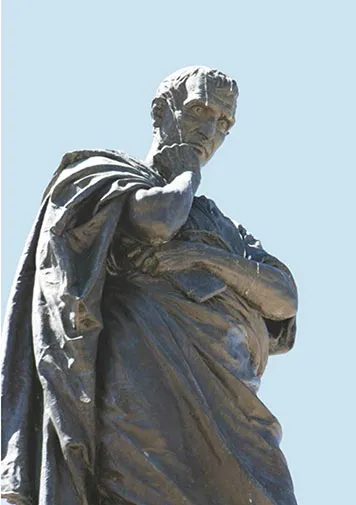
Statue of Ovid in Constanţa, Romania. https://commons.wikimedia.org/wiki/
File:Constanta_-_Ovid-Platz_-_Statue_des_Ovid.webp
Abbreviations
Table of Contents
Symbols and Terms
Table of Contents
| § | Indicates a section (e.g. of the Introduction or of a reference work). |
| * | Indicates a term defined in either Appendix 1 (Versification) or Appendix 2 (Glossary of Rhetorical and Syntactic Figures). |
| ⌣ | Indicates a syllable that scans short (for details of scansion, see Appendix 1). |
| — | Indicates a syllable that scans long (for details of scansion, see Appendix 1). |
| CE/BCE | Common Era/Before Common Era (a designation for the calendar year, equivalent to AD/BC). In this volume CE should be assumed when no indication is provided. |
| Comm. | Refers to the Commentary in this volume. |
| Intro. | Refers to the Introduction (normally with following section specification). |
| n. | Refers to an entry in the Commentary (normally with preceding line specification). |
Reference Works
Table of Contents
| AG | Allen and Greenough’s New Latin Grammar for Schools and Colleges , edited by J. B. Greenough, G. L. Kitteredge, A. A. Howard, and B. L. D’Ooge (Boston, 1903). |
| CIL | Corpus Inscriptionum Latinarum (Berlin, 1862). |
| L-S | A Latin Dictionary, edited by C. T. Lewis and C. Short (Oxford, 1879). |
| LSJ | A Greek-English Lexicon, 9th edition, with Supplement, edited by H. J. Liddle and R. Scott, revised by H. S. Jones (Oxford, 1968) |
| OLD | Oxford Latin Dictionary, edited by P. G. W. Glare (Oxford, 1968–82). |
| TLL | Thesaurus Linguae Latinae (Leipzig, 1900). |
Grammatical Terms
Table of Contents
| abl. | ablative (similarly nom. = nominative; gen. = genitive; dat. = dative; acc. = accusative) |
| act. | active voice (similarly pass. = passive voice) |
| fut. | future tense (similarly perf. = perfect; pres. = present; etc.) |
| indic. | indicative (similarly subjunct. = subjunctive) |
| part. | participle |
| pers. | person |
| pl. | plural (similarly sing. = singular) |
Ancient Literature
Table of Contents
| Apollod. | Apollodorus, Bibliotheca (Library) | |
| Ap. Rhod. | Apollonius Rhodius, Argonautica | |
| Apul. | Apuleius | |
| Met. | Metamophoses (or Golden Ass) | |
| Arat. | Aratus | |
| Phaen. | Phaenomena | |
| Cat. | Catullus, Carmina (Poems) | |
| Cic. | Cicero | |
| Fam. | Epistulae ad Familiares (Letters to his Friends) | |
| Leg. | De Legibus (On the Law) | |
| Nat. D. | De Natura Deorum (On the Nature of the Gods) | |
| Enn. | Ennius | |
| Ann. | Annales (Annals) | |
| Eur. | Euripides | |
| Bacch. | Bacchae | |
| Hdt. | Herodotus, Histories | |
| Hes. | Hesiod | |
| Op. | Opera et Dies (Works and Days) | |
| Hom. | Homer | |
| Il. | Iliad | |
| Od. | Odyssey | |
| Hor. | Horace | |
| Carm. | Carmina (Odes) | |
| Epod. | Epodes | |
| Hyg. | Hyginus | |
| Fab. | Fabulae | |
| Hymn. Hom. | Homeric Hymns | |
| Liv. | Livy, Ab urbe condita | |
| Luc. | Lucan, Bellum Civile (Civil War) | |
| Lucr. | Lucretius, De Rerum Natura | |
| Mart. | Martial | |
| Ep. | Epigrams | |
| Ov. | Ovid | |
| Am. | Amores | |
| Ars | Ars Amatoria (The Art of Love) | |
| Fast. | Fasti | |
| Her. | Heroides | |
| Met. | Metamorphoses | |
| Trist. | Tristia | |
| Plaut. | Plautus | |
| Cas. | Casina | |
| Merc. | Mercator | |
| Plin. | Pliny (the Elder) | |
| NH | Naturalis Historia (Natural History) | |
| Plut. | Plutarch | |
| Caes. | Caesar | |
| Prop. | Propertius, Carmina (Poems) | |
| Sen. | Seneca (the Younger) | |
| Oed. | Oedipus | |
| Serv. | Statius | |
| Ach. | Achilleid | |
| Silv. | Silvae | |
| Theb. | Thebaid | |
| Suet. | Suetonis | |
| Aug. | Divus Augustus (Life of Augustus) | |
| Theoc. | Theocritus | |
| Id. | Idylls | |
| Val. Max. | Valerius Maximus | |
| Val. Flacc. | Valerius Flaccus, Argonautica | |
| Varr. | Varro | |
| Ling. | De Lingua Latina (On the Latin Language) | |
| Virg. | Virgil | |
| Aen. | Aeneid | |
| Ecl. | Eclogues | |
| G. | Georgics | |
INTRODUCTION
Table of Contents
1. Ovid and His Times
Table of Contents
Ovid, or (to give him his full Roman name) Publius Ovidius Naso, was born in 43 BCE to a prominent equestrian family in Sulmo (modern Sulmona), a small town about 140 km east of Rome. He died in banishment, a resident of Tomi on the Black Sea, in 17 CE. Ovid was one of the most prolific authors of his day, as well as one of the most controversial.1 He had always been constitutionally unable to write anything in prose — or so he claims in his autobiography (composed, of course, in verse). Whatever flowed from his pen was in metre, even after his father had told him to put an end to such nonsense:
saepe pater dixit ‘studium quid inutile temptas?
Maeonides2 nullas ipse reliquit opes’.
motus eram dictis, totoque Helicone3 relicto
scribere temptabam verba soluta modis.
sponte sua carmen numeros veniebat ad aptos,
et quod temptabam dicere versus erat.
(Trist. 4.10.21–26)
My father often said, ‘Why try a useless
Vocation? Even Homer left no wealth’.
So I obeyed, all Helicon abandoned,
And tried to write in prose that did not scan.
But poetry in metre came unbidden,
And what I tried to write in verses ran.
(tr. Melville)
Maeonides2 nullas ipse reliquit opes’.
motus eram dictis, totoque Helicone3 relicto
scribere temptabam verba soluta modis.
sponte sua carmen numeros veniebat ad aptos,
et quod temptabam dicere versus erat.
(Trist. 4.10.21–26)
My father often said, ‘Why try a useless
Vocation? Even Homer left no wealth’.
So I obeyed, all Helicon abandoned,
And tried to write in prose that did not scan.
But poetry in metre came unbidden,
And what I tried to write in verses ran.
(tr. Melville)
Students of Latin may well be familiar with Naso senior’s banausic attitude: classics graduates, some wrongly assume, have similarly dismal career prospects. But eventually Ovid would shrug off paternal disapproval in pursuit of his passion. After dutifully filling certain minor offices, he chose not to go on to the quaestorship, thereby definitively renouncing all ambition for a senatorial career. In his case, the outcome was an oeuvre for the ages. For quick orientation, here is a time-line with the basics:4
Battle of Actium
Secular Games; Augustus adopts Gaius and LuciusAugustus dies; Tiberius accedes
| Time-line | Historical Events | Ovid's Biography | Literary History |
| 50s BCE | Catullus, Lucretius | ||
| 44 | Julius Caesar murdered | ||
| 43 | Cicero murdered | Ovid born | |
| 30s | [Gallus Amores 1-4 (lost)], Horace Epodes | ||
| 35 | Virgil Eclogues Horace Satires 1 | ||
| 31 | |||
| 29 | Virgil Georgics | ||
| 27 | Octavian becomes 'Augustus' | ||
| Early 20s | Livy 1-10 | ||
| 20s | Propertius 1-3, Tibullus, 1, Horace Odes 1-3, Epistles 1 | ||
| 19 | Virgil Aeneid, Tibullus 1-2 | ||
| 18 | Leges Iuliae (initial Augustan marriage legislation) | ||
| 17 | Horace Carmen Saeculare | ||
| 16 | Propertius 4 | ||
| 10s-0s | Amores 1-3, Heroides, Medicamina faciei femineae, Medea (a lost tragedy) | Horace Ars Poetica, Epistles 2, Odes 4 | |
| 2 BCE | Ars Amatoria 1-2 | ||
| 1 CE | Birth of Jesus | ||
| 2 | Ars Amatoria 3 and Remedia Amoris | ||
| 4 | Augustus adopts Tiberius | ||
| 8 | Scandal at court; Augustus relegates Ovid to Tomi on the Black Sea | Finished just before the relegation (?): Metamorphoses 1-15, Fasti 1-6 | |
| 8-17 | Tristia 1-5, Epistulae ex Ponto 1-4, Ibis, Double Heroides | ||
| 14 | |||
| Manilius Astronomica | |||
| Ovid dies | Livy dies |
Ovid was born when the Republic, the oligarchic system of government that had ruled Rome for centuries, was in its death throes. He was a teenager at the time of the Battle of Actium, the final showdown between Mark Antony and Octavian that saw the latter emerge victorious, become the first princeps, and eventu...
Table of contents
- Ovid, Metamorphoses (3.511–733)
- Table of Contents
Trusted by 375,005 students
Access to over 1.5 million titles for a fair monthly price.
Study more efficiently using our study tools.
Frequently asked questions
Yes, you can cancel anytime from the Subscription tab in your account settings on the Perlego website. Your subscription will stay active until the end of your current billing period. Learn how to cancel your subscription
No, books cannot be downloaded as external files, such as PDFs, for use outside of Perlego. However, you can download books within the Perlego app for offline reading on mobile or tablet. Learn how to download books offline
Perlego offers two plans: Essential and Complete
- Essential is ideal for learners and professionals who enjoy exploring a wide range of subjects. Access the Essential Library with 800,000+ trusted titles and best-sellers across business, personal growth, and the humanities. Includes unlimited reading time and Standard Read Aloud voice.
- Complete: Perfect for advanced learners and researchers needing full, unrestricted access. Unlock 1.5M+ books across hundreds of subjects, including academic and specialized titles. The Complete Plan also includes advanced features like Premium Read Aloud and Research Assistant.
We are an online textbook subscription service, where you can get access to an entire online library for less than the price of a single book per month. With over 1.5 million books across 990+ topics, we’ve got you covered! Learn about our mission
Look out for the read-aloud symbol on your next book to see if you can listen to it. The read-aloud tool reads text aloud for you, highlighting the text as it is being read. You can pause it, speed it up and slow it down. Learn more about Read Aloud
Yes! You can use the Perlego app on both iOS and Android devices to read anytime, anywhere — even offline. Perfect for commutes or when you’re on the go.
Please note we cannot support devices running on iOS 13 and Android 7 or earlier. Learn more about using the app
Please note we cannot support devices running on iOS 13 and Android 7 or earlier. Learn more about using the app
Yes, you can access Ovid, Metamorphoses (3.511–733) by Ingo Gildenhard,Andrew Zissos in PDF and/or ePUB format, as well as other popular books in History & Roman Ancient History. We have over 1.5 million books available in our catalogue for you to explore.