eBook - ePub
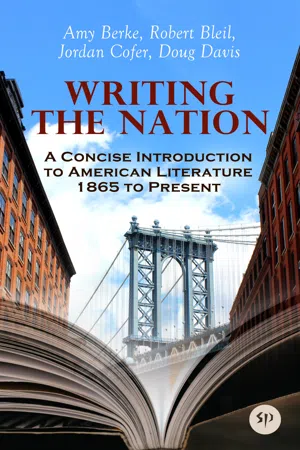
Writing the Nation: A Concise Introduction to American Literature 1865 to Present
- 957 pages
- English
- ePUB (mobile friendly)
- Available on iOS & Android
eBook - ePub
Writing the Nation: A Concise Introduction to American Literature 1865 to Present
About this book
Writing the Nation displays key literary movements and the American authors associated with the movement. Topics include late romanticism, realism, naturalism, modernism, and modern literature.
Contents:
Late Romanticism (1855-1870)
Realism (1865-1890)
Local Color (1865-1885)
Regionalism (1875-1895)
William Dean Howells
Ambrose Bierce
Henry James
Sarah Orne Jewett
Kate Chopin
Mary E. Wilkins Freeman
Charles Waddell Chesnutt
Charlotte Perkins Gilman
Naturalism (1890-1914)
Frank Norris
Stephen Crane
Turn of the Twentieth Century and the Growth of Modernism (1893 - 1914)
Booker T. Washington
Zane Grey
Modernism (1914 - 1945)
The Great War
Une Generation Perdue… (a Lost Generation)
A Modern Nation
Technology
Modernist Literature
Further Reading: Additional Secondary Sources
Robert Frost
Wallace Stevens
William Carlos Williams
Ezra Pound
Marianne Moore
T. S. Eliot
Edna St. Vincent Millay
E. E. Cummings
F. Scott Fitzgerald
Ernest Hemingway
Arthur Miller
Southern Renaissance – First Wave
Ellen Glasgow
William Faulkner
Eudora Alice Welty
The Harlem Renaissance
Jessie Redmon Fauset
Zora Neale Hurston
Nella Larsen
Langston Hughes
Countee Cullen
Jean Toomer
American Literature Since 1945 (1945 - Present)
Southern Literary Renaissance - Second Wave (1945-1965)
The Cold War and the Southern Literary Renaissance
Economic Prosperity
The Civil Rights Movement in the South
New Criticism and the Rise of the MFA Program
Innovation
Tennessee Williams
James Dickey
Flannery O'Connor
Postmodernism
Theodore Roethke
Ralph Ellison
James Baldwin
Allen Ginsberg
Adrienne Rich
Toni Morrison
Donald Barthelme
Sylvia Plath
Don Delillo
Alice Walker
Leslie Marmon Silko
David Foster Wallace
Information
Index
Literature1 LATE ROMANTICISM (1855-1870)
Robert R. Bleil
Table of Contents
1.1 Learning Outcomes
Table of Contents
After completing this chapter, you should be able to:
- Describe the key features of Romanticism.
- Analyze the ways in which the works of Emily Dickinson and Walt Whitman broke from the American literary tradition of Emerson, Hawthorne, and Melville.
- Analyze the impact of the Industrial Revolution and the Civil War on American literature.
- Compare the ways in which Emily Dickinson and Walt Whitman established new voices in American literature.
1.2 Introduction
Table of Contents
Emily Dickinson and Walt Whitman, the authors whose works appear in this chapter, are unlikely protagonists—or leading characters—for a literary movement. Each was an outsider: Dickinson, an unmarried woman who lived a life of quiet seclusion in western Massachusetts, and Whitman, a vagabond who lived a life in search of community. Dickinson and Whitman promoted a spirit of exploration and inventiveness that matched the geographical, industrial, political, and social growth of the United States. From their works, we gain not so much a literary renaissance as we do a sense of artistic innovation that developed alongside these other areas of American life and commerce.
As literary historians like William Charvat have noted, the development of an American literary tradition owes as much to the development of the American publishing industry in the middle decades of the nineteenth century as it does to the prominence of individual authors like Catharine Maria Sedgwick, Washington Irving, Nathaniel Hawthorne, Edgar Allan Poe, Herman Melville, Ralph Waldo Emerson, Henry David Thoreau, and Harriet Beecher Stowe. Sales of these authors’ works were dwarfed by the sales of pirated editions of novels by British authors like Walter Scott and Charles Dickens. Nonetheless, the success of these British imports convinced American publishers that the American market was sufficiently robust to demand new works; this demand created an opportunity for American writers to expand their audience, and a flourishing literary culture began to prosper.
American authors still faced steep odds in seeing their works into print, and American literary publishing did not flourish until the completion of the First Transcontinental Railroad in 1869 allowed the reliably consistent shipment of individuals and goods across the country. Additional technological improvements, including the widespread adoption of steam-powered machinery and gas-fueled lights, also provide the necessary conditions for the rapid production of printed materials and the means by which these materials could be enjoyed at the conclusion of a day of laboring. Thus, only when the Industrial Age expands the definition of leisure do Americans begin to embrace the culture of print and expand the boundaries of American literature.
The first attempts to define the literary culture of the mid-nineteenth century began in the 1930s and early 1940s as the United States took on a larger role in global politics, and the need for definition gained sharper focus with the publication of F. O. Matthiessen’s The American Renaissance in 1941. Matthiessen argued that writers like Hawthorne, Melville, Emerson, and Thoreau represented the expansion of a uniquely American style of writing that interacted with, and embraced, the North American landscape in new ways. What Matthiessen called a renaissance, however, was less of a cultural flourishing than the limited success of a few male authors from New England. Despite the real impact of Matthiessen’s work in recognizing the presence of significant male American writers, his catalogue still neglected writing of women, African-Americans, and Native Americans whose works would not be widely recognized until the 1970s.
In order to describe the work of these authors, Matthiessen and others turned to literary labels popularized in reference to British authors of the late eighteenth and early nineteenth centuries. Romanticism, a literary movement emphasizing the freedom and originality of self-expression that began in Europe at the end of the eighteenth century, also seemed to capture the spirit of nineteenth-century America and was frequently applied to authors of both prose and poetry. In the hands of these authors, the meadows of western Massachusetts replaced the Lake District as the source of inspiration, and the rejection of Puritan morality continued the American emphasis on freedom of expression. When Whitman and Dickinson began writing poetry in the 1850s, the thriving Abolitionist movement added urgency to the need for new voices and rapid change.
When we refer to Whitman and Dickinson as late Romantics, we place them at the end of a period that begins in the 1820s, and we suggest that their works are merely derivative from those that preceded them chronologically. Yet Whitman’s and Dickinson’s poetry is contemporary with these other works, and it seems more fruitful to consider the differences in genre than the differences in chronology. Whitman and Dickinson achieved their fame by changing American poetry from patriotic and historical ballads to free verse—poetry that lacks both rhyme and regular meter— and musically inspired celebrations of the individual in the American landscape.
Whitman and Dickinson are the most famous of the Late Romantics, and their work inspired successive generations of American authors. From these poets, Mark Twain, Stephen Crane, and Charles Chesnutt found the freedom to use a variety of American dialects in their work, the realists of the late nineteenth and early twentieth centuries discovered the richness of the American landscape, and the Modernist poets located a source of new poetical forms to meet the needs of the adolescent Republic that came of age in the decades immediately following the Civil War.
That national coming of age, in the years of Reconstruction, Western Expansion, Manifest Destiny, industrial might, and rapid immigration, also marks the traditional beginning of courses like this one. The Civil War, while not a precise dividing line, is regarded as the most reliable current method for marking the split between the first and second half of the literary history of the United States. Teachers and critics quickly realized, however, that the continued growth of the literary and cultural productions of the United States required more precise divisions than the chronological division into pre-bellum and post-bellum periods can provide. This collection of readings follows those new divisions, with chapters on Late Romanticism, Realism, Naturalism, Pre-Modernism, Modernism, and post-1945 American Literature, but the boundaries between these divisions remain fluid.
The readings that follow are arranged loosely by chronology, and the authoreditors of this collection have tried to provide useful headnotes to the sections and the individual authors, but do not be afraid to draw connections beyond the loose boundaries and invent new terms that better describe these works. As American literature continues to grow, we create new categories that better describe our shared experience.
1.3 Walt Whitman
(1819 – 1892)
Table of Contents
The second of nine children and born in 1819 to a Long Island farmer and carpenter, Walt Whitman is both the journeyman poet of American-ness and its champion. A journalist and newspaper editor throughout his life, Whitman worked as a law clerk, a schoolteacher, a printer, a civil servant, and a hospital aide, but he was always writing; from his teenage years until his death, his byline was on constant view. Contemporary reports suggest that Whitman was an industrious worker but that he was often accused of idleness because his habit of long midday walks contrasted sharply with nineteenth-century attitudes toward work. In “Song of Myself,” Whitman addressed these critics directly by writing, “I loafe and invite my soul,/ I lean and loafe at my ease observing a spear of summer grass” (4- 5). For Whitman, too much industry dulled the ability to celebrate the ordinary. In the preface to the first edition of Leaves of Grass in 1855, Whitman expounds on his love for the common: “Other states indicate themselves in their deputies…but the genius of the United States is not best or most in its executives or legislators, nor in its ambassadors or authors or colleges or churches or parlors, nor even in its newspapers or inventors…but always most in the common people.”1 Whitman’s love for the common people that he encountered and observed in the urban centers of the north is expressed in all of his poetry; if his British contemporary Alfred Lord Tennyson is the national poet of mourning, then Whitman is the national poet of celebration.

Image 1.1 | Walt Whitman, 1887.
Photographer: George C. Cox
Photographer: George C. Cox
Source: Wikimedia Commons
License: Public Domain
Many readers feel confused and disoriented when reading Whitman for the first time. Without using the aid of rhyme and meter as a guide, Whitman’s poetry may initially appear disjointed and meandering, but at the same time readers often take great comfort in the simplicity of the language, the clarity of the images, and the deep cadences, or rhythms, of the verse. Such contradictions are at the heart of Whitman’s work. Much of Whitman’s success and endurance as a poet comes from his ability to marry embedded cultural forms to the needs of a growing and rapidly modernizing nation. Whitman first came to wide public attention with the publication of the first edition of Leaves of Grass in 1855 when he was just twentyfive years old. Grand in scope if not in size, the first edition established Whitman as a poet who loved wordplay and common images; by the time of his death in 1892, Whitman had expanded the initial collection of just twelve poems over the course of six editions to one that ultimately included more than 400 poems. The selection included here largely samples Whitman’s early poetry up through the Civil War. In the selections from Song of Myself and “Crossing Brooklyn Ferry,” we see Whitman at his most iconic: sweeping views of everyday life that freely mingle high and low culture. Yet the poet of the common man did not spend all of his days gazing at his fellow Americans. In the final selection from Whitman, we see Whitman rising as a national poet with “O Captain! My Captain!” one of two poems on the death of Abraham Lincoln. An urban poet who lived almost his entire life in New York, New Jersey, and Washington, DC, the enduring appeal of his works testifies to his ability to connect the great and the common through language.
1.3.1 Song of Myself
1
I CELEBRATE myself, and sing myself,
And what I assume you shall assume,
For every atom belonging to me as good belongs to you.
I loafe and invite my soul,
I lean and loafe at my ease observing a spear of summer grass.
My tongue, every atom of my blood, form’d from this soil, this air,
Born here of parents born here from parents the same, and their parents the same,
I, now thirty-seven years old in perfect health begin,
Hoping to cease not till death.
Creeds and schools in abeyance,
Retiring back a while sufficed at what they are, but never forgotten,
I harbor for good or bad, I...
Table of contents
- Writing the Nation: A Concise Introduction to American Literature 1865 to Present
- Table of Contents
- CHAPTER 1: LATE ROMANTICISM (1855-1870)
- CHAPTER 2: REALISM (1865-1890)
- CHAPTER 3; NATURALISM (1890-1914)
- CHAPTER 4; TURN OF THE TWENTIETH CENTURY AND THE GROWTH OF MODERNISM (1893 – 1914)
- CHAPTER 5: MODERNISM (1914 – 1945)
- CHAPTER 6: AMERICAN LITERATURE SINCE 1945 (1945 – PRESENT)
- GLOSSARY
Trusted by 375,005 students
Access to over 1.5 million titles for a fair monthly price.
Study more efficiently using our study tools.
Frequently asked questions
Yes, you can cancel anytime from the Subscription tab in your account settings on the Perlego website. Your subscription will stay active until the end of your current billing period. Learn how to cancel your subscription
No, books cannot be downloaded as external files, such as PDFs, for use outside of Perlego. However, you can download books within the Perlego app for offline reading on mobile or tablet. Learn how to download books offline
Perlego offers two plans: Essential and Complete
- Essential is ideal for learners and professionals who enjoy exploring a wide range of subjects. Access the Essential Library with 800,000+ trusted titles and best-sellers across business, personal growth, and the humanities. Includes unlimited reading time and Standard Read Aloud voice.
- Complete: Perfect for advanced learners and researchers needing full, unrestricted access. Unlock 1.5M+ books across hundreds of subjects, including academic and specialized titles. The Complete Plan also includes advanced features like Premium Read Aloud and Research Assistant.
We are an online textbook subscription service, where you can get access to an entire online library for less than the price of a single book per month. With over 1.5 million books across 990+ topics, we’ve got you covered! Learn about our mission
Look out for the read-aloud symbol on your next book to see if you can listen to it. The read-aloud tool reads text aloud for you, highlighting the text as it is being read. You can pause it, speed it up and slow it down. Learn more about Read Aloud
Yes! You can use the Perlego app on both iOS and Android devices to read anytime, anywhere — even offline. Perfect for commutes or when you’re on the go.
Please note we cannot support devices running on iOS 13 and Android 7 or earlier. Learn more about using the app
Please note we cannot support devices running on iOS 13 and Android 7 or earlier. Learn more about using the app
Yes, you can access Writing the Nation: A Concise Introduction to American Literature 1865 to Present by Amy Berke,Robert Bleil,Jordan Cofer,Doug Davis in PDF and/or ePUB format, as well as other popular books in Literature & North American Literary Collections. We have over 1.5 million books available in our catalogue for you to explore.