eBook - ePub
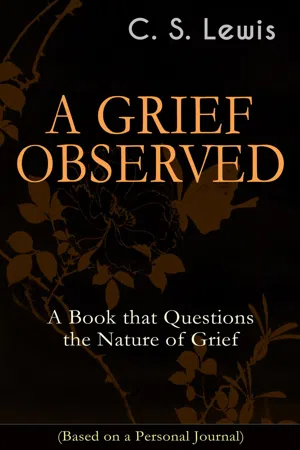
A GRIEF OBSERVED: A Book that Questions the Nature of Grief (Based on a Personal Journal)
Autobiographical Work in Which the Author Explores the Fundamental Questions of Faith and Theodicy
- 160 pages
- English
- ePUB (mobile friendly)
- Available on iOS & Android
eBook - ePub
A GRIEF OBSERVED: A Book that Questions the Nature of Grief (Based on a Personal Journal)
Autobiographical Work in Which the Author Explores the Fundamental Questions of Faith and Theodicy
About this book
This carefully crafted ebook: "A GRIEF OBSERVED: A Book that Questions the Nature of Grief (Based on a Personal Journal)" is formatted for your eReader with a functional and detailed table of contents.
A Grief Observed is a collection of Lewis's reflections on the experience of bereavement following the death of his wife, Joy Davidman, in 1960. The book was first published under the pseudonym N.W. Clerk as Lewis wished to avoid identification as the author. Though republished in 1963 after his death under his own name, the text still refers to his wife as "H" (her first name, which she rarely used, was Helen). The book is compiled from the four notebooks which Lewis used to vent and explore his grief. He illustrates the everyday trials of his life without Joy and explores fundamental questions of faith and theodicy. Lewis's step-son (Joy's son) Douglas Gresham points out in his 1994 introduction that the indefinite article 'a' in the title makes it clear that Lewis's grief is not the quintessential grief experience at the loss of a loved one, but one individual's perspective among countless others. The book helped inspire a 1985 television movie Shadowlands, as well as a 1993 film of the same name.
Clive Staples Lewis (1898-1963) was a British novelist, poet, academic, medievalist, lay theologian and Christian apologist. He is best known for his fictional work, especially The Screwtape Letters, The Chronicles of Narnia, and The Space Trilogy, and for his non-fiction Christian apologetics, such as Mere Christianity, Miracles, and The Problem of Pain.
Trusted by 375,005 students
Access to over 1.5 million titles for a fair monthly price.
Study more efficiently using our study tools.
Information
Topic
Theology & ReligionSubtopic
Christian DenominationsTable of Contents
Chapter I
Chapter II
Chapter III
Chapter IV
Chapter I
Table of Contents
No one ever told me that grief felt so like fear. I am not afraid, but the sensation is like being afraid. The same fluttering in the stomach, the same restlessness, the yawning. I keep on swallowing.
At other times it feels like being mildly drunk, or concussed. There is a sort of invisible blanket between the world and me. I find it hard to take in what anyone says. Or perhaps, hard to want to take it in. It is so uninteresting. Yet I want the others to be about me. I dread the moments when the house is empty. If only they would talk to one another and not to me.
There are moments, most unexpectedly, when something inside me tries to assure me that I don’t really mind so much, not so very much, after all. Love is not the whole of a man’s life. I was happy before I ever met H. I’ve plenty of what are called ‘resources’. People get over these things. Come, I shan’t do so badly. One is ashamed to listen to this voice but it seems for a little to be making out a good case. Then comes a sudden jab of red-hot memory and all this ‘commonsense’ vanishes like an ant in the mouth of a furnace.
On the rebound one passes into tears and pathos. Maudlin tears. I almost prefer the moments of agony. These are at least clean and honest. But the bath of self-pity, the wallow, the loathsome sticky-sweet pleasure of indulging it—that disgusts me. And even while I’m doing it I know it leads me to misrepresent H. herself. Give that mood its head and in a few minutes I shall have substituted for the real woman a mere doll to be blubbered over. Thank God the memory of her is still too strong (will it always be too strong?) to let me get away with it.
For H. wasn’t like that at all. Her mind was lithe and quick and muscular as a leopard. Passion, tenderness and pain were all equally unable to disarm it. It scented the first whiff of cant or slush; then sprang, and knocked you over before you knew what was happening. How many bubbles of mine she pricked! I soon learned not to talk rot to her unless I did it for the sheer pleasure—and there’s another red-hot jab—of being exposed and laughed at. I was never less silly than as H’s lover.
And no one ever told me about the laziness of grief. Except at my job—where the machine seems to run on much as usual—I loathe the slightest effort. Not only writing but even reading a letter is too much. Even shaving. What does it matter now whether my cheek is rough or smooth? They say an unhappy man wants distractions—something to take him out of himself. Only as a dog-tired man wants an extra blanket on a cold night; he’d rather lie there shivering than get up and find one. It’s easy to see why the lonely become untidy; finally, dirty and disgusting.
Meanwhile, where is God? This is one of the most disquieting symptoms. When you are happy, so happy that you have no sense of needing Him, so happy that you are tempted to feel His claims upon you as an interruption, if you remember yourself and turn to Him with gratitude and praise, you will be—or so it feels—welcomed with open arms. But go to Him when your need is desperate, when all other help is vain, and what do you find? A door slammed in your face, and a sound of bolting and double bolting on the inside. After that, silence. You may as well turn away. The longer you wait, the more emphatic the silence will become. There are no lights in the windows. It might be an empty house. Was it ever inhabited? It seemed so once. And that seeming was as strong as this. What can this mean? Why is He so present a commander in our time of prosperity and so very absent a help in time of trouble?
I tried to put some of these thoughts to C. this afternoon. He reminded me that the same thing seems to have happened to Christ: ‘Why hast thou forsaken me?’ I know. Does that make it easier to understand?
Not that I am (I think) in much danger of ceasing to believe in God. The real danger is of coming to believe such dreadful things about Him. The conclusion I dread is not ‘So there’s no God after all,’ but ‘So this is what God’s really like. Deceive yourself no longer.’
Our elders submitted and said ‘Thy will be done.’ How often had bitter resentment been stifled through sheer terror and an act of love—yes, in every sense, an act—put on to hide the operation?
Of course it’s easy enough to say that God seems absent at our greatest need because He is absent—non-existent. But then why does He seem so present when, to put it quite frankly, we don’t ask for Him?
One thing, however, marriage has done for me. I can never again believe that religion is manufactured out of our unconscious, starved desires and is a substitute for sex. For those few years H. and I feasted on love; every mode of it—solemn and merry, romantic and realistic, sometimes as dramatic as a thunderstorm, sometimes as comfortable and unemphatic as putting on your soft slippers. No cranny of heart or body remained unsatisfied. If God were a substitute for love we ought to have lost all interest in Him. Who’d bother about substitutes when he has the thing itself? But that isn’t what happens. We both knew we wanted something besides one another—quite a different kind of something, a quite different kind of want. You might as well say that when lovers have one another they will never want to read, or eat—or breathe.
After the death of a friend, years ago, I had for some time a most vivid feeling of certainty about his continued life; even his enhanced life. I have begged to be given even one hundredth part of the same assurance about H. There is no answer. Only the locked door, the iron curtain, the vacuum, absolute zero. ‘Them as asks don’t get.’ I was a fool to ask. For now, even if that assurance came I should distrust it. I should think it a self-hypnosis induced by my own prayers.
At any rate I must keep clear of the spiritualists. I promised H. I would. She knew something of those circles.
Keeping promises to the dead, or to anyone else, is very well. But I begin to see that ‘respect for the wishes of the dead’ is a trap. Yesterday I stopped myself only in time from saying about some trifle ‘H. wouldn’t have liked that.’ This is unfair to the others. I should soon be using ‘what H. would have liked’ as an instrument of domestic tyranny; with her supposed likings becoming a thinner and thinner disguise for my own.
I cannot talk to the children about her. The moment I try, there appears on their faces neither grief, nor love, nor fear, nor pity, but the most fatal of all non-conductors, embarrassment. They look as if I were committing an indecency. They are longing for me to stop. I felt just the same after my own mother’s death when my father mentioned her. I can’t blame them. It’s the way boys are.
I sometimes think that shame, mere awkward, senseless shame, does as much towards preventing good acts and straightforward happiness as any of our vices can do. And not only in boyhood.
Or are the boys right? What would H. herself think of this terrible little notebook to which I come back and back? Are these jottings morbid? I once read the sentence ‘I lay awake all night with toothache, thinking about toothache and about lying awake.’ That’s true to life. Part of every misery is, so to speak, the misery’s shadow or reflection: the fact that you don’t merely suffer but have to keep on thinking about the fact that you suffer. I not only live each endless day in grief, but live each day thinking about living each day in grief. Do these notes merely aggravate that side of it? Merely confirm the monotonous, tre...
Table of contents
- A GRIEF OBSERVED: A Book that Questions the Nature of Grief
- Table of Contents
Frequently asked questions
Yes, you can cancel anytime from the Subscription tab in your account settings on the Perlego website. Your subscription will stay active until the end of your current billing period. Learn how to cancel your subscription
No, books cannot be downloaded as external files, such as PDFs, for use outside of Perlego. However, you can download books within the Perlego app for offline reading on mobile or tablet. Learn how to download books offline
Perlego offers two plans: Essential and Complete
- Essential is ideal for learners and professionals who enjoy exploring a wide range of subjects. Access the Essential Library with 800,000+ trusted titles and best-sellers across business, personal growth, and the humanities. Includes unlimited reading time and Standard Read Aloud voice.
- Complete: Perfect for advanced learners and researchers needing full, unrestricted access. Unlock 1.5M+ books across hundreds of subjects, including academic and specialized titles. The Complete Plan also includes advanced features like Premium Read Aloud and Research Assistant.
We are an online textbook subscription service, where you can get access to an entire online library for less than the price of a single book per month. With over 1.5 million books across 990+ topics, we’ve got you covered! Learn about our mission
Look out for the read-aloud symbol on your next book to see if you can listen to it. The read-aloud tool reads text aloud for you, highlighting the text as it is being read. You can pause it, speed it up and slow it down. Learn more about Read Aloud
Yes! You can use the Perlego app on both iOS and Android devices to read anytime, anywhere — even offline. Perfect for commutes or when you’re on the go.
Please note we cannot support devices running on iOS 13 and Android 7 or earlier. Learn more about using the app
Please note we cannot support devices running on iOS 13 and Android 7 or earlier. Learn more about using the app
Yes, you can access A GRIEF OBSERVED: A Book that Questions the Nature of Grief (Based on a Personal Journal) by C. S. Lewis in PDF and/or ePUB format, as well as other popular books in Theology & Religion & Christian Denominations. We have over 1.5 million books available in our catalogue for you to explore.