The idea that a private enterprise has a social function and some obligations to all stakeholders is not something that has always existed. Concepts like sustainable development and shared value appeared only after a long process of trial and error. Understanding the origins of the theory of corporate social responsibility and its evolution will allow us to be ever closer to solving the mystery of what should be the role of private capital in society. It will also help us determine its importance when facing significant challenges due to government absence or weakness over certain territories.
eBook - ePub
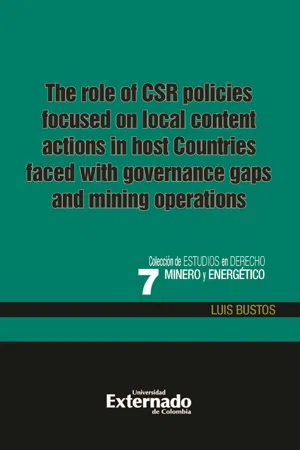
The role of the CSR policies focused on local content actions in host countries faced with governance gaps and mining operations
- 118 pages
- English
- ePUB (mobile friendly)
- Available on iOS & Android
eBook - ePub
The role of the CSR policies focused on local content actions in host countries faced with governance gaps and mining operations
About this book
Information
Subtopic
Law Theory & PracticeIndex
LawCHAPTER ONE: DEFINITIONS, EVOLUTION AND FUNCTION OF CORPORATE SOCIAL RESPONSIBILITY THEORY
“Corporate responsibility can therefore be understood as no more or less than the domains within and process by which business renegotiates and realigns its basis of accountability.”5
1.1 INTRODUCTION
Corporate Social Responsibility (CSR) is a theory, phenomenon and practice that has been present in the business environment for many years. Sometimes, it becomes an intangible issue: everyone knows of its existence but at the same time its scope and forms of implementation are unknown. This chapter seeks to introduce the concept of CSR through a historical analysis that will present the evolution of the understanding of this concept, which has affected the relation between extractive companies and the communities. Extractive companies develop their operations on site, on the understanding that they have responsibilities related to their contribution to social development. This has led to the creation of a link between CSR, local content actions and community development policies.
The aim of these discussions is to highlight ‘why’ companies have this type of responsibilities and if these so-called local content actions deserve to be given ‘special attention’ as corporate behaviours that help fill ‘governance gaps’ and generate welfare at the local level. However, this structure will not exclude the possibility that the benefits obtained from resource extraction are used to contribute to the social development of other communities different from the local communities and the entire country.
1.2 EVOLUTION OF THE CORPORATE SOCIAL RESPONSIBILITY
If we look at the past, commencing at the period of ancient Babylon, there were some vestiges of CSR. The Babylonians located special responsibility on the man who built a house in deficient condition and as a result collapsed injuring some person. In this case the specific builder of the structure must pay for this mistake with his life; this was what they called the law of an eye for an eye. But, besides that, there was an understanding of the existence of a liability of the constructer towards those affected by the mentioned activity.6
However, it is only in 1930, in the book “The Modern Corporation and Private Property”, written by ADOLF BERLE and GARDINER MEANS’s, that a more conceptual structure of CSR appears, bringing examples of the clashes between ownership, control and corporation governance.7 It is important to recognize that the decision of a company to be a socially responsible initiates at the corporate governance processes.8 Furthermore, the Great Depression during 1929-1939 opened a space to point out that companies have a much more significant social role than simply producing profits. Another historic event that contributed the raising of awareness by the entrepreneurs was the beginning of the Cold War in 1945 which created a new consciousness for businessmen, suggested as a more active role in the promotion and establishment of the capitalist model by a sense of patriotism.9
During the Post-Cold War period several complaints have emerged against the bad implementation of global social policies by the States. This pressured companies to engage in social programs and actions helping to settle these difficulties. An important landmark that highlighted the shift in consciousness in the world of business is Fortune Magazine with the introduction to the concept of “social consciousness” in 1946. It presented the idea that the responsibility of companies and its directors did not rely only with the shareholders, but were extended to all the stakeholders. At the mentioned survey, it was identified that nearly 93% of businessmen agreed to recognize this type of social responsibility.10
Also during this time, there was a strong influence of the Keynesian Economic Model in which State intervention and public spending was encouraged to stimulate the economy and prevent a recession. This model also had a secondary objective, which was focused on an increase interest over the behaviour of private capital related to environmental and social issues. The reason for this interest was related to the large portion of the public budget that was directed to stimulate the economy through private-owned entities that are big beneficiaries of these types of policies.11
Parallel to these events, there were several academic and ideological movements that spread the theory of CSR and, likewise, have influenced their graduate students to see the CSR policies as a tool that will solve the social demands associated with the improvement on living standards of the people, improving the labour rights and optimize environmental protection.12 Additionally, there was a remarkable contribution given by HOWARD BOWEN who defined the CSR as “the obligation of businessmen to persuade politicians to take actions and guidelines that are desirable targets and values for the society.” BOWEN also affirmed that social responsibility is not just an unobtainable and theoretical idea, but rather it is a fact that should lead the future of the business world.13
In 1970, there was an exponential growth of multinational companies that took refuge in the arrival of the first outbreaks of globalization. This rapid growth gathered the attention of various actors of civil society organized as pressure groups such as environmental groups, human rights groups, labour groups, non-governmental organiza...
Table of contents
- Cover
- Half Title
- Title
- Copyright
- Dedication
- Acknowledgement
- Table of Contents
- List of abbreviations
- Abstract
- Introduction to the Study
- Chapter One: Definitions, Evolution and Function of Corporate Social Responsibility Theory
- Chapter Two: the Social Conflicts and Local Economic Impacts Presented by the Operation of Extractive Industries
- Chapter Three: the Approach of the Local Content Initiatives
- Chapter Four: Practical Examples/Case-Studies for the Implementation of CSR Policies Related with Local Content in Mining Operations
- Chapter Five: Conclusions and Major Findings
- Bibliography
- Notes
Trusted by 375,005 students
Access to over 1.5 million titles for a fair monthly price.
Study more efficiently using our study tools.
Frequently asked questions
Yes, you can cancel anytime from the Subscription tab in your account settings on the Perlego website. Your subscription will stay active until the end of your current billing period. Learn how to cancel your subscription
No, books cannot be downloaded as external files, such as PDFs, for use outside of Perlego. However, you can download books within the Perlego app for offline reading on mobile or tablet. Learn how to download books offline
Perlego offers two plans: Essential and Complete
- Essential is ideal for learners and professionals who enjoy exploring a wide range of subjects. Access the Essential Library with 800,000+ trusted titles and best-sellers across business, personal growth, and the humanities. Includes unlimited reading time and Standard Read Aloud voice.
- Complete: Perfect for advanced learners and researchers needing full, unrestricted access. Unlock 1.5M+ books across hundreds of subjects, including academic and specialized titles. The Complete Plan also includes advanced features like Premium Read Aloud and Research Assistant.
We are an online textbook subscription service, where you can get access to an entire online library for less than the price of a single book per month. With over 1.5 million books across 990+ topics, we’ve got you covered! Learn about our mission
Look out for the read-aloud symbol on your next book to see if you can listen to it. The read-aloud tool reads text aloud for you, highlighting the text as it is being read. You can pause it, speed it up and slow it down. Learn more about Read Aloud
Yes! You can use the Perlego app on both iOS and Android devices to read anytime, anywhere — even offline. Perfect for commutes or when you’re on the go.
Please note we cannot support devices running on iOS 13 and Android 7 or earlier. Learn more about using the app
Please note we cannot support devices running on iOS 13 and Android 7 or earlier. Learn more about using the app
Yes, you can access The role of the CSR policies focused on local content actions in host countries faced with governance gaps and mining operations by Luis Bustos in PDF and/or ePUB format, as well as other popular books in Law & Law Theory & Practice. We have over 1.5 million books available in our catalogue for you to explore.