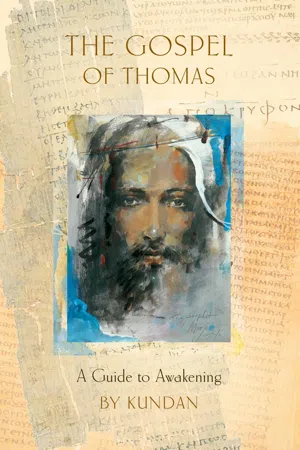
The Gospel of Thomas is an amazing scripture of heavenly inspired wisdom. It was discovered in 1945 near the village of Nag Hammadi in Egypt and is now commonly known as the 5th Gospel. It is considered to be the most important non-canonical scripture ever found. Consisting of 114 beautiful sayings the Gospel of Thomasperfectly enshrines the sacred mystical teachings of Jesus Christ. Jesus´ voice is a fervent call for us to wake up and look beyond the veil of illusion continuouslycreated by the egotistical mind. If there is any core message of the 5th Gospel that ought to be emphasized, it is Jesus´ consistent teaching that enlightenmentand the experience of awakening are, at any given moment, available to each and every one of us. Recognizing who we already are and always have been is all that needs to be achieved. In Verse 108, Jesus says: Whoever drinks from my mouthWill become like me;I myself will become that person, And the hidden thingsWill be revealed to him.The 5th Gospel thus focuses on a universal experience of Cosmic Consciousness, which, in Eastern cultures, is called Samadhi or Satori. Therefore, Jesus´ sayingsare in perfect accord with what has been taught by the mystics, sages, and Masters for thousands of years. Far from being an academic commentary, this guide is meant to create a comprehensive and intimate dialogue with the reader andlend a helping hand to those who long to integrate Jesus´ timeless wisdom intotheir daily lives.
- 264 pages
- English
- ePUB (mobile friendly)
- Available on iOS & Android
eBook - ePub
About this book
Information
THE NATURE OF THE MIND
The Heart Wears no Disguise
By Kathryn Phillips
What do you see
When you look at me?
Do your eyes tell all
But how can that be
For what I truly am
Is hidden from view
The real me
Is on the inside
Of me and you You
shall not see me
Until you open your eyes
For the Heart can wear
No such disguise...
The Wedding Guest
As told by Sri Swami Satchidananda
Once, a fellow received an invitation to a wedding party. He went to the party very simply dressed. But the host happened to be a very rich man, so all the other guests were very elegantly dressed. When the fellow arrived, the gatekeeper stopped him and demanded, “Hey, who are you? Where do you think you’re going?” Everyone just stared at the fellow. In fact, even the owner of the house pretended to not recognize him.
So the fellow went back home, borrowed an expensive suit, and returned to the party. Immediately, the same gatekeeper said, “Please, please come in. Our master has been looking for you. Where did you go? What happened to you? Please come this way.” And he escorted him to the dinner table.
The man sat down, and when everybody started eating, he picked up his food and began throwing it all over himself. He took a little pudding and rubbed it on his jacket; he took some bread and stuffed it in his pocket; he poured the soup on his pants. “Hey, what are you doing? Are you crazy?” asked the other guests.
“Oh, no, of course not. I’m just eating.”
“That’s not the way to eat!”
“Yes, but when I came before, dressed in my usual way, nobody would feed me. Now, when I am dressed like this, everybody is ready to host me. So, obviously, the food is being offered to the clothes, not to me.”
Who Is Dying?
Death is nothing but just changing our jackets.
- SRI SRI RAVI SHANKAR
Molecules dissolve and pass away, but consciousness survives the death of the matter on which it rides.
- DEEPAK CHOPRA
Whoever discovers the interpretation of these sayings will not taste death. (1)
We are strongly identified with this body, with our self-image, and with these feelings. When somebody asks us who we are, we say, for example, “I am a psychologist, I am a man, I am a woman, I am an American, I am a European, I am a Catholic, I am a father, I am a wife, I am a scientist, I am a handyman,” and many other things as well. Alternatively, we respond to our momentary condition and say, “I am hungry, I am curious, I am angry, I am depressed, I am happy, I am enlightened,” and so on. But is this actually a good description for what we really are?
We usually have some very solid ideas about who we are and how we are. And we are attached to some weird story about “me.” In one way or another, we tend to repeat our life story thousands of times, and we are not even aware of it. However, what we usually believe to be our “true biography” is nothing but a mere collection of memorized experiences from the storehouses of the past. Actually, we are rather talking about thoughts and imaginations pointing to past experiences, and, in addition, these thoughts and imaginations continuously change their appearance. Therefore, saying that our self-image is accurately mirroring past experiences is not true. Our self-image is rather based on a very unreliable construction consisting of memories and thoughts that merely refer to past experiences. Just honestly inquire whether you are truly able to exactly recall even your most recent experiences! If you speak the Truth, you must admit that you can’t! Most of it will be lost forever.
Forensic psychologists know very well that the so-called eyewitness is utterly unreliable. On one hand the eyewitness actually observes his own blurred reality projection and on the other hand, the memory of even this distorted experience gradually deteriorates. The point is that all of these experiences do not reflect anything real, and in addition to that, they no longer exist. They are all gone. The whole past is gone. There is no past anymore. There are only thoughts about the past, but the past itself will be gone forever. So there is no need to be concerned about it, because anything coming from the past is just virtual reality.
Living this life is being exposed to continuous change. Nothing remains the same. Experiences come and go; feelings come and go; memories come and go; thoughts come and go; all kinds of ideas about who I am and how I am come and go. All of this is not dependable. It is not even real. So what about this construct of ideas about “my” identity? Is there anything solid we can rely upon? Is there anything permanent about this “me?” Is there anything that will eternally survive after death? Even the body, which may seem dense and solid to you, is subject to continuous change and reconstruction. During your lifetime, the body undergoes endless transmutations. And finally, after a fairly short while, this body will definitely die and disappear forever. It will not live eternally. It will be rotting in the soil of your grave together with everything you “attained” in this life and with everything else that made up your identity in society. So believing that you are this body or this mind is indeed a very limited perspective. Jesus says:
Two will rest on a bed: the one will die, and the other will live. (61a)
They live in the same house,
rest in the same room, and lie in the same bed and yet there is a major difference between these two persons. The one who will die is identified with name and form, mind and body, and therefore is spiritually dead even before the death of the physical body and the false self occurs. But the one who will live has transcended name and form and thus became one with the Eternal Self which, by definition, is beyond birth and death. He knows that – as an individual human being – he is just a tourist on this earth, making a quite short holiday. In his perspective, death is not the end of existence but merely a transition from one state of being into another. This realization is an unfathomable gift, because Jesus says:
Blessed is he who came into being before coming into being. (19a)
This utterly deep mystical saying can be interpreted on three different levels. On the first level, it refers to the liberated individual having fully realized that God dwells in him, and that he dwells in God (cf. 84). On a second level, the verse also points to the reality of the so-called Bodhisattvas and Tulkus, enlightened Masters choosing to reincarnate for the sake of all sentient beings. They already have come into real Being in former lives and are now ordained to be among us in order to spirituality uplift and enlighten humanity through their boundless and unconditional Love. On the third and deepest level, Jesus speaks about the nameless and unchanging Absolute, which is the essence and Source of all that-is, ever was, and ever will be.
To taste THAT which in substance is permanent, you have to turn inside. You have to come here, into the present moment, again and again. Only here will you realize your true nature, which is beyond all of your thoughts and far beyond these animal bodies. Here in the silence of your being it is all quiet; here you discover your innocence, your purity, your peace. Here, in the immaculate stillness of the Now, your eternal divine essence will be revealed (cf. 85). You will never find it in your thoughts because the mind can’t possibly figure out who you are.
Who you really are was never born.
Who you really are is eternal, limitless, and unbound.
Who you really are is beyond time and space.
Who you really are is Divine Consciousness.
Who you really are will never taste death.
As long as we do not realize our Eternal Beingness and instead believe that we are this body-mind, the inevitability of death will be a dreadful perspective. As a matter of fact, the fear of death is deeply rooted in our materialistic Western society. Actually, the issue of death and dying is more or less taboo. However, do we know anything about what really happens in the moment of death? We can see that those of us who desperately try to hold on to a life that is bound to expire tend to experience a “difficult” death. On the other hand, it is witnessed that in the moment of death sometimes the whole room seems to be filled with a sacred Light and an all-pervading peace. From the Masters, we even hear that death itself can be a lovely experience and that many of us attain the highest realms of Consciousness precisely in this moment. Near-death experiences more or less point in the same direction. The most common experience seems to be a blissful vision of pure and unstained white Light. It is also very interesting to see that those who “came back” often changed their ways in a radical manner and hence, in deep gratefulness, dedicated their entire lives to serving the Divine.
Can we prepare for death? In the Buddhist tradition, we find the advice to always be aware that death can tap on our shoulder at any moment of the day. Does this mean that we have to live in constant dread or sorrow? Obviously not! Quite the contrary. This powerful technique is meant to be an incentive to ruthlessly enjoy the wonder of Life in the ever-present Now. It is meant to bring us here, back home, into the very core of the present moment. Here and only here do we find the greatest treasure ever, which is peace of mind. Being able to live a harmonious and serene life is an invaluable gift from the Divine and by far the best preparation for death. Live peacefully and you will, for certain, die peacefully! As Samarpan says, “Death is nothing to be afraid of. It’s a natural part of life. These bodies come. They grow, they change, and then they die. This has nothing to do with who you are.”
The Mind Is Powerless
But only he who, himself enlightened is not afraid of the shadows.
- IMMANUEL KANT
Ego implies unawareness. Awareness and ego cannot coexist.
- ECKHART TOLLE
Lucky is the lion that the human will eat, so that the lion becomes human. And foul is the human that the lion will eat, and the lion still will become human. (7)
The lion is a symbol for power and respect. Just as the lion is the king of all beasts, the ego mind is worshiped as the ruler over the world. We gave all our power to the mind program, because we are in fear of getting punished. If we don’t follow the mind’s instructions, he freaks out and punishes us with unpleasant feelings like guilt, fear, and panic. We all have learned a lot of useless things in school, but nobody told us how to deal with heavy feelings. Instead of learning how to boldly face the lion, we were conditioned to escape from all kinds of unpleasant feelings. Psychologists call this defense mechanism avoidance behavior.
The trigger for avoidance always is the fear to feel what we don’t want to feel. The real problem is that this kind of behavior is self-rewarding. Avoiding the fear reduces the fear for a short while, but in the long run the fear of the fear steadily increases and a lot of psychological disorders and strange behaviors are being created. Fear is the cornerstone of the mind’s illusionary power. Many dreadful thoughts are linked to anxiety. We are afraid of getting bruised, humiliated, ridiculed, rejected, or disliked, because all of this again triggers unpleasant feelings. But who is afraid? Looking closely it is the ego itself that is in fear. Dislike, humiliation, and rejection are dangerous attacks against the mind’s false self-image, and this “idea of me” has to be protected and defended. The ego, therefore, pretends to be a lion. Nonetheless, the ego is totally powerless because it has no existence separate from the thoughts.
The whole ego is dependent upon the idea of being somebody separate from everybody and everything else. We steadily compare ourselves to others and thus develop either a positive or negative self-image – which is basically the same rubbish. When we want to feel superior, we try to dominate others, and when we feel inferior, we tend toward submissive behavior. In both cases, there is a mutual dependency and the mind is in command. Without this false concept of separateness, we wouldn’t have any crimes or wars. If I realize that you and I are one and the same Being, how can I then do any harm to you? I would just hurt myself, wouldn’t I? As long as this illusionary mind is worshiped as the master, we will have no freedom and no peace on this planet. The lion called “mind” will eat us and destroy all of our human qualities.
Looking closely we find out that thoughts are just nothing. Thoughts are just thoughts. They come, and they go. If we don’t cling to them they just vaporize. Some teachers advise us to neutrally watch the thoughts. However, this will not be recommended here. This technique can surely help us to become more aware of the incessant chattering of the thinking mind, but, at the same time, the danger to once again become entangled with incoming thoughts is imminent. You can easily observe that your attention is the real source of power. It is, in other words, the power supply for the mind. If you give, for instance, your whole attention to some pessimistic thoughts, problems, or conflicts, they will inevitably grow and the mind will torture you in return.
Focusing your attention on “positive thinking” doesn’t help either, because the positive thought by nature includes the negative one. It just has moved into the background for a while. Steadily thinking that you are a “good” person is hard work, and it actually means that you somehow believe yourself to also be a “bad” person. So you are once more caught by your selfjudgments, though all of these are just fleeting and arbitrary thoughts. Instead of watching the thoughts or compulsively trying to think positively, just totally ignore the thoughts and, by that, y...
Table of contents
- Dedication
- Table of Contents
- Acknowledgements
- Introduction
- WHO IS JESUS?
- THE NATURE OF THE MIND
- MAJOR ATTACHMENTS
- THE SPIRITUAL PATH
- MORE GIFTS FOR THE SEEKER
- LIVING IN THE NOW
- THE DEEPEST SECRETS
- SHARING THE TRUTH
- Concluding Words
- The Mystic Shore
- Appendix
- Copyright
Trusted by 375,005 students
Access to over 1.5 million titles for a fair monthly price.
Study more efficiently using our study tools.
Frequently asked questions
Yes, you can cancel anytime from the Subscription tab in your account settings on the Perlego website. Your subscription will stay active until the end of your current billing period. Learn how to cancel your subscription
No, books cannot be downloaded as external files, such as PDFs, for use outside of Perlego. However, you can download books within the Perlego app for offline reading on mobile or tablet. Learn how to download books offline
Perlego offers two plans: Essential and Complete
- Essential is ideal for learners and professionals who enjoy exploring a wide range of subjects. Access the Essential Library with 800,000+ trusted titles and best-sellers across business, personal growth, and the humanities. Includes unlimited reading time and Standard Read Aloud voice.
- Complete: Perfect for advanced learners and researchers needing full, unrestricted access. Unlock 1.5M+ books across hundreds of subjects, including academic and specialized titles. The Complete Plan also includes advanced features like Premium Read Aloud and Research Assistant.
We are an online textbook subscription service, where you can get access to an entire online library for less than the price of a single book per month. With over 1.5 million books across 990+ topics, we’ve got you covered! Learn about our mission
Look out for the read-aloud symbol on your next book to see if you can listen to it. The read-aloud tool reads text aloud for you, highlighting the text as it is being read. You can pause it, speed it up and slow it down. Learn more about Read Aloud
Yes! You can use the Perlego app on both iOS and Android devices to read anytime, anywhere — even offline. Perfect for commutes or when you’re on the go.
Please note we cannot support devices running on iOS 13 and Android 7 or earlier. Learn more about using the app
Please note we cannot support devices running on iOS 13 and Android 7 or earlier. Learn more about using the app
Yes, you can access The Gospel of Thomas by Kundan in PDF and/or ePUB format, as well as other popular books in Theology & Religion & Religion. We have over 1.5 million books available in our catalogue for you to explore.