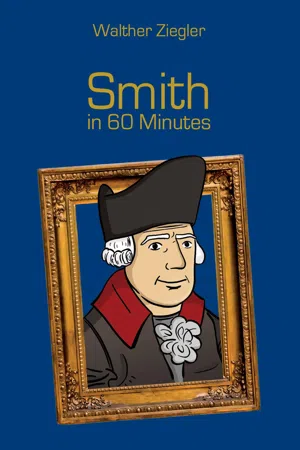
It was, of all people, to a Scottish philosopher of morality that there fell the role of intellectual forefather of capitalism. It was Adam Smith who was the first to recognize and describe, in 1776, the basic principle of the market economy. His magnum opus, "The Wealth of Nations", is still looked on today as "the Bible of capitalism". And indeed, for a period of ten years it was, after the Bible itself, the most-translated book on earth. Smith created the "magic formula" of the free play of supply and demand and his theory of "the invisible hand" spread like wildfire around the world, remaining still today the core of the capitalist market model. What is more, Smith provided a philosophical justification for capitalism in the form of a theory of human nature: Man, he argued, is by nature egoistic and self-interested. And nothing suits such a being so well as a market economy, because it gives everyone the chance to increase their wealth. But this, in the end, benefits all, since each of us, working at improving his or her own quality of life, is led willy-nilly, as if by an "invisible hand", to promote also the welfare of society as a whole. Do egoistic energies really tend to be transformed into social prosperity in this way? Is capitalism "natural"? The book "Smith in 60 Minutes" explains the incisive theories of this philosopher and economist in a clear and comprehensible way, using over 50 key passages from Smith's own works. The final chapter on "what use Smith's discovery is for us today" discusses both the triumphal progress of Smith's market model and the catastrophic crises that capitalism's triumph has brought with it. The mechanism of the "invisible hand" and the free play of supply and demand are more than just theories. They form the very heart of the capitalist world and it is indispensable to know the economic and philosophical foundations of the social order in which we live. The book forms part of the popular series Great Thinkers in 60 Minutes.
- 100 pages
- English
- ePUB (mobile friendly)
- Available on iOS & Android
eBook - ePub
About this book
Information
Smith’s Central Idea
The Four Stages of History
Already in the introduction to The Wealth of Nations Smith makes implicit reference to his own ambitious idea of dividing the whole of human history into four succeeding ages: the age of hunters; that of shepherds; that of agriculture; and his own age of commerce and industry. But Smith understands the motor driving all these stages of history to be self-interest or, as he puts it, the striving for personal prosperity. This, he claims, is innate in Man and is Man’s essential distinguishing feature: we are constantly driven by “the desire of bettering our condition”:
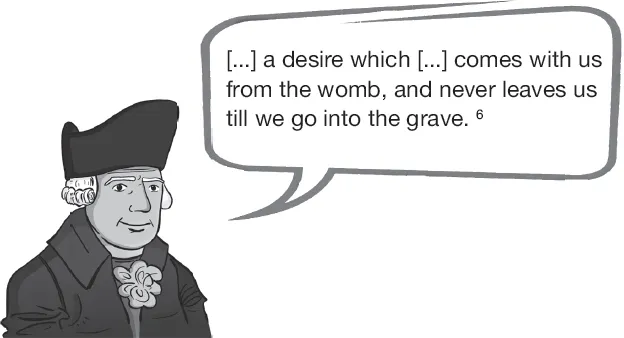
Smith, then, clearly states his basic belief that Man is essentially and entirely an egoist. But for Smith this is no bad thing but rather the source of all progress. Because, as he argues, “the pleasures of wealth and greatness [...] strike the imagination as something grand and beautiful and noble, of which the attainment is well worth all the toil and anxiety which we are so apt to bestow upon it.”7 Man thus runs great risks and makes great efforts with a view to gaining prosperity. And even if the pleasure of personal profit proves, in the end, not to be so great, the years of committed industriousness will have served, indirectly, to improve conditions of life for all:
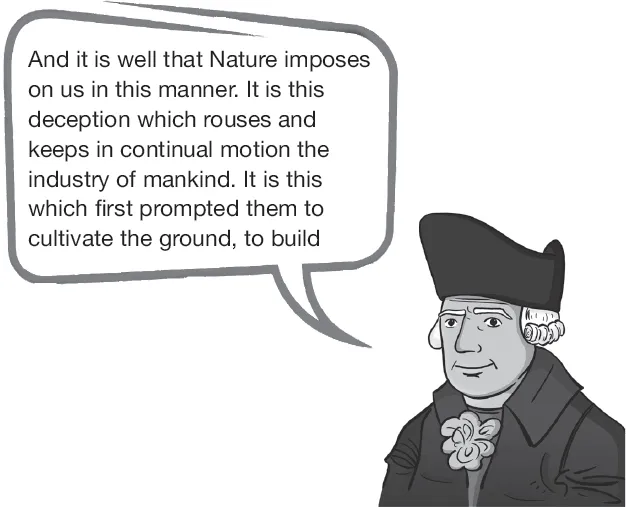
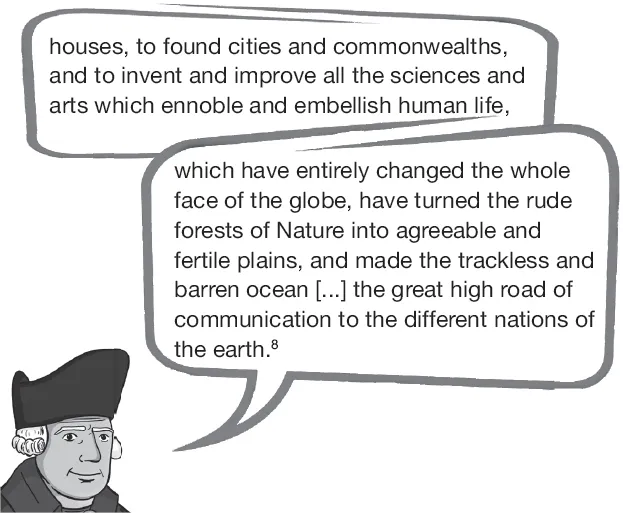
It is self-interest, then, that motivates historical progress and the global process of civilization. The first stage of development here is the age of hunters and gatherers. Human beings gain their livelihood by hunting or by gathering the fruits of the earth. In this era there is no property. Tribes work together to hunt down animals and share the results. Smith considers the American Indians who followed the buffalo herds across the Great Plains to be an example of a highly developed hunter culture. Accumulation of property was impossible here because each Indian could own no more than could be transported behind a horse from site to site. Hunter-gatherer society, therefore, displays great equality. In this stage of history there is not even a government, because:
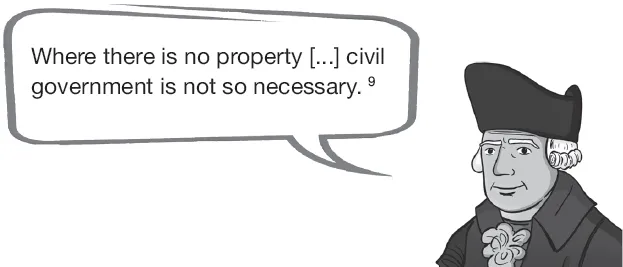
The second great historical epoch is that of shepherds and cattle-breeders. Man has now discovered that it is easier to breed animals than hunt them in the wild. Livelihoods are now gained by animals’ domestication. There thus arises property in the form of camels, sheep or cattle. But no true government comes into being as yet.
This we see for the first time in the next epoch: that of agriculture. The reason for this, says Smith, is that livelihoods are now gained by the planting of fields, so that tracts of land must now be fenced off. Property arises in the form of ownership of this land, which makes the landless totally and non-reciprocally dependent on the landowners. Life is now hard for those who own nothing.
The slaves, serfs and villeins who worked land held by feudal tenure were not only materially dependent on their landlord, being bound to perform unpaid work for him; they were also forbidden to move elsewhere and even had to ask their lord’s permission to marry. This one-sided dependency, argues Smith, led to a stagnation of production:
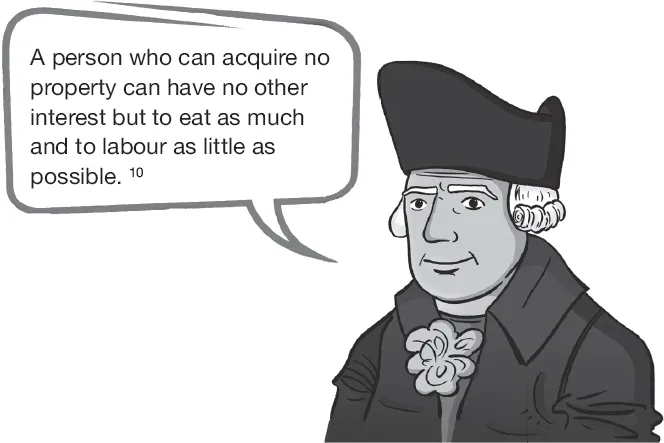
Here too it is clear that Smith considers self-interest to be Man’s strongest motive. Since Man is egoistic and always seeks his advantage, a slave or a serf will naturally work as little as possible. Working more would bring him nothing, since he must cede the whole harvest to the landlord anyway. This latter’s accumulating riches also gives rise to ever greater resentment:
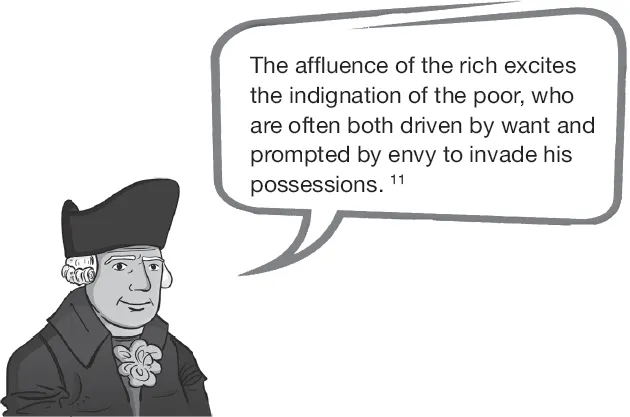
Serfs and landless peasants also remain, during this stage of history, legally dependent, since their noble feudal lord is both legislator and judge. This feudal society is the first in history, then, to need a government and civil authorities because – so Smith argues – without these the inequality of this society could not be enforced:

Smith, then, sees the state – much as Marx did a century later – as, in its origin, a tool of the ruling classes used to maintain social inequality. But for Smith all this changes in the next stage of history
There now occurs an unexpected turn in the history of mankind: namely, the transition to our modern industrial era. Smith speaks here of a revolutionary change: specifically, of “the great revolution”. On the view defended by Smith there has really only been one true revolution: the Industrial Revolution. Because “revolution” comes from the Latin word revoluere, meaning “to turn around”, “turn over” or “transform”. And human life has in fact never, at any point in history, been so fundamentally transformed in so short a time as through the transition from agricultural to industrial society.
The modern industrial worker is no longer, as the peasant farmer had been, dependent on the seasons, or even on the rhythm of day and night. Thanks to canning and other preservative methods and new forms of transport, things can now be eaten all year round that could once only be eaten in specific seasons. Extended families are disintegrating. More and more people live in cities. But above all – and this, for Smith, is the decisive difference – people now gain their livelihoods by the exchange of commodities for money. This money comes either from some form of annuity, from invested capital, or from the sale of one’s own labour.
The line between the “haves” and “have-nots” is no longer absolute. Because in industrial society even a man who owns no land or capital is at least the owner of his own labour-power. This he can sell competitively on the market. Smith celebrates this as a great historical gain:
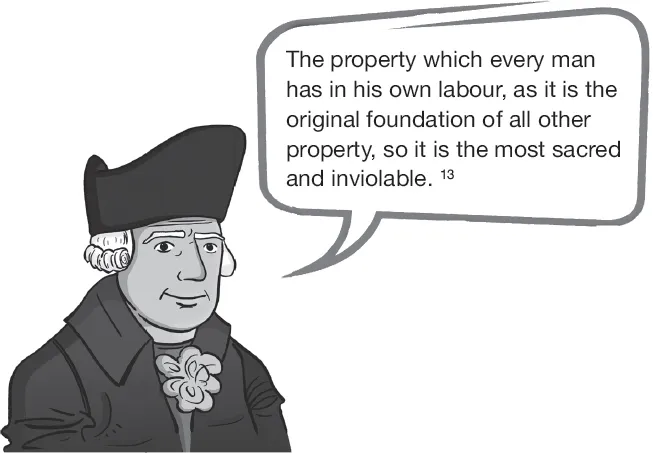
The factory workers as well as the agricultural workers are no longer bound, as in the Middle Ages, to a single piece of land, slaves to a feudal lord who maintains their lives with recompense “in kind”. Rather, they can move about freely and even save from their wages to build up their own capital, emigrate to America, or open their own business. Such mobility, indeed, was still limited in Smith’s day; but the one-sided dependency of feudal society was already beginning inexorably to give way to the “dependency of all on all” of the industrial age. The factory-owner is dependent on the workers who sell him their labour, the suppliers who provide raw materials, and on the wholesalers, retailers and consumers who, in the end, buy what he produces.
This mutual economic dependency that characterizes a developed market society leads, argues Smith, to greater personal freedom and, in the end, to equality before the law. Smith believed, as Marx did later, that a material change in the mode of production was always necessarily followed by a change in the political form of society. Not only the well-off bourgeoisie, prophesied Smith, but also ordinary workers would, sooner or later, due to their essential role in economic life, begin to press for political power and universal free elections. And within a hundred years this had indeed happened in most European countries. But most especially Smith saw the transition to industrial society as involving the shattering of the restraints of the old guild system. Formerly, the blacksmith’s son was bound to become a blacksmith, the baker’s son a baker, the serf’s son a serf etc. But in modern society with its division of labour, Smith foretold, all these medieval guild restrictions would sooner or later be swept away. Here too he was proven right.
It must be borne in mind that Smith was writing at the very beginning of this Industrial Revolution. The first cotton mills and still quasi-artisanal factories had just begun to arise. The steam engine had been invented but there were, as yet, no railways. Nevertheless Smith recognized the tremendous explosive power of the new mode of production, seeing industrial society as the fourth and highest stage of human social development after the stages of hunter-gatherer, pastoral, and agricultural production. Only now, as a consequence of industrialization, was there a historical chance of an entire nation’s, and eventually – such was Smith’s great vision – of all mankind’s, enjoying prosperity. It was not least for this reason that he entitled the book which brought him fame The Wealth of Nations.
The Division of Labour
One reason for Smith’s optimistic prognosis was the emergence, in his lifetime, of the practice of the division of labour. To point up the enormous efficiency of the new industrial mode of production Smith uses his famous example of the pin-maker:
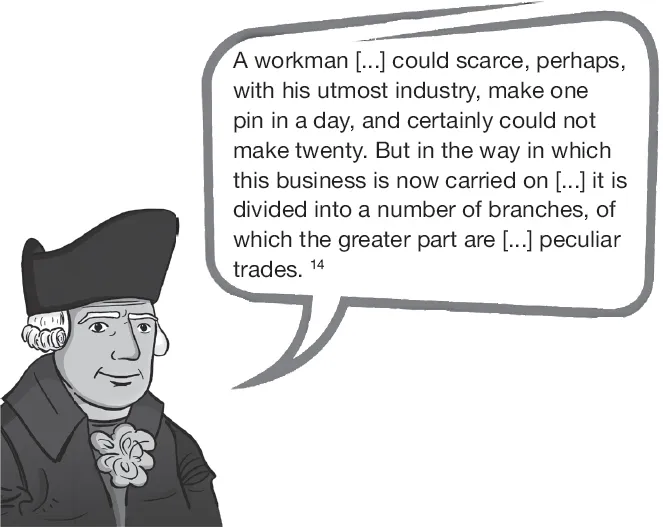
Whereas, formerly, a worker had formed and forged, alone, a single needle from beginning to end – setting the head on it himself and so on – he now takes on only a small part of the production process and passes his part-product on to other workers:
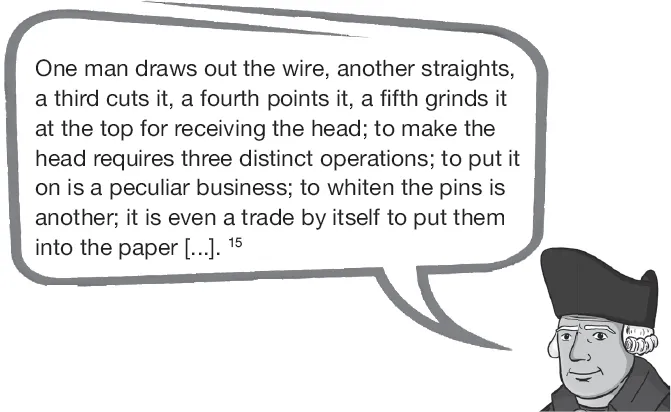
Smith himself had visited such a pin manufactory in which ten men were employed, each specializi...
Table of contents
- Dedication
- Table of Contents
- Smith’s Great Discovery
- Smith’s Central Idea
- Of What Use is Smith’s Discovery for Us Today?
- Bibliographical References
- Already published in the same series
- Coming soon in the same series
- The author
- Copyright
Trusted by 375,005 students
Access to over 1.5 million titles for a fair monthly price.
Study more efficiently using our study tools.
Frequently asked questions
Yes, you can cancel anytime from the Subscription tab in your account settings on the Perlego website. Your subscription will stay active until the end of your current billing period. Learn how to cancel your subscription
No, books cannot be downloaded as external files, such as PDFs, for use outside of Perlego. However, you can download books within the Perlego app for offline reading on mobile or tablet. Learn how to download books offline
Perlego offers two plans: Essential and Complete
- Essential is ideal for learners and professionals who enjoy exploring a wide range of subjects. Access the Essential Library with 800,000+ trusted titles and best-sellers across business, personal growth, and the humanities. Includes unlimited reading time and Standard Read Aloud voice.
- Complete: Perfect for advanced learners and researchers needing full, unrestricted access. Unlock 1.5M+ books across hundreds of subjects, including academic and specialized titles. The Complete Plan also includes advanced features like Premium Read Aloud and Research Assistant.
We are an online textbook subscription service, where you can get access to an entire online library for less than the price of a single book per month. With over 1.5 million books across 990+ topics, we’ve got you covered! Learn about our mission
Look out for the read-aloud symbol on your next book to see if you can listen to it. The read-aloud tool reads text aloud for you, highlighting the text as it is being read. You can pause it, speed it up and slow it down. Learn more about Read Aloud
Yes! You can use the Perlego app on both iOS and Android devices to read anytime, anywhere — even offline. Perfect for commutes or when you’re on the go.
Please note we cannot support devices running on iOS 13 and Android 7 or earlier. Learn more about using the app
Please note we cannot support devices running on iOS 13 and Android 7 or earlier. Learn more about using the app
Yes, you can access Smith in 60 Minutes by Walther Ziegler in PDF and/or ePUB format, as well as other popular books in Business & Business General. We have over 1.5 million books available in our catalogue for you to explore.