- 125 pages
- English
- ePUB (mobile friendly)
- Available on iOS & Android
eBook - ePub
About this book
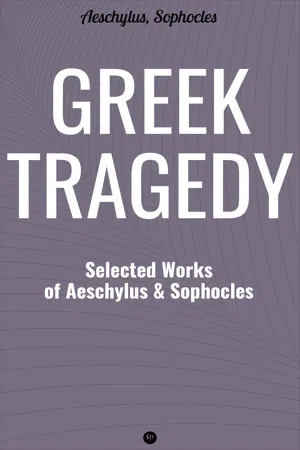
"Greek Tragedy" is meticulously edited collection of the most famous plays written by Aeschylus and Sophocles.
Aeschylus (525/524 – c. 456/455 BC) was an ancient Greek tragedian. He is often described as the father of tragedy. According to Aristotle, he expanded the number of characters in theater allowing conflict among them; characters previously had interacted only with the chorus.
Sophocles (c. 497/6 – 406/5 BC) is one of three ancient Greek tragedians whose plays have survived. His first plays were written later than those of Aeschylus, and earlier than or contemporary with those of Euripides. Sophocles wrote over 120 plays. For almost 50 years, Sophocles was the most celebrated playwright in the dramatic competitions of the city-state of Athens.
Contents:
Prometheus Bound
The Persians
The Seven Against Thebes
Agamemnon
The Choephoroe
The Eumenides
Oedipus At Colonus
Antigone
Ajax
Electra
Information
Subtopic
Ancient & Classical DramaIndex
LiteratureSOPHOCLES
OEDIPUS THE KING.
Table of Contents
Oedipus is the son of Laius, King of Thebes, and Queen Jocasta. It had been prophesied of him, before his birth, that he would kill his father and lie with his mother. To avert this, when born, he is devoted by his mother to death by exposure on a mountain. But he is saved and taken to Polybus, King of Corinth, who adopts him, and whose son he believes himself to be. Having heard of the prophecy concerning himself, he leaves Corinth to avoid its fulfilment; but on his road falls in with Laius, has a quarrel with his attendants, and kills him. He then goes to Thebes, delivers the Thebans from the Sphinx, by guessing her riddle, is rewarded with the kingdom, and marries the widowed Queen Jocasta, his own mother, who bears children to him. The gods, offended by the presence of murder and incest, send a plague on Thebes. Oedipus sends his brother-in-law, Creon, to consult the oracle at Delphi respecting the visitation. The oracle bids the Thebans expel the murderer of Laius. This leads to an inquiry after the murderer, and through successive disclosures, in the management of which the poet exerts his art, to the revelation of the dreadful secret. It is a story of overmastering fate.
* * * * *
THE PLAGUE.
The plague sent by the angry gods is raging at Thebes. The people are gathered in supplication round the altars before the palace of Oedipus, who comes forth to them.
LINES 1-77.
OEDIPUS.
My children, progeny of Cadmus old,
Why in this posture do I find you here,
With wool-wreathed branches in your suppliant hands?
The city is with breath of incense filled,
Filled with sad chant, and voices of lament,
Whereof the truth to learn from other lips
Deeming not right, myself am present here,
That Oedipus, the world-renowned, am hight.
Say, reverend sir, since thee it well beseems
To speak for all, what moves this company,
Fear or desire? Know that I fain would aid
With all my power. Hard-hearted I must be
If pity for such suppliants touched me not.
Why in this posture do I find you here,
With wool-wreathed branches in your suppliant hands?
The city is with breath of incense filled,
Filled with sad chant, and voices of lament,
Whereof the truth to learn from other lips
Deeming not right, myself am present here,
That Oedipus, the world-renowned, am hight.
Say, reverend sir, since thee it well beseems
To speak for all, what moves this company,
Fear or desire? Know that I fain would aid
With all my power. Hard-hearted I must be
If pity for such suppliants touched me not.
THE PRIEST.
Oedipus, puissant ruler of our land,
Behold us prostrate at thy altars here,
And mark our ages; some are callow boys,
Others are priests laden with years, as I
Am priest of Zeus; others are chosen youths.
The rest, with suppliant emblems in their hands,
Sit in the mart, or at the temples twain
Of Pallas' or Ismenus' prescient hearth.
The city, as thou dost perceive, is tossed
On the o'er-mastering billows, and no more
Can lift her head above the murderous surge.
Her foodful fruits all withering in the germ,
Her flocks and herds expiring on the lea,
Her births abortive, while the fiery fiend
Of deadly pestilence has swooped on her,
Making the homes of Cadmus desolate,
And gluts dark Hades with the wail of death.
An equal of the gods, I and these youths
That here sit on this earth, account thee not;
But we account thee first of men to deal
With visitation or cross accident.
A stranger thou didst bring to us release
From tribute to that cruel songstress paid.
Advantage from our guidance thou hadst none,
'Twas by the inspiration of a god
As we believe that thou didst redeem our State.
Now, Oedipus, thou whom we all revere,
We bow before thee, and implore thy grace
To find some succour for us if thou canst
By heavenly teaching or through human aid.
In men, who by experience have been tried,
We find the happiest fruits of policy.
Come, best of men, lift up our city's head!
Look to thy own renown; thy zeal once shown
Has earned for thee a patriot saviour's name.
Let us not think of thee as of a prince
That raised us up to let us fall again;
But make our restoration firm and sure.
'Twas under happy omens that thou then
Didst succour us; what then thou wast, be now.
Our king thou art; if king thou wilt remain,
Reign o'er a peopled realm, not o'er a waste.
Naught is the bravest ship without her crew,
The strongest fort without its garrison.
Behold us prostrate at thy altars here,
And mark our ages; some are callow boys,
Others are priests laden with years, as I
Am priest of Zeus; others are chosen youths.
The rest, with suppliant emblems in their hands,
Sit in the mart, or at the temples twain
Of Pallas' or Ismenus' prescient hearth.
The city, as thou dost perceive, is tossed
On the o'er-mastering billows, and no more
Can lift her head above the murderous surge.
Her foodful fruits all withering in the germ,
Her flocks and herds expiring on the lea,
Her births abortive, while the fiery fiend
Of deadly pestilence has swooped on her,
Making the homes of Cadmus desolate,
And gluts dark Hades with the wail of death.
An equal of the gods, I and these youths
That here sit on this earth, account thee not;
But we account thee first of men to deal
With visitation or cross accident.
A stranger thou didst bring to us release
From tribute to that cruel songstress paid.
Advantage from our guidance thou hadst none,
'Twas by the inspiration of a god
As we believe that thou didst redeem our State.
Now, Oedipus, thou whom we all revere,
We bow before thee, and implore thy grace
To find some succour for us if thou canst
By heavenly teaching or through human aid.
In men, who by experience have been tried,
We find the happiest fruits of policy.
Come, best of men, lift up our city's head!
Look to thy own renown; thy zeal once shown
Has earned for thee a patriot saviour's name.
Let us not think of thee as of a prince
That raised us up to let us fall again;
But make our restoration firm and sure.
'Twas under happy omens that thou then
Didst succour us; what then thou wast, be now.
Our king thou art; if king thou wilt remain,
Reign o'er a peopled realm, not o'er a waste.
Naught is the bravest ship without her crew,
The strongest fort without its garrison.
OEDIPUS.
Poor children, little needs to tell me that
For which ye come to pray; too well I know
Ye all are sick. And, sick as ye may be,
There is not one whose sickness equals mine.
The grief of each of you touches himself,
And touches none beside: your sovereign's heart
Bears your griefs, and the city's and his own.
Not from a slumber have ye wakened me,
Trust me, I many an anxious tear have shed,
And many a path have tried in wandering thought.
Such remedy as, scanning all, I find
I have applied. Creon, Menoeceus' son
And my Queen's brother, to the Pythian shrine
Of Phoebus I have sent to ask what act
Or word of mine this city will redeem.
And now, as anxiously I mete the time,
My soul is troubled, for, to my surprise,
He has been absent longer than he ought.
But when he comes, a caitiff I shall be
If I do not all that the god ordains.
For which ye come to pray; too well I know
Ye all are sick. And, sick as ye may be,
There is not one whose sickness equals mine.
The grief of each of you touches himself,
And touches none beside: your sovereign's heart
Bears your griefs, and the city's and his own.
Not from a slumber have ye wakened me,
Trust me, I many an anxious tear have shed,
And many a path have tried in wandering thought.
Such remedy as, scanning all, I find
I have applied. Creon, Menoeceus' son
And my Queen's brother, to the Pythian shrine
Of Phoebus I have sent to ask what act
Or word of mine this city will redeem.
And now, as anxiously I mete the time,
My soul is troubled, for, to my surprise,
He has been absent longer than he ought.
But when he comes, a caitiff I shall be
If I do not all that the god ordains.
* * * * *
THE DAWN OF DISCOVERY.
Oedipus, having learned from the oracle that the cause of the wrath of the gods and of the plague is the presence of the murderer of Laius in the land, sends for the blind prophet, Tiresias, to tell him who is the murderer. Tiresias, knowing the secret, is reluctant to reveal it, and an altercation ensues, Oedipus suspecting that Tiresias has been set on by Creon, the Queen's brother, who he thinks is intriguing to supplant him in the monarchy.
LINES 300-462.
OEDIPUS.
Tiresias, thou whose thought embraces all,
Revealed or unrevealed, in heaven or earth,
In how sad plight our city is, thy mind,
If not thy eye, discerns. Prophet, in thee
Resides our sole hope of deliverance.
Phoebus, if thou hast not the tidings heard,
Has to our envoys answered, that the plague
Will never leave this city till we...
Revealed or unrevealed, in heaven or earth,
In how sad plight our city is, thy mind,
If not thy eye, discerns. Prophet, in thee
Resides our sole hope of deliverance.
Phoebus, if thou hast not the tidings heard,
Has to our envoys answered, that the plague
Will never leave this city till we...
Table of contents
- Greek Tragedy: Selected Works of Aeschylus and Sophocles
- Table of Contents
- PREFACE.
- AESCHYLUS
- SOPHOCLES OEDIPUS THE KING.
- THE TRACHINIAE.
Trusted by 375,005 students
Access to over 1.5 million titles for a fair monthly price.
Study more efficiently using our study tools.
Frequently asked questions
Yes, you can cancel anytime from the Subscription tab in your account settings on the Perlego website. Your subscription will stay active until the end of your current billing period. Learn how to cancel your subscription
No, books cannot be downloaded as external files, such as PDFs, for use outside of Perlego. However, you can download books within the Perlego app for offline reading on mobile or tablet. Learn how to download books offline
Perlego offers two plans: Essential and Complete
- Essential is ideal for learners and professionals who enjoy exploring a wide range of subjects. Access the Essential Library with 800,000+ trusted titles and best-sellers across business, personal growth, and the humanities. Includes unlimited reading time and Standard Read Aloud voice.
- Complete: Perfect for advanced learners and researchers needing full, unrestricted access. Unlock 1.5M+ books across hundreds of subjects, including academic and specialized titles. The Complete Plan also includes advanced features like Premium Read Aloud and Research Assistant.
We are an online textbook subscription service, where you can get access to an entire online library for less than the price of a single book per month. With over 1.5 million books across 990+ topics, we’ve got you covered! Learn about our mission
Look out for the read-aloud symbol on your next book to see if you can listen to it. The read-aloud tool reads text aloud for you, highlighting the text as it is being read. You can pause it, speed it up and slow it down. Learn more about Read Aloud
Yes! You can use the Perlego app on both iOS and Android devices to read anytime, anywhere — even offline. Perfect for commutes or when you’re on the go.
Please note we cannot support devices running on iOS 13 and Android 7 or earlier. Learn more about using the app
Please note we cannot support devices running on iOS 13 and Android 7 or earlier. Learn more about using the app
Yes, you can access Greek Tragedy: Selected Works of Aeschylus and Sophocles by Aeschylus,Sophocles in PDF and/or ePUB format, as well as other popular books in Literature & Ancient & Classical Drama. We have over 1.5 million books available in our catalogue for you to explore.