- 252 pages
- English
- ePUB (mobile friendly)
- Available on iOS & Android
eBook - ePub
The Story of Liberty (Illustrated Edition)
About this book
This "Story of Liberty" is a true narrative. It covers a period of five hundred years fight for liberty, from the Magna Carta (1215) up to the landing of the Pilgrims in Massachusetts (1620)
Contents:
John Lackland and the Barons
The Man Who Preached After He Was Dead
The Fire That Was Kindled in Bohemia
What Laurence Coster and John Gutenberg Did for Liberty
The Men Who Ask Questions
How a Man Tried to Reach the East by Sailing West
The New Home of Liberty
A Boy Who Objected to Marrying His Brother's Widow
The Man Who Can Do No Wrong
The Boy Who Sung for His Breakfast
What the Boy Who Sung for His Breakfast Saw in Rome
The Boy-Cardinal
The Boy-Emperor
The Field of the Cloth of Gold
The Men Who Obey Orders
Plans That Did Not Come to Pass
The Man Who Split the Church in Twain
The Queen Who Burned Heretics
How Liberty Began in France
The Man Who Filled the World With Woe
Progress of Liberty in England
How the Pope Put Down the Heretics
The Queen of the Scots
St. Bartholomew
How the "Beggars" Fought for Their Rights
Why the Queen of Scotland Lost Her Head
The Retribution That Followed Crime
William Brewster and His Friends
The Star of Empire
The "Half-Moon"
Strangers and Pilgrims
Information
Subtopic
Early American HistoryIndex
HistoryThe Story of Liberty (Illustrated Edition)
Madison & Adams Press, 2019
Contact [email protected]
Contact [email protected]
ISBN 978-80-273-0499-8
This is a publication of Madison & Adams Press. Our production consists of thoroughly prepared educational & informative editions: Advice & How-To Books, Encyclopedias, Law Anthologies, Declassified Documents, Legal & Criminal Files, Historical Books, Scientific & Medical Publications, Technical Handbooks and Manuals. All our publications are meticulously edited and formatted to the highest digital standard. The main goal of Madison & Adams Press is to make all informative books and records accessible to everyone in a high quality digital and print form.
Table of Contents
INTRODUCTION
CHAPTER I JOHN LACKLAND AND THE BARONS
CHAPTER II THE MAN WHO PREACHED AFTER HE WAS DEAD
CHAPTER III THE FIRE THAT WAS KINDLED IN BOHEMIA
CHAPTER IV WHAT LAURENCE COSTER AND JOHN GUTTENBERG DID FOR LIBERTY
CHAPTER V THE MEN WHO ASK QUESTIONS
CHAPTER VI HOW A MAN TRIED TO REACH THE EAST BY SAILING WEST
CHAPTER VII THE NEW HOME OF LIBERTY
CHAPTER VIII A BOY WHO OBJECTED TO MARRYING HIS BROTHER'S WIDOW
CHAPTER IX THE MAN WHO CAN DO NO WRONG
CHAPTER X THE BOY WHO SUNG FOR HIS BREAKFAST
CHAPTER XI WHAT THE BOY WHO SUNG FOR HIS BREAKFAST SAW IN ROME
CHAPTER XII THE BOY-CARDINAL
CHAPTER XIII THE BOY-EMPEROR
CHAPTER XIV THE FIELD OF THE CLOTH OF GOLD
CHAPTER XV THE MEN WHO OBEY ORDERS
CHAPTER XVI PLANS THAT DID NOT COME TO PASS
CHAPTER XVII THE MAN WHO SPLIT THE CHURCH IN TWAIN
CHAPTER XVIII THE QUEEN WHO BURNED HERETICS
CHAPTER XIX HOW LIBERTY BEGAN IN FRANCE
CHAPTER XX THE MAN WHO FILLED THE WORLD WITH WOE
CHAPTER XXI PROGRESS OF LIBERTY IN ENGLAND
CHAPTER XXII HOW THE POPE PUT DOWN THE HERETICS
CHAPTER XXIII THE QUEEN OF THE SCOTS
CHAPTER XXIV ST. BARTHOLOMEW
CHAPTER XXV HOW THE "BEGGARS" FOUGHT FOR THEIR RIGHTS
CHAPTER XXVI WHY THE QUEEN OF SCOTLAND LOST HER HEAD
CHAPTER XXVII THE RETRIBUTION THAT FOLLOWED CRIME
CHAPTER XXVIII WILLIAM BREWSTER AND HIS FRIENDS
CHAPTER XXIX THE STAR OF EMPIRE
CHAPTER XXX THE "HALF-MOON"
CHAPTER XXXI STRANGERS AND PILGRIMS
INTRODUCTION
Table of Contents
This "Story of Liberty" is a true narrative. It covers a period of five hundred years, and is an outline of the march of the human race from Slavery to Freedom.
There are some points in this book to which I desire to direct your attention. You will notice that the events which have given direction to the course of history have not always been great battles, for very few of the many conflicts of arms have had any determining force; but it will be seen that insignificant events have been not unfrequently followed by momentous results: You will see that everything of the present, be it good or bad, may be traced to something in the past; that history is a chain of events. You will also notice that history is like a drama, and that there are but a few principal actors. How few there have been!
The first to appear in this "Story" is King John of England. Out of his signing his. name to the Magna Charta have come the Parliament of Great Britain and the Congress of the United States, and representative governments everywhere. The next actors were John Wicklif and Geoffrey Chaucer, who sowed seed that is now ripening in individual liberty. Then came Henry VII., Henry VIII, Katherine of Aragon, Anne Boleyn, Katherine's daughter (Mary Tudor), Cardinal Wolsey, Archbishop Cranmer, Anne Boleyn's daughter (Elizabeth), King James, John Smith, John Robinson, William Brewster, and the men and women of Austerfield and Scrooby.
In Scotland were Mary Stuart and George Buchanan; in Bohemia, Professor Faulfash and John Huss; in Germany, the boy who sung for his breakfast (Martin Luther), Duke Frederick, John Tetzel, and John Guttenberg; in Holland, Laurence Coster, Doctor Erasmus, and William the Silent; in France, Francis I., Catherine de' Medici, the Duke of Guise, Charles IX., and Henry IV.; in Spain, Thomas de Torquemada, Isabella, Ferdinand, Christopher Columbus, Charles V., Philip II., and Loyola; in Italy, Alexander VI and Leo X. These have taken great parts in the drama: actively or passively, they have been the central figures.
One other thing: you will notice that the one question greater than all others has been in regard to the right of men to think for themselves, especially in matters pertaining to religion. Popes, archbishops, cardinals, bishops, and priests have disputed the right, to secure which hundreds of thousands of men and women have yielded their lives. You will also take special notice that nothing is said against religion — nothing against the Pope because he is Pope; nothing against a Catholic because he is a Catholic; nor against a Protestant because he protests against the authority of the Church of Rome. Facts of history only are given.' Catholics and Protestants alike have persecuted, robbed, plundered, maltreated, imprisoned, and burned men and women for not believing as they believed. Through ignorance, superstition, intolerance, and bigotry; through thinking that they alone were right, and that those who differed with them were wrong; forgetting that might never makes right; honestly thinking that they were doing God service in rooting out heretics, they filled the world with woe.
There is still another point to be noticed: that the successes of those who have struggled to keep men in slavery have often proved to be in reality failures; while the defeats of those who were fighting for freedom have often been victories. Emperors, kings, cardinals, priests, and popes have had their own way, and yet their plans have failed in the end. They plucked golden fruit, which changed to apples of Sodom. Mary Tudor resolutely set herself to root out all heretics, and yet there were more heretics in England on the day of her death than when she ascended the throne. Charles V. and Philip II. grasped at universal dominion; but their strength became weakness, their achievements failures. On the other hand, see what has come from disaster! How bitter to John Robinson, William Brewster, and the poor people of Scrooby and Austerfield, to be driven from home, to be exiles! But out of that bitterness has come the Republic of the Western world! Who won — King James, or John Robinson and William Brewster?
There is still one other point: you will notice that while the oppressors have carried out their plans, and had things their own way, there were other forces silently at work, which in time undermined their plans, as if a Divine hand were directing the counter-plan. Whoever peruses the "Story of Liberty" without recognizing this feature will fail of fully comprehending the meaning of history. There must be a meaning to history, or else existence is an incomprehensible enigma.
Some men assert that the marvellous events of history are only a series of coincidences; but was it by chance that the great uprising in Germany once lay enfolded, as it were, in the beckoning hand of Ursula Cotta? How happened it that behind the passion of Henry VIII. for Anne Boleyn should be the separation of England from the Church of Rome, and all the mighty results to civilization and Christianity that came from that event? How came it to pass that, when the world was ready for it, and not before, George Buchanan should teach the doctrine that the people were the only legitimate source of power? Men act freely in laying and executing their plans; but behind the turmoil and conflict of human wills there is an unseen power that shapes destiny — nations rise and fall, generations come and go; yet through the ages there has been an advancement of Justice, Truth, Right, and Liberty. To what end? Is it not the march of the human race toward an Eden of rest and peace?
If while reading this "Story" you are roused to indignation, or pained at the recital of wrong and outrage, remember that out of endurance and sacrifice has come all that you hold most dear; so will you comprehend what Liberty has cost, and what it is worth.
Charles Carleton Coffin.
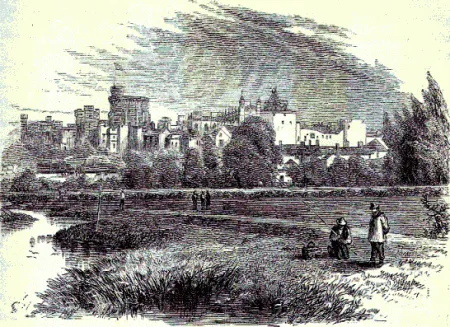
WINDSOR CASTLE, FROM THE MEADOW AT RUNNYMEDE.
CHAPTER I
JOHN LACKLAND AND THE BARONS
Table of Contents
AT the time when this story begins there is very little liberty in the world. It is the 15th of June, and the grass is fresh and green in the Runnymede meadow, where the Army of God has set up its encampment. No other army like it was ever seen. All the great men of England are in its ranks — the barons and lords, the owners of castles who ride on noble horses, wear coats of mail, and are armed with swords and lances.
Pavilions and tents dot the meadow; flags and banners wave in the summer air; General Fitzwalter is commander. There is no hostile army near at hand, nor will there be any clashing of arms on this 15th of June, and yet before the sun goes down the Army of God will win a great vitory over the King of England, Jolin Lackland, who is in Windsor Castle, which overlooks the meadow from the south side of the river Thames, which comes down from the north-west and sweeps on to London.
The king is called John Lackland because his father did not deed him any land. His brother was Richard Cœur de Lion — the lion-hearted — who was brave, but also wicked and cruel. He commanded the Crusaders, and fought the Saraceus under Saladin, in Palestine. One day he told his cook to have some fresh pork for dinner, but the cook had no pork, nor did he know where to find a pig. He was in trouble, for if there was no pork on the table he won1d stand a chance of having his head chopped o£F. He had heard it said, however, that human fresh tasted like pork. Knowing that no pork was to be had, he killed a Saracen prisoner and cooked some of the flesh and placed it on the table.
The king praised the dinner. Perhaps, however, he mistrusted that it was not pork, for, said Richard," Bring in the head of the pig, that I may see it."
The poor cook knew not what to do. Now he certainly would ha^e his head cut off. With much trembling he brought in the head of the Saracen. The king laughed when he saw it.
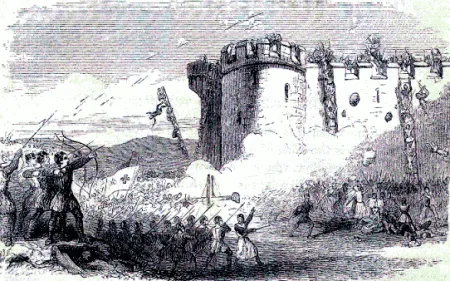
BATTLE OF ACRE.
"We shall not want for pork as long as we have sixty thousand prisoners," he paid, not in the least disturbed to know that he had been eating human flesh. The Saracen general — Saladin — sent thirty ambassadors to Richard beseeching him not to put the prisoners to death, Richard gave the...
Table of contents
- The Story of Liberty (Illustrated Edition)
Trusted by 375,005 students
Access to over 1.5 million titles for a fair monthly price.
Study more efficiently using our study tools.
Frequently asked questions
Yes, you can cancel anytime from the Subscription tab in your account settings on the Perlego website. Your subscription will stay active until the end of your current billing period. Learn how to cancel your subscription
No, books cannot be downloaded as external files, such as PDFs, for use outside of Perlego. However, you can download books within the Perlego app for offline reading on mobile or tablet. Learn how to download books offline
Perlego offers two plans: Essential and Complete
- Essential is ideal for learners and professionals who enjoy exploring a wide range of subjects. Access the Essential Library with 800,000+ trusted titles and best-sellers across business, personal growth, and the humanities. Includes unlimited reading time and Standard Read Aloud voice.
- Complete: Perfect for advanced learners and researchers needing full, unrestricted access. Unlock 1.5M+ books across hundreds of subjects, including academic and specialized titles. The Complete Plan also includes advanced features like Premium Read Aloud and Research Assistant.
We are an online textbook subscription service, where you can get access to an entire online library for less than the price of a single book per month. With over 1.5 million books across 990+ topics, we’ve got you covered! Learn about our mission
Look out for the read-aloud symbol on your next book to see if you can listen to it. The read-aloud tool reads text aloud for you, highlighting the text as it is being read. You can pause it, speed it up and slow it down. Learn more about Read Aloud
Yes! You can use the Perlego app on both iOS and Android devices to read anytime, anywhere — even offline. Perfect for commutes or when you’re on the go.
Please note we cannot support devices running on iOS 13 and Android 7 or earlier. Learn more about using the app
Please note we cannot support devices running on iOS 13 and Android 7 or earlier. Learn more about using the app
Yes, you can access The Story of Liberty (Illustrated Edition) by Charles Carleton Coffin in PDF and/or ePUB format, as well as other popular books in History & Early American History. We have over 1.5 million books available in our catalogue for you to explore.