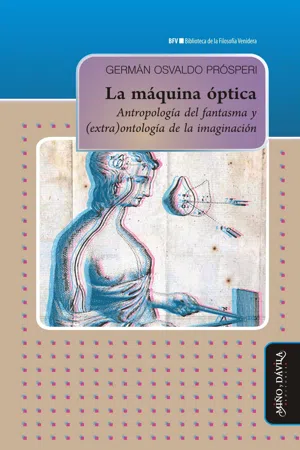
"Fue en los márgenes, en el Asia Menor, en aquella tierra luego sometida a los dictados de Ciro, donde nació el rapsoda Jenófanes quien, por vez primera, pronunció el enigma que dice, en referencia a la divinidad, que "todo entero ve, todo entero piensa". El designio marcó de manera indeleble la historia de la filosofía occidental que se quiso un andamiaje donde el régimen de la visibilidad fuese equivalente a las series de los pensamientos. El Ojo de la metafísica hizo entonces su aparición, aún innominada, para que otros la desarrollasen en el futuro: Platón, Aristóteles, Agustín de Hipona o René Descartes.La apuesta de este libro asume la audaz tarea de volver inteligible la propia matriz de luminosidad de la metafísica buscando que, en un acto inusitado, el Ojo pueda verse a sí mismo en las condiciones de su optocracia. Este proyecto arqueológico admirablemente desentraña los secretos del binocularcentrismo occidental pues el Ojo, en verdad, puede serlo del cuerpo o del alma. Se articulan así los dos engranajes fundamentales de la máquina óptica cuyo artificio más propio es nada menos que el humano mismo comprendido como imagen. Si el hombre no es más que el fantasma de una maquinaria que no cesa de complejizarse con el correr de los siglos, ¿cómo sería posible superar las aporías de este dispositivo caracterizado por la diplopía?Germán Prósperi, uno de los filósofos más originales de nuestro presente, asume la tarea de idear de un modo completamente nuevo la cuestión insoslayable de la imagen y, por ende, la naturaleza misma de lo humano en cuanto tal. Con este horizonte, el lector es invitado a preguntarse por los meandros inesperados que unen la mística sufí con la poesía de William Blake o bien por los encantos del arpa eólica que se entrecruzan con las maravillas de la Flatland de Abbott. Un proyecto de semejante envergadura supone una sub-ontología del quiasmo o, dicho de otro modo, un pensamiento especulativo de lo imaginal libre, al fin, de las trampas del Ojo soberano" (Fabián Ludueña Romandini).
eBook - ePub
La máquina óptica
Antropología del fantasma y (extra)ontología de la imaginación
- 616 pages
- English
- ePUB (mobile friendly)
- Available on iOS & Android
eBook - ePub
La máquina óptica
Antropología del fantasma y (extra)ontología de la imaginación
About this book
Information
Topic
PhilosophySubtopic
Philosophical MetaphysicsBibliografía
Se consignan aquí únicamente las obras citadas a lo largo del libro.
Las traducciones pertenecen al autor salvo en los casos en los que una edición castellana es explícitamente mencionada.
Libros
ABBOTT ABBOTT, Edwin (1885). Flatland: A Romance of Many Dimensions. Boston: Roberts Brothers.
ABRAHAMOV, Binyamin (2014). Ibn al-ʿArabī and the Sufis. Oxford: Anqa Publishing.
ABRAM, Jan (2007). The Language of Winnicott. A Dictionary of Winnicott’s Use of Words. London: Karnac.
ABRAMS, Meyer H. (1971). The Mirror and the Lamp: Romantic Theory and The Critical Tradition. London – Oxford – New York: Oxford University Press.
ADAMS, Suzi (2011). Castoriadis’s Ontology. New York: Fordham University Press.
AGAMBEN, Giorgio & DELEUZE, Gilles (1993). Bartleby. La formula della creazione. Macerata: Quodlibet.
AGAMBEN, Giorgio (1978). Infanzia e storia: Distruzione dell’esperienza e origine della storia. Torino: Einaudi.
AGAMBEN, Giorgio (1998). Image et mémoire. Paris: Éditions Hoëbeke.
Agamben, Giorgio (2002). L’aperto. L’uomo e l’animale. Torino: Bollati Boringhieri.
AGAMBEN, Giorgio (2005). La potenza del pensiero. Saggi e conferenze. Vicenza: Neri Pozza.
AGAMBEN, Giorgio (2006). Estancias. La palabra y el fantasma en la cultura occidental. Valencia: Pre-Textos. Traducido por Tomás Segovia.
AGAMBEN, Giorgio (2007). Il Regno e la Gloria. Per una genealogia teologica dell’economia e del governo. Vicenza: Neri Pozza.
Agamben, Giorgio (2007). Ninfe. Torino: Bollati Boringhieri.
AGAMBEN, Giorgio (2014). L’uso dei corpi. Vicenza: Neri Pozza.
AGAMBEN, Giorgio (2017). Karman. Breve trattato sull’azione, la colpa e il gesto. Torino: Bollati Boringhieri.
AGUSTÍN DE HIPONA (1957). De Genesis ad litteram. Madrid: Biblioteca de los Autores Cristianos, tomo XV.
AGUSTÍN DE HIPONA (1971). De Spiritu et littera. Madrid: Biblioteca de los Autores Cristianos, tomo VI.
AGUSTÍN DE HIPONA (1974-1977). Confessionum libri XIII. Madrid: Biblioteca de los Autores Cristianos, tomo II.
AGUSTÍN DE HIPONA (1994). Soliloquiorum libri duo. Madrid: Biblioteca de los Autores Cristianos, tomo I.
AGUSTÍN DE HIPONA (2006). De Trinitate. Madrid: Biblioteca de los Autores Cristianos, tomo V.
AGUSTÍN DE HIPONA (2007). De civitate Dei. Madrid: Biblioteca de los Autores Cristianos, tomos XVI-XVII.
al-‘Arabī (1852). Al-Futûhât al-Makkiyya. Bulaq Dar al-tiba’ah al-bahirah. Edición inglesa: Chodkiewicz, Michel (ed.) (2002). The Meccan Revelations. Varios volúmenes. Pir Press. Traducido por William C. Chittick & James W. Morris.
ALHACÉN (1622). “Kitab al-Manazir”. En: Opticae Thesaurus Libri Septem. Basileae: Per Episcopios.
Alighieri, Dante (1994). Divina Commedia. A cura di Giorgio Petrocchi. Firenze: Casa Editrice Le Lettere.
ALMOND, Ian (2004). Sufism and Deconstruction. A comparative study of Derrida and Ibn’Arabi. London – New York: Routledge.
ALTHUSSER, Louis & BALIBAR, Étienne (1973). Lire Le Capital. Tome I. Paris: François Maspero.
Altizer, Thomas (2000). The New Apocalypse: The Radical Christian Vision of William Blake. Colorado: The Michigan State University Press.
Ambrosi, Luigi (1898). La psicologia della immaginazione nella storia della filosofía. Roma: Società Editrice Dante Alighieri.
AMBUEL, David (2007). Image and Paradigm in Plato’s Sophist. Las Vegas – Zurich – Athens: Parmenides Publishing.
Anastos, Milton V. (1979). Studies in Byzantine Intellectual History. London: Variorum Reprints.
ANDERS, Günther (2011). La obsolescencia del hombre. Sobre el alma en la época de la segunda revolución industrial. Vol. I. Valencia: Pre-Textos.
ANDREWS, Carol (1994). Amulets on Ancient Egypt. London: British Museum Press.
ANNAS, Julia (1981). An Introduction to Plato’s Republic. Oxford: Clarendon Press.
ANTONOVA, Clemena (2009). Space, Time, and Presence in the Icon. Seeing the World with the eyes of God. Farnham – Burlington: Ashgate Publishing Company.
APULEYO (1914). Apologia sive pro se de magia liber. Oxford: Clarendon Press. Introducción y comentarios por Harold Edgeworth y Arthur Synge Owen.
Arendt, Hannah (1978). The Life of the Mind. New York: Harcourt Inc.
ARISTÓTELES (1846). Psychologie d’Aristote: traité de l’âme. Paris: Librairie Philosophique de Ladrange. Traducido por Jules Barthélemy-Saint-Hilaire.
Aristóteles (1976). Metafísica. Buenos Aires: Sudamericana. Traducido por Hernán Zuchi.
Aristóteles (1978). Acerca del alma. Madrid: Gredos. Traducido por Tomás Calvo Martínez.
ARISTÓTELES (1987). “De sensu et sensibilibus”. En: Tratados breves de historia natural. Madrid: Gredos. Traducido por Alberto Bernabé Pajares.
ARISTÓTELES (2004). Problemas. Madrid: Gredos. Traducido por Ester Sánchez Millán.
ARMSTRONG, M. A. (1983). Basic Topology. New York: Springer.
ASÍN PALACIOS, Miguel (1931). El Islam cristianizado. Estudio del “Sufismo” a través de las obras de Abenarabi de Murcia. Madrid: Plutarco.
AYRES, Lewis (2010). Augustine and the Trinity. New York: Cambridge University Press.
BACHELARD, Gaston (1942). L’eau et les rêves. Essai sur l’imagination de la matière. Paris: José Corti.
BACHELARD, Gaston (1948). La terre et les rêveries du repos. Paris: José Corti.
BACHELARD, Gaston (1970). Le droit de rêver. Paris: P.U.F.
BADIOU, Alain (1992). Conditions. Paris: Éditions du Seuil.
BADIOU, Alain (1997). Deleuze. El clamor del Ser. Buenos Aires: Manantial. Traducido por Dardo Scavino.
Balthasar, Hans Urs von (1998). Theodramatik. Die Personen des Spiels: 2. Teil: Die Personen in Christus. Einsiedeln: Johannes.
BARBARAS, Renaud (2004). The Being of the Phaenomenon. Merleau-Ponty’s Ontology. Bloomington – Indianapolis: Indiana University Press.
BARCLAY, William (1962). Flesh and Spirit: An Examination of Galatians 5, 19-23. London: SCM Press.
BARR SMITH, Robert (1738). A Compleat System of Opticks in Four Books. Cambridge: Cornelius Crownfield, Vol. II.
BARRIE, James Matthew (1911). Peter and Wendy. New York: C. Scribner’s Sons.
BARTH, Karl (1958). Church Dogmatics III.1. The Doctrine of Creation. Edinburgh: T. & T. Clark. Traducido por J. W. Edwards, O. Bussey y Harold Knight.
BARTH, Karl (1962). Christ and Adam. Man and Humanity in Romans 5. New York: Collier Books. Traducido por T. A. Smail.
BARTH, Robert J. (1977). The Symbolic Imagination. Coleridge and the Romantic Tradition. New Jersey: Princeton University Press.
BASHIER, Salman H. (2004). Ibn al-‘Arabī’s Barzakh. The Concept of the Limit and the Relationship between God and the World. New York: State University of New York Press.
BATAILLE, Georges (1970). “Dossier de l’œil pinéal”. En: Oeuvres complétes. Paris: Gallimard, Tome II.
BATAILLE, Georges (1973). “L’expérience intérieure”. En: Oeuvres complétes. Paris: Gallimard, Tome V.
BAYNES, Norman H. (1974). Byzantine Studies and Other Essays. Connecticut: Greenwood Press.
BEARE, John I. (1906). Greek Theories of Elementary Cognition from Alcmaeon to Aristotle. Oxford: Clarendon Press.
Behr, John (2000). Asceticism and Anthropology in Irenaeus and Clement. New York: Oxford University Press.
BELL, Emma; WARRE, Samantha & SCHROEDER, Jonathan (eds.) (2014). The Routledge Companion to Visual Organization. New York – London: Routledge.
BELTING, Hans (2007). Antropología de la imagen. Buenos Aires: Katz Editores. Traducido por Gonzalo María Vélez Espinosa.
B...
Table of contents
- Agradecimientos
- Introducción general
- Aclaración preliminar
- Introducción Sección I
- Capítulo I
- Capítulo II
- Capítulo III
- Capítulo IV
- Conclusión Sección I
- Introducción Sección II
- Capítulo V
- Capítulo VI
- Capítulo VII
- Capítulo VIII
- Conclusión Sección II
- Introducción Sección III
- Capítulo IX
- Capítulo X
- Capítulo XI
- Capítulo XII
- Capítulo XIII
- Capítulo XIV
- Conclusión Sección III
- Introducción Sección IV
- Capítulo XV
- Capítulo XVI
- Capítulo XVII
- Capítulo XVIII
- Capítulo XIX
- Capítulo XX
- Capítulo XXI
- Capítulo XXII
- Conclusión Sección IV
- Conclusión general
- Anexo
- Apéndice I
- Apéndice II
- Apéndice III
- Apéndice IV
- Bibliografía
Trusted by 375,005 students
Access to over 1.5 million titles for a fair monthly price.
Study more efficiently using our study tools.
Frequently asked questions
Yes, you can cancel anytime from the Subscription tab in your account settings on the Perlego website. Your subscription will stay active until the end of your current billing period. Learn how to cancel your subscription
No, books cannot be downloaded as external files, such as PDFs, for use outside of Perlego. However, you can download books within the Perlego app for offline reading on mobile or tablet. Learn how to download books offline
Perlego offers two plans: Essential and Complete
- Essential is ideal for learners and professionals who enjoy exploring a wide range of subjects. Access the Essential Library with 800,000+ trusted titles and best-sellers across business, personal growth, and the humanities. Includes unlimited reading time and Standard Read Aloud voice.
- Complete: Perfect for advanced learners and researchers needing full, unrestricted access. Unlock 1.5M+ books across hundreds of subjects, including academic and specialized titles. The Complete Plan also includes advanced features like Premium Read Aloud and Research Assistant.
We are an online textbook subscription service, where you can get access to an entire online library for less than the price of a single book per month. With over 1.5 million books across 990+ topics, we’ve got you covered! Learn about our mission
Look out for the read-aloud symbol on your next book to see if you can listen to it. The read-aloud tool reads text aloud for you, highlighting the text as it is being read. You can pause it, speed it up and slow it down. Learn more about Read Aloud
Yes! You can use the Perlego app on both iOS and Android devices to read anytime, anywhere — even offline. Perfect for commutes or when you’re on the go.
Please note we cannot support devices running on iOS 13 and Android 7 or earlier. Learn more about using the app
Please note we cannot support devices running on iOS 13 and Android 7 or earlier. Learn more about using the app
Yes, you can access La máquina óptica by Germán Osvaldo Prósperi in PDF and/or ePUB format, as well as other popular books in Philosophy & Philosophical Metaphysics. We have over 1.5 million books available in our catalogue for you to explore.