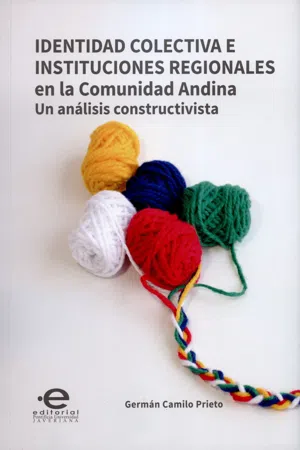
Este libro ofrece un análisis constructivista de la Comunidad Andina, en un esfuerzo por aplicar el constructivismo al estudio del regionalismo en Suramérica y América Latina. El énfasis en la identidad colectiva y las instituciones regionales obedece a la prioridad que los estudios constructivistas sobre el regionalismo en otras partes del mundo le otorgan a estas dos estructuras ideacionales. La mención recurrente a la identidad andina en el discurso oficial de la CAN y la complejidad de su estructura institucional justifican también el énfasis en ambas variables. Además de indagar sobre su rol explicativo de la acción de los Estados miembros frente al proyecto regional andino, el libro también propone un método particular para ofrecer explicaciones con base en el rol de las ideas, el cual combina elementos del realismo crítico como filosofía de la ciencia, y de metodologías interpretivistas como el análisis lingüístico y del discurso, para distinguir los efectos constitutivos y causales de las ideas, y poder cumplir así el cometido ontológico del constructivismo de mostrar la importancia de las ideas en la construcción social de la realidad, y en este caso particular, del regionalismo.
eBook - ePub
Identidad colectiva e instituciones regionales en la Comunidad Andina
Un análisis constructivista
- 354 pages
- English
- ePUB (mobile friendly)
- Available on iOS & Android
eBook - ePub
Identidad colectiva e instituciones regionales en la Comunidad Andina
Un análisis constructivista
About this book
Information
Table of contents
- Portada
- Portadilla
- Créditos
- Siglas y abreviaturas
- Agradecimientos
- Prólogo
- Introducción
- Capítulo 1
- Capítulo 2
- Capítulo 3
- Capítulo 4
- Capítulo 5
- CONCLUSIÓN
- APÉNDICE 1
- APÉNDICE 2
- APÉNDICE 3
- Apéndice 4
- REFERENCIAS
Trusted by 375,005 students
Access to over 1.5 million titles for a fair monthly price.
Study more efficiently using our study tools.
Frequently asked questions
Yes, you can cancel anytime from the Subscription tab in your account settings on the Perlego website. Your subscription will stay active until the end of your current billing period. Learn how to cancel your subscription
No, books cannot be downloaded as external files, such as PDFs, for use outside of Perlego. However, you can download books within the Perlego app for offline reading on mobile or tablet. Learn how to download books offline
Perlego offers two plans: Essential and Complete
- Essential is ideal for learners and professionals who enjoy exploring a wide range of subjects. Access the Essential Library with 800,000+ trusted titles and best-sellers across business, personal growth, and the humanities. Includes unlimited reading time and Standard Read Aloud voice.
- Complete: Perfect for advanced learners and researchers needing full, unrestricted access. Unlock 1.5M+ books across hundreds of subjects, including academic and specialized titles. The Complete Plan also includes advanced features like Premium Read Aloud and Research Assistant.
We are an online textbook subscription service, where you can get access to an entire online library for less than the price of a single book per month. With over 1.5 million books across 990+ topics, we’ve got you covered! Learn about our mission
Look out for the read-aloud symbol on your next book to see if you can listen to it. The read-aloud tool reads text aloud for you, highlighting the text as it is being read. You can pause it, speed it up and slow it down. Learn more about Read Aloud
Yes! You can use the Perlego app on both iOS and Android devices to read anytime, anywhere — even offline. Perfect for commutes or when you’re on the go.
Please note we cannot support devices running on iOS 13 and Android 7 or earlier. Learn more about using the app
Please note we cannot support devices running on iOS 13 and Android 7 or earlier. Learn more about using the app
Yes, you can access Identidad colectiva e instituciones regionales en la Comunidad Andina by Germán Camilo Prieto in PDF and/or ePUB format, as well as other popular books in Política y relaciones internacionales & Política mundial. We have over 1.5 million books available in our catalogue for you to explore.