This book is available to read until 25th February, 2026
- 88 pages
- English
- ePUB (mobile friendly)
- Available on iOS & Android
eBook - ePub
Available until 25 Feb |Learn more
About this book
Lucas Condró and Pablo Messiez gather in this essay a set of notes on pedagogy and movement, result from their long experience giving workshops on the work with the body.
English version by Carlota Gaviño .
Frequently asked questions
Yes, you can cancel anytime from the Subscription tab in your account settings on the Perlego website. Your subscription will stay active until the end of your current billing period. Learn how to cancel your subscription.
At the moment all of our mobile-responsive ePub books are available to download via the app. Most of our PDFs are also available to download and we're working on making the final remaining ones downloadable now. Learn more here.
Perlego offers two plans: Essential and Complete
- Essential is ideal for learners and professionals who enjoy exploring a wide range of subjects. Access the Essential Library with 800,000+ trusted titles and best-sellers across business, personal growth, and the humanities. Includes unlimited reading time and Standard Read Aloud voice.
- Complete: Perfect for advanced learners and researchers needing full, unrestricted access. Unlock 1.4M+ books across hundreds of subjects, including academic and specialized titles. The Complete Plan also includes advanced features like Premium Read Aloud and Research Assistant.
We are an online textbook subscription service, where you can get access to an entire online library for less than the price of a single book per month. With over 1 million books across 1000+ topics, we’ve got you covered! Learn more here.
Look out for the read-aloud symbol on your next book to see if you can listen to it. The read-aloud tool reads text aloud for you, highlighting the text as it is being read. You can pause it, speed it up and slow it down. Learn more here.
Yes! You can use the Perlego app on both iOS or Android devices to read anytime, anywhere — even offline. Perfect for commutes or when you’re on the go.
Please note we cannot support devices running on iOS 13 and Android 7 or earlier. Learn more about using the app.
Yes, you can access Asymmetrical-Motion by Lucas Condró,Pablo Messiez, Carlota Gaviño in PDF and/or ePUB format, as well as other popular books in Media & Performing Arts & Teaching Arts & Humanities. We have over one million books available in our catalogue for you to explore.
Information
Subtopic
Teaching Arts & HumanitiesNOTES ON PEDAGOGY AND MOVEMENT

Continta Me Tienes
C/ Belmonte de Tajo 55, 3º C
28019, Madrid
91 469 35 12
www.contintametienes.com
www.facebook.com/ContintaMeTienes
@Continta_mt
Escénicas collection, 12
First edition: February, 2016
Second edition: May, 2016
© Lucas Condró y Pablo Messiez
© of traduction: Carlota Gaviño
© of this edition: Continta Me Tienes
Cover design: Marta Azparren
Lucas Condró & Pablo Messiez
NOTES ON PEDAGOGY AND MOVEMENT
English version

Index
Introduction
Notes
Exercises
Introduction
Asymmetrical-Motion is a research on movement in the field of contemporary dance.
I have long been interested in two main ideas. On the one hand, the logic ruling independence and correlation of the parts of the body: the possibility of moving each one trying to understand its uniqueness, and then that of moving all of them at the same time while preserving the independence of each one. On the other hand, the ideas of structure and weight as two factors that simultaneously provide the body with movement and agility.
These two ideas revealed to me the asymmetries of the body appearing in movement, something which was already inherent in the nature of the body and which, however, the habits of training had kept silent. Then, I decided that the name of the research was to be Asymmetrical-Motion. Giving a name to the work inevitably changes the scope. It leads the eyes towards some areas, discarding others. It focuses the work and sharpens it.
At the same time, I felt the need to think about the pedagogical questions that had developed in parallel with my practice. What was their specificity, if any? And then appeared the idea of observing to be able to understand; naming that which had been observed to be able to transform the experience into tools; and then taking those tools back to the body.
The possibility of creating together a single common body appeared as well. The aim of generating a certain work logic from a shared object of study. Each one’s reflections will be the tools that allow the construction of that joint knowledge, of that single shared body.
However, if generating a single body is the aim, attention should be focused on neither the teacher, nor the students, but rather on that other body resulting from ...
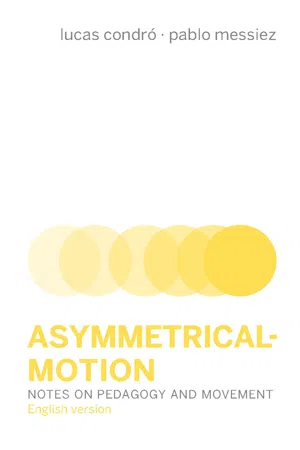
Table of contents
- COVER
- NOTES ON PEDAGOGY AND MOVEMENT
- CREDITS
- INDEX
- INTRODUCTION
- NOTES
- EXERCISES