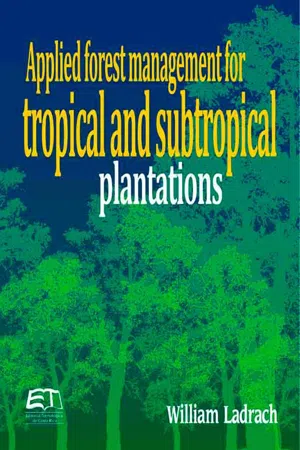
Global demand for forest products is increasing daily. This implies an incremental pressure on tropical and subtropical forests to supply wood products. Natural forests continue to supply wood, although their capacity is decreasing steadily. We are depending more and more on forest plantations to satisfy industrial needs for solid wood as well as pulpwood. Fortunately, the warm climates have an enormous potential to produce wood fiber when the production is based on applied science. By selecting the appropriate species for given sites and the use of the principles of silviculture and genetic improvement, tree plantations can often produce more than 50 m3/ha/year. Because of their capacity for rapid growth, the tropical and subtropical regions have a great advantage over the temperate regions. William Ladrach has dedicated more than 40 years to the research and management of forest plantations in various parts of the world, principally in Central and South America. This book, Applied Forest Management for Tropical and Subtropical Plantations, provides a guide to future forest production. It is a guide to applied forestry and covers subjects from viewpoints of the biological, ecological, economic and industrial sciences. This work is of great value to foresters, students, industrial managers, researchers and others who work in equatorial countries. It will have a strong and positive impact on the establishment of tree plantations during the coming decades.
- 150 pages
- English
- ePUB (mobile friendly)
- Available on iOS & Android
eBook - ePub
Applied forest management for tropical and subtropical plantations
About this book
Information
Subtopic
Ecosystems & HabitatsIndex
Biological Sciences15
Forest finance
Profitability of reforestation projects
Interest and discount
Risk versus gain and the importance of fiscal incentives
Financial terminology
Financial analysis using the typical hectare method
Sensitivity analysis
Stumpage value
Land cost in a forestry analysis
What is inflation and how does it affect the forestry investment?
The use of inflation in financial analyses
How to valuate plantations for the buying and selling of forest properties
Calculating forestry machine operating costs
Machine sinking fund
A cost comparisons for two harvesting methods
Financial analysis of a total forestry project
How to make the decision to invest in forest tree plantations
Profitability of reforestation projects
Three basic conditions are required for an investment to be profitable (Rose & Blinn, 1987):
- The benefits need to be greater than the costs of a project after adjustment of the cash flow for time.
- Each component of a project must provide benefits that are equal to or greater than the costs, after the cash flow is adjusted for time.
- There is no other alternative at a lower cost that would provide the same benefits.
From the point of view of international banks (Keipi, 1997), the five most important factors for the successful development of tree plantations are:
- Political and macro-economic stability.
- Free commerce and free access to foreign investment.
- Legal clarity regarding land ownership.
- A stable government with an adequate capacity to enforce laws and administrate incentive programs.
- Good natural growing conditions, adequate technology and a basic infrastructure.
A calendar of events or activities is required for each project with a defined length of time. Some activities generate costs while others produce profits to the investor. The following four steps are required for a financial analysis (Davis & Johnson, 1987):
- Define the time limits for evaluating a project,
- Identify the calendar of activities for the project,
- Convert all activities into their equivalent monetary values,
- Adjust the rates of interest corresponding to the periods in which there will be the expected expenditures and incomes.
The objective of the financial analysis is to compare the relationship between expe...
Table of contents
- inicio
- Credits
- Content
- Dedication
- Acknowledgements
- Presentation
- Preface
- 01-History of forest plantations
- 02-Plantations to supply wood
- 03-Plant production and forest nurseries
- 04-Plantation establishment
- 05-Silviculture
- 06-Mensuration
- 07-Diseases and insects
- 08-Wildfires
- 09-Wood harvest and transport
- 10-Forest certification
- 11-Forest research
- 12-Wood physiology and pulping
- 13-Environmental influences
- 14-Administrative organization
- 15-Forest finance
- References
- Anexes
- About the author
Trusted by 375,005 students
Access to over 1.5 million titles for a fair monthly price.
Study more efficiently using our study tools.
Frequently asked questions
Yes, you can cancel anytime from the Subscription tab in your account settings on the Perlego website. Your subscription will stay active until the end of your current billing period. Learn how to cancel your subscription
No, books cannot be downloaded as external files, such as PDFs, for use outside of Perlego. However, you can download books within the Perlego app for offline reading on mobile or tablet. Learn how to download books offline
Perlego offers two plans: Essential and Complete
- Essential is ideal for learners and professionals who enjoy exploring a wide range of subjects. Access the Essential Library with 800,000+ trusted titles and best-sellers across business, personal growth, and the humanities. Includes unlimited reading time and Standard Read Aloud voice.
- Complete: Perfect for advanced learners and researchers needing full, unrestricted access. Unlock 1.5M+ books across hundreds of subjects, including academic and specialized titles. The Complete Plan also includes advanced features like Premium Read Aloud and Research Assistant.
We are an online textbook subscription service, where you can get access to an entire online library for less than the price of a single book per month. With over 1.5 million books across 990+ topics, we’ve got you covered! Learn about our mission
Look out for the read-aloud symbol on your next book to see if you can listen to it. The read-aloud tool reads text aloud for you, highlighting the text as it is being read. You can pause it, speed it up and slow it down. Learn more about Read Aloud
Yes! You can use the Perlego app on both iOS and Android devices to read anytime, anywhere — even offline. Perfect for commutes or when you’re on the go.
Please note we cannot support devices running on iOS 13 and Android 7 or earlier. Learn more about using the app
Please note we cannot support devices running on iOS 13 and Android 7 or earlier. Learn more about using the app
Yes, you can access Applied forest management for tropical and subtropical plantations by William Ladrach in PDF and/or ePUB format, as well as other popular books in Biological Sciences & Ecosystems & Habitats. We have over 1.5 million books available in our catalogue for you to explore.