eBook - ePub
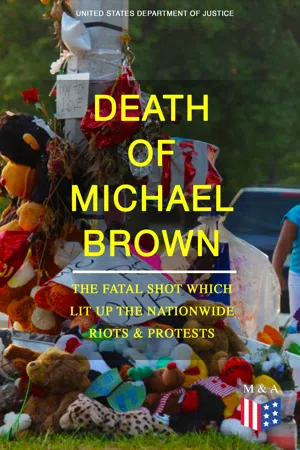
Death of Michael Brown - The Fatal Shot Which Lit Up the Nationwide Riots & Protests
The Ferguson shooting: federal findings on policing and discrimination
- 254 pages
- English
- ePUB (mobile friendly)
- Available on iOS & Android
eBook - ePub
Death of Michael Brown - The Fatal Shot Which Lit Up the Nationwide Riots & Protests
The Ferguson shooting: federal findings on policing and discrimination
About this book
The shooting of Michael Brown occurred on August 9, 2014, in Ferguson, Missouri, a northern suburb of St. Louis. Brown, an 18-year-old black man, was fatally shot by Darren Wilson, a white Ferguson police officer, after robbing a convenience store. In response to the shooting the U.S. Department of Justice conducted two investigations into the circumstances of Brown's murder and the policing practices of the Ferguson Police Department. This e-book presents all the findings and established facts of these investigations; including the misconduct against the citizens by the Ferguson Police, discrimination against African-Americans and conclusions regarding the shooting incident.
Information
Subtopic
North American HistoryIndex
Social SciencesInvestigation into the Policing Practices of the Ferguson Police Department
Table of Contents
I. REPORT SUMMARY
II. BACKGROUND
III. FERGUSON LAW ENFORCEMENT EFFORTS ARE FOCUSED ON GENERATING REVENUE
IV. FERGUSON LAW ENFORCEMENT PRACTICES VIOLATE THE LAW AND UNDERMINE COMMUNITY TRUST, ESPECIALLY AMONG AFRICAN AMERICANS
A.Ferguson’s Police Practices
1. FPD Engages in a Pattern of Unconstitutional Stops and Arrests in Violation of the Fourth Amendment
2. FPD Engages in a Pattern of First Amendment Violations
3. FPD Engages in a Pattern of Excessive Force in Violation of the Fourth Amendment
B.Ferguson’s Municipal Court Practices
1. Court Practices Impose Substantial and Unnecessary Barriers to the Challenge or Resolution of Municipal Code Violations
2. The Court Imposes Unduly Harsh Penalties for Missed Payments or Appearances
C. Ferguson Law Enforcement Practices Disproportionately Harm Ferguson’s African-American Residents and Are Driven in Part by Racial Bias
1. Ferguson’s Law Enforcement Actions Impose a Disparate Impact on African Americans that Violates Federal Law
2. Ferguson’s Law Enforcement Practices Are Motivated in Part by Discriminatory Intent in Violation of the Fourteenth Amendment and Other Federal Laws
D. Ferguson Law Enforcement Practices Erode Community Trust, Especially Among Ferguson’s African-American Residents, and Make Policing Less Effective, More Difficult, and Less Safe
1. Ferguson’s Unlawful Police and Court Practices Have Led to Distrust and Resentment Among Many in Ferguson
2. FPD’s Exercise of Discretion, Even When Lawful, Often Undermines Community Trust and Public Safety
3. FPD’s Failure to Respond to Complaints of Officer Misconduct Further Erodes Community Trust
4. FPD’s Lack of Community Engagement Increases the Likelihood of Discriminatory Policing and Damages Public Trust
5. Ferguson’s Lack of a Diverse Police Force Further Undermines Community Trust
V. CHANGES NECESSARY TO REMEDY FERGUSON’S UNLAWFUL LAW ENFORCEMENT PRACTICES AND REPAIR COMMUNITY TRUST
VI. CONCLUSION
I. REPORT SUMMARY
Table of Contents
The Civil Rights Division of the United States Department of Justice opened its investigation of the Ferguson Police Department (“FPD”) on September 4, 2014. This investigation was initiated under the pattern-or-practice provision of the Violent Crime Control and Law Enforcement Act of 1994, 42 U.S.C. § 14141, the Omnibus Crime Control and Safe Streets Act of 1968, 42 U.S.C. § 3789d(“Safe Streets Act”), and Title VI of the Civil Rights Act of 1964, 42 U.S.C. § 2000d (“Title VI”). This investigation has revealed a pattern or practice of unlawful conduct within the Ferguson Police Department that violates the First, Fourth, and Fourteenth Amendments to the United States Constitution, and federal statutory law.
Over the course of the investigation, we interviewed City officials, including City Manager John Shaw, Mayor James Knowles, Chief of Police Thomas Jackson, Municipal Judge Ronald Brockmeyer, the Municipal Court Clerk, Ferguson’s Finance Director, half of FPD’s sworn officers, and others. We spent, collectively, approximately 100 person-days onsite in Ferguson. We participated in ride-alongs with on-duty officers, reviewed over 35,000 pages of police records as well as thousands of emails and other electronic materials provided by the police department. Enlisting the assistance of statistical experts, we analyzed FPD’s data on stops, searches, citations, and arrests, as well as data collected by the municipal court. We observed four separate sessions of Ferguson Municipal Court, interviewing dozens of people charged with local offenses, and we reviewed third-party studies regarding municipal court practices in Ferguson and St. Louis County more broadly. As in all of our investigations, we sought to engage the local community, conducting hundreds of in-person and telephone interviews of individuals who reside in Ferguson or who have had interactions with the police department. We contacted ten neighborhood associations and met with each group that responded to us, as well as several other community groups and advocacy organizations. Throughout the investigation, we relied on two police chiefs who accompanied us to Ferguson and who themselves interviewed City and police officials, spoke with community members, and reviewed FPD policies and incident reports.
We thank the City officials and the rank-and-file officers who have cooperated with this investigation and provided us with insights into the operation of the police department, including the municipal court.Notwithstanding our findings about Ferguson’s approach to law enforcement and the policing culture it creates, we found many Ferguson police officers and other City employees to be dedicated public servants striving each day to perform their duties lawfully and with respect for all members of the Ferguson community. The importance of their often-selfless work cannot be overstated.
We are also grateful to the many members of the Ferguson community who have met with us to share their experiences. It became clear during our many conversations with Ferguson residents from throughout the City that many residents, black and white, genuinely embrace Ferguson’s diversity and want to reemerge from the events of recent months a truly inclusive, united community. This Report is intended to strengthen those efforts by recognizing the harms caused by Ferguson’s law enforcement practices so that those harms can be better understood and overcome.
Ferguson’s law enforcement practices are shaped by the City’s focus on revenue rather than by public safety needs. This emphasis on revenue has compromised the institutional character of Ferguson’s police department, contributing to a pattern of unconstitutional policing, and has also shaped its municipal court, leading to procedures that raise due process concerns and inflict unnecessary harm on members of the Ferguson community. Further, Ferguson’s police and municipal court practices both reflect and exacerbate existing racial bias, including racial stereotypes.Ferguson’s own data establish clear racial disparities that adversely impact African Americans. The evidence shows that discriminatory intent is part of the reason for these disparities. Over time, Ferguson’s police and municipal court practices have sown deep mistrust between parts of the community and the police department, undermining law enforcement legitimacy among African Americans in particular.
Focus on Generating Revenue
The City budgets for sizeable increases in municipal fines and fees each year, exhorts police and court staff to deliver those revenue increases, and closely monitors whether those increases are achieved. City officials routinely urge Chief Jackson to generate more revenue through enforcement. In March 2010, for instance, the City Finance Director wrote to Chief Jackson that “unless ticket writing ramps up significantly before the end of the year, it will be hard to significantly raise collections next year… . Given that we are looking at a substantial sales tax shortfall, it’s not an insignificant issue.” Similarly, in March 2013, the Finance Director wrote to the City Manager:“Court fees are anticipated to rise about 7.5%. I did ask the Chief if he thought the PD could deliver 10% increase. He indicated they could try.” The importance of focusing on revenue generation is communicated to FPD officers. Ferguson police officers from all ranks told us that revenue generation is stressed heavily within the police department, and that the message comes from City leadership. The evidence we reviewed supports this perception.
Police Practices
The City’s emphasis on revenue generation has a profound effect on FPD’s approach to law enforcement. Patrol assignments and schedules are geared toward aggressive enforcement of Ferguson’s municipal code, with insufficient thought given to whether enforcement strategies promote public safety or unnecessarily undermine community trust and cooperation. Officer evaluations and promotions depend to an inordinate degree on “productivity,” meaning the number of citations issued. Partly as a consequence of City and FPD priorities, many officers appear to see some residents, especially those who live in Ferguson’s predominantly African- American neighborhoods, less as constituents to be protected than as potential offenders and sources of revenue.
This culture within FPD influences officer activities in all areas of policing, beyond just ticketing. Officers expect and demand compliance even when they lack legal authority. They are inclined to interpret the exercise of free-speech rights as unlawful disobedience, innocent movements as physical threats, indications of mental or physical illness as belligerence. Police supervisors and leadership do too little to ensure that officers act in accordance with law and policy, and rarely respond meaningfully to civilian complaints of officer misconduct. The result is a pattern of stops without reasonable suspicion and arrests without probable cause in violation of the Fourth Amendment; infringement on free expression, as well as retaliation for protected expression, in violation of the First Amendment; and excessive force in violation of the Fourth Amendment.
Even relatively routine misconduct by Ferguson police officers can have significant consequences for the people whose rights are violated. For example, in the summer of 2012, a 32-year-old African-American man sat in his car cooling off after playing basketball in a Ferguson public park. An officer pulled up behind the man’s car, blocking him in, and demanded the man’s Social Security number and identification. Without any cause, the officer accused the man of being a pedophile, referring to the presence of children in the park, and ordered the man out of his car for a pat-down, although the officer had no reason to believe the man was armed. The officer also asked to search the man’s car. The man objected, citing his constitutional rights. In response, the officer arrested the man, reportedly at gunpoint, charging him with eight violations of Ferguson’s municipal code. One charge, Making a False Declaration, was for initially providing the short form of his first name (e.g., “Mike” instead of “Michael”), and an address which, although legitimate, was different from the one on his driver’s license. Another charge was for not wearing a seat belt, even though he was seated in a parked car. The officer also charged the man both with having an expired operator’s license, and with having no operator’s license in his possession. The man told us that, because of these charges, he lost his job as a contractor with the federal government that he had held for years.
Municipal Court Practices
Ferguson has allowed its focus on revenue generation to fundamentally compromise the role of Ferguson’s municipal court. The municipal court does not act as a neutral arbiter of the law or a check on unlawful police conduct. Instead, the court primarily uses its judicial authority as the means to compel the payment of fines and fees that advance theCity’s financial interests. This has led to court practices that violate the Fourteenth Amendment’s due process and equal protectionrequirements. The court’s practices also impose unnecessary harm, overwhelmingly on African-American individuals, and run counter to public safety.
Most strikingly, the court issues municipal arrest warrants not on the basis of public safety needs, but rather as a routine response to missed court appearances and required fine payments. In 2013 alone, the court issued over 9,000 warrants on cases stemming in large part from minor violations such as parking infractions, traffic tickets, or housing code violations. Jail time would be considered far too harsh a penalty for the great majority of these code violations, yet Ferguson’s municipal court routinely issues warrants for people to be arrested and incarcerated for failing to timely pay related fines and fees. Under state law, a failure to appear in municipal court on a traffic charge involving a moving violation also results in a license suspension. Ferguson has made this penalty even more onerous by only allowing the suspension to be lifted after payment of an owed fine is made in full. Further, until recently, Ferguson also added charges, fines, and fees for each missed appearance and payment. Many pending cases still include such charges that were imposed before the court recently eliminated them, making it as difficult as before for people to resolve these cases.
The court imposes these severe penalties for missed appearances and payments even as several of the court’s practices create unnecessary barriers to resolving a municipal violation. The court often fails to provide clear and accurate information regarding a person’s charges or court obligations. And the court’s fine assessment procedures do not adequately provide for a defendant to seek a fine reduction on account of financial incapacity or to seek alternatives to payment such as community service. City and court officials have adhered to these court practices despite acknowledging their needlessly harmful consequences. In August 2013, for example, one City Councilmember wrote to the City Manager, the Mayor, and other City officials lamenting the lack of a community service option and noted the benefits of such a program, including that it would “keep those people that simply don’t have the money to pay their fines from constantly being arrested and going to jail, only to be released and do it all over again.”
Together, these court practices exacerbate the harm of Ferguson’s unconstitutional police practices. They impose a particular hardship upon Ferguson’s most vulnerable residents, especially upon those living in or near poverty. Minor offenses can generate crippling debts, result in jail time because of an inability to pay, and result in the loss of a driver’s license, employment, or housing.
We spoke, for example, with an African-American woman who has a still-pending case stemming from 2007, when, on a single occasion, she parked her car illegally. She received two citations and a $151 fine, plus fees. The woman, who experienced financial difficulties and periods of homelessness over several years, was charged with seven Failure to Appear offenses for missing court dates or fine payments on her parking tickets between 2007 and 2010. For each Failure to Appear, the court issued an arrest warrant and imposed new fines and fees. From 2007 to 2014, the woman was arrested twice, spent six days in jail, and paid $550 to the court for the events stemming from this single instance of illegal parking. Court records show that she twice attempted to make partial payments of $25 and $50, but the court returned those payments, refusing to accept anything less than payment in full. One of those payments was later accepted, but only after the court’s letter rejecting payment by money order was returned as undeliverable. This woman is now making regular payments on the fine. As of December 2014, over seven years later, despite initially owing a $151 fine and having already paid $550, she still owed $541.
Racial Bias
Ferguson’s approach to law enforcement both reflects and reinforces racial bias, including stereotyping. The harms of Ferguson’s police and court practices are borne disproportionately by African Americans, and there is evidence that this is due in part to intentional discrimination on the basis of race.
Ferguson’s law enforcement practices overwhelmingly impact African Americans. Data collected by the Ferguson Police Department from 2012 to 2014 shows that African Americans account for 85% of vehicle stops, 90% of citations, and 93% of arrests made by FPD officers, despite comprising only 67% of Ferguson’s population. African Americans are more than twice as likely as white drivers to be searched during vehicle stops even after controlling for non-race based variables such as the reason the vehicle stop was initiated, but are found in possession of contraband 26% less often than white drivers, suggesting officers are impermissibly considering race as a factor when determining whether to search. African Americans are more likely to be cited and arrested following a stop regardless of why the stop was initiated and are more likely to receive multiple citations during a single incident. From 2012 to 2014, FPD issued four or more citations to African Americans on 73 occasions, but issued four or more citations to non-African Americans only twice. FPD appears to bring certain offenses almost exclusively against African A...
Table of contents
- Death of Michael Brown - The Fatal Shot Which Lit Up the Nationwide Riots & Protests
- Table of Contents
- Investigation into the Shooting of Michael Brown
- Investigation into the Policing Practices of the Ferguson Police Department
Trusted by 375,005 students
Access to over 1.5 million titles for a fair monthly price.
Study more efficiently using our study tools.
Frequently asked questions
Yes, you can cancel anytime from the Subscription tab in your account settings on the Perlego website. Your subscription will stay active until the end of your current billing period. Learn how to cancel your subscription
No, books cannot be downloaded as external files, such as PDFs, for use outside of Perlego. However, you can download books within the Perlego app for offline reading on mobile or tablet. Learn how to download books offline
Perlego offers two plans: Essential and Complete
- Essential is ideal for learners and professionals who enjoy exploring a wide range of subjects. Access the Essential Library with 800,000+ trusted titles and best-sellers across business, personal growth, and the humanities. Includes unlimited reading time and Standard Read Aloud voice.
- Complete: Perfect for advanced learners and researchers needing full, unrestricted access. Unlock 1.5M+ books across hundreds of subjects, including academic and specialized titles. The Complete Plan also includes advanced features like Premium Read Aloud and Research Assistant.
We are an online textbook subscription service, where you can get access to an entire online library for less than the price of a single book per month. With over 1.5 million books across 990+ topics, we’ve got you covered! Learn about our mission
Look out for the read-aloud symbol on your next book to see if you can listen to it. The read-aloud tool reads text aloud for you, highlighting the text as it is being read. You can pause it, speed it up and slow it down. Learn more about Read Aloud
Yes! You can use the Perlego app on both iOS and Android devices to read anytime, anywhere — even offline. Perfect for commutes or when you’re on the go.
Please note we cannot support devices running on iOS 13 and Android 7 or earlier. Learn more about using the app
Please note we cannot support devices running on iOS 13 and Android 7 or earlier. Learn more about using the app
Yes, you can access Death of Michael Brown - The Fatal Shot Which Lit Up the Nationwide Riots & Protests by United States Department of Justice in PDF and/or ePUB format, as well as other popular books in Social Sciences & North American History. We have over 1.5 million books available in our catalogue for you to explore.