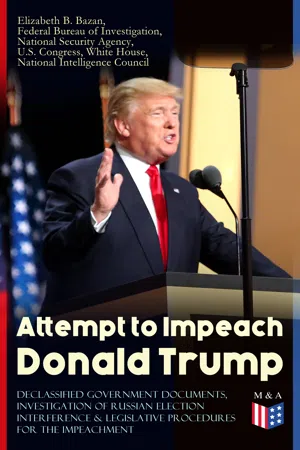
eBook - ePub
Attempt to Impeach Donald Trump - Declassified Government Documents, Investigation of Russian Election Interference & Legislative Procedures for the Impeachment
Overview of Constitutional Provisions for President Impeachment, Russian Cyber Activities, Russian Intelligence Activities, Calls for Trump Impeachment, Testimony of James Comey and other Documents
- 235 pages
- English
- ePUB (mobile friendly)
- Available on iOS & Android
eBook - ePub
Attempt to Impeach Donald Trump - Declassified Government Documents, Investigation of Russian Election Interference & Legislative Procedures for the Impeachment
Overview of Constitutional Provisions for President Impeachment, Russian Cyber Activities, Russian Intelligence Activities, Calls for Trump Impeachment, Testimony of James Comey and other Documents
About this book
Since the beginning of his presidential term president Donald Trump is faced with constant criticism for his business projects in Russia and his connections with the Russian authorities. On June 12th 2017 US Congressman Brad Sherman submitted the Resolution for Impeaching Donald John Trump, President of the United States, for high crimes and misdemeanors. This book presents the latest investigation results, declassified documents, transcripts and reports of various US security agencies and other actors involved in the investigation of the Russian Interference in the 2016 United States Elections and the connection of the American president with the Russian Government. This book will provide all necessary information on the event that can easily turn out to be the biggest political scandal in the modern American history.
Contents:
Impeachment: An Overview of Constitutional Provisions, Procedure, and Practice
Efforts to Impeach Donald Trump
Russian Interference in the 2016 United States Elections
Documents Related to Russian Interference
Executive Order - Taking Additional Steps to Address the National Emergency With Respect to Significant Malicious Cyber-Enabled Activities
Russian Cyber Activity – The Grizzly Steppe Report
Assessing Russian Activities and Intentions in Recent US Elections
Joint Statement on Committee Inquiry into Russian Intelligence Activities
National Security Agency Report
Documents & Transcripts Related to Impeachment Attempt
Dismissal of James Comey
James Comey FBI Farewell Letter
Representative Al Green Calls for Trump Impeachment
Jason Chaffetz Letter to FBI Over Comey Memo
Appointment of Special Counsel to Investigate Russian Interference With the 2016 Presidential Election and Related Matters
Comey Statement for the Record Senate Select Committee on Intelligence
Impeaching Donald John Trump, President of the United States, for High Crimes and Misdemeanors
Information
Subtopic
Political BiographiesIndex
LawAttempt to Impeach Donald Trump - Declassified Government Documents, Investigation of Russian Election Interference & Legislative Procedures for the Impeachment
Overview of Constitutional Provisions for Impeachment, Russian Cyber Activities, Russian Intelligence Activities, Calls for Trump Impeachment, Testimony of James Comey
Madison & Adams Press, 2017. No claim to original U.S. Government Works and to texts licensed as Creative Commons CC BY-SA 3.0.
Contact [email protected]
Contact [email protected]
ISBN 978-80-268-7813-1
This is a publication of Madison & Adams Press. Our production consists of thoroughly prepared educational & informative editions: Advice & How-To Books, Encyclopedias, Law Anthologies, Declassified Documents, Legal & Criminal Files, Historical Books, Scientific & Medical Publications, Technical Handbooks and Manuals. All our publications are meticulously edited and formatted to the highest digital standard. The main goal of Madison & Adams Press is to make all informative books and records accessible to everyone in a high quality digital and print form.
Table of Contents
Impeachment: An Overview of Constitutional Provisions, Procedure, and Practice
Efforts to Impeach Donald Trump
Russian Interference in the 2016 United States Elections
Documents Related to Russian Interference:
Executive Order - Taking Additional Steps to Address the National Emergency With Respect to Significant Malicious Cyber-Enabled Activities
Russian Cyber Activity – The Grizzly Steppe Report
Assessing Russian Activities and Intentions in Recent US Elections
Joint Statement on Committee Inquiry into Russian Intelligence Activities
National Security Agency Report
Documents & Transcripts Related to Impeachment Attempt:
Dismissal of James Comey
James Comey FBI Farewell Letter
Representative Al Green Calls for Trump Impeachment
Jason Chaffetz Letter to FBI Over Comey Memo
Appointment of Special Counsel to Investigate Russian Interference With the 2016 Presidential Election and Related Matters
Comey Statement for the Record Senate Select Committee on Intelligence
Impeaching Donald John Trump, President of the United States, for High Crimes and Misdemeanors
Impeachment: An Overview of Constitutional Provisions, Procedure, and Practice
Table of Contents
Background
The Constitutional Framework
Judicial Decisions Related to Impeachment
Some Basic Research Tools to Assist in Impeachment Proceedings
A Brief History and Some Preliminary Issues Relating to Impeachment
Who Are “civil Officers of the United States” Under Article II, Sec. 4 of the Constitution?
What Kinds of Conduct May Give Rise to an Impeachment?
Conclusions and Other Observations
Background
Table of Contents
Authority to remove the President, Vice President, and federal civil officers by impeachment has been placed, by constitutional mandate, in the hands of the legislative branch of the United States government. Although rooted in the soil of English impeachment experience, the American impeachment system differs from its English forebear in some significant respects. Recorded incidents of English impeachments may begin as early as 1376, and one source would place the first in 1283.1 A more fixed procedure appears to have begun in 1399, with the passage of the statute of I Henry IV, c. 14.2 Whichever date one chooses, it is clear that the English practice took root well before the colonial beginnings of the United States. It ceased to be used in England at about the time that it became part of the American system of government. The last two impeachments in England appear to have been those of Warren Hastings in 1787 and of Lord Melville in 1805.3 The English system permitted any person to be impeached by the House of Commons for any crime or misdemeanor, whether the alleged offender was a peer or a commoner.4
Unlike the British system, which permitted penal sanctions to attach upon conviction of impeachment,5 the American system is designed to be remedial in function. Despite surface similarities to a criminal trial, the judgments which may be rendered upon conviction of an article of impeachment in the American system are limited to removal from office and disqualification from holding further offices of public trust. Thus, the American system seems more designed to protect the public interest than to punish the person impeached. Nevertheless, much of the procedure and practice involved in this country’s application of its impeachment process draws guidance and support from British precedents.6
1 See Simpson, Jr., A., “Federal Impeachments,” 64 U. Pa. L. Rev. 651 (1916); Yankwich, L., “Impeachment of Civil Officers Under the Federal Constitution,” 26 Geo. L.J. 849 (1938), reproduced in H. COMM. ON THE JUDICIARY, 93RD CONG., 1ST SESS., IMPEACHMENT, SELECTED MATERIALS 689 (Comm. Print, October 1973), and in H. COMM. ON THE JUDICIARY, 105THCONG., 2D SESS., IMPEACHMENT, SELECTED MATERIALS 1825 (Comm. Print, November 1998). Simpson, in his 1916 article, discussed the British history in considerable depth before moving into a discussion of some aspects of the Constitutional Convention’s consideration of impeachment as envisioned in what would become the American system.
2 Simpson, Jr., A., Federal Impeachment, 64 U. PA. L. REV. 651 (1916).
3 Brief of Anthony Higgins and John M. Thurston, counsel for the respondent, Judge Charles Swayne, offered in the latter’s impeachment trial on February 22, 1905, reprinted in III HINDS’ PRECEDENTS OF THE HOUSE OF REPRESENTATIVES § 2009, at 322 (1907).
4 Yankwich, supra n. 14, at 690.
5 Conviction under the British impeachment system could result in punishment by imprisonment, fine or even death. Berger, R., Impeachment for ‘High Crimes and Misdemeanors,’ 44 SO. CAL. L. REV. 395 (1971), reprinted in H. COMM. ON THE JUDICIARY, 93RDCONG., 1STSESS., IMPEACHMENT, SELECTED MATERIALS 617 (Comm. Print October 1973), and in H. COMM. ON THE JUDICIARY, 105THCONG., 2D SESS., IMPEACHMENT, SELECTED MATERIALS 1825 (Comm. Print November 1998).
6 JEFFERSON’S MANUAL, published in CONSTITUTION, JEFFERSON’S MANUAL AND RULES OF THE HOUSE OF REPRESENTATIVES OF THE UNITED STATES, ONE HUNDRED TENTH CONGRESS, H. Doc. No. 109-157, 109th Cong., 2d Sess. 314-331 (2007). This may also be found at http://www.gpoaccess.gov/hrm/browse_110.html, which, in turn, may be accessed through the website of the House Rules Committee under the heading “House Rules Manual (GPO Access)” at http://www.rules.house.gov/house_rules_precedents.htm.
The Constitutional Framework
Table of Contents
The somewhat skeletal constitutional framework for the impeachment process can be found in a number of provisions. These include the following:
Art. I, Sec. 2, Cl. 5:
The House of Representatives ... shall have the sole Power of Impeachment.
Art. I, Sec. 3, Cl. 6 and 7:
The Senate shall have the sole Power to try all Impeachments. When sitting for that Purpose, they shall be on Oath or Affirmation. When the President of the United States is tried, the Chief Justice shall preside: And no Person shall be convicted without the Concurrence of two-thirds of the Members present.
Judgment in Cases of Impeachment shall not extend further than toremoval from Office, and disqualification to hold and enjoy any Office of honor, Trust or Profit under the United States: but the Party convicted shall nevertheless be liable and subject to Indictment, Trial, Judgment and Punishment, according to Law.
Art. II, Sec. 2, Cl. 1:
The President ... shall have Power to grant Reprieves and Pardons for offences against the United States, except in Cases of Impeachment.
Art. II, Sec. 4:
The President, Vice President and all civil Officers of the United States, shall be removed from Office on Impeachment for and Conviction of, Treason, Bribery, or other high Crimes and Misdemeanors.
Art. III, Sec. 2, Cl. 3:
The Trial of all Crimes, except in Cases of Impeachment, shall be by Jury.
A number of principles can be drawn from these provisions. Impeachment applies only to the President, the Vice President, and those other federal officials or employees who fall within the category of “civil Officers of the United States.” Impeachment will only lie where articles of impeachment are brought alleging that the individual to be impeached has engaged in conduct amounting to treason, bribery, or other high crimes and misdemeanors. The power to determine whether impeachment is appropriate in a given instance rests solely with the House of Representatives. The ultimate decisions both as to whether to impeach1 and as to what articles of impeachment should be presented to the Senate for trial rest in the hands of the House.2
The Senate also has a unique role to play in the impeachment process. It alone has the authority and responsibility to try an impeachment brought by the House. The final decision as to whether to convict on any of the articles of impeachment is one that only the Senate can make. As to each article, a conviction must rest upon a two-thirds majority vote of the Senators present. In addition, should an individual be convicted on any of the articles, the Senate must determine the appropriate judgment: either removal from office alone, or, alternatively, removal and disqualification from holding further offices of “honor, Trust or Profit under the United States.” The precedents suggest that removal flows automatically from conviction on one or more articles of impeachment,3 but if the Senate chooses to impose an additional judgment disqualifying the individual convicted from holding future federal offices, a separate vote is necessary. A simple majority vote is required on such a judgment.4 The Constitution precludes the President from extending executive clemency to anyone to preclude their impeachment by the House of Representatives or trial by the Senate.5
Conviction on impeachment does not foreclose the possibility of criminal prosecution arising out of the same factual situation. The four most recent impeachments of federal judges after the conclusion of criminal proceedings against them, including that of Judge Kent, indicate that, at least as to federal judges, the impeachment need not precede criminal proceedings arising out of the same facts. Nor does an acquittal in the criminal proceedings preclude a subsequent impeachment.
While the constitutional provisions establish the basic framework for American impeachments, they do not begin to address all of the issues which may arise during the course of a given impeachment proceeding or to answer all of the procedural questions which might become pertinent to an inquiry of this sort. To fill this void, a number of resources are available.
1 Historically, a number of circumstances are seen as having triggered or led to an impeachment investigation. See JEFFERSON’S MANUAL, supra, § 603 at 316. These have included charges made on the floor by a Member or Delegate; charges preferred by a memorial, usually referred to a committee for examination; a resolution dropped in the hopper by a Member and referred to a committee; a message from the President; charges transmitted from the legislature of a state or territory or from a grand jury; facts explored and reported by a House investigating committee; or a suggestion from the Judicial Conference of the United States, under 28 U.S.C. § 354(b), that the House may wish to consider whether impeachment of a particular federal judge would be appropriate. Prior to the expiration of the independent counsel provisions on June 30, 1999, an independent counsel, under 28 U.S.C. § 595(c), advised the House of Representatives of “substantial and credible information which such independent counsel receive[d], in carrying out the independent counsel’s responsibilities ..., that may constitute grounds for an impeachment.”
A resolution introduced by a Member and referred to a committee may take one of two general forms. It may be a resolution impeaching a specified person falling within the constitutionally prescribed category of “President, Vice President, and all civil Officers of the Unite...
Table of contents
- Attempt to Impeach Donald Trump - Declassified Government Documents, Investigation of Russian Election Interference & Legislative Procedures for the Impeachment
Trusted by 375,005 students
Access to over 1.5 million titles for a fair monthly price.
Study more efficiently using our study tools.
Frequently asked questions
Yes, you can cancel anytime from the Subscription tab in your account settings on the Perlego website. Your subscription will stay active until the end of your current billing period. Learn how to cancel your subscription
No, books cannot be downloaded as external files, such as PDFs, for use outside of Perlego. However, you can download books within the Perlego app for offline reading on mobile or tablet. Learn how to download books offline
Perlego offers two plans: Essential and Complete
- Essential is ideal for learners and professionals who enjoy exploring a wide range of subjects. Access the Essential Library with 800,000+ trusted titles and best-sellers across business, personal growth, and the humanities. Includes unlimited reading time and Standard Read Aloud voice.
- Complete: Perfect for advanced learners and researchers needing full, unrestricted access. Unlock 1.5M+ books across hundreds of subjects, including academic and specialized titles. The Complete Plan also includes advanced features like Premium Read Aloud and Research Assistant.
We are an online textbook subscription service, where you can get access to an entire online library for less than the price of a single book per month. With over 1.5 million books across 990+ topics, we’ve got you covered! Learn about our mission
Look out for the read-aloud symbol on your next book to see if you can listen to it. The read-aloud tool reads text aloud for you, highlighting the text as it is being read. You can pause it, speed it up and slow it down. Learn more about Read Aloud
Yes! You can use the Perlego app on both iOS and Android devices to read anytime, anywhere — even offline. Perfect for commutes or when you’re on the go.
Please note we cannot support devices running on iOS 13 and Android 7 or earlier. Learn more about using the app
Please note we cannot support devices running on iOS 13 and Android 7 or earlier. Learn more about using the app
Yes, you can access Attempt to Impeach Donald Trump - Declassified Government Documents, Investigation of Russian Election Interference & Legislative Procedures for the Impeachment by White House,Federal Bureau of Investigation,National Security Agency,U.S. Congress,National Intelligence Council,Elizabeth B. Bazan in PDF and/or ePUB format, as well as other popular books in Law & Political Biographies. We have over 1.5 million books available in our catalogue for you to explore.