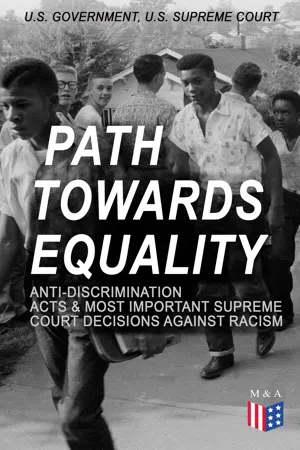
eBook - ePub
Path Towards Equality: Anti-Discrimination Acts & Most Important Supreme Court Decisions Against Racism
Pivotal Acts & Cases in Civil Rights History
- 447 pages
- English
- ePUB (mobile friendly)
- Available on iOS & Android
eBook - ePub
Path Towards Equality: Anti-Discrimination Acts & Most Important Supreme Court Decisions Against Racism
Pivotal Acts & Cases in Civil Rights History
About this book
This is a unique legal collection comprised of the most important U.S. Civil Rights Acts and Supreme Court decisions considering racial discrimination. Ideals, hopes and dreams of Nat Turner, Dred Scott, Martin Luther King and many other activists who fought for equality, are built in the legislative work presented in this edition. Whether you are a law student or a person interested in civil rights and concerned about equality, "Path Towards Equality" will provide you with insight into one of the most controversial issues of the American society.
Table of Contents:
Emancipation Proclamation & Gettysburg Address (1863)
Thirteenth Amendment to the United States Constitution (1865)
Civil Rights Act of 1866
Fourteenth Amendment to the United States Constitution (1868)
Reconstruction Acts (1867-1868)
Fifteenth Amendment to the United States Constitution (1870)
Enforcement Act of 1870
The First Enforcement Act of 1871 (to enforce the rights of citizens of the United States to vote in the several States of this Union)
The Second Enforcement Act of 1871 (Ku Klux Klan Act)
Civil Rights Act of 1875
Executive Order 9981 (1948)
Voting Rights Law of 1965
Executive Order 11246 (1965)
Fair Housing Act (1968)
United States Code Title 18 Chapter 13 (1968, 1976, 1988, 1994, 2009)
The Community Reinvestment Act (1977)
Matthew Shepard and James Byrd, Jr. Hate Crimes Prevention Act (2007)
Case Law:
Strauder v. West Virginia (1880)
Buchanan v. Warley (1917)
Shelley v. Kraemer (1948)
Sweatt v. Painter (1950)
Brown v. Board of Education (1954)
Boynton v. Virginia (1960)
Heart of Atlanta Motel Inc. v. United States (1964)
Loving v. Virginia (1967)
Jones v. Alfred H. Mayer Co. (1968)
Regents of the University of California v. Bakke (1978)
Batson v. Kentucky (1986)
Information
Subtopic
Civil Rights in LawIndex
Social SciencesPath Towards Equality: Anti-Discrimination Acts & Most Important Supreme Court Decisions Against Racism
Civil Rights Legislation, Racial Discrimination Law & Cases: From the Thirteenth Amendment to the Hate Crimes Prevention Act & From the Strauder v. West Virginia to the Batson v. Kentucky
Madison & Adams Press, 2017. No claim to original U.S. Government Works
Contact [email protected]
Contact [email protected]
ISBN 978-80-268-7311-2
This is a publication of Madison & Adams Press. Our production consists of thoroughly prepared educational & informative editions: Advice & How-To Books, Encyclopedias, Law Anthologies, Declassified Documents, Legal & Criminal Files, Historical Books, Scientific & Medical Publications, Technical Handbooks and Manuals. All our publications are meticulously edited and formatted to the highest digital standard. The main goal of Madison & Adams Press is to make all informative books and records accessible to everyone in a high quality digital and print form.
Table of Contents
Emancipation Proclamation & Gettysburg Address (1863)
LEGISLATION
1. Thirteenth Amendment to the United States Constitution (1865)
2. Civil Rights Act of 1866
3. Fourteenth Amendment to the United States Constitution (1868)
4. Reconstruction Acts (1867-1868)
5. Fifteenth Amendment to the United States Constitution (1870)
6. Enforcement Acts (1870-1871)
7. Civil Rights Act of 1875
8. Executive Order 9981 (1948)
9. Voting Rights Law of 1965
10. Executive Order 11246 (1965)
11. Fair Housing Act (1968)
12. United States Code Title 18 Chapter 13 (1968, 1976, 1988, 1994, 2009)
13. The Community Reinvestment Act (1977)
14. Matthew Shepard and James Byrd, Jr. Hate Crimes Prevention Act (2007)
CASE LAW
1. Strauder v. West Virginia (1880)
2. Buchanan v. Warley (1917)
3. Shelley v. Kraemer (1948)
4. Sweatt v. Painter (1950)
5. Brown v. Board of Education (1954)
6. Boynton v. Virginia (1960)
7. Heart of Atlanta Motel Inc. v. United States (1964)
8. Loving v. Virginia (1967)
9. Jones v. Alfred H. Mayer Co. (1968)
10. Regents of the University of California v. Bakke (1978)
11. Batson v. Kentucky (1986)
Emancipation Proclamation & Gettysburg Address (1863)
Table of Contents
Emancipation Proclamation
Gettysburg Address
Emancipation Proclamation
(1863)
Table of Contents
PROCLAMATION 93
PROCLAMATION 93- Changed by William Seward
PROCLAMATION 95
PROCLAMATION 93
Table of Contents
By the President of the United States of America.
A PROCLAMATION.
A PROCLAMATION.
I, Abraham Lincoln, President of the United States of America, and Commander-in-Chief of the Army and Navy thereof, do hereby proclaim and declare that hereafter, as heretofore, the war will be prosecuted for the object of practically restoring the constitutional relation between the United States, and each of the States, and the people thereof, in which States that relation is, or may be, suspended or disturbed.
That it is my purpose, upon the next meeting of Congress to again recommend the adoption of a practical measure tendering pecuniary aid to the free acceptance or rejection of all slave States, so called, the people whereof may not then be in rebellion against the United States and which States may then have voluntarily adopted, or thereafter may voluntarily adopt, immediate or gradual abolishment of slavery within their respective limits; and that the effort to colonize persons of African descent, with their consent, upon this continent, or elsewhere, with the previously obtained consent of the Governments existing there, will be continued.
That on the first day of January in the year of our Lord, one thousand eight hundred and sixty-three, all persons held as slaves within any State, or designated part of a State, the people whereof shall then be in rebellion against the United States shall be then, thenceforward, and forever free; and the executive government of the United States, including the military and naval authority thereof, will recognize and maintain the freedom of such persons, and will do no act or acts to repress such persons, or any of them, in any efforts they may make for their actual freedom.
That the executive will, on the first day of January aforesaid, by proclamation, designate the States, and part of States, if any, in which the people thereof respectively, shall then be in rebellion against the United States; and the fact that any State, or the people thereof shall, on that day be, in good faith represented in the Congress of the United States, by members chosen thereto, at elections wherein a majority of the qualified voters of such State shall have participated, shall, in the absence of strong countervailing testimony, be deemed conclusive evidence that such State and the people thereof, are not then in rebellion against the United States.
That attention is hereby called to an Act of Congress entitled ‘‘An Act to make an additional Article of War’’ approved March 13, 1862, and which act is in the words and figure following:
‘‘Be it enacted by the Senate and House of Representatives of the United States of America in Congress assembled, That hereafter the following shall be promulgated as an additional article of war for the government of the army of the United States, and shall be obeyed and observed as such:
Article –. All officers or persons in the military or naval service of the United States are prohibited from employing any of the forces under their respective commands for the purpose of returning fugitives from service or labor, who may have escaped from any persons to whom such service or labor is claimed to be due, and any officer who shall be found guilty by a court-martial of violating this article shall be dismissed from the service.
Sec. 2. And be it further enacted, That this act shall take effect from and after its passage.’’
Also to the ninth and tenth sections of an act entitled ‘‘An Act to suppress Insurrection, to punish Treason and Rebellion, to seize and confiscate property of rebels, and for other purposes,’’ approved July 17, 1862, and which sections are:
‘‘Sec. 9. And be it further enacted, That all slaves of persons who shall hereafter be engaged in rebellion against the government of the United States, or who shall in any way give aid or comfort thereto, escaping from such persons and taking refuge within the lines of the army; and all slaves captured from such persons or deserted by them and coming under the control of the government of the United States; and all slaves of such persons found (or) being within any place occupied by rebel forces and afterwards occupied by the forces of the United States, shall be deemed captives of war, and shall be forever free of their servitude, and not again held as slaves.
‘‘Sec. 10. And be it further enacted, That no slave escaping into any State, Territory, or the District of Columbia, from any other State, shall be delivered up, or in any way impeded or hindered of his liberty, except for crime, or some offence against the laws, unless the person claiming said fugitive shall first make oath that the person to whom the labor or service of such fugitive is alleged to be due is his lawful owner, and has not borne arms against the United States in the present rebellion, nor in any way given aid and comfort thereto; and no person engaged in the military or naval service of the United States shall, under any pretence whatever, assume to decide on the validity of the claim of any person to the service or labor of any other person, or surrender up any such person to the claimant, on pain of being dismissed from the service.’’
And I do hereby enjoin upon and order all persons engaged in the military and naval service of the United States to observe, obey, and enforce, within their respective spheres of service, the act, and sections above recited.
And the executive will in due time recommend that all citizens of the United States who shall have remained loyal thereto throughout the rebellion, shall (upon the restoration of the constitutional relation between the United States, and their respective States, and people, if that relation shall have been suspended or disturbed) be compensated for all losses by acts of the United States, including the loss of slaves.
In Witness Whereof, I have hereunto set my hand, and caused the seal of the United States to be affixed.
Done US Great Seal 1877 at the City of Washington this twenty-second day of September, in the year of our Lord, one thousand, eight hundred and sixty-two, and of the Independence of the United States the eighty seventh.

Abraham Lincoln
By the President:
William H. Seward,
Secretary of State.
William H. Seward,
Secretary of State.
PROCLAMATION 93- Changed by William Seward
Table of Contents
By the President of the United States of America.
A PROCLAMATION.
A PROCLAMATION.
I, Abraham Lincoln, President of the United States of America, and Commander-in-Chief of the Army and Navy thereof, do hereby proclaim and declare that hereafter, as heretofore, the war will be prosecuted for the object of practically restoring the constitutional relation between the United States, and each of the states, and the people thereof, in which states that relation is, or may be suspended, or disturbed.
That it is my purpose, upon the next meeting of Congress to again recommend the adoption of a practical measure tendering pecuniary aid to the free acceptance or rejection of all slave-states, so called, the people whereof may not then be in rebellion against the United States, and which states [and] may then have voluntarily adopted, or thereafter may voluntarily adopt, immediate, or gradual abolishment of slavery within their respective limits; and that the effort to colonize persons of African descent [with their consent] upon this continent, or elsewhere, [with the previously obtained consent of the governments existing there,] will be continued.
That on the first day of January in the year of our Lord, one thousand eight hundred and sixty-three, all persons held as slaves within any state, or designated part of a state, the people whereof shall than be in rebellion against the United States; shall be then, thenceforward, and forever free; and the executive government of the United States [including the military and naval authority thereof] will, during the continuance in office of the present incumbents , recognize [and maintain the freedom of] such persons, as being free , and will do no act or acts to repress such persons, or any of them, in any efforts they may make for their actual freedom.
That the executive will, on the first day of January aforesaid, by proclamation, designate the States, and parts of states, if any, in which the people thereof respectively, shall then be in rebellion against the United States; and the fact that any state, or the people thereof shall, on that day be, in good faith represented in the Congress of the United States, by members chosen thereto, at elections wherein a majority of the qualified voters of such state shall have participated, shall, in the absence of strong countervailing testimony, be deemed conclusive evidence that such state, and the people thereof, are not then in rebellion against the United States.
That attention is hereby called to an Act of Congress entitled ‘‘An Act to make an additional Article of War’’ approved March 13, 1862, and which act is in the words and figure following:
‘‘Be it enacted by the Senate and House of Representatives of the United States of America in Congress assembled, That hereafter the following shall be promulgated as an additional article of war for the government of the army of the United States, and shall be obeyed and observed as such:
Article –. All officers or persons in the military or naval service of the United States are prohibited from employing any of the forces under their respective commands for the purpose of returning fugitives from service or labor, who may have escaped from any persons to whom such service or labor is claimed to be due, and any officer who shall be found guilty by a court-martial of violating this article shall be dismissed from the service.
Sec. 2. And be it further enacted, That this act shall take effect from and after its passage.’’
Also to the ninth and tenth sections of an act entitled ‘‘An Act to suppress Insurrection, to punish Treason and Rebellion, to seize and confiscate property of rebels, and for other purposes,’’ approved July 17, 1862, and which sections are:
‘‘Sec. 9. And be it further enacted, That all slaves of persons who shall hereafter be engaged in rebellion against the government of the United States, or who shall in any way give aid or comfort thereto, escaping from such persons and taking refuge within the lines of the army; and all slaves captured from such persons or deserted by them and coming under the control of the government of the United States; and all slaves of such persons found [or] being within any place occupied by rebel forces and afterwards occupied by the forces of the United States, shall be deemed captives of war, and shall be forever free of their servitude, and not again held as slaves.
‘‘Sec. 10. And be it further enacted, That no slave escaping into any State, Territory, or the District of Columbia, from any other State, shall be delivered up, or in any way impeded or hindered of his liberty, except for crime, or some offence against the laws, unless the person claiming said fugitive shall first make oath that the person to whom the labor or service of such fugitive is alleged to be due is his lawful owner, and has not borne arms against the United States in the present rebellion, nor in any way given aid and comfort thereto; and no person engaged in the military or naval service of the United States shall, under any pre...
Table of contents
- Path Towards Equality: Anti-Discrimination Acts & Most Important Supreme Court Decisions Against Racism
Trusted by 375,005 students
Access to over 1.5 million titles for a fair monthly price.
Study more efficiently using our study tools.
Frequently asked questions
Yes, you can cancel anytime from the Subscription tab in your account settings on the Perlego website. Your subscription will stay active until the end of your current billing period. Learn how to cancel your subscription
No, books cannot be downloaded as external files, such as PDFs, for use outside of Perlego. However, you can download books within the Perlego app for offline reading on mobile or tablet. Learn how to download books offline
Perlego offers two plans: Essential and Complete
- Essential is ideal for learners and professionals who enjoy exploring a wide range of subjects. Access the Essential Library with 800,000+ trusted titles and best-sellers across business, personal growth, and the humanities. Includes unlimited reading time and Standard Read Aloud voice.
- Complete: Perfect for advanced learners and researchers needing full, unrestricted access. Unlock 1.5M+ books across hundreds of subjects, including academic and specialized titles. The Complete Plan also includes advanced features like Premium Read Aloud and Research Assistant.
We are an online textbook subscription service, where you can get access to an entire online library for less than the price of a single book per month. With over 1.5 million books across 990+ topics, we’ve got you covered! Learn about our mission
Look out for the read-aloud symbol on your next book to see if you can listen to it. The read-aloud tool reads text aloud for you, highlighting the text as it is being read. You can pause it, speed it up and slow it down. Learn more about Read Aloud
Yes! You can use the Perlego app on both iOS and Android devices to read anytime, anywhere — even offline. Perfect for commutes or when you’re on the go.
Please note we cannot support devices running on iOS 13 and Android 7 or earlier. Learn more about using the app
Please note we cannot support devices running on iOS 13 and Android 7 or earlier. Learn more about using the app
Yes, you can access Path Towards Equality: Anti-Discrimination Acts & Most Important Supreme Court Decisions Against Racism by U.S. Government,U.S. Supreme Court in PDF and/or ePUB format, as well as other popular books in Social Sciences & Civil Rights in Law. We have over 1.5 million books available in our catalogue for you to explore.