Anyone can be a leader, but to be a successful leader can be a real challenge. A leader needs to be able to draw on a vast array of skills and attributes and be able to apply them at the right time and in the right way. Above all a leader has to recognise that his/her success will ultimately depend on the people that he/ she leads which means creating an environment in which all of these people can Tlourish.
eBook - ePub
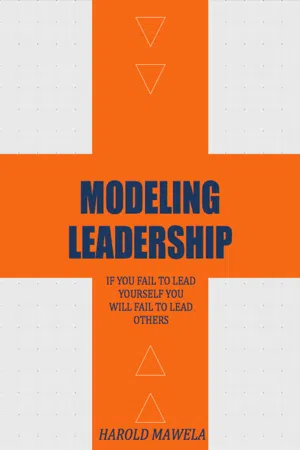
Modeling Leadership
If You Fail To Lead Yourself You Will Fail To Lead Others
- 78 pages
- English
- ePUB (mobile friendly)
- Available on iOS & Android
eBook - ePub
About this book
Information
Subtopic
LeadershipIndex
Business
1 Introduction
Modeling leadership is genuine leadership
Basically leadership is about people. When people need to work together to achieve an objective, they need leadership. When people are uncertain what to do next, they need leadership. When people are struggling to overcome difficult situations, they need leadership.
Whatever definition you favour, and there are many to choose from, leadership is about getting the best from people. It is underpinned by a real belief in people and a desire to want to help those people make the most of their talents.
Success in any organisation depends on people and so great leaders believe, and behave in accordance with that belief, that real, long-term success is best delivered through embracing the skills and energies of people.
Leadership is also about vision. Leaders need a clear vision of the future goal, but they will not be able to achieve that vision unless they take the people that they lead along with them. A leader without followers is plainly no leader at all and neither is a leader who has unwilling followers. So leadership involves winning people's hearts and minds, persuading them to share and embrace that vision and then motivating them to give of their best to help achieve it. Leaders must therefore understand what motivates people, recognising that people are different and that those differences should be embraced.

Of course, the word leadership comes from the verb 'to lead', the dictionary definition of which includes 'guide or show the way' and 'guide by persuasion or example'. So leadership must be about showing the way; not only creating the vision but also showing by example what people should do and how they should behave. True leadership is not therefore about telling people what to do, giving orders and expecting them to be carried out without explanation or guidance. People are generally too bright and skilled for that to be an appropriate way to lead and so they need to be free to realise their full potential. Leaders must therefore set high standards in everything that they do for others to follow.
Leaders should be careful never to forget how much they depend on people. They should never believe too much in their own ability, never believe that they always know best and never rely purely on their status as a leader to tell others what to do. Leaders should never see themselves as better than the people that they are trying to lead and should not put themselves, or allow others to put them, on a pedestal that creates a barrier between themselves and those people that they depend on.
Achieving success for an organisation, while at the same time developing and nurturing people and taking real delight from their success, means that leadership can, and should, be a positive, exciting, energising and fulfilling role. For those leaders who find leadership a lonely, isolated role, it is most likely because they have not understood and embraced the people aspect of leadership.
So leadership is about human interactions and relationships, not about theoretical models, and a team's, or an organisation's, success depends to a great extent on the leader setting the tone and establishing a positive culture by his/her own behaviour. Truly effective leadership is about creating the right environment, recruiting the right people, and then leading by example.
Who is a leader?
Too often leadership is associated with a title, but the reality is that leadership is about what people do. Titles may give someone authority and perhaps power, but trust and respect are only given to people because of their behaviour.
Although leaders may be CEO's of large multinational organisations or heads of nations or large public organisations, most are typically ordinary people who have simply been asked to do a job which involves getting other people to help in achieving an objective. Leadership is often only a temporary role when, for example, a particular task or project requires someone to take the role of leader to accomplish a specific outcome.
For some people leadership is only a part-time role so that in addition to leading, they also spend time managing resources and carrying out tasks alongside the other team members. As such it is important that people understand when they are taking on a leadership role, and when they are not, so that they behave in the right way for the role that they are fulfilling at any particular time.
Sometimes leaders are formally given the role of leader, while in other situations people assume that role. Regardless of how someone becomes a leader, the principles of leadership apply to all situations in which a person takes on that role. It may be in work: leading a meeting, leading a project team, leading a business department, leading a business division or as head of the whole organisation. Equally there are many situations outside work where people become leaders. For example; as a parent, coaching a sports team, leading a music group, leading a young persons' group, leading a keep-fit class or leading a group on a walk up a mountain.
As there are so many occasions when people need to behave as leaders, does this mean that anyone can be a leader? The simplest, and often the most effective, form of leadership is example and everyone can set an example. So yes, anyone can be a leader. After all, many of the ideal leadership behaviours are exactly the same behaviours that any decent person should follow in the way that they behave towards others.
Why is modeling so important?
Put simply, modeling, like laughter, is infectious - it is capable of affecting the emotions and attitudes of anyone who is exposed to it.
Throughout our lives, we have all been, and continue to be, influenced by the behaviour of others, whether it is the example set by parents, teachers, work colleagues, friends, sportstars, celebrities, politicians or just people that we meet any and every day. We are influenced by what we see other people doing and how they are behaving. In some cases we respond to other people's examples by making a conscious choice as to how we behave, but in other cases the influences are more subtle and we are less aware of our behaviours changing.
So whether they like it or not, leaders lead by modeling. Leaders are role models. Of course people can, and should, make independent choices and they should not just be blind followers doing whatever the leader does, but the leader's behaviour is a reference point. A leader's behaviour, good and bad, will affect the behaviour of others and so clearly leaders need to focus on setting a good example to encourage positive behaviours from the people that they lead.
By their own example, leaders need to instil in the people that they lead the right values and behaviours. Leaders should not rely on rules and regulations to set down how people should behave. People are contrary beings. If told not to do something there is a temptation to do the opposite. Think of a child who is told not to touch something! Telling people how to behave; threatening them with punishment if they fail to behave in the right way or offering financial incentives for positive behaviours are likely to achieve only shortterm success. In the long-term, people need to recognise for themselves why behaving in a certain way has positive results and the leader's positive example will undoubtedly be a powerful influence.
A leader's words and actions set the tone for the people he/she leads. A leader is never off duty, his/her behaviour is constantly being scrutinised for verbal and non-verbal signals which will be interpreted, commented on and copied. How the leader approaches opportunities and meets challenges actively influences the approach of everyone he/she leads. Leaders need to consistently and persistently behave the right way and then encourage those good behaviours to pervade the whole organisation.
If leaders' behaviour is to influence that of the people that they lead, then they must behave in a consistent manner. They need to behave consistently every day in their response to similar situations and in the way that they meet different challenges. They also need to demonstrate consistency between their actions and words. It is no good adopting a 'do as I say' philosophy as this will quickly dampen enthusiasm and morale and the levels of cynicism will rise. Why should anyone follow an instruction that the instructor is not following themselves? Leaders must adopt a 'do as I do' philosophy, or using a cliché, they must 'walk the talk'. Only by maintaining this consistency can leaders hope to embed positive behaviours in their team and create the positive culture that they should be aiming for.
While setting the right example does not ensure that everyone will follow that positive behaviour, setting the wrong example is very unlikely to result in people behaving well. Leaders cannot behave in a way that they ask their people not to. The way that leaders work and behave will be the best that they can reasonably expect from the people they lead. If leaders set low standards by their own actions and behaviours, then they are to blame for low standards in the people that they lead.
How this book will help you
Whether you are preparing for a leadership role, new to leadership, or an experienced leader; whether your leadership role is at work or outside work; this book contains straightforward, practical advice and ideas that will help you to become a more effective leader simply by the model that you set to those people that you lead, emphasising the most important positive behaviours to focus on.
While not everyone has all of th...
Table of contents
- MODELING LEADERSHIP
- Title Page
- Copyright Page
- Table of Contents
- Intro
- Chapter 2 Building blocks of a first-class leader
- Chapter 3 Conduct yourself with integrity
- Chapter 4 Be reliable
- Chapter 5 Value your team
- Chapter 6 Create a culture of high-quality communication
- Chapter 7 Consider new ideas and opinions of others
- Chapter 8 Give praise where praise is due
- Chapter 9 Be operational
- Chapter 10 Have faith and be passionate
- Chapter 11 Invest in your team
- Chapter 12 Upgrade yourself
Trusted by 375,005 students
Access to over 1.5 million titles for a fair monthly price.
Study more efficiently using our study tools.
Frequently asked questions
Yes, you can cancel anytime from the Subscription tab in your account settings on the Perlego website. Your subscription will stay active until the end of your current billing period. Learn how to cancel your subscription
No, books cannot be downloaded as external files, such as PDFs, for use outside of Perlego. However, you can download books within the Perlego app for offline reading on mobile or tablet. Learn how to download books offline
Perlego offers two plans: Essential and Complete
- Essential is ideal for learners and professionals who enjoy exploring a wide range of subjects. Access the Essential Library with 800,000+ trusted titles and best-sellers across business, personal growth, and the humanities. Includes unlimited reading time and Standard Read Aloud voice.
- Complete: Perfect for advanced learners and researchers needing full, unrestricted access. Unlock 1.5M+ books across hundreds of subjects, including academic and specialized titles. The Complete Plan also includes advanced features like Premium Read Aloud and Research Assistant.
We are an online textbook subscription service, where you can get access to an entire online library for less than the price of a single book per month. With over 1.5 million books across 990+ topics, we’ve got you covered! Learn about our mission
Look out for the read-aloud symbol on your next book to see if you can listen to it. The read-aloud tool reads text aloud for you, highlighting the text as it is being read. You can pause it, speed it up and slow it down. Learn more about Read Aloud
Yes! You can use the Perlego app on both iOS and Android devices to read anytime, anywhere — even offline. Perfect for commutes or when you’re on the go.
Please note we cannot support devices running on iOS 13 and Android 7 or earlier. Learn more about using the app
Please note we cannot support devices running on iOS 13 and Android 7 or earlier. Learn more about using the app
Yes, you can access Modeling Leadership by Harold Mawela in PDF and/or ePUB format, as well as other popular books in Business & Leadership. We have over 1.5 million books available in our catalogue for you to explore.