- 566 pages
- English
- ePUB (mobile friendly)
- Available on iOS & Android
eBook - ePub
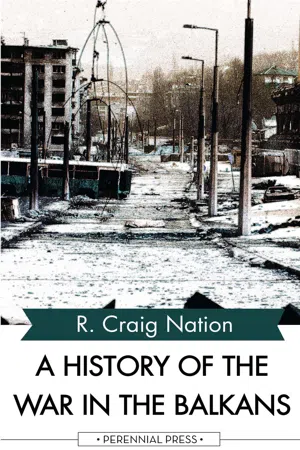
A History of the War in the Balkans
About this book
The Balkans is often described as a grim backwater, a "no man's land of world politics" in the words of a post-World War II study "foredoomed to conflict springing from heterogeneity." The stereotype is false, but it has been distressingly influential in shaping perceptions of the Balkan conflict and its origin. By encouraging pessimism about prospects for recovery, it may also make it more difficult to sustain commitments to post conflict peace building. This book seeks to refute simplistic "ancient hatreds" explanations by looking carefully at the sources and dynamics of the Balkan conflict in all of its dimensions.
Information
Subtopic
Eastern European HistoryIndex
HistoryCHAPTER 1: THE BALKAN REGION IN WORLD POLITICS
~
On Board the Orient Express.
It has become common to use the term Balkan as a synonym for backwardness and bigotry. The most widely read and influential account of the region written during the 1990s portrays it as a repository of sadism and violence, haunted by the “ghosts” of implacable enmity.1 A prominent European diplomat, embittered by the failure of peacemaking efforts in Bosnia-Herzegovina, speaks with disdain of the subject of his mediation as “a culture of violence within a crossroads civilization.”2 Even the Turkish novelist Nedim Gürsel, a friend of the region whose family originates from Ottoman Üsküb (Skopje), laments that hatred between peoples condemned to coexist has become “the destiny of the Balkans.”3
Such atavisms could be dismissed as Orientalist fantasies were it not for two inconvenient facts.4 First, the perception of the Balkans as a region torn by violence and ethnic strife has an objective foundation. From the emergence of the first national liberation movements among the Christian subjects of the Ottoman Empire in the early 19th century, Southeastern Europe has been a chronically unstable European sub-region.5
Clashes with the Ottomans culminated in the Balkan wars of 1912-1913, and in both 20th century world wars the Balkans was a significant theater of operations. A phase of equilibrium during the Cold War could not be sustained after the collapse of communism, and the new Balkan war of the 1990s has been the only major European armed conflict since 1945 (with the partial exception of the Greek civil war of 1945-1947, really a continuation of struggles born during the Second World War). Second, even when they are exaggerated or inaccurate, perceptions matter. The fact that the Balkans is widely viewed as an area of ancient hatreds, irrespective of whatever real merit the argument may have, has shaped, and continues to shape, the international community’s approach toward the region and its problems.
What is the Balkans? The term itself, derived from Persian through Turkish, originally referred to a high house or mountain. It was incorporated into the phrase “Balkan Peninsula” by the German geographer Johann August Zeune in 1808 to call attention to the area’s mountainous terrain, but did not come into common use until the mid-19th century. The pejorative connotation that the designation Balkan has taken on has led to resistance to its use, and in some ways the more neutral term “Southeastern Europe” is a preferable alternative.6 The Balkans, however, is more than just a peninsular extension of greater Europe. It is also a distinctive physical and cultural zone possessed of what Maria Todorova calls “historical and geographic concreteness.”7
Most histories of the modern Balkans begin with a definition of the region based upon its physical characteristics. The Balkans is constituted as a peninsula, bounded by the Adriatic and Ionian Seas in the West, the Aegean Sea in the South, and the Black Sea in the East, and its ports of call have been a focus for commercial interaction since classical antiquity. Coastal areas and outlying island groups, with a more cosmopolitan background and milder Mediterranean climate, may be distinguished from inland regions, which are predominantly mountainous, relatively isolated, and subject to more severe continental weather patterns. Mountain barriers paralleling the coastline and an absence of navigable rivers cut the Balkan interior off from the sea. Unlike the Iberian and Italian Peninsulas, divided from the European heartland by the Pyrenees and the Alps, the Balkans opens to central Europe through the valley of the Danube and across the Pannonian plain. Internally, the region is fragmented by a series of mountain chains—the Julien Alps in the north, the Dinaric and Pindus mountains stretching dorsally along the peninsula’s western flank, the Carpathians in the northeast, the Balkan mountains (the Haemus range of classical antiquity) running east-west through the heart of Bulgaria, and the Rhodope mountains paralleling them in the south beyond the valley of the Maritsa River and falling away toward the Aegean. The lack of well irrigated lowlands suitable for intensive agriculture has been an impediment to population growth. Mountainous terrain has encouraged cultural differentiation, and contributed to the failure of attempts at integration.8
As an exposed and strategically important area without a tradition of independent statehood, the Balkan Peninsula has served as a shatterbelt and point of confrontation between neighboring power complexes—one source, externally imposed, of the propensity toward violence purported to be an indigenous trait.9 Sea, river, and overland lines of communication running adjacent to and across the region ...
Table of contents
- CHAPTER 1: THE BALKAN REGION IN WORLD POLITICS
- CHAPTER 2: THE BALKANS IN THE SHORT 20th CENTURY
- CHAPTER 3: THE STATE OF WAR: SLOVENIA AND CROATIA, 1991-92
- CHAPTER 4: THE LAND OF HATE: BOSNIA-HERZEGOVINA, 1992-95
- CHAPTER 5: WAR AND REVENGE IN KOSOVO, 1998-99
- CHAPTER 6 GREECE, TURKEY, CYPRUS
- CHAPTER 7: THE BALKANS BETWEEN WAR AND PEACE
Trusted by 375,005 students
Access to over 1.5 million titles for a fair monthly price.
Study more efficiently using our study tools.
Frequently asked questions
Yes, you can cancel anytime from the Subscription tab in your account settings on the Perlego website. Your subscription will stay active until the end of your current billing period. Learn how to cancel your subscription
No, books cannot be downloaded as external files, such as PDFs, for use outside of Perlego. However, you can download books within the Perlego app for offline reading on mobile or tablet. Learn how to download books offline
Perlego offers two plans: Essential and Complete
- Essential is ideal for learners and professionals who enjoy exploring a wide range of subjects. Access the Essential Library with 800,000+ trusted titles and best-sellers across business, personal growth, and the humanities. Includes unlimited reading time and Standard Read Aloud voice.
- Complete: Perfect for advanced learners and researchers needing full, unrestricted access. Unlock 1.5M+ books across hundreds of subjects, including academic and specialized titles. The Complete Plan also includes advanced features like Premium Read Aloud and Research Assistant.
We are an online textbook subscription service, where you can get access to an entire online library for less than the price of a single book per month. With over 1.5 million books across 990+ topics, we’ve got you covered! Learn about our mission
Look out for the read-aloud symbol on your next book to see if you can listen to it. The read-aloud tool reads text aloud for you, highlighting the text as it is being read. You can pause it, speed it up and slow it down. Learn more about Read Aloud
Yes! You can use the Perlego app on both iOS and Android devices to read anytime, anywhere — even offline. Perfect for commutes or when you’re on the go.
Please note we cannot support devices running on iOS 13 and Android 7 or earlier. Learn more about using the app
Please note we cannot support devices running on iOS 13 and Android 7 or earlier. Learn more about using the app
Yes, you can access A History of the War in the Balkans by R. Craig Nation in PDF and/or ePUB format, as well as other popular books in History & Eastern European History. We have over 1.5 million books available in our catalogue for you to explore.