eBook - ePub
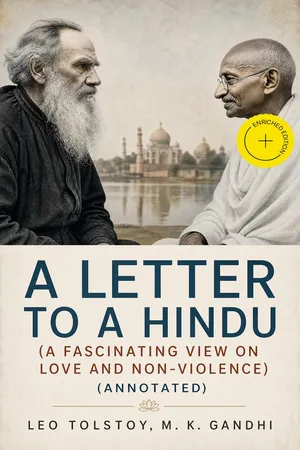
A LETTER TO A HINDU (A Fascinating View on Love and Non-Violence) (Annotated)
Enriched Edition. Including Correspondences with Gandhi & Letter to Ernest Howard Crosby
- 38 pages
- English
- ePUB (mobile friendly)
- Available on iOS & Android
eBook - ePub
A LETTER TO A HINDU (A Fascinating View on Love and Non-Violence) (Annotated)
Enriched Edition. Including Correspondences with Gandhi & Letter to Ernest Howard Crosby
About this book
A Letter to a Hindu gathers a compact yet momentous exchange of ideas on love, moral force, and resistance to empire. Centered on the famous letter advocating non-violence as a spiritual and political principle, the volume ranges from prophetic moral argument to epistolary persuasion and philosophical reflection. Its significance lies in the convergence of ethical universalism, anti-colonial critique, and practical counsel, presenting non-violence not as passivity but as an active, disciplined power. The work brings together Leo Tolstoy, the Russian novelist and religious thinker whose late writings challenged state violence, institutional religion, and coercive modernity, and M. K. Gandhi, whose political practice transformed such ideas into a mass movement for Indian self-rule. Their encounter belongs to the broader history of transnational reform, Christian anarchism, Hindu ethical thought, and the emergence of satyagraha. Together, these voices illuminate how literature, conscience, and politics can reshape historical possibility. This volume is recommended for readers seeking a concise but profound introduction to the intellectual genealogy of non-violent resistance. It offers students, historians, and general readers a rare opportunity to witness a dialogue across cultures and empires, one that continues to inform debates on justice, freedom, and the moral responsibilities of collective action.
This enriched edition has been carefully crafted to add value to your reading experience.
- A succinct Introduction situates the work's timeless appeal and themes.
- The Synopsis outlines the central plot, highlighting key developments without spoiling critical twists.
- A detailed Historical Context immerses you in the era's events and influences that shaped the writing.
- An Author Biography reveals milestones in the author's life, illuminating the personal insights behind the text.
- A thorough Analysis dissects symbols, motifs, and character arcs to unearth underlying meanings.
- Reflection questions prompt you to engage personally with the work's messages, connecting them to modern life.
- Hand?picked Memorable Quotes shine a spotlight on moments of literary brilliance.
Introduction
Table of Contents
Leo Tolstoy: A Short Biography
by Aylmer Maude
Table of Contents
COUNT LEO TOLSTOY was born 28th August 1828 [in the Julian calendar then used in Russia; 9th September 1828 in today’s internationally accepted Gregorian calendar], at a house in the country not many miles from Toúla, and about 130 miles south of Moscow.
He has lived most of his life in the country, preferring it to town, and believing that people would be healthier and happier if they lived more natural lives, in touch with nature, instead of crowding together in cities.
He lost his mother when he was three, and his father when he was nine years old. He remembers a boy visiting his brothers and himself when he was twelve years old, and bringing the news that they had found out at school that there was no God, and that all that was taught about God was a mere invention.
He himself went to school in Moscow, and before he was grown up he had imbibed the opinion, generally current among educated Russians, that ‘religion’ is old-fashioned and superstitious, and that sensible and cultured people do not require it for themselves.
After finishing school Tolstoy went to the University at Kazán. There he studied Oriental languages, but he did not pass the final examinations.
In one of his books Tolstoy remarks how often the cleverest boy is at the bottom of the class. And this really does occur. A boy of active, independent mind, who has his own problems to think out, will often find it terribly hard to keep his attention on the lessons the master wants him to learn. The fashionable society Tolstoy met at his aunt’s house in Kazán was another obstacle to serious study.
He then settled on his estate at Yásnaya Polyána, and tried to improve the condition of the serfs. His attempts were not very successful at the time, though they served to prepare him for work that came later. He had much to contend against in himself, and after three years he went to the Caucasus to economise, in order to pay off debts made at cards. Here he hunted, drank, wrote his first sketches, and entered the army, in which an elder brother to whom he was greatly attached was serving, and which was then engaged in subduing the native tribes.
When the Crimean War began, in 1854, Tolstoy applied for active service, and was transferred to the army on the frontier of European Turkey, and then, soon after the siege began, to an artillery regiment engaged in the defence of Sevastopol. His uncle, Prince Gortchakóf, was commander-in-chief of the Russian army, and Tolstoy received an appointment to his staff. Here he obtained that first-hand knowledge of war which has helped him to speak on the subject with conviction. He saw war as it really is.
The men who governed Russia, France, England, Sardinia, and Turkey had quarrelled about the custody of the ‘Holy Places’ in Palestine, and about the meaning of two lines in a treaty made in 1774 between Russia and Turkey.
They stopped at home, but sent other people — most of them poorly paid, simple people, who knew nothing about the quarrel — to kill each other wholesale in order to settle it.
Working men were taken from Lancashire, Yorkshire, Middlesex, Essex, and all parts of England, Scotland, Wales, Ireland, France, and Sardinia, and shipped, thousands of miles, to join a number of poor Turkish peasants in trying to kill Russian peasants. These latter had in most cases been forced unwillingly to leave their homes and families, and to march on foot thousands of miles to fight these people they never saw before, and against whom they bore no grudge.
Some excuse had, of course, to be made for all this, and in England people were told the war was “in defence of oppressed nationalities.”
When some 500,000 men had perished, and about £340,000,000 had been spent, those who governed said it was time to stop. They forgot all about the “oppressed nationalities,” but bargained about the number and kind of ships Russia might have on the Black Sea.
Fifteen years later, when France and Germany were fighting each other, the Russian Government tore up that treaty, and the other Governments then said it did not matter. Later still, Lord Salisbury said that in the Crimean War we “put our money on the wrong horse.” To have said so at the time the people were killing each other would have been unpatriotic. In all countries truth, on such matters, spoken before it is stale, is unpatriotic.
When the war was over Count Tolstoy left the army and settled in Petersburg. He was welcome to whatever advantages the society of the capital had to offer, for not only was he a nobleman and an officer, just back from the heroic defence of Sevastopol, but he was then already famous as a brilliant writer. He had written short sketches since he was twenty-three, and while still young was recognised among Russia’s foremost literary men.
He had, therefore, fame, applause, and wealth — and at first he found these things very pleasant. But being a man of unusually sincere nature, he began in the second, and still more in the third, year of this kind of life, to ask himself seriously why people made such a fuss about the stories, novels, or poems, that he and other literary men were producing. If, said he, our work is really so valuable that it is worth what is paid for it, and worth all this praise and applause — it must be that we are saying something of great importance to the world to know. What, then, is our message? What have we to teach?
But the more he considered the matter, the more evident it was to him that the authors and artists did not themselves know what they wanted to teach — that, in fact, they had nothing of real importance to say, and often relied upon their powers of expression, when they had nothing to express. What one said, another contradicted, and what one praised, another jeered at.
When he examined their lives, he saw that, so far from being exceptionally moral and self-denying, they were a more selfish and immoral set of men even than the officers he had been among in the army.
In later years, when he had quite altered his views of life, he wrote with very great severity of the life he led when in the army and in Petersburg. This is the passage — it occurs in My Confession: “I cannot now think of those years without horror, loathing, and heart-ache. I killed men in war, and challenged men to duels in order to kill them; I lost at cards, consumed what the peasants produced, sentenced them to punishments, lived loosely, and deceived people. Lying, robbery, adultery of all kinds, drunkenness, violence, murder … there was no crime that I did not commit; and people approved of my conduct, and my contemporaries considered, and consider me, to be, comparatively speaking, a moral man.”
Many people — forgetting Tolstoy’s strenuous manner of writing, and the mood in which My Confession was written — have concluded from these lines that as a young man he led a particularly immoral life. Really, he is selecting the worst incidents, and is calling them by their harshest names: war and the income from his estate are “murder” and “robbery.” In this passage he is — like John Bunyan and other good men before him — denouncing rather than describing the life he lived as a young man. The simple fact is that he lived among an immoral, upper-class, city society, and to some extent yielded to the example of those around him; but he did so with qualms of conscience and frequent strivings after better things. Judged even as harshly as he judges himself, the fact remains that those among whom he lived considered him to be above their average moral level.
Dissatisfied with his life, sceptical of the utility of his work as a writer, convinced that he could not teach others without first knowing what he had to teach, Tolstoy left Petersburg and retired to an estate in the country, near the place where he was born, and where he has spent most of his life.
It was the time of the great emancipation movement in Russia. Tolstoy improved the condition of his serfs by commuting their personal service for a fixed annual payment, but it was not possible for him to set them free until after the decree of emancipation in 1861.
In the country Tolstoy attended to his estates and organised schools for the peasants. If he did not know enough to teach the ‘cultured crowd’ in Petersburg, perhaps he could teach peasant children. Eventually he came to see that before you can know what to teach — even to a peasant child — you must know the purpose of human life. Otherwise you may help him to ‘get on,’ and he may ‘get on to other people’s backs,’ and there be a nuisance even to himself.
Tolstoy twice travelled abroad, visiting Germany, France, and England, and studying the educational systems, which seemed to him very bad. Children born with different tastes and capacities are put through the same course of lessons, just as coffee beans of different sizes are ground to the same grade. And this is done, not because it is best for them, but because it is easiest for the teachers, and because the parents lead artificial lives and neglect their own children.
In spite of his dissatisfaction with literary work Tolstoy continued to write — but he wrote differently. Habits are apt to follow from afar. A man’s conduct may be influenced by new thoughts and feelings, but his future conduct will result both from what he was and from what he wishes to become. So a billiard ball driven by a cue and meeting another ball in motion, takes a new line, due partly to the push from the cue and partly to the impact of the other ball.
At this period of his life, perplexed by problems he was not yet able to solve, Tolstoy, who in general even up to old age has possessed remarkable strength and endurance of body as well as of mind, was threatened with a breakdown in health — a nervous prostration. He had to leave all his work and go for a time to lead a merely animal existence and drink a preparation of mare’s milk among the wild Kirghíz in Eastern Russia.
In 1862 Tolstoy married, and he and his wife, to whom he has always been faithful, have lived to see the century out together. Not even the fact that the Countess has not agreed with many of the views her husband has expressed during the last twenty years, and has been dissatisfied at his readiness to part with his property, to associate with ‘dirty’ low-class people, and to refuse payment for his literary work — not even these difficulties have diminished their affection for one another. Thirteen children were born to them, of whom five died young.
The fact that twenty years of such a married life preceded Tolstoy’s change of views, and that the opinions he now expresses were formed when he was still as active and vigorous as most men are at half his age, should be a sufficient answer to those who have so misunderstood him as to suggest that, having worn himself out by a life of vice, he now cries sour grapes lest others should enjoy pleasures he is obliged to abandon.
For some time Tolstoy was active as a “Mediator of the Peace,” adjusting difficulties between the newly emancipated serfs and their former owners. During the fourteen years that followed his marriage he also wrote the long novels, War and Peace, and Anna Karénina. His wife copied out War and Peace no less than seven times, as he altered and improved it again and again. With his work, as with his life, Tolstoy is never satisfied — he always wants to get a step nearer perfection, and is keen to note and to admit his deficiencies.
The happiness and fulness of activity of his family life kept in the background for nearly fifteen years the great problems that had begun to trouble him. But ultimately the great question: What is the meaning of my life? presented itself more clearly and insistently than ever, and he began to feel that unless he could answer it he could not live.
Was wealth the aim of his life?
He was highly paid for his books, and he had 20,000 acres of land in the Government of Samára; but suppose he became twice or ten times as rich, he asked himself, would it satisfy him? And if it satisfied him — was not death coming: to take it all away? The more satisfying the wealth, the more terrible must death be, which would deprive him of it all.
Would family happiness — the love of wife and children — satisfy him, and explain the purpose of life? Many fond parents stake their happiness on the well-being of an only child, and make that the aim of their lives. But how unfortunate such ...
Table of contents
- Introduction
- Author Biography
- Historical Context
- Synopsis (Selection)
- A LETTER TO A HINDU (A Fascinating View on Love and Non-Violence)
- Analysis
- Reflection
- Memorable Quotes
Trusted by 375,005 students
Access to over 1.5 million titles for a fair monthly price.
Study more efficiently using our study tools.
Information
Frequently asked questions
Yes, you can cancel anytime from the Subscription tab in your account settings on the Perlego website. Your subscription will stay active until the end of your current billing period. Learn how to cancel your subscription
No, books cannot be downloaded as external files, such as PDFs, for use outside of Perlego. However, you can download books within the Perlego app for offline reading on mobile or tablet. Learn how to download books offline
Perlego offers two plans: Essential and Complete
- Essential is ideal for learners and professionals who enjoy exploring a wide range of subjects. Access the Essential Library with 800,000+ trusted titles and best-sellers across business, personal growth, and the humanities. Includes unlimited reading time and Standard Read Aloud voice.
- Complete: Perfect for advanced learners and researchers needing full, unrestricted access. Unlock 1.5M+ books across hundreds of subjects, including academic and specialized titles. The Complete Plan also includes advanced features like Premium Read Aloud and Research Assistant.
We are an online textbook subscription service, where you can get access to an entire online library for less than the price of a single book per month. With over 1.5 million books across 990+ topics, we’ve got you covered! Learn about our mission
Look out for the read-aloud symbol on your next book to see if you can listen to it. The read-aloud tool reads text aloud for you, highlighting the text as it is being read. You can pause it, speed it up and slow it down. Learn more about Read Aloud
Yes! You can use the Perlego app on both iOS and Android devices to read anytime, anywhere — even offline. Perfect for commutes or when you’re on the go.
Please note we cannot support devices running on iOS 13 and Android 7 or earlier. Learn more about using the app
Yes, you can access A LETTER TO A HINDU (A Fascinating View on Love and Non-Violence) (Annotated) by Leo Tolstoy,M. K. Gandhi, Aylmer Maude,Leo Wiener in PDF and/or ePUB format, as well as other popular books in Philosophy & Asian Literary Collections. We have over 1.5 million books available in our catalogue for you to explore.