An authentic leader is true to himself and helps others to be true to themselves, always seeking to leave mediocrity behind and striving for mastery. In organisations that work like this, people become happy and are committed to their performances and their passion.
- 9 pages
- English
- ePUB (mobile friendly)
- Available on iOS & Android
eBook - ePub
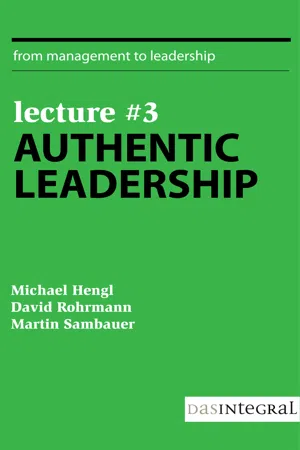
Lecture #3 - Authentic Leadership
About this book
Information
Subtopic
ManagementIndex
BusinessIntroduction
When a social system strengthens its members it strengthens itself. Therefore every good leader will empower his followers with strength. In this understanding of leadership, manipulation must be minimised while maximizing ability..
Strengthen your strengths
In classic education, especially in schools, we often try to weaken our weaknesses. We should be as good in algebra as in history or languages. In case of failures, the weaker subjects get extra attention and more learning support. But is that really beneficial?
We do not wish to weaken the weaknesses of leaders but rather strengthen their strengths. It is proven that this accelerates the whole cognitive and mental process immensely. Self-confidence, acknowledgement, freedom from fear or simply the higher blood flow in the brain brings about a significant performance boost. Latest results from neuroscience show another compelling positive side effect on the weaknesses: they get weaker.
Didactical three-folding
In the process of mastering selected strengths, three elementary stages can be defined:
- Beginner
- Intermediate
- Professional (Master)
For every teacher, coach, facilitator or leader it is important to know, which competences on what level already exist to provide the adequate development incentives and methods.
The S-curve to the top
The development of behaviours from beginner to professional can be mapped on an S-curve. It can be challenging to acquire some solid fundamentals, like learning to play the piano or skiing. Once the basics are there, a steep learning curve in the intermediate section results in a significant increase of performance. The last step to mastery is again relatively long with slow progress. These patterns can be found with artists, in sports and also leadership.
The tight 80% barrier
Remarkably is the relatively tight 80% barrier, which keeps people from advancing. The reason is that above this level, mastery can no longer be acquired by the training of technical rational skills. Beyond 80%, mental capabilities and attitude play a dominant role and they have to be carefully developed rather than trained through repetition. Personal development is needed to deliver top performances.
The missing mirror
In sports, this is relatively easy. For further development, fast and precise feedback is key. Michael Hengl, one of the authors of this text and world cup ski-racer in the 80s, tells of a ski instructor who tried to improve his style with unclear instruction. Only the introduction of partial time measurement along the different areas of the training track to refine the best techniques in each situation brought the desired and measurable acceleration. The division in sub-parts, repetitive feedback and the reflexion of potential improvements based on regular and timely feedback are the foundation for significant performance enhancement.
In leadership development that task is much more difficult since there are no simple rules and metrics to follow for a great leadership experience. We depend on the perception and feedback of others around us, an important aspect of the work of leaders. We face another challenge in not only the self-perception and the external view of our performance which is hard to grasp, but also the very performance delivery of the leader. How strong was the impact of exercised leadership on a certain result? Was it the team? Could they have done it alone? Was it profitable? Usually there is a mirror missing to be able to see the true performance.
Modern technology makes it possible nowadays to increase the visibility of performance through collective intelligent feedback tools like the Sonar tool. The social scientist Peter Gloor from the MIT has shown that the number and quality of social relations are directly proportional to success. We captured these insights in the Sonar, an abbreviation for Social Network Analysis of Relations, to substitute the missing mirror for individual performance.
Effort versus effect
We call this the share of influence to a certain result effect. The effort describes the amount of activities to get there: emails, meetings, orders, etc. In leadership development, the pure assessment of efforts is secondary. It is the effect that counts and that needs to be maximised. Then effort can be reduced to increase efficiency: the ratio between effort and effect. When a single letter can achieve the desired result compared to endless meetings, efficiency is high. Increased efficiency while maintaining effectiveness leads to positive influences on leaders and organisations
● Individual and collective expansion: The departments of responsibility under the leader can expand and with it the whole organisation because more resources are available.
● Work-life-balance: a higher personal efficiency can lead to a better work-life-balance, which has a positive effect on efficiency itself – a positive recursive loop.
● Positive feedback: higher efficiency reduces the likelihood of leadership frustrations.
● Positive feedback: higher efficiency reduces the likelihood of leadership frustrations.
The density of successful moments becomes higher. Self-confidence and the social acceptance of leadership claims increases. Personal satisfaction and happiness follow. The resulting attractiveness leads to more encouragement and feedback. Positive recursive loops between the social system and the leader spiral upwards, negative ones go down.
How to enter the top
No doubts: we need self-development
How can high effectiveness and efficiency be continuously developed and delivered on a top performance level? In every sports discipline where we see recurrent, ...
Table of contents
- Introduction
Trusted by 375,005 students
Access to over 1.5 million titles for a fair monthly price.
Study more efficiently using our study tools.
Frequently asked questions
Yes, you can cancel anytime from the Subscription tab in your account settings on the Perlego website. Your subscription will stay active until the end of your current billing period. Learn how to cancel your subscription
No, books cannot be downloaded as external files, such as PDFs, for use outside of Perlego. However, you can download books within the Perlego app for offline reading on mobile or tablet. Learn how to download books offline
Perlego offers two plans: Essential and Complete
- Essential is ideal for learners and professionals who enjoy exploring a wide range of subjects. Access the Essential Library with 800,000+ trusted titles and best-sellers across business, personal growth, and the humanities. Includes unlimited reading time and Standard Read Aloud voice.
- Complete: Perfect for advanced learners and researchers needing full, unrestricted access. Unlock 1.5M+ books across hundreds of subjects, including academic and specialized titles. The Complete Plan also includes advanced features like Premium Read Aloud and Research Assistant.
We are an online textbook subscription service, where you can get access to an entire online library for less than the price of a single book per month. With over 1.5 million books across 990+ topics, we’ve got you covered! Learn about our mission
Look out for the read-aloud symbol on your next book to see if you can listen to it. The read-aloud tool reads text aloud for you, highlighting the text as it is being read. You can pause it, speed it up and slow it down. Learn more about Read Aloud
Yes! You can use the Perlego app on both iOS and Android devices to read anytime, anywhere — even offline. Perfect for commutes or when you’re on the go.
Please note we cannot support devices running on iOS 13 and Android 7 or earlier. Learn more about using the app
Please note we cannot support devices running on iOS 13 and Android 7 or earlier. Learn more about using the app
Yes, you can access Lecture #3 - Authentic Leadership by David Rohrmann,Michael Hengl,Martin Sambauer in PDF and/or ePUB format, as well as other popular books in Business & Management. We have over 1.5 million books available in our catalogue for you to explore.