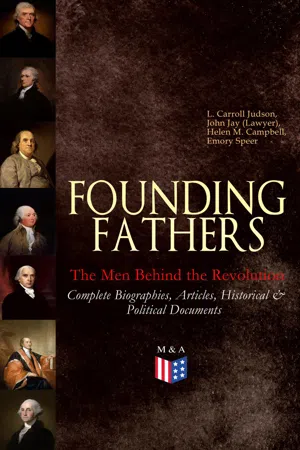
eBook - ePub
FOUNDING FATHERS – The Men Behind the Revolution: Complete Biographies, Articles, Historical & Political Documents
Biographies & Documents of Freedom
- 661 pages
- English
- ePUB (mobile friendly)
- Available on iOS & Android
eBook - ePub
FOUNDING FATHERS – The Men Behind the Revolution: Complete Biographies, Articles, Historical & Political Documents
Biographies & Documents of Freedom
About this book
This book is dedicated to seven outstanding men to whom America owes its freedom: John Adams, Benjamin Franklin, Alexander Hamilton, John Jay, Thomas Jefferson, James Madison, and George Washington. In seven fascinating life stories you will meet the men behind the great names we all know. Alongside their biographies, this edition contains key documents of American Independence, Continental Association, Declaration of Independence, Articles of Confederation and the Constitution.
Table of Contents:
Biographies
John Adams
Benjamin Franklin
Alexander Hamilton
Thomas Jefferson
George Washington
John Jay
James Madison
Continental Association
Declaration of Independence
Articles of Confederation
United States Constitution
Information
Subtopic
Early American HistoryIndex
HistoryFOUNDING FATHERS – The Men Behind the Revolution: Complete Biographies, Articles, Historical & Political Documents
John Adams, Benjamin Franklin, Alexander Hamilton, John Jay, Thomas Jefferson, James Madison and George Washington
Madison & Adams Press, 2017. No claim to original U.S. Government Works and to texts licensed as Creative Commons CC BY-SA 3.0.
Contact [email protected]
Contact [email protected]
ISBN 978-80-268-7730-1
This is a publication of Madison & Adams Press. Our production consists of thoroughly prepared educational & informative editions: Advice & How-To Books, Encyclopedias, Law Anthologies, Declassified Documents, Legal & Criminal Files, Historical Books, Scientific & Medical Publications, Technical Handbooks and Manuals. All our publications are meticulously edited and formatted to the highest digital standard. The main goal of Madison & Adams Press is to make all informative books and records accessible to everyone in a high quality digital and print form.
Table of Contents
Biographies
John Adams
Benjamin Franklin
Alexander Hamilton
Thomas Jefferson
George Washington
John Jay
James Madison
Appendix:
Continental Association
Declaration of Independence
Articles of Confederation
The Federalist Papers & Anti-Federalist Papers
United States Constitution
Biographies
Table of Contents
John Adams
Table of Contents
Genuine moral courage is a sterling quality that ennobles and dignifies the man. It invigorates the mind like an impregning cloud — shedding its gentle dews on the flowers of spring. It is a heavenly spark, animating the immortal soul with the fire of divinity that illuminates the path of rectitude. It is an attribute that opposes all wrong and propels its subject right onward to the fearless performance of all right. It is based upon virtue and equity, and spurns vice in all its borrowed and delusive forms. It courts no servile favours — it fears no earthly scrutiny. No flattery can seduce it, no eclat can allure it, no bribe can purchase it, no tyrant can awe it, no misfortune can bend it, no intrigue can corrupt it, no adversity can quench it, no tortures can subdue it. Its motto is — “Fiat justitia, ruat cœlum.” [Let justice be done though the heavens should fall.] Without it, fame is ephemeral and renown transient. It is the saline basis of a good name that gives richness to its memory. It is a pillar of light to revolving thought, and the polar star that points to duty and leads to merit. It is the soul of reason, the essence of wisdom, and the crowning glory of mental power. It was this that influenced the signers of the declaration of independence and nerved them for the conflict.
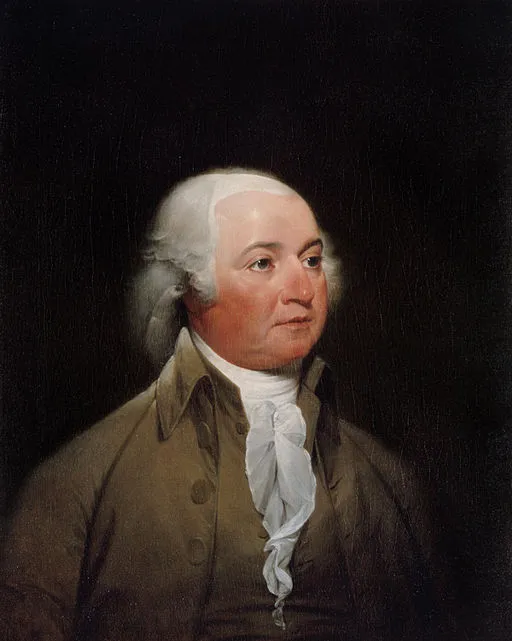
No one among them was more fully imbued with it than John Adams. He was a native of Quincy, Massachusetts, and born on the 19th of October (O.S.) 1735. He was the fourth in descent from Henry Adams, whose tomb bears this singular inscription — “He took his flight from the dragon persecution, in Devonshire, England, and alighted, with eight sons, near Mount Wollaston.” In childhood the career of John Adams was marked with a rapid developement of strong intellectual powers, which were skilfully cultivated by Mr. Marsh, at Braintree, a celebrated and successful teacher. At the age of sixteen years he entered Harvard College, at Cambridge, where he became a finished scholar and graduated at the age of twenty. He gained a high reputation for frankness, honesty and untiring industry, and was greatly esteemed by the professors and his classmates.
From college he proceeded to Worcester, commenced the study of law under Mr. Putnam, and finished with Mr. Gridley, supporting himself in the mean time by teaching a grammar class. At that early age he possessed wisdom to perceive right, and moral courage to pursue it. In view of the past and present, he made a philosophic grasp at the future, as will appear from the following extract from a letter written by him on the 12th of October, 1755, shortly after he took up his residence at Worcester.
“Soon after the reformation a few people came over into this new world for conscience sake. Perhaps this apparently trivial incident may transfer the great seat of empire into America. It looks likely to me, if we can remove the turbulent Gallics, our people, according to the exactest computations, will, in another century, become more numerous than England herself. Should this be the case, since we have, I may say, all the naval stores of the nation in our hands, it will be easy to obtain the mastery of the seas, and then the united force of all Europe will not be able to subdue us. The only way to keep us from setting up for ourselves — is to disunite us. * * * Keep us in distinct colonies, and then some men in each colony, desiring the monarchy of the whole, will destroy each other’s influence and keep the country in equilibrio.”
This broad and expansive view of the future, conceived by a youth, was very remarkable. He saw the one thing needful to render our nation powerful — the creation of a navy — for which nature has given us all the stores. The paralysis that pervades our government in its naval improvements has long astonished the nations of the old world, and a few of our own statesmen. The time will arrive when our country will be made to feel most keenly — that “a navy is the right arm of defence.”
After pursuing his studies three years, Mr. Adams was admitted to the practice of law. He then commenced his professional career at Braintree. Questions of constitutional right and law had already become the subject of investigation and a root of bitterness between the colonists and the officers of the crown. The latter, that were engaged in the custom-house, claimed unlimited power to search the private dwellings of all persons whom they suspected of having dutiable goods. This suspicion, or pretended suspicion, often arose from personal animosity, without a shadow of evidence or reasonable cause. The right of search was of course resisted as arbitrary, unconstitutional and assumed. This led to an application to the superior court for “writs of assistance,” which may be considered as one of the first germs of the revolution. Mr. Gridley, who had led Mr. Adams to the bar, and was then his friend and admirer, maintained the legality of the proceeding, not upon the ground of constitutional law, but from the necessity of the case in order to protect the revenue. Mr. Adams took a deep interest in the question, which was finally argued before the superior court at Boston, by Mr. Gridley for the crown and Mr. Otis for the people. In listening to the latter gentleman, a fire of patriotism was kindled in the bosom of Mr. Adams, that death alone could extinguish. He asserted in after life, that “Mr. Otis’s oration against writs of assistance, breathed into this nation the breath of life. * * * American independence was then and there born. * * * Every man of an immense crowded audience appeared to me to go away, as I did, ready to take up arms against writs of assistance. Then and there was the first scene of the first act of opposition to the arbitrary claims of Great Britain.”
The court publicly decided against the writs, but secretly issued them. That people had their houses searched to satisfy revenge, will appear from the following described incident.
“Mr. Justice Wally had called Mr. Ware, one of the persons in possession of such a writ, before him, by a constable, to answer for a breach of the Sabbath-day acts, or for profane swearing. As soon as he had finished, Mr. Ware asked him if he had done. He replied — yes. Well, then, said Mr. Ware, I will show you a little of my power. I command you to permit me to search your house for uncustomed goods — and went on to search his house from garret to cellar — and then served the constable in the same manner.”
We can readily imagine the natural consequences of such a procedure, against which Mr. Adams at once took a bold and decided stand. The assembly also interfered in behalf of the people, and in 1762 prepared a bill to prevent these writs from being issued to any but custom-house officers, and to them only upon a specific information on oath — which bill was vetoed by the governor. As a blow at the royal authority this was well aimed, and showed a disposition in the members to do the will of their constituents. As a retaliative measure they reduced the salary of the judges.
In 1761, Mr. Adams attained the rank of barrister and rose to eminence in his profession. In 1764, he married the accomplished Miss Abigail, the daughter of the Rev. William Smith, who participated with him in the changing scenes of life for fifty-four years. The following extract from a letter written by her to a friend, after the commencement of the revolution, will exhibit the strength of her mind and the patriotic feelings of the ladies at that eventful era.
“Heaven is our witness that we do not rejoice in the effusion of blood or the carnage of the human species — but, having been forced to draw the sword, we are determined never to sheathe it — slaves to Britain. Our cause, sir, I trust, is the cause of truth and justice, and will finally prevail, though the combined force of earth and hell should rise against it. To this cause I have sacrificed much of my own personal happiness, by giving up to the councils of America one of my nearest connexions, and living for more than three years in a state of widowhood.”
When the stamp act was passed, the fire of indignation against lawless oppression rose in the bosom of Mr. Adams to a luminous flame. He at once became a public man, and entered into a defence of chartered rights and rational freedom. He published an “Essay on the Canon and Feudal Law,” which placed him on a lofty eminence as an able and vigorous writer. Its raciness penetrated the joints and marrow of royal power as practised, and the parliamentary legislation as assumed. He traced the former law to its original source — the Roman clergy — by them subtlely planned, extensively exercised and acutely managed, to effect their own aggrandizement. He then delineated the servile dogmas of the latter, that made each manor the miniature kingdom of a petty tyrant. He then drew a vivid picture of their powerful but unholy confederacy, by which they spread the mantle of ignorance over the world, drove virtue from the earth, and commenced the era of mental obscurity. He then explored the labyrinthian mazes of the dark ages, portrayed the first glimmerings of returning light, travelled through the gigantic struggles of the reformation amidst the bloody scenes of cruel persecution, and finally placed his readers upon the granite shores of New England, where, for a century, liberty had shed its happy influence upon the sons and daughters of freemen, unmolested by canons or feuds. That liberty was now invaded, and, unless the tyranny that had already commenced its desolating course was arrested in its bold career, slavery would be the consequence. This is the syllabus of a pamphlet of over forty pages, written in a strong, bold and nervous style.
From that time forward Mr. Adams became a leading whig. He became associated with Samuel Adams, Quincy, Otis and other kindred spirits, all much older men, but not more zealous in the cause than him. The repeal of the odious stamp act and the removal of Mr. Grenville from the ministry was the result of the labours of the patriots in 1765. A delusive calm ensued in parliamentary and ministerial proceedings, openly avowed. Mr. Adams was among those who watched closely the signs of the times. Governor Barnard occasionally showed the cloven foot, and his officers put on airs that were far from being agreeable to the yeomanry of the country. Festering wounds occasionally became irritated, and no balm was found that restored them to perfect soundness.
In 1766 Mr. Adams removed to Boston, and at the end of two years had become so conspicuous and had displayed so much talent that the governor thought him worth purchasing. The lucrative and honourable office of advocate-general in the court of admiralty was offered to him, which was deemed a sufficient bribe to allure him. In this the governor found himself mistaken. Moral courage was the firm basis on which this devoted patriot stood. He spurned the royal harness, glittering with gold, with as much disdain as the wild horse of the prairie looks upon a moping mule.
In 1769 he was one of the committee appointed by the citizens of Boston to propose instructions for their representatives in the legislative body, which were highly spiced with free principles, and were very unsavoury to the royal governor. Many of his measures were severely censured, particularly that of quartering the mercenary soldiers in the town. He was unbending in his purposes, and the people determined on maintaining their rights. The consequences were tragical. On the fifth of March, 1770, an affray occurred between the military and citizens, in which five of the latter were killed and others wounded. The following description of the scene that ensued is from the pen of Mr. Adams, the present subject of this memoir.
“The people assembled first at Faneuil Hall and adjourned to the old South Church, to the number, as was conjectured, of ten or twelve hundred men, among whom were the most virtuous, substantial, independent, disinterested and intelligent citizens. They formed themselves into a regular deliberative body, chose their moderator and secretary, entered into discussions, deliberations and debates, adopted resolutions and appointed committees. Their resolutions in public were conformable to every man in private who dared express his thoughts or his feelings — ‘that the regular soldiers should be banished from the town at all hazards.’ Jonathan Williams, a very pious, inoffensive and conscientious gentleman, was their moderator. A remonstrance to the governor, or governor and council, was ordained, and a demand that the regular troops should be removed from the town. A committee was appointed to present this remonstrance, of which Samuel Adams was chairman.
“This was a delicate and dangerous crisis. The question in the last resort was — whether the town of Boston should become a scene of carnage and desolation or not. Humanity to the soldiers conspired with a regard for the safety of the town, in suggesting the measure in calling the town together to deliberate, for nothing but the most solemn promises to the people, that the soldiers should, at all hazards, be driven from the town, had preserved its peace. Not only the immense assemblies of the people from day to day, but military arrangements from night to night were necessary to keep the people and the soldiers from getting together by the ears. The life of a red coat would not have been safe in any street or corner of the town; nor would the lives of the inhabitants been much more secure. The whole militia of the city was in requisition, and military watches and guards were every where placed. We were all upon a level; no man was exempted; our military officers were our only superiors. I had the honour to be summoned in my turn and attended at the State-house with my musket and bayonet, my broad sword and cartridge box, under the command of the famous Paddock. I know you will laugh at my military figure; but I believe there was not a more obedient soldier in the regiment, nor one more impartial between the people and the regulars. In this character I was upon duty all night in my turn. No man appeared more anxious or more deeply impressed with a sense of danger on all sides than our commander Paddock. He called me, common soldier as I was, frequently to his councils. I had a great deal of conversation with him, and no man appeared more apprehensive of a fatal calamity to the town, or more zealous by every prudent measure to prevent it.”1
Order was finally restored and the civil authorities again assumed their functions. Captain Preston was arrested and brought before the court, charged with giving the order to the regulars to fire upon the citizens; and also the soldiers who committed the outrage. As is uniformly the case, each party was charged with blame by the respective friends of the other. Some inconsiderate citizens had thrown snowballs at the king’s troops, who returned the change in blue pills. The former were imprudent, the latter were revengeful.
Mr. Adams was employed by the accused to defend them. Some of his friends were fearful that it might injure his popularity with the people, whose excitement was still very great. But so ingeniously and eloquently did he manage the case, that Captain Preston and all the soldiers but two were acquitted, and those two were only convicted of manslaughter, and Mr. Adams stood approved and applauded by the citizens, having performed his professional duty to his clients, and at the same time vindicated the rights of the people; the result of being guided entirely by the polar star of moral courage.
The same year he was elected to the legislative body, then called the “General Court,” and was a bold opposer of the arbitrary measures of Lieutenant-governor Hutchinson, who undisguisedly followed the directions of the ministry in violation of the charter of the colony, in all things that were necessary to carry out the plans of the British cabinet, pleading his instructions as an excuse.
Mr. Adams was one of the committee that prepared an address to him, the style of which induces me to think it was penned by him. From the following extract the reader may judge. After vividly portraying the violations of right complained of, the address concludes, “These and other grievances and cruelties, too many to be here enumerated, and too melancholy to be much longer borne by this injured people, we have seen brought upon us by the devices of ministers of state. And we have, of late, seen and heard of instructions to governors which threaten to destroy all the remaining privileges of our charter. Should these struggles of the house prove unfortunate and ineffectual, this province will submit, with pious resignation, to the will of Providence; but it would be a kind of suicide, of which we have the ...
Table of contents
- FOUNDING FATHERS – The Men Behind the Revolution: Complete Biographies, Articles, Historical & Political Documents
Trusted by 375,005 students
Access to over 1.5 million titles for a fair monthly price.
Study more efficiently using our study tools.
Frequently asked questions
Yes, you can cancel anytime from the Subscription tab in your account settings on the Perlego website. Your subscription will stay active until the end of your current billing period. Learn how to cancel your subscription
No, books cannot be downloaded as external files, such as PDFs, for use outside of Perlego. However, you can download books within the Perlego app for offline reading on mobile or tablet. Learn how to download books offline
Perlego offers two plans: Essential and Complete
- Essential is ideal for learners and professionals who enjoy exploring a wide range of subjects. Access the Essential Library with 800,000+ trusted titles and best-sellers across business, personal growth, and the humanities. Includes unlimited reading time and Standard Read Aloud voice.
- Complete: Perfect for advanced learners and researchers needing full, unrestricted access. Unlock 1.5M+ books across hundreds of subjects, including academic and specialized titles. The Complete Plan also includes advanced features like Premium Read Aloud and Research Assistant.
We are an online textbook subscription service, where you can get access to an entire online library for less than the price of a single book per month. With over 1.5 million books across 990+ topics, we’ve got you covered! Learn about our mission
Look out for the read-aloud symbol on your next book to see if you can listen to it. The read-aloud tool reads text aloud for you, highlighting the text as it is being read. You can pause it, speed it up and slow it down. Learn more about Read Aloud
Yes! You can use the Perlego app on both iOS and Android devices to read anytime, anywhere — even offline. Perfect for commutes or when you’re on the go.
Please note we cannot support devices running on iOS 13 and Android 7 or earlier. Learn more about using the app
Please note we cannot support devices running on iOS 13 and Android 7 or earlier. Learn more about using the app
Yes, you can access FOUNDING FATHERS – The Men Behind the Revolution: Complete Biographies, Articles, Historical & Political Documents by L. Carroll Judson,John (Lawyer) Jay,Helen M. Campbell,Emory Speer,John Jay (Lawyer) in PDF and/or ePUB format, as well as other popular books in History & Early American History. We have over 1.5 million books available in our catalogue for you to explore.