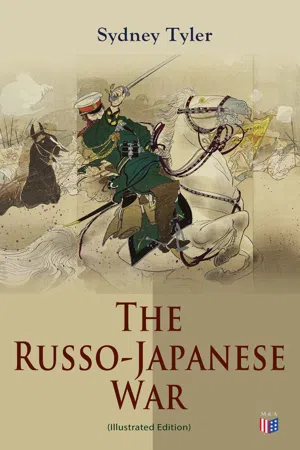
eBook - ePub
The Russo-Japanese War (Illustrated Edition)
1904–05 clash over Manchuria and Korea—from Port Arthur and Liaoyang to Mukden and the Battle of the Japan Sea
- 308 pages
- English
- ePUB (mobile friendly)
- Available on iOS & Android
eBook - ePub
The Russo-Japanese War (Illustrated Edition)
1904–05 clash over Manchuria and Korea—from Port Arthur and Liaoyang to Mukden and the Battle of the Japan Sea
About this book
The Russo–Japanese War (1904–05) was an armed conflict between the Russian Empire and the Empire of Japan over rival imperial ambitions in Manchuria (China)and Korea. The major theatres of operations were the Liaodong Peninsula and Mukden in Southern Manchuria and the seas around Korea, Japan and the Yellow Sea.
Contents:
Causes of the War
The First Blow
The Korean Campaign
Naval Operations
Sinking of the "Petropavlovsk"
Battle of the Yalu
Cutting off Port Arthur
The Assault that Failed
Battle of Liaoyang
Naval Battle off Port Arthur
Battle of the Sha-ho
The North Sea Outrage
Surrender of Port Arthur
The First Year of the War
After Port Arthur
In Winter Quarters
The Battle of Mukden
Retreat towards Harbin
The Battle of the Japan Sea
The Treaty of Peace
Information
Subtopic
Japanese HistoryIndex
HistoryTable of Contents
INTRODUCTION
CHAPTER I.
CHAPTER II.
CHAPTER III.
CHAPTER IV.
CHAPTER V.
CHAPTER VI.
CHAPTER VII.
CHAPTER VIII.
CHAPTER IX.
CHAPTER X.
CHAPTER XI.
CHAPTER XII.
CHAPTER XIII.
CHAPTER XIV.
CHAPTER XV.
CHAPTER XVI.
CHAPTER XVII.
CHAPTER XVIII.
CHAPTER XIX.
CHAPTER XX.
INTRODUCTION
Table of Contents
The Japan-Russia War goes into history as the greatest military struggle the world has known. Its story, therefore, rivals in interest those of the great wars of the past which have been an unceasing inspiration in every field of art and literature. The political machinations of great and little kings, of famed prime ministers, of peoples and states have attracted attention in more or less limited circles, but the world's wars have appealed to every class and rank. The world's vast army of readers have never wearied of the classic stories of feats of arms by men and armies told of the dawning days of world history; the tales of later map-making struggles of Asia, of Europe, of America, have never grown old or dull. So in the Orient of to-day. The great political battles which have centred about China and Japan for the last half century have interested the few. But to-day the attention of the world is centred on the lands bordering the Pacific, because a war has waged; because the whole human family loves the stories of valorous deeds, of military achievement, of the history-making that is done with the sword.
The purpose of this volume is to bring American readers face to face with the events of the struggle of such stupendous magnitude, now drawn to a close. From battlefield to battlefield the author carries his thrilling narrative, bringing the scenes before the mind's eye as only one could do who stood within sound of the roaring guns, within sight of the onrush of resistless battalions, elbow to elbow with Japan's brilliant history makers. From the opening of the struggle to its close there was never a moment when stupendous events were not either in the process of making or so imminent that the civilized world held its breath. A single year's campaign in Manchuria and around famed Port Arthur furnish three land battles, greater in the number engaged in the awful cost of life, in the period of duration, than is presented by all of the pages of history. The siege of Port Arthur has no duplicate among all recorded military achievements. The opening of the second year of the war added a battle, that at Mukden, so vast, so brilliant from the standpoint of the victors, so disastrous from the standpoint of the defeated, that it has been accorded by masters of strategy a niche by itself in the chronicles of war. The author saw this wonderful panorama of events unfolded. His story bristles with dramatic touches, flashes of enlightening description that bring the scene home to the reader with a vividness that thrills.
American readers have a more immediate interest in the struggle than the universal love of the stories of battle. With Japan victor over Russia, with the great Muscovite Empire deprived of a foothold on the Pacific, Japan and America remain the only Powers there to divide the rich spoils of Oriental commerce. Our possessions, the Philippines, are Japan's nearest neighbors, and their proximity to Japan, their bearing upon the Asiatic problem open the way for events of more than ordinary importance, if not of seriousness. Already the statement has been made that Japan covets these Islands. Will the United States, one day be called upon to go to war in their behalf? The question is one which no American can ignore. The nation must educate itself to decide one day, the issue, for or against a struggle with this wonderful little Empire, the Great Britain of Asia. The volume, therefore, in addition to its value and interest as a chronicle of a marvelous series of bloody battles is educational, the pioneer, blazing the way to an appreciation of events, of possibilities for our own country which lie in the story of Japan's overwhelming success. Will the Mikado come to believe that having humbled and crushed what was Europe's mightiest Power, he can as readily drive from the Pacific the American Republic?
The author in this volume has even more completely demonstrated his genius as a chronicler of war than in any of his earlier efforts. Step by step he followed the British in Africa and at the conclusion of that struggle contributed to British literature a history which was generally conceded to have been more accurate, more graphic, less warped by prejudices than any other. Step by step he followed the unfolding of our own Spanish war and the story of that struggle as told by Mr. Tyler became at once the standard not only in Great Britain, but in the several Continental countries in which it appeared. With the priceless experience of these two wars to ably equip him, Mr. Tyler has contributed one more narrative of a great war to military literature and the assertion is unhesitatingly made that it will not be equalled by any of the hosts of volumes destined to be written of this memorable war.
Along with the author went his camera. To that fact the reader is indebted to a series of illustrations never before attempted in the portrayal of military campaigns. What little the author has left to the imagination is supplied by these graphic pictures that bridge nine thousand miles and bring the sights and almost the sounds of battle to the reader.
In brief, this volume as a description of the succeeding struggles of the Japan-Russia War, for accuracy, graphic qualities, detail and literary finish; for its educational value and significance, for the hitherto unattempted excellence of its illustration is presented to the American public with confidence that an appreciative reception will not possibly be denied.
THE PUBLISHERS.
CHAPTER I.
Table of Contents
Never since the great Napoleonic wars which convulsed Europe a century ago has the world witnessed an appeal to arms so momentous in its issues and so tremendous in its possibilities as that which has just been tried between Russia and Japan in the Far East. The great internecine struggle in the United States in the middle of the last century, the disastrous duel between France and Germany which followed, and England's recently-concluded campaign in South Africa, have each, indeed, left a deep mark upon history. But while their import was at most Continental, if not local, the conflict between Japan and Russia is fraught with consequences which must inevitably be world-wide in scope. There is no civilized Power in either hemisphere whose interests are not more or less directly concerned in the question—Who shall be the dominant Power in the China Seas? For the whole course of the world's development in that quarter must depend on whether the mastery remains to the obstructive and oppressive Colossus of the North or to the progressive and enlightened island-Empire which, like Pallas in Pagan myth, has sprung fully armed from an ancient civilization into the very van of modern progress. It was no mere dynastic jealousy or racial animosity that brought about this fateful collision. It was the inevitable antagonism of two irreconcilable destinies. "Two stars keep not their motion in one sphere"; and the ambitions of Russia and the aspirations of Japan cannot find room for fulfilment together. One or the other must be crushed.
For Japan, the question is one of national existence. With Russia established in Manchuria and dominating the Yellow Sea, the absorption of Korea becomes a mere matter of time; and then the very independence of Japan would be subject to a perpetual and intolerable menace; while the new life which has dawned for its wonderfully gifted people would be crushed at the outset. But if Japan is fighting for her life, Russia is fighting for something almost as precious—the consummation of an ambition which has been the dream and the fixed goal of her statesmen for more than a generation. The expansion of the Russian Empire has been steadily eastwards; and the further conquest and dominion have spread, the more has the necessity been felt for an outlet to the navigable seas. Unless all the labor and sacrifices of years are to be in vain, and the great Siberian Empire is to remain a mere gigantic cul-de-sac, Russia must establish herself permanently in the Gulf of Pechili, and find in its ice-free ports that natural outlet for her trans-continental railway which will enable the life-blood of commerce to circulate through her torpid bulk. The struggle, therefore, was one between two irreconcilable destinies.
But if the issue was immediately of such paramount significance to the two combatants, it was only less charged with import for all Asia, Europe and America. The victory of Japan would incontestably give her the predominance in the Far East, commercially as well as politically. Not only would she be a formidable trade rival to the European nations whose methods she has so successfully adopted, but she would be able to influence the conditions under which that trade was carried on. The immensely valuable and as yet imperfectly developed market of China would be practically within her control; and European Powers would no longer be able with impunity to seize naval bases and proclaim exclusive spheres of influence in Chinese territory. On the other hand, if Russia were to emerge victorious from the war, the whole of China would become a mere vassal state, if indeed its integrity could be preserved. Trade would be discouraged and finally extinguished by the exclusive methods of Russian policy, and except on sufferance no other Power could obtain a footing in the Far East. The whole future of this vast region, therefore, hung in the balance, for the battle was between freedom, progress and enlightenment, as represented by Japan, and obscurantism, oppression and stagnation, as represented by Russia.
But the anxious concern of the world in this Far Eastern war was based not only upon a calculation of material interests. Every civilized Government had before its eyes the imminent danger of other countries being dragged into the conflict. The situation was such that at any moment some untoward incident might set Europe in a blaze. The specific obligations of France to Russia under the terms of the Dual Alliance, and of Great Britain to Japan under the Treaty of Alliance concluded in 1901, made the limitation of the struggle to the original combatants not only difficult, but even precarious. A breach of neutrality by any third Power would at once have compelled France to join forces with her Russian ally, or Great Britain to come to the assistance of Japan. Such a breach might have been merely trivial or technical, and yet sufficient to give a hard-pressed belligerent ground for calling her ally to her assistance. It might even have been deliberately provoked, in the hope of retrieving disaster by extending the area of conflict; and if the two Western Powers were once dragged into war, no statesman would be bold enough to put a limit to the consequences. Both Germany and the United States are profoundly interested in the Far East and in the issue of this great struggle for predominance; and one or both of them might at any moment have been ranged on one side or the other. From such an Armageddon the factors which determine the balance of power throughout the world, and therefore the development of national destinies, could hardly have emerged without profound modification; and the ultimate establishment of peace would have found many more international rivalries and antagonisms resolved than those which are immediately connected with the Far East. Lord Beaconsfield once said that there were only two events in history—the Siege of Troy and the French Revolution. It seems more than possible that the Russo-Japanese war will have to be reckoned as a third supreme factor in the progress of the world.
The outbreak of the present war became practically inevitable as long ago as 1895, when, on the conclusion of peace between China and Japan the three European Powers—Russia, France and Germany—stepped in and robbed the Mikado and his people of the fruits of their hard-earned victory. From that time up to the present Russia has steadily, and without ceasing, tightened her grip upon the Northern province of the hapless Chinese Empire, and has ended by threatening the independence of Korea, the legitimate sphere of influence of Japan, and the indispensable buffer between herself and the insatiable and ever-advancing Northern Power.
It must be borne in mind that the determining consideration which led Russia to cast longing eyes upon Manchuria—apart from that eternal hunger for territory which is one of her strongest characteristics—was the necessity of acquiring a warm water port as a naval base and commercial harbor. The port of Vladivostock—which, by the way, she acquired from China as early as 1860 by a truly Russian piece of bluff—has proved of little use in this respect, owing to the fact that during the winter months it is almost entirely icebound. A striking illustration of the embarrassment such a state of things must cause was afforded in the course of the present war by the plight into which the Russian Cruiser Squadron stationed there fell. There can be no doubt that the ambitions of the Czar's advisers had for years been directed towards the acquisition of the fortress and harbor of Port Arthur (known to the Chinese as Lu-shun-kau), which situated as it is upon the narrow neck of land at the extreme southernmost point of the Liao-tung Peninsula, should, if properly served by a strong and efficient naval force, dominate the Gulf of Pechili, and prove the most powerful strategic post in Northern China.
It is not known, of course, what path the development of Russian plans in this respect would have followed if they had been allowed to proceed without interruption; but, as it turned out, they were suddenly threatened with a dangerous obstacle in the complete and unexpected success of Japan over China and her capture of the whole of the Liao-tung Peninsula. This short but sanguinary conflict between China and Japan is memorable for having first revealed to the world the amazing progress which Japan had made in her efforts to engraft and assimilate the characteristics of Western civilization. It proved that in less than twenty years Japan had earned for herself an established position in the community of progressive nations. The war also made it possible for the first time to estimate the influence and effect in warlike operations of the tremendous engines of destruction with which modern science has equipped the fleets and armies of to-day. The navy of Japan had been organized on the latest model, and her officers had been trained in British schools; and though China's equipment was not to be compared with that of her antagonist, she possessed several powerful armorclads of the latest type, officered and engineered by experienced Europeans.
The salient features of the war were, at sea, the battles of the Yalu River and of Wei-hai-Wei; and on land, the rout of the Chinese at Ping-Yang, the passage of the Yalu and storming of Port Arthur. The first of these in order of time was the battle of Ping-Yang, a town situated near the north-west coast of Korea. Here the Chinese troops under General Tso attempted to prevent the advance of the Japanese towards the Yalu. By a series of skilful movements carried out on September 15th and 16th, 1894, the Japanese Commander-in-Chief, Marshal Yamagata, completely surrounded the Chinese and defeated them with great slaughter, their General himself falling dead upon the field. On the next day the Chinese fleet stationed at the mouth of the Yalu, which had proved entirely ineffective in preventing the landing of the enemy's forces upon Korea, gave battle to the Japanese. The ships of the latter Power were mainly cruisers, but the extraordinary skill with which they were manœuvred and the rapidity of their fire completely outweighed the advantage possessed by the Chinese Admiral in battleships. He sustained a crushing defeat, and eight of his best vessels were destroyed. In the meanwhile Marshal Yamagata continued his march to the North, and after a bloody but indecisive conflict near Wiju on October 22nd he succeeded in crossing the Yalu River and driving his antagonists in rout before him. The Japanese now proceeded to overrun Manchuria and the Liao-tung Peninsula, capturing all the principal positions one after the other with unvarying success. A great army under Marshal Oyama invested Port Arthur in November, and on the 20th and 21st he took that powerful fortress by storm, the defenders being massacred to a man. The final and decisive act of the war was the bombardment of Wei-hai-Wei and the island fortress of Leu-Kung-tan by the combined naval and military forces of Admiral Ito and Marshal Oyama. The operations lasted from January 30th, 1895, till February 12th, when, unable to hold out any longer against the terrific assault, Admiral Ting, the Chinese Commander, surrendered his fleet and the forts under honors of war. A closing touch of tragedy was the suicide of Ting and his principal officers, unable to bear the shame of their defeat. On March 19th negotiations for peace were opened at Shimonoseki, and the final treaty was signed on April 17th. The Treaty of Shimonoseki gave Japan unqualified possession ...
Table of contents
- The Russo-Japanese War (Illustrated Edition)
- Table of Contents
Trusted by 375,005 students
Access to over 1.5 million titles for a fair monthly price.
Study more efficiently using our study tools.
Frequently asked questions
Yes, you can cancel anytime from the Subscription tab in your account settings on the Perlego website. Your subscription will stay active until the end of your current billing period. Learn how to cancel your subscription
No, books cannot be downloaded as external files, such as PDFs, for use outside of Perlego. However, you can download books within the Perlego app for offline reading on mobile or tablet. Learn how to download books offline
Perlego offers two plans: Essential and Complete
- Essential is ideal for learners and professionals who enjoy exploring a wide range of subjects. Access the Essential Library with 800,000+ trusted titles and best-sellers across business, personal growth, and the humanities. Includes unlimited reading time and Standard Read Aloud voice.
- Complete: Perfect for advanced learners and researchers needing full, unrestricted access. Unlock 1.5M+ books across hundreds of subjects, including academic and specialized titles. The Complete Plan also includes advanced features like Premium Read Aloud and Research Assistant.
We are an online textbook subscription service, where you can get access to an entire online library for less than the price of a single book per month. With over 1.5 million books across 990+ topics, we’ve got you covered! Learn about our mission
Look out for the read-aloud symbol on your next book to see if you can listen to it. The read-aloud tool reads text aloud for you, highlighting the text as it is being read. You can pause it, speed it up and slow it down. Learn more about Read Aloud
Yes! You can use the Perlego app on both iOS and Android devices to read anytime, anywhere — even offline. Perfect for commutes or when you’re on the go.
Please note we cannot support devices running on iOS 13 and Android 7 or earlier. Learn more about using the app
Please note we cannot support devices running on iOS 13 and Android 7 or earlier. Learn more about using the app
Yes, you can access The Russo-Japanese War (Illustrated Edition) by Sydney Tyler in PDF and/or ePUB format, as well as other popular books in History & Japanese History. We have over 1.5 million books available in our catalogue for you to explore.