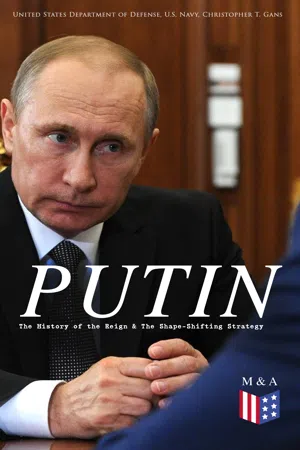
eBook - ePub
PUTIN: The History of the Reign & The Shape-Shifting Strategy
Analyzing Putin's Anti-Americanism and Its Political Impact on Russia
- 193 pages
- English
- ePUB (mobile friendly)
- Available on iOS & Android
eBook - ePub
PUTIN: The History of the Reign & The Shape-Shifting Strategy
Analyzing Putin's Anti-Americanism and Its Political Impact on Russia
About this book
Is Vladimir Putin nuts? Has he drunk too much Russian vodka? Does he truly hate America? Do the people he presides over truly hate America? This book analyzes modern anti-Americanism in Russia during the era of Vladimir Putin. The main objective is to evaluate Vladimir Putin's anti-Americanism and the domestic political implications of Putinist anti-Americanism within Russia.
Contents:
Putin's Evolving Anti-Americanism
Putin's Hybrid-authoritarian Machine
Implications of Russians' Anti-Americanism
Putin's Early History
Early Life and College
Into the Shadows: Putin in the KGB and the Case for a Long Term Cognitive Predisposition
Yeltsin Era
Putin in the Aftermath of Collapse
Russia and the West in the 1990s: U.S. As an Inadvertent Contributor to PutinistAnti-americanism
NATO
Balkans
Economic Collapse and the Absence of U.S. Aid
Putin: A Sudden Thrust Into the Limelight
Putin's Short-lived Premiership and Acting Presidency
Crisis in Chechnya
Presidential Election of 2000
Putin's First Presidency
Integrate Into or With the West… or Neither?
The Attacks of 9/11 and the Aftermath
Brotherly Love: Putin and Bush
Iraq and a Sudden Turn Against America?
Putin's Second Presidency
Shift From the West
America Inadvertently Plays Into Putin's Hand
The Future of U.S. Unilateralism
Western Turn by Former Constituent States
Critical Reciprocity? Attack on Those Who Criticize Him
President to Puppet Master and Back Again: Putin's Recent Premiership and Return to the Presidency Georgia
The Obama-Medvedev Reset: Short Lived or DOA?
The 2012 Election and Putin's Third Term
Russian Anti-Americanism: The Man, the Machine, and the Nation
The Russian Connection: Anti-Americanism and the Putin-state-polity Link
Anti-Americanism's Role in the Future of Russian–American Relations
Most Recent Events
How Can America Cope?
Information
PUTIN: The History of the Reign & The Shape-Shifting Strategy
Madison & Adams Press, 2017. No claim to original U.S. Government Works
Contact [email protected]
Contact [email protected]
ISBN 978-80-268-8206-0
This is a publication of Madison & Adams Press. Our production consists of thoroughly prepared educational & informative editions: Advice & How-To Books, Encyclopedias, Law Anthologies, Declassified Documents, Legal & Criminal Files, Historical Books, Scientific & Medical Publications, Technical Handbooks and Manuals. All our publications are meticulously edited and formatted to the highest digital standard. The main goal of Madison & Adams Press is to make all informative books and records accessible to everyone in a high quality digital and print form.
Table of Contents
I. PUTINIST AUTHORITARIANISM AND ANTI-AMERICANISM: AN INTRODUCTION
A. PURPOSE
B. IMPORTANCE
C. HYPOTHESIS AND THEORY
D. BACKGROUND
1. Putin’s Evolving Anti-Americanism
2. Putin’s Hybrid-Authoritarian Machine
3. Implications of Russians’ Anti-Americanism
E. METHODOLOGY AND SOURCES
F. ROADMAP
II. VLADIMIR PUTIN’S ANTI-AMERICANISM: OUTWARDLY FLUCTUATING BUT INTERNALLY CONSISTENT?
A. PUTIN’S EARLY HISTORY
1. Early Life and College
2. Into the Shadows: Putin in the KGB and the Case for a Long Term Cognitive Predisposition
B. YELTSIN ERA
1. Putin in the Aftermath of Collapse
2. Russia and the West in the 1990s: U.S. as an Inadvertent Contributor to Putinist Anti-Americanism
a. NATO
b. Balkans
c. Economic Collapse and the Absence of U.S. Aid
C. PUTIN: A SUDDEN THRUST INTO THE LIMELIGHT
1. Putin’s Short-Lived Premiership and Acting Presidency
a. Crisis in Chechnya
b. Presidential Election of 2000
D. PUTIN’S FIRST PRESIDENCY
1. Integrate Into or With the West… or Neither?
2. The Attacks of 9/11 and the Aftermath
3. Brotherly Love: Putin and Bush
4. Iraq and a Sudden Turn Against America?
5. Elections of 2003 and 2004
E. PUTIN’S SECOND PRESIDENCY
1. Shift from the West
2. America Inadvertently Plays into Putin’s Hand
a. NATO
b. The Future of U.S. Unilateralism
c. BMD
d. Western Turn by Former Constituent States
3. Critical Reciprocity? Attack on Those who Criticize Him
F. PRESIDENT TO PUPPETMASTER AND BACK AGAIN: PUTIN’S RECENT PREMIERSHIP AND RETURN TO THE PRESIDENCY
1. Georgia
2. The Obama-Medvedev Reset: Short Lived or DOA?
3. The 2012 Election and Putin’s Third Term
4. Ongoing Events
G. CONCLUSIONS
III. VLADIMIR PUTIN’S RUSSIA: BETWEEN DEMOCRACY AND DICATORSHIP?
A. WHAT MAKES AN AUTHORITARIAN STATE?
1. True Authoritarian States
2. Hybrid Authoritarian States
B. PUTIN’S AUTHORITARIAN CONTROLLED DEMOCRACY: THE MECHANISMS
1. Attack the Yeltsin Years
2. State Control and Resource Theory
3. Maintaining the Illusion
a. “Democratic” Elections
b. Political Parties
C. ROLE OF ELITES AND THE PUBLIC IN PUTIN’S MACHINE: AN AUTOCRAT STILL ANSWERABLE TO OTHERS?
1. Elites
2. The Public at Large
D. CONCLUSION
IV. THE POLITICS OF ANTI-AMERICANISM
A. POLLING PERSPECTIVE ON THE RUSSIAN PUBLICS’ ANTI-AMERICANISM
1. The Pre-Putin Years
2. Under Putin: Fluctuating or as Steady as Putin?
B. ANTI-AMERICANISM OF THE ELITES
1. Disenchantment Under Yeltsin
2. Anti-Americanism to Demonstrate one’s Political Bona Fides
C. PUTIN’S POLITICAL BENEFITS FROM ANTI-AMERICANISM
1. A Leader Representative of his Constituents
2. Distract the Constituents
D. CONCLUSION
V. CONCLUSION
A. RUSSIAN ANTI-AMERICANISM: THE MAN, THE MACHINE, AND THE NATION
1. Summary of Findings
2. The Russian Connection: Anti-Americanism and the Putin-State-Polity Link
B. ANTI-AMERICANISM’S ROLE IN THE FUTURE OF RUSSIAN — AMERICAN RELATIONS
1. Most Recent Events
2. How Can America Cope?
C. FINAL ANALYSIS
I. PUTINIST AUTHORITARIANISM AND ANTI-AMERICANISM: AN INTRODUCTION
Table of Contents
A. PURPOSE
Table of Contents
Is Vladimir Putin nuts? Has he drunk too much Russian vodka? Does he truly hate America? Do the people he presides over truly hate America? This thesis analyzes modern anti-Americanism in Russia during the era of Vladimir Putin. The objective is to evaluate Vladimir Putin’s anti-Americanism and the domestic political implications of Putinist anti-Americanism within Russia.
The central questions that this thesis strives to answer are: (1) What are the roots of Vladimir Putin’s anti-Americanism as well as the anti-American tendencies of segments of the Russian populace from the 1990s to present day? (2) What is the relationship between the progression of Putin’s anti-Americanism and the anti-American sympathies of the Russian public? and, (3) What are the potential domestic political benefits garnered by Putin’s hybrid authoritarian regime as a result of his anti-American rhetoric and policy positions?
This thesis will show that Vladimir Putin has maintained an anti-American attitude rooted in his youth and early adulthood in the Soviet Union. Vladimir Putin developed an anti-American cognitive pre-disposition. As president, Putin’s anti-American outward volume fluctuated, but his intrinsic anti-American attitude remained. Vladimir Putin has been, is, and will be inherently anti-American. The hybrid democratic-authoritarian nature of Putin’s state necessitates his usage of authoritarian mechanisms to manipulate democratic practices. A unified opposition movement of the public and disaffected elites could pose a serious challenge to regime. This thesis will also show that Anti-Americanism is employed by Putin to inhibit such a union, keeping one or both segments loyal, or at least ambivalent. Anti-Americanism allows Putin to demonstrate democratic political conformity while simultaneously providing authoritarian political distraction. He represents the sentiments of the people who “elected” him by enunciating their beliefs, like anti-Americanism, even though that sentiment has been manipulated by him. Anti-Americanism also distracts the two pillar segments of society from forming common by helping to hide the underlying problems associated with Putin’s regime.
This thesis shall also demonstrate that the level of the Russian public’s hostility toward America tends to increase or decrease in conjunction with an increasing or decreasing level of anti-American vehemence displayed by Putin’s Kremlin. Putin can sway his nation’s moods as he deems prudent. A perpetual relationship developed between Vladimir Putin’s anti-Americanism and the Russian populace’s anti-Americanism, to include the public and elite sectors. Putin’s anti-Americanism, by means of his authoritarian mechanisms, sufficiently arouses the public’s anti-Americanism, thereby allowing Putin and the political elites to feed off of that public temperament. A positive feedback relationship between Putin and his polity has developed, and the state machine powers that loop, all for the political benefit of Putin.
B. IMPORTANCE
Table of Contents
A roller-coaster metaphor could easily be used to describe ongoing Russian-American relations on the global scene. Since the disintegration of the Soviet Union, relations between the surviving superpower, the United States, and the dominant Soviet successor state, the Russian Federation, have fluctuated wildly between open friendship, cold-war like intransigence, and anything in between. Anti-American rhetoric and policy actions have emanated from the Kremlin for decades, but hostile words and quarrelsome policies cannot force the United States into a standoffish position toward Russia. Under the leadership of Vladimir Putin, Russia’s continued vital importance on the geostrategic scene need only be demonstrated by its actions. Such actions include Putin’s baptism of fire in the Chechen Caucasus crisis upon ascending to the presidency in 1999, a revitalized Russian economic might hinged on mineral resources, an invasion of Georgia in 2008, their bilateral relations with several of the most potentially de-stabilizing regimes like those in Syria and Iran, and their permanent leverage within the United Nations Security Council. America must interact with Russia one way or another in this ever-shrinking world. Understanding the nature and impetuses of Russian/Putinist anti-Americanism could go a long way in aiding American policy-makers’ perception of just why Putin and Russia do what they do.
As the USSR dissolved, Boris Yeltsin took the reins of the Russian Federation, the largest country on the globe, and the most powerful of the post-Soviet successor states. Many in the West harbored dreams that Russia would transform into a democracy on the Western model and adopt foreign policies compatible with the current Western democratic states. When Putin came to the forefront in 1999, many hoped he, too, would continue down a path toward liberalization; it was not to be. Putin has steered the Russian political system’s development closer toward an authoritarian model, but not a total one; Russia has become what many in the broader literature refer to as a “hybrid,” or “electoral authoritarian,” or “competitive authoritarian” regime.1 Since the spread of Western democracy stagnated beyond former Soviet Eastern Europe in the 1990s, hybrid regimes that combine aspects of authoritarianism and institutional democracy have become ever-more commonplace as a result of what some call a “democrati...
Table of contents
- PUTIN: The History of the Reign & The Shape-Shifting Strategy
Trusted by 375,005 students
Access to over 1.5 million titles for a fair monthly price.
Study more efficiently using our study tools.
Frequently asked questions
Yes, you can cancel anytime from the Subscription tab in your account settings on the Perlego website. Your subscription will stay active until the end of your current billing period. Learn how to cancel your subscription
No, books cannot be downloaded as external files, such as PDFs, for use outside of Perlego. However, you can download books within the Perlego app for offline reading on mobile or tablet. Learn how to download books offline
Perlego offers two plans: Essential and Complete
- Essential is ideal for learners and professionals who enjoy exploring a wide range of subjects. Access the Essential Library with 800,000+ trusted titles and best-sellers across business, personal growth, and the humanities. Includes unlimited reading time and Standard Read Aloud voice.
- Complete: Perfect for advanced learners and researchers needing full, unrestricted access. Unlock 1.5M+ books across hundreds of subjects, including academic and specialized titles. The Complete Plan also includes advanced features like Premium Read Aloud and Research Assistant.
We are an online textbook subscription service, where you can get access to an entire online library for less than the price of a single book per month. With over 1.5 million books across 990+ topics, we’ve got you covered! Learn about our mission
Look out for the read-aloud symbol on your next book to see if you can listen to it. The read-aloud tool reads text aloud for you, highlighting the text as it is being read. You can pause it, speed it up and slow it down. Learn more about Read Aloud
Yes! You can use the Perlego app on both iOS and Android devices to read anytime, anywhere — even offline. Perfect for commutes or when you’re on the go.
Please note we cannot support devices running on iOS 13 and Android 7 or earlier. Learn more about using the app
Please note we cannot support devices running on iOS 13 and Android 7 or earlier. Learn more about using the app
Yes, you can access PUTIN: The History of the Reign & The Shape-Shifting Strategy by United States Department of Defense,U.S. Navy,Christopher T. Gans in PDF and/or ePUB format, as well as other popular books in Politics & International Relations & Political Biographies. We have over 1.5 million books available in our catalogue for you to explore.