eBook - ePub
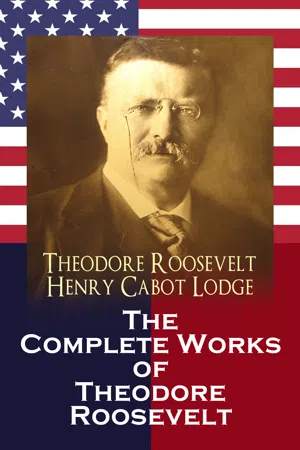
The Complete Works of Theodore Roosevelt
- 4,120 pages
- English
- ePUB (mobile friendly)
- Available on iOS & Android
eBook - ePub
The Complete Works of Theodore Roosevelt
About this book
This meticulously edited ebook edition represents the great literary legacy of the president Theodore Roosevelt. Besides historical books, biographies, nature and guide books, you will find in this collection – his memoirs, personal and presidential writings through which you will discover surprising adventurous life the former president, as well as details of his presidential actions and truth behind certain decisions.
Contents:
Autobiography
The Naval War of 1812
Hero Tales from American History
The Winning of the West
Through the Brazilian Wilderness
Letters to His Children
The Rough Riders
A Book-Lover's Holidays in the Open
Hunting The Grisly And Other Sketches
America and the World War
Average Americans
The Strenuous Life
Expansion and Peace
Fellow-Feeling as Political Factor
Character & Success
History as Literature
Biological Analogies in History
The World Movement
The Thraldom of Names
Productive Scholarship
Dante and the Bowery
The Foundations of the Nineteenth Century
The Search for Truth in a Reverent Spirit
The Ancient Irish Sagas
An Art Exhibition
The Duties of American Citizenship
Professionalism in Sports
Practical Work in Politics
Resignation Letter
Colonel Roosevelt's Reports
Strength & Decency
The Square Deal
Nobel Peace Prize Acceptance Speech
The Man With the Muck Rake
Sons of the Puritans
Where We Can Work With Socialists
Where We Cannot Work With Socialists
Citizenship in a Republic (the Man in the Arena)
International Peace
The New Nationalism
Duty & Self-control
The Right of the People to Rule
I Have Just Been Shot
Address to the Boys Progressive League
Address to the Knights of Columbus
Information
Subtopic
Political BiographiesIndex
LiteratureThe Winning of the West
Table of Contents
Volume I
Preface
Foreword
I. The Spread of the English-Speaking Peoples
II. The French of the Ohio Valley, 1763-1775
III. The Appalachian Confederacies, 1765-1775
IV. The Algonquins of the Northwest, 1769-1774
V. The Backwoodsmen of the Alleghanies. 1769-1774
VI. Boon and the Long Hunters; And Their Hunting in No-Man's-Land, 1769-1774
VII. Sevier, Robertson, and the Watauga Commonwealth, 1769-1774
VIII. Lord Dunmore's War, 1774
IX. The Battle of the Great Kanawha; And Logan's Speech, 1774
X. Boon and the Settlement of Kentucky, 1775
XI. In the Current of the Revolution—the Southern Backwoodsmen Overwhelm the Cherokees, 1776
XII. Growth and Civil Organization of Kentucky, 1776
Volume II
I. The War in the Northwest, 1777-1778
II. Clark's Conquest of the Illinois, 1778
III. Clark's Campaign Against Vincennes, 1779
IV. Continuance of the Struggle in Kentucky and the Northwest, 1779-1781
V. The Moravian Massacre, 1779-1782
VI. The Administration of the Conquered French Settlements, 1779-1783
VII. Kentucky Until the End of the Revolution, 1782-1783
VIII. The Holston Settlements, 1777-1779
IX. King's Mountain, 1780
X. The Holston Settlements to the End of the Revolution, 1781-83
XI. Robertson Founds the Cumberland Settlement, 1779-1780
XII. The Cumberland Settlements to the Close of the Revolution, 1781-1783
XIII. What the Westerners Had Done During the Revolution, 1783
Volume III
Preface
I. The Inrush of Settlers, 1784-1787
II. The Indian Wars, 1784-1787
III. The Navigation of the Mississippi; Separatist Movements and Spanish Intrigues, 1784-1788
IV. The State of Franklin, 1784-1788
V. Kentucky's Struggle for Statehood. 1784-1790
VI. The Northwest Territory; Ohio. 1787-1790
VII. The War in the Northwest. 1787-1790
VIII. The Southwest Territory, 1788-1790
Volume IV
Preface
I. St. Clair's Defeat, 1791
II. Mad Anthony Wayne; And the Fight of the Fallen Timbers, 1792-1795
III. Tennessee Becomes a State, 1791-1796
IV. Intrigues and Land Speculations—The Treaties of Jay and Pinckney, 1793-1797
V. The Men of the Western Waters, 1798-1802
VI. The Purchase of Louisiana; And Burr's Conspiracy, 1803-1807
VII. The Explorers of the Far West, 1804-1807
Volume I
Table of Contents
Preface
Table of Contents
Much of the material on which this work is based is to be found in the archives of the American Government, which date back to 1774, when the first Continental Congress assembled. The earliest sets have been published complete up to 1777, under the title of "American Archives," and will be hereafter designated by this name. These early volumes contain an immense amount of material, because in them are to be found memoranda of private individuals and many of the public papers of the various colonial and State governments, as well as those of the Confederation. The documents from 1789 on—no longer containing any papers of the separate States—have also been gathered and printed under the heading of "American State Papers"; by which term they will be hereafter referred to.
The mass of public papers coming in between these two series, and covering the period extending from 1776 to 1789, have never been published, and in great part have either never been examined or else have been examined in the most cursory manner. The original documents are all in the Department of State at Washington, and for convenience will be referred to as "State Department MSS." They are bound in two or three hundred large volumes; exactly how many I cannot say, because, though they are numbered, yet several of the numbers themselves contain from two or three to ten or fifteen volumes apiece. The volumes to which reference will most often be made are the following:
No. 15. Letters of Huntington.
No. 16. Letters of the Presidents of Congress.
No. 18. Letter-Book B.
No. 20. Vol. 1. Reports of Committees on State Papers.
No. 27. Reports of Committees on the War Office. 1776 to 1778.
No. 30. Reports of Committees.
No. 32. Reports of Committees of the States and of the Week.
No. 41. Vol. 3. Memorials E. F. G. 1776-1788.
No. 41. Vol. 5. Memorials K. L. 1777-1789.
No. 50. Letters and Papers of Oliver Pollock. 1777-1792.
No. 51. Vol. 2 Intercepted Letters. 1779-1782.
No. 56. Indian Affairs.
No. 71. Vol. 1. Virginia State Papers.
No. 73. Georgia State Papers.
No. 81. Vol. 2. Reports of Secretary John Jay.
No. 120. Vol. 2. American Letters.
No. 124. Vol. 3. Reports of Jay.
No. 125. Negotiation Book.
No. 136. Vol. 1. Reports of Board of Treasury.
No. 136. Vol. 2. Reports of Board of Treasury.
No. 147. Vol. 2. Reports of Board of War.
No. 147. Vol. 5. Reports of Board of War.
No. 147. Vol. 6. Reports of Board of War.
No. 148. Vol. 1. Letters from Board of War.
No. 149. Vol. 1. Letters and Reports from B. Lincoln, Secretary at War.
No. 149. Vol. 2. Letters and Reports from B. Lincoln, Secretary at War.
No. 149. Vol. 3. Letters and Reports from B. Lincoln, Secretary at War.
No. 150. Vol. 1. Letters of H. Knox, Secretary at War.
No. 150. Vol. 2. Letters of H. Knox, Secretary at War.
No. 150. Vol. 3. Letters of H. Knox, Secretary at War.
No. 152. Vol. 11. Letters of General Washington.
No. 163. Letters of Generals Clinton, Nixon, Nicola, Morgan, Harmar, Muhlenburg.
No. 169. Vol. 9. Washington's Letters.
No. 180. Reports of Secretary of Congress.
No. 16. Letters of the Presidents of Congress.
No. 18. Letter-Book B.
No. 20. Vol. 1. Reports of Committees on State Papers.
No. 27. Reports of Committees on the War Office. 1776 to 1778.
No. 30. Reports of Committees.
No. 32. Reports of Committees of the States and of the Week.
No. 41. Vol. 3. Memorials E. F. G. 1776-1788.
No. 41. Vol. 5. Memorials K. L. 1777-1789.
No. 50. Letters and Papers of Oliver Pollock. 1777-1792.
No. 51. Vol. 2 Intercepted Letters. 1779-1782.
No. 56. Indian Affairs.
No. 71. Vol. 1. Virginia State Papers.
No. 73. Georgia State Papers.
No. 81. Vol. 2. Reports of Secretary John Jay.
No. 120. Vol. 2. American Letters.
No. 124. Vol. 3. Reports of Jay.
No. 125. Negotiation Book.
No. 136. Vol. 1. Reports of Board of Treasury.
No. 136. Vol. 2. Reports of Board of Treasury.
No. 147. Vol. 2. Reports of Board of War.
No. 147. Vol. 5. Reports of Board of War.
No. 147. Vol. 6. Reports of Board of War.
No. 148. Vol. 1. Letters from Board of War.
No. 149. Vol. 1. Letters and Reports from B. Lincoln, Secretary at War.
No. 149. Vol. 2. Letters and Reports from B. Lincoln, Secretary at War.
No. 149. Vol. 3. Letters and Reports from B. Lincoln, Secretary at War.
No. 150. Vol. 1. Letters of H. Knox, Secretary at War.
No. 150. Vol. 2. Letters of H. Knox, Secretary at War.
No. 150. Vol. 3. Letters of H. Knox, Secretary at War.
No. 152. Vol. 11. Letters of General Washington.
No. 163. Letters of Generals Clinton, Nixon, Nicola, Morgan, Harmar, Muhlenburg.
No. 169. Vol. 9. Washington's Letters.
No. 180. Reports of Secretary of Congress.
Besides these numbered volumes, the State Department contains others, such as Washington's letter-book, marked War Department 1792, '3, '4, '5. There are also a series of numbered volumes of "Letters to Washington," Nos. 33 and 49 containing reports from Geo. Rogers Clark. The Jefferson papers, which are likewise preserved here, are bound in several series, each containing a number of volumes. The Madison and Monroe papers, also kept here, are not yet bound; I quote them as the Madison MSS. and the Monroe MSS.
My thanks are due to Mr. W. C. Hamilton, Asst. Librarian, for giving me every facility to examine the material.
At Nashville, Tennessee, I had access to a mass of original matter in the shape of files of old newspapers, of unpublished letters, diaries, reports, and other manuscripts. I was given every opportunity to examine these at my leisure, and indeed to take such as were most valuable to my own home. For this my thanks are especially due to Judge John M. Lea, to whom, as well as to my many other friends in Nashville, I shall always feel under a debt on account of the unfailing courtesy with which I was treated. I must express my particular acknowledgments to Mr. Lemuel R. Campbell. The Nashville manuscripts, etc. of which I have made most use are the following:
The Robertson MSS., comprising two large volumes, entitled the "Correspondence, etc., of Gen'l James Robertson," from 1781 to 1814. They belong to the library of Nashville University; I had some difficulty in finding the second volume but finally succeeded.
The Campbell MSS., consisting of letters and memoranda to and from different members of the Campbell family who were prominent in the Revolution; dealing for the most part with Lord Dunmore's war, the Cherokee wars, the battle of King's Mountain, land speculations, etc. They are in the possession of Mr. Lemuel R. Campbell, who most kindly had copies of all the important ones sent me, at great personal trouble.
Some of the Sevier and Jackson papers, the original MS. diaries of Donelson on the famous voyage down the Tennessee and up the Cumberland, and of Benj. Hawkins while surveying the Tennessee boundary, memoranda of Thos. Washington, Overton and Dunham, the earliest files of the Knoxville Gazette, from 1791 to 1795, etc. These are all in the library of the Tennessee Historical Society.
For original matter connected with Kentucky, I am greatly indebted to Col. Reuben T. Durrett, of Louisville, the founder of the "Filson Club," which has done such admirable historical work of late years. He allowed me to work at my leisure in his library, the most complete in the world on all subjects connected with Kentucky history. Among other matter, he possesses the Shelby MSS., containing a number of letters to and from, and a dictated autobiography of, Isaac Shelby; MS. journals of Rev. James Smith, during two tours in the western country in 1785 and '95; early files of the "Kentucke Gazette"; books owned by the early settlers; papers of Boon, and George Rogers Clark; MS. notes on Kentucky by George Bradford, who settled there in 1779; MS. copy of the record book of Col. John Todd, the first governor of the Illinois country after Clark's conquest; the McAfee MSS., consisting of an Account of the First Settlement of Salt River, the Autobiography of Robert McAfee, and a Brief Memorandum of the Civil and Natural History of Kentucky; MS. autobiography of Rev. William Hickman, who visited Kentucky in 1776, etc., etc.
I am also under great obligations to Col. John Mason Brown of Louisville, another member of the Filson Club, for assistance rendered me; particularly for having sent me six bound volumes of MSS., containing the correspondence of the Spanish Minister Gardoqui, copied from the Spanish archives.
At Lexington I had access to the Breckenridge MSS., through the kindness of Mr. Ethelbert D. Warfield; and to the Clay MSS. through the kindness of Miss Lucretia Hart Clay. I am particularly indebted to Miss Clay for her courtesy in sending me many of the most valuable old Hart and Benton letters, depositions, accounts, and the like.
The Blount MSS. were sent to me from California by the Hon. W. D. Stephens of Los Angeles, although I was not personally known to him; an instance of courtesy and generosity, in return for which I could do nothing save express my sincere appreciation and gratitude, which I take this opportunity of publicly repeating.
The Gates MSS., from which I drew some important facts not hitherto known concerning the King's Mountain campaign, are in the library of the New York Historical Society.
The Virginia State Papers have recently been published, and are now accessible to all.
Among the most valuable of the hitherto untouched manuscripts which I have obtained are the Haldimand papers, preserved in the Canadian archives at Ottawa. They give, for the first time, the British and Indian side of all the northwestern fighting; including Clark's campaigns, the siege of Boonsborough, the battle of the Blue Licks, Crawford's defeat, etc. The Canadian archivist. Mr. Douglass Brymner, furnished me copies of all I needed with a prompt courtesy for which I am more indebted than I can well express.
I have been obliged to rely mainly on these collections of early documents as my authorities, especially for that portion of western history prior to 1783. Excluding the valuable, but very brief, and often very inaccurate, sketch which Filson wrote down as coming from Boon, there are no printed histories of Kentucky earlier than Marshall's, in 1812; while the first Tennessee history was Haywood's, in 1822. Both Marshall and Haywood did excellent work; the former was an able writer, the latter was a student, and (like the Kentucky historian Mann Butler) a sound political thinker, devoted to the Union, and prompt to stand up for the right. But both of them, in dealing with the early history of the country beyond the Alleghanies, wrote about matters that had happened from thirty to fifty years before, and were obliged to base most of their statements on tradition or on what the pioneers remembered in their old age. The later historians, for the most part, merely follow these two. In consequence, the mass of original material, in the shape of official reports and contemporary letters, contained in the Haldimand MSS., the Campbell MSS., the McAfee MSS., the Gardoqui MSS., the State Department MSS., the Virginia State Papers, etc., not only cast a flood of new light upon this early history, but necessitate its being entirely re-written. For instance, they give an absolutely new aspect to, and in many cases completely reverse, the current accounts of all the Indian fighting, both against the Cherokees and the Northwestern tribes; they give for the first time a clear view of frontier diplomacy, of the intrigues with the Spaniards, and even of the mode of life in the backwoods, and of the workings of the civil government. It may be mentioned that the various proper names are spelt in so many different ways that it is difficult to know which to choose. Even Clark is sometimes spelt Clarke, while Boon was apparently indifferent as to whether his name should or should not contain the final silent e. As for the original Indian titles, it is often quite impossible to give them even approximately; the early writers often wrote the same Indian words in such different ways that they bear no resemblance whatever to one another.
In conclusion I would say that it has been to me emphatically a labor of love to write of the great deeds of the border people. I am not blind to their manifold shortcomings, nor yet am I ignorant of their many strong and good qualities. For a number of years I spent most of my time on the frontier, and lived and worked like any other frontiersman. The wild country in which we dwelt and across which we wandered was in the far west; and there were of course many features in which the life of a cattleman on the Great Plains and among the Rockies differed from that led by a backwoodsman in the Alleghany forests a century before. Yet the points of resemblance were far more numerous and striking. We guarded our herds of branded cattle and shaggy horses, hunted bear, bison, elk, and deer, established civil government, and put down evil-doers, white and red, on the banks of the Little Missouri and among the wooded, precipitous foot-hills of the Bighorn, exactly as did the pioneers who a hundred years previously built their log-cabins beside the Kentucky or in the valleys of the Great Smokies. The men who have shared in the fast vanishing frontier life of the present feel a peculiar sympathy with the already long-vanished frontier life of the past.
THEODORE ROOSEVELT.
SAGAMORE HILL, May, 1889
Foreword
Table of Contents
In the year 1898 the United States finished the work begun over a century before by the backwoodsman, and drove the Spaniard outright from the western world. During the march of our people from the crests of the Alleghanies to the Pacific, the Spaniard was for a long period our chief white opponent; and after an interval his place among our antagonists was taken by his Spanish-American heir. Although during the Revolution the Spaniard at one time became America's friend in the sense that he was England's foe, he almost from the outset hated and dreaded his new ally more than his old enemy. In the peace negotiations at the close of the contest he was jealously eager to restrict our boundaries to the line of the Alleghanies; while even during the concluding years of the war the Spanish soldiers on the upper Mississippi were regarded by the Americans in Illinois as a menace no less serious than the British troops at Detroit.
In the opening years of our national life the Western backwoodsman found the Spanish ownership of the mouth of the Mississippi even more hurtful and irksome than the retention by the British king of the posts on the Great Lakes. After years of tedious public negotiations, under and through which ran a dark woof of private intrigue, the sinewy western hands so loosened the Spanish grip that in despair Spain surrendered to France the mouth of the river and the vast territories stretching thence into the dim Northwest. She hoped thereby to establish a strong barrier between her remaining provinces and her most dreaded foe. But France in her turn grew to understand that America's position as regards Louisiana, thanks to the steady westward movement of the backwoodsman, was such as to render it on the one hand certain that the retention of the province by France would mean an armed clash with the United States, and on the other hand no less certain that in the long run such a conflict would result to France's disadvantage. Louisiana thus passed from the hands of Spain, after a brief interval, into those of the young Republic. There remained to Spain, Mexico and Florida; and forthwith the pressure of the stark forest riflemen began to be felt on the outskirts of these two provinces. Florida was the first to fall. After a portion of it had been forcibly annexed, after Andrew Jackson had marched at will through part of the remainder, and after the increasing difficulty of repressing the American filibustering efforts had shown the imminence of some serious catastrophe,...
Table of contents
- The Complete Works of Theodore Roosevelt
- Table of Contents
- Autobiography of Theodore Roosevelt
- The Naval War of 1812
- Hero Tales From American History
- The Winning of the West
- Through the Brazilian Wilderness
- Letters to His Children
- The Rough Riders
- A Book-Lover's Holidays in the Open
- Hunting The Grisly And Other Sketches
- America and the World War
- Average Americans
- The Strenuous Life
- History as Literature
- Articles & Speeches of Theodore Roosevelt
- Inaugural Address of Theodore Roosevelt
- State of the Union Addresses
- Presidential Messages
- Proclamations
- Executive Orders
Trusted by 375,005 students
Access to over 1.5 million titles for a fair monthly price.
Study more efficiently using our study tools.
Frequently asked questions
Yes, you can cancel anytime from the Subscription tab in your account settings on the Perlego website. Your subscription will stay active until the end of your current billing period. Learn how to cancel your subscription
No, books cannot be downloaded as external files, such as PDFs, for use outside of Perlego. However, you can download books within the Perlego app for offline reading on mobile or tablet. Learn how to download books offline
Perlego offers two plans: Essential and Complete
- Essential is ideal for learners and professionals who enjoy exploring a wide range of subjects. Access the Essential Library with 800,000+ trusted titles and best-sellers across business, personal growth, and the humanities. Includes unlimited reading time and Standard Read Aloud voice.
- Complete: Perfect for advanced learners and researchers needing full, unrestricted access. Unlock 1.5M+ books across hundreds of subjects, including academic and specialized titles. The Complete Plan also includes advanced features like Premium Read Aloud and Research Assistant.
We are an online textbook subscription service, where you can get access to an entire online library for less than the price of a single book per month. With over 1.5 million books across 990+ topics, we’ve got you covered! Learn about our mission
Look out for the read-aloud symbol on your next book to see if you can listen to it. The read-aloud tool reads text aloud for you, highlighting the text as it is being read. You can pause it, speed it up and slow it down. Learn more about Read Aloud
Yes! You can use the Perlego app on both iOS and Android devices to read anytime, anywhere — even offline. Perfect for commutes or when you’re on the go.
Please note we cannot support devices running on iOS 13 and Android 7 or earlier. Learn more about using the app
Please note we cannot support devices running on iOS 13 and Android 7 or earlier. Learn more about using the app
Yes, you can access The Complete Works of Theodore Roosevelt by Theodore Roosevelt,Henry Cabot Lodge, Joseph Bucklin Bishop in PDF and/or ePUB format, as well as other popular books in Literature & Political Biographies. We have over 1.5 million books available in our catalogue for you to explore.