eBook - ePub
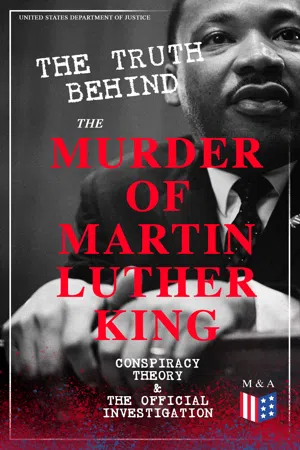
The Truth Behind the Murder of Martin Luther King – Conspiracy Theory & The Official Investigation
MLK's Murder in Memphis: Probing Mafia and Government Claims
- 142 pages
- English
- ePUB (mobile friendly)
- Available on iOS & Android
eBook - ePub
The Truth Behind the Murder of Martin Luther King – Conspiracy Theory & The Official Investigation
MLK's Murder in Memphis: Probing Mafia and Government Claims
About this book
Martin Luther King Jr. was assassinated at the Lorraine Motel in Memphis, TN, on April 4, 1968. In December 1993, decades after the murder, Loyd Jowers, a white man from Memphis, asserted that the Mafia and the U.S. government were involved in a conspiracy against Martin Luther King. Jowers claimed that he participated in a conspiracy to kill Dr. King, along with an alleged Mafia figure, Memphis police officers, and a man named Raoul. For 30 years, others have similarly alleged that Ray was Raoul's unwitting pawn and that a conspiracy orchestrated Dr. King's murder. These varied theories have generated several comprehensive government investigations regarding the assassination, none of which confirmed the existence of any conspiracy. United States Department of Justice has examined all allegations and presented its findings in this report.
Information
Subtopic
North American HistoryIndex
Social SciencesJowers' Allegations
Table of Contents
A. Introduction
For several years beginning in the late 1960s, Loyd Jowers owned and operated Jim's Grill, a tavern located below the rooming house on South Main Street where James Earl Ray rented a room on the day of the assassination. In the late 1940s, Jowers was brieflya Memphis police officer. Subsequently, he made his living on and off over the years as a taxi driver and through ownership of a string of small businesses in Memphis, including Jim's Grill, another bar, and Memphis taxi cab companies. In the early 1990s, Jowers left Memphis for his hometown of Martin, Tennessee, where he opened a small convenience store. In late 1993, he moved to Arkansas.
For the first 25 years after the assassination, Jowers maintained in several statements to law enforcement officials and defense investigators that he was behind the counter serving customers in Jim's Grill when Dr. King was shot. He did not claim any involvement in or provide any significant information about the assassination.
In December 1993, Jowers appeared on ABC's Prime Time Live, radically changed his story, and "confessed" to having participated in a plot to kill Dr. King. Since that appearance, he has given additional statements about the assassination to the media, Dr. King's son Dexter King, Ray's attorney, a law enforcement agent, relatives, friends, and courts. In these statements, Jowers has repeatedly changed key aspects of his new story, disavowed his confession, and even retreated to his long-standing account of the previous 25 years.
The investigative team analyzed the contents of Jowers' many statements. We also interviewed numerous witnesses and reviewed tens of thousands of pages of documents, including transcripts from the King v. Jowers trial,to determine whether there is credible evidence to support any aspect of Jowers' varied accounts. Finally, we attempted to interview Jowers, but he refused to speak with us.
B. The Origin Of Jowers' Allegations
1. Statements between 1968-1992
Jowers spoke to the Memphis police and the FBI a total of four times within five days of the assassination. He later talked to investigators working on behalf of James Earl Ray. In each of these accounts, Jowers consistently described his own uneventful activities at Jim's Grill on the afternoon of the assassination. He told authorities that he arrived at the tavern around 4:00 p.m. and noticed a white Mustang in his usual parking spot in front of the grill. At around 6:00 p.m., while behind the counter in the front of his tavern, he heard a loud noise and went to the kitchen to investigate. When he saw nothing unusual, he returned to serve his customers. He was behind the counter when the police arrived minutes after the shooting.8
During the next quarter of a century, Jowers revealed nothing about the assassination that was materially different from his original accounts. In discussions with HSCA staff and Ray's investigators, as well as in testimony in a legal proceeding in which Ray sought to withdraw his guilty plea, Jowers focused exclusively on his observations of the Mustang and potential witnesses in the rooming house and the grill.9
2. The Evolution of the Alleged Confession
In 1992, Jowers hinted that his story was about to change. That year, Home Box Office (HBO) and Thames Television of London initiated a project to produce and televise a mock trial of James Earl Ray. The producers hired Ray's real-life attorney, Dr. William Pepper, to represent him, and Hickman Ewing, the former United States Attorney in Memphis, to be the prosecutor. From the show's $3 million budget, they gave each side an expense account in excess of $100,000 to hire investigators, pursue leads, and prepare its case. As the investigators and production crew came to Memphis, public interest in the King assassination increased substantially. The program, which included the mock jury's verdict of not-guilty, ultimately aired in April 1993, on the 25th anniversary of the assassination.
In December 1992, Jowers met in his attorney's office with a prosecutorial investigator working on the mock trial. In the reception room, without his attorney, Jowers repeated the story he had been telling for years. He added that the gunshot had come from inside the building since he believed that he would not have heard a noise from outside.
Immediately after the reception room conversation, the investigator met with Jowers and his attorney, Lewis Garrison. During the meeting, Garrison revealed that Jowers had information that would put "a different slant" on the assassination. He would not, however, disclose the information. Instead, he stated that Jowers wanted more compensation than the standard $40 per day witness fee provided participants in the mock trial.
In January 1993, Jowers testified at the mock trial for the defense. He essentially repeated what he had been saying since 1968. Jowers was somewhat unclear as to whether he had actually heard a gunshot, but again claimed that he went to the kitchen to investigate a noise. Significantly, he denied telling anyone that he had found a gun and kept it under the counter at Jim's Grill after the assassination.
In the fall of 1993, Garrison forwarded a written request for immunity to the Shelby County District Attorney General on behalf of five unnamed clients, later determined to include Jowers, his former girlfriend Betty Spates, and two of his former co-workers in the taxicab business, James McCraw and Willie Akins. The request provided very little detail and stated that an unnamed person (Jowers) received money to hire Dr. King's assassin. It further maintained that immediately after the shooting, the assassin passed the murder weapon to Jowers, who disassembled and hid it. The request also stated that Jowers "had close contact with some persons employed by the Memphis Police Department" and included representations from Garrison's other clients inculpating Jowers in the plot. The District Attorney General was not persuaded by the limited proffer and did not grant immunity to any of Garrison's clients.
After submitting the request for immunity, Jowers and Garrison met with Jack Saltman, one of the producers of the televised mock trial. Jowers revealed his alleged involvement in the assassination and, for the first time, provided details of the alleged plot, including the names of the alleged assassin and other co-conspirators. Because Jowers did not have immunity, his statement to Saltman was an admission that could be used against him in a criminal prosecution.
3. Jowers' 1993 Televised Prime Time Live Appearance
In December 1993, after his discussion with Saltman, Jowers agreed to an interview with ABC journalist, Sam Donaldson. The interview aired on Prime Time Live on December 16, 1993. At Jowers' request, the network partially shaded his face, but broadcast his full name and the fact that he was from Memphis. Jowers' attorney, Lewis Garrison, also appeared on the program.
During the interview, Jowers announced that he was "indirectly" involved in a conspiracy to kill Dr. King. He explained that Frank Liberto,10 a Memphis produce dealer, asked him to "hire someone to assassinate Dr. Martin Luther King." Donaldson also reported that Jowers claimed to have received approximately $100,000 as part of the assassination plot at his grill sometime before the murder.
Jowers further asserted that a man with a name sounding like Raoul "brought a rifle in a box" and "asked [him] to hold [it] [un]til * * * he made arrangements or we made arrangements, one or the other of us, for the killing." According to Jowers, Liberto said that the police "wouldn't be there" and "it'd be set up where it looked like someone else had done the killing." Jowers also added that he did not believe that James Earl Ray knew he was part of the plot. When Jowers revealed that he had hired the killer, his attorney Garrison abruptly terminated the interview, saying Jowers has "gone as far as we can." In an off-camera interview with program producer Ira Rosen, however, Jowers specifically named the assassin, identifying an African American man who was found on South Main Street by the police after the shooting.
4. Subsequent Statements
Since Prime Time Live, Jowers has made several statements to the media and private parties regarding the assassination. Additionally, his attorney Lewis Garrison has made statements to the media, private parties, and an attorney with our investigationGarrison also advocated Jowers' position in both King v. Jowers and Ray v. Jowers, an earlier false imprisonment civil suit filed by Dr. Pepper on behalf of Ray. Nonetheless, Jowers would not speak with our investigation and did not testify during King v. Jowers, where he was the only party sued.
In November 1994, Jowers testified under oath in a deposition in Ray v. Jowers. In April 1997, he spoke about his allegations in a recorded telephone conversation with Mark Glankler, an investigator with the Shelby County District Attorney General. Jowers also talked to Dexter King, Dr. King's son, on two occasions, in October 1997 and March 1998, joined by Dr. Pepper and Ambassador Andrew Young, respectively. In April 1998, Jowers appeared a second time on Prime Time Live. Additionally, since 1993, Jowers has spoken about his conspiracy claims on several occasions to friends and a close relative.
Garrison filed answers to the complaints in Ray v. Jowers and King v. Jowers in October 1994 and October 1998, respectively, and amended the latter in 1999.11 In March 1995, in Jowers' presence, Garrison spoke with Dr. Pepper, and in April 1997, without Jowers,he talked to author Gerald Posner. In March 1999, Garrison discussed Jowers' allegations with an attorney from our investigation. He also represented Jowers' position at the trial of King v. Jowers and on several occasions made comments to the media regarding Jowers' claims.
On three occasions when Jowers spoke about his conspiracy claims, he essentially disavowed them. In his 1994 deposition the onlystatement he has made under oath -- Jowers repeated the account he originally gave soon after the shooting, and did not claim any involvement in the assassination. He also repudiated his conspiracy allegations in separate conversations with District Attorney General investigator Glankler and a close relative.
Jowers' remaining statements are inconsistent with both one another and the original Prime Time Live interview. Among other things, Jowers has vacillated about the identity of the assassin, his own role in the alleged conspiracy, the disposal of the alleged murder weapon, and the degree to which Memphis police officers were involved. To the extent there are any common elements to his varied accounts, he has maintained that he participated in a plot with Liberto, Raoul, and Memphis police officers to smuggle money and a rifle into Jim's Grill. Jowers also has alleged that the assassin fired from behind the grill and that he received and concealed the murder weapon from him immediately after the shooting.
Garrison's statements on Jowers' behalf, including his closing argument in King v. Jowers, are inconsistent with each other and Jowers' own varied accounts. Additionally, when speaking to an attorney from our investigation, Garrison acknowledged that Jowers had lied.
C. Analysis Of Jowers' Statements Since 1993
Since 1993, Jowers' statements have deviated significantly from both the account he gave on Prime Time Live and each other.
1. Statements Rejecting Conspiracy Claims
a. Statement under oath
Jowers has never made his conspiracy claims under oath. In fact, although he was the only party being sued, he did not testify in King v. Jowers.
In his only statement under oath since his 1993 revelation, Jowersdid not confess. Specifically, in a November 1994 sworn deposition in Ray v. Jowers, approximately a year after his initial appearance on Prime Time Live, Jowers refused to adopt his televised confession. When asked about the truth of his comments on Prime Time Live, he invoked his Fifth Amendment privilege against self-incrimination. He did not, however, resist discussing the events surrounding the assassination. Rather, he retreated to his 1968 account. Repeating what he had said many times before, he testified that while serving customers at Jim's Grill, he heard a noise, briefly inspected the kitchen, and immediately returned to the counter.12
b. Other repudiations
Central to Jowers' conspiracy allegations are his claims that he concealed the murder weapon after the assassination and that James Earl Ray was not the shooter. Together, these assertions necessarily imply that the 30.06 rifle with Ray's fingerprints found by the police in front of Canipe's store was not the weapon that fired the shot that killed Dr. King.
In April 1997, in a tape-recorded conversation with Shelby County District Attorney General's office investigator Mark Glankler, Jowers disavowed this key aspect of his story and characterized it as "bullshit." Jowers had telephoned Glankler to complain about investigators interviewing his relatives (emphasis added):
Jowers: Well tell him [Jowers' attorney Garrison] you heard all this from my relatives, okay?
Glankler: Sure.
Jowers: But now you can believe this. What I've told you so far, which wasn't very much. Now I, I got to tell you this. I got to tell you this. That rifle -
Glankler: Yes sir.
Jowers: Is the one that killed Martin Luther King.
Glankler: Which - which one? The one that in the uh-
Jowers: Yeah.
Glankler: Evidence room now?
Jowers: Yeah.
Glankler: That is or is not?
Jowers: That is.
Glankler: Okay.
Jowers: There was no - there was no second rifle.
Glankler: Okay.
Jowers: All that bullshit they come up with a second rifle or a second firer -- that's bullshit.
Glankler: Uhuh (indicating yes)
Jowers: There wasn't no second one.
The timing of Jowers' disavowal may be significant. The conversation occurred not only when Jowers' allegations were under investigation by the District Attorney General, but also at the time of the court hearings concerning Ray's motion for additional testing of the rifle, referred to in the above conversation as the rifle in the evidence room.
Jowers'attorney later offered an explanation for Jowers' comments. Garrison told an attorney with our investigation that Jowers falsely stated there was "no second rifle" because he wanted to stop the prosecutor's office from interviewing his family members, and he hoped to influence Ray's pending motion for additional testing on the rifle. According to Garrison, Jowers reasoned that, if the judge doubted the existence of a second rifle, he would be more inclined to grant Ray's motion.
If Garrison is wrong and Jowers told Glankler the truth, Jowers' allegations are in fact false. If Garrison is right, then Jowers lied to influence an ongoing court proceeding. Either way, Jowers' claims about a second rifle and a different shooter are suspect. In the first scenario, Jowers has expressly conceded the central features of his allegation are false. In the second, by lying -- and doing so with an unquestionably unlawful motive -- he has severely undermined his own credibility.
Jowers also repudiated his conspiracy claims in a one-on-one conversation with a family member, with whom he speaks frequently. Sometime after his first appearance on Prime Time Live, the relative asked Jowers whether he was actually involved in the assassination. According to the relative, Jowers answered, "Hell, no." The fact that the response was spontaneous and occurred during a private conversation with a very close relative suggests that it was truthful.
2. Contradictory Conspiracy Claims
Setting aside Jowers' repudiations of his conspiracy allegations, his statements claiming involvement in the assassination contradict each other on almost every key issue.
a. The man who allegedly shot Dr. King
Since 1993, Jowers has identified different people as Dr. King's assassin. He has alternatively claimed that the shooter was: (1) an African American man who was on South Main Street on the night of the assassination (the "Man on South Main Street"); (2) Raoul; (3) a white "Lieutenant" with the Memphis Police Department; and (4) a person whom he did not recognize.13
Initially, during a 1993 interview with HBO mock trial producer Jack Saltman, Jowers identified the assassin as an African American man, whom the police ushered into Jim's Grill from South Main Street minutes after the shooting. He named the same man during a subsequent interview with Prime Time Live producer Ira Rosen. Jowers, however, dropped the allegation short...
Table of contents
- The Truth Behind the Murder of Martin Luther King – Conspiracy Theory & The Official Investigation
- Table of Contents
- Overview
- Summary of the Findings of the Investigation
- Description of the Investigative Process
- Summary of Facts Related to the Assassination
- Jowers' Allegations
- Wilson's Allegations
- Raoul and His Alleged Participation in the Assassination
- King v. Jowers Conspiracy Allegations
- Conclusion and Recommendation
Trusted by 375,005 students
Access to over 1.5 million titles for a fair monthly price.
Study more efficiently using our study tools.
Frequently asked questions
Yes, you can cancel anytime from the Subscription tab in your account settings on the Perlego website. Your subscription will stay active until the end of your current billing period. Learn how to cancel your subscription
No, books cannot be downloaded as external files, such as PDFs, for use outside of Perlego. However, you can download books within the Perlego app for offline reading on mobile or tablet. Learn how to download books offline
We are an online textbook subscription service, where you can get access to an entire online library for less than the price of a single book per month. With over 1.5 million books across 990+ topics, we’ve got you covered! Learn about our mission
Look out for the read-aloud symbol on your next book to see if you can listen to it. The read-aloud tool reads text aloud for you, highlighting the text as it is being read. You can pause it, speed it up and slow it down. Learn more about Read Aloud
Yes! You can use the Perlego app on both iOS and Android devices to read anytime, anywhere — even offline. Perfect for commutes or when you’re on the go.
Please note we cannot support devices running on iOS 13 and Android 7 or earlier. Learn more about using the app
Please note we cannot support devices running on iOS 13 and Android 7 or earlier. Learn more about using the app
Yes, you can access The Truth Behind the Murder of Martin Luther King – Conspiracy Theory & The Official Investigation by United States Department of Justice in PDF and/or ePUB format, as well as other popular books in Social Sciences & North American History. We have over 1.5 million books available in our catalogue for you to explore.