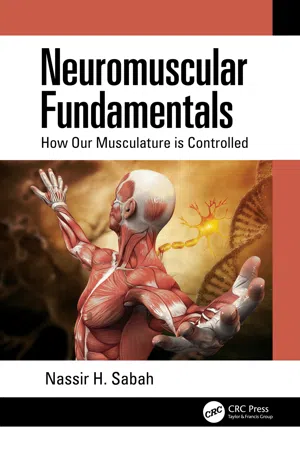
Neuromuscular Fundamentals
eBook - ePub

Neuromuscular Fundamentals

How Our Musculature is Controlled

  1. 548 pages
  2. English
  3. ePUB (mobile friendly)
  4. Available on iOS & Android
eBook - ePub

Neuromuscular Fundamentals

How Our Musculature is Controlled

About this book

This book is rather unique in its approach and coverage. The approach is essentially that of an engineering textbook, emphasizing the quantitative aspects and highlighting the fundamentals and basic concepts involved. The coverage progresses in a logical and systematic manner from the subcellular, starting with the electrophysiology of the cell membrane, then proceeding to synapses, neurons, and muscle, before considering neuronal motor ensembles and the neuromuscular system as a whole. Simple, clear, and comprehensive explanations are given throughout. After an introductory chapter on some background material in biology, biophysics, and chemical kinetics, a substantial part of the book (Chapters 2-8) necessarily covers in considerable detail the basic components and processes that underlie the electrical and associated activities of the nervous system. The remaining chapters of the book (Chapters 9-13) focus on the neuromuscular system, starting with the structure of muscle cells, the generation of force by muscular contraction, and muscle receptors. The last chapter examines aspects of the control of movement, motor learning and memory, the maintenance of posture, and locomotion, and critically examines some of the theories that have been advanced to explain how movement is controlled. The book is intended for undergraduate or graduate students in the natural sciences, mathematics, or engineering who seek a deeper understanding of the fundamentals of neuroscience and the somatomotor system, in accordance with the aforementioned objectives. The book can serve as a textbook for a one-semester course on the neuromuscular system or as a reference in a more general course on neuroscience.


  • Provides a thorough analytical treatment of membrane electrophysiology, starting from the first principles


  • Emphasizes strongly the basic and fundamental concepts throughout


  • Discusses thoroughly the essential features and properties of the basic constituents of the nervous system, that is, neurons and synapses, including the neuromuscular junction


  • Explains the main aspects of posture, locomotion, and control of movement


  • Includes practice problems throughout the text and a solutions manual will be available for adopting professors

Nassir Sabah is professor of biomedical engineering in the electrical and computer engineering department at the American University of Beirut, Lebanon. He received his B.Sc. (Hons. Class I) and his M.Sc. in electrical engineering from the University of Birmingham, U.K., and his Ph.D. in biophysical sciences from the State University of New York (SUNY/Buffalo). He has served as Chairman of the Electrical Engineering Department, Director of the Institute of Computer Studies, and Dean of the Faculty of Engineering and Architecture at the American University of Beirut. In these capacities, he was responsible for the development of programs, curricula, and courses in electrical, biomedical, communications, and computer engineering.

Professor Sabah has extensive professional experience in the fields of electrical engineering, electronics, and computer systems, with more than 35 years' teaching experience in neuroengineering, biomedical engineering, electronics, and electric circuits. He has over 100 technical publications, mainly in neurophysiology, biophysics, and biomedical instrumentation.

He has served on numerous committees and panels in Lebanon and the region. He is a Fellow of the Institution of Engineering and Technology (IET, U.K.), a member of the American Association for the Advancement of Science (AAAS), and a member of the American Society for Engineering Education (ASEE).

Frequently asked questions

Yes, you can cancel anytime from the Subscription tab in your account settings on the Perlego website. Your subscription will stay active until the end of your current billing period. Learn how to cancel your subscription.
At the moment all of our mobile-responsive ePub books are available to download via the app. Most of our PDFs are also available to download and we're working on making the final remaining ones downloadable now. Learn more here.
Perlego offers two plans: Essential and Complete
  • Essential is ideal for learners and professionals who enjoy exploring a wide range of subjects. Access the Essential Library with 800,000+ trusted titles and best-sellers across business, personal growth, and the humanities. Includes unlimited reading time and Standard Read Aloud voice.
  • Complete: Perfect for advanced learners and researchers needing full, unrestricted access. Unlock 1.4M+ books across hundreds of subjects, including academic and specialized titles. The Complete Plan also includes advanced features like Premium Read Aloud and Research Assistant.
Both plans are available with monthly, semester, or annual billing cycles.
We are an online textbook subscription service, where you can get access to an entire online library for less than the price of a single book per month. With over 1 million books across 1000+ topics, we’ve got you covered! Learn more here.
Look out for the read-aloud symbol on your next book to see if you can listen to it. The read-aloud tool reads text aloud for you, highlighting the text as it is being read. You can pause it, speed it up and slow it down. Learn more here.
Yes! You can use the Perlego app on both iOS or Android devices to read anytime, anywhere — even offline. Perfect for commutes or when you’re on the go.
Please note we cannot support devices running on iOS 13 and Android 7 or earlier. Learn more about using the app.
Yes, you can access Neuromuscular Fundamentals by Nassir H. Sabah in PDF and/or ePUB format, as well as other popular books in Medicine & Astronomy & Astrophysics. We have over one million books available in our catalogue for you to explore.

Information

Publisher
CRC Press
Year
2020
eBook ISBN
9781000191448

1
Introduction: Background Material

Objective and Overview

The chapter provides some general background material for subsequent chapters and for following the relevant literature. The first part (Sections 1.1, 1.2, and 1.3) deals with some biological background, starting with living cells and cell organelles that are important for later discussions. Specialized cells, namely neurons and glia, which are the constituents of the nervous system, are considered next, with emphasis on some of their basic features. In order to appreciate the references to various parts of the nervous system in the following chapters, Section 1.3 presents the general organization of this system, including the main subdivisions of the brain.
Section 1.4 is concerned with some basic concepts on diffusion, fluxes, and potentials. The concept of chemical potential is explained and the expression for chemical potential derived. The concept of chemical potential and its expression are then generalized to those of electrochemical potential, and some important conclusions involving electrochemical potential are drawn. The definition of permeability and its relation to diffusion are considered.
The concepts introduced in Section 1.4 are used to discuss ionic equilibriums in Section 1.5, including the well-known case of the Gibbs–Donnan equilibrium. The chapter ends with an introduction to chemical kinetics and their extension to the kinetics of ion-channel gating.

1.1 Living Cells

All living cells have a surrounding envelope referred to as the cell membrane, or plasma membrane. Animal cells are eukaryotic, that is, they have a well-developed nucleus and other membrane-bounded organelles, which are cell elements that perform some specialized functions. Figure 1.1 illustrates a typical eukaryotic cell and some of its organelles. The part of the cell that is outside the nucleus and bounded by the cell membrane is the cytoplasm. The cytosol, or intracellular fluid, is the liquid part of the cytoplasm, exclusive of organelles. It consists of a complex mixture of substances that are dissolved or suspended in water. The cell membrane is discussed in considerable detail in Sections 2.1 and 2.2. The following cell organelles are particularly relevant for our purposes.
FIGURE 1.1
Eukaryotic cell and cell organelles.

1.1.1 Endoplasmic Reticulum

The endoplasmic reticulum (ER) is an elaborate network of vesicles, tubules, and cisternae. It can take the form of a rough endoplasmic reticulum (RER) because of the presence of ribosomes, which are granular structures that are the sites of protein synthesis. Ribosomes can also be free in the cytosol in addition to being membrane-bound in the RER. The RER is thus involved in the synthesis of integral membrane proteins and proteins that are to be secreted outside the cell, including hormones. The smooth endoplasmic reticulum (SER) is almost devoid of ribosomes and is involved in the synthesis of lipids and steroids and in Ca2+ homeostasis, that is, regulation of Ca2+ concentration in the cytosol, by acting as the principal store of Ca2+ in the cell. A type of SER, the sarcoplasmic reticulum (SR), is found in muscle cells (Section 9.1.2) and is specialized for the uptake and release of Ca2+.

1.1.2 Mitochondria

The mit...

Table of contents

  1. Cover
  2. Half-Title
  3. Title
  4. Copyright
  5. Dedication
  6. Contents
  7. Preface
  8. Acknowledgments
  9. Convention for Symbols
  10. Author Biography
  11. 1. Introduction: Background Material
  12. 2. The Cell Membrane in the Steady State
  13. 3. Generation of the Action Potential
  14. 4. Propagation of the Action Potential
  15. 5. The Neuromuscular Junction
  16. 6. Synapses
  17. 7. Neurons
  18. 8. Neuronal Firing Patterns and Models
  19. 9. Skeletal Muscle
  20. 10. Functional Properties of Muscle
  21. 11. Spinal Cord and Reflexes
  22. 12. Brain Motor Centers and Pathways
  23. 13. Control of Movement and Posture
  24. Bibliography and References
  25. Index