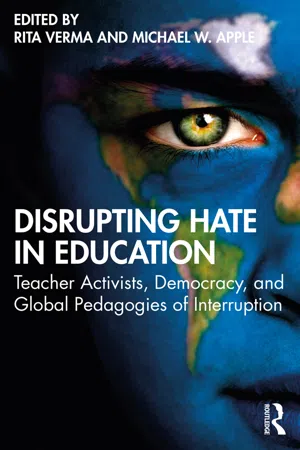
Disrupting Hate in Education aims to identify and respond to the ideological forms of hate and fear that are present in schools, which echo larger nativist and populist agendas. Contributions to this volume are international in scope, providing powerful examples from US schools and communities, examining anti-extremism work in the UK, the "saffronization" of schools in India, struggles to re-orient the villainization of teachers in Brazil, and more. Written by a dynamic group of activist educators and critical researchers, chapters demonstrate how conservative mobilizations around collective identities gain momentum, and how these mobilizations can be interrupted. Out of these interruptions come new opportunities to practice a critically democratic education that hinges upon risk-taking, deep dialogue, and creating a space for common dignity.
eBook - ePub
Disrupting Hate in Education
Teacher Activists, Democracy, and Global Pedagogies of Interruption
- 236 pages
- English
- ePUB (mobile friendly)
- Available on iOS & Android
eBook - ePub
Disrupting Hate in Education
Teacher Activists, Democracy, and Global Pedagogies of Interruption
About this book
Information
Part I
Inside the United States
1
Civility and Democratic Schools Under Assault
Engaging “Teaching Tolerance.org” as Interruption, an Interview with Maureen Costello
Rita Verma
On the evening of April 20, 2020, an ominous tweet from Donald Trump exclaimed he would temporarily end all immigration to the United States. A signature cornerstone of Trump’s agenda has been to stop immigration. Laced with hate, fear and anger, with this tweet he pushed his great fantasy to possible realization – a move that would be extreme and unprecedented in American history. When fantasy collided with reality, Trump indeed took bold steps to curtail immigration that further elucidates the danger of his agenda to redefine vast contours of his imagined America. “Nationalist imaginaries” are increasingly based on anti-immigrant rhetoric, Islamophobia and homophobia and are built upon a rejection of “Otherness.” There is a clear imagined nationalist agenda that instills fear, divides communities and rewrites the parameters of belonging. According to Seyla Benhabib (2004), tensions with “Otherness” are a barrier to nation-states in their abilities to establish codes of belonging, to negotiate secure boundaries and borders, and to establish who belongs. With the charting of as-of-yet emerging political forms of globalization with old maps, “we are like travelers navigating on unknown terrain” (2004, p. 6). The new landscape represents a tension of human rights versus territorial sovereignty. Nationalism is constituted through a series of imaginary as well as very real demarcations between “us and them,” “we and the other” (2004, p. 18).
Research has understood “hate” to be anchored in the psychological roots of fear and aggression. A fear of the “Other” as a threat to what we consider normal or acceptable provokes “hate.” A survival mechanism of turning instinctively to our in-group with whom we identify occurs when we feel threatened by outsiders that are perceived as threatening who form the out-group Abrams (2017) further explains that
Hatred is driven by two key emotions of love and aggression: One love for the in-group—the group that is favored; and two, aggression for the out-group—the group that has been deemed as being different, dangerous, and a threat to the in-group.
When the data indicates that children as young as kindergarten are able to vocalize fear or participate in hate and answer the call to “reject” the perceived “Other,” it further demands that we interrupt and forge a counter-narrative and counterhegemonic dialogue. “Trumpism” represents an ideology of hate and demagoguery that rears its ugly head in various moments during the school day across America. The response to it by school officials however leaves much to be desired. Most often, paralysis and pause characterize that moment when teachers are faced with these incidents. The call to action is replaced by inaction as teachers often state that they are ill equipped in how to handle themselves and students with regard to such issues. They blame a lack of protocol and blurred lines in relation to what is defined as overt racist nativism and a student’s desire to support Trump. Such inaction fails to interrupt racist nativist forms and allows hate to become normalized.
Since 1971, the Southern Poverty Law Center (SPLC) and Teaching Tolerance (TT) have been critical players in the interruption of hate through their legal and pedagogical work. SPLC was founded to ensure the promises of the civil rights movement, and their Intelligence Project tracks and exposes the activities of hate groups and domestic extremists. Teaching Tolerance, founded in 1991, distributes and produces free curriculum and materials that emphasize anti-bias and social justice and prevent the growth of hate. In the following chapter, former organization Director, Maureen Costello, will share stories, challenges and the vision going forward for Teaching Tolerance during times when interruptions are more critical than ever.
Teaching Tolerance at the Southern Poverty Law Center published a report entitled The Trump Effect: The Impact of the Presidential Campaign on Our Nation’s Schools in April 2016. In 2018, they issued another report entitled, Hate at School. The reports provide rich data that reinforces the challenges and pressures of “common sense” that is increasingly divisive, stems from racist nativism and clearly contributes to nationalist imaginaries that exclude a large segment of the American populace. The findings of the Trump Effect paint a grim picture of the growing “normalization” around the politics of hate and xenophobia that has become the platform from which Trump has chosen to mobilize his campaign. Schools as sites of social and cultural reproduction begin to feel the immediate negative impact of such rhetoric, especially when there is little effort to interrupt racist forms. The report notes an increase in anxiety and fear amongst students of color while simultaneously noting students who are becoming emboldened and divisive. Some highlighted findings of the Trump Effect report are as follows:
More than two-thirds of the teachers reported that students—mainly immigrants, children of immigrants and Muslims—have expressed concerns or fears about what might happen to them or their families after the election. More than half have seen an increase in uncivil political discourse. More than one-third have observed an increase in anti-Muslim or anti-immigrant sentiment. More than 40 percent are hesitant to teach about the election.
According to teacher and student commentaries, the report stated the following:
“Students are hearing more hate language than I have ever heard at our school before,” says a high school teacher in Helena, Montana. Another teacher reports that a fifth-grader told a Muslim student “that he was supporting Donald Trump because he was going to kill all of the Muslims if he became president!”
Hate at School identified 821 school-based incidents that were reported in the media. Teaching Tolerance revealed that this number was just the tip of the iceberg. This number falls embarrassingly short of the 3,265 incidents documented by SPLC and Teaching Tolerance in their supplemental survey Hate at School. Executive findings were as follows:
•More than two-thirds of the 2,776 educators who responded to the questionnaire witnessed a hate or bias incident in their school during the fall of 2018.
•Fewer than 5 percent of the incidents witnessed by educators were reported in the news media.
•Racism appears to be the motivation behind most hate and bias incidents in school, accounting for 63 percent of incidents reported in the news and 33 percent of incidents reported by teachers.
•Of the incidents reported by educators, those involving racism and antisemitism were the most likely to be reported in the news media; anti-Latinx and anti-LGBTQ incidents were the least likely.
•Most of the hate and bias incidents witnessed by educators were not addressed by school leaders. No one was disciplined in 57 percent of them. Nine times out of 10, administrators failed to denounce the bias or reaffirm school values.
In relation to civics instruction in schools, Teaching Tolerance describes a chilling impact in schools. For example, some teacher responses illustrate the impact of the political landscape in their classroom walls.
•“In class discussions, students take sides very quickly and refuse to listen to people’s views; they are more likely to shout down or openly diss an opinion they don’t agree with. They are more likely to say negative things about the person rather than argue about the ideas.” (K–12 school, North Dakota)
•“Any time ‘president’ or ‘Trump’ or any past president is mentioned, an argument between students is inevitable. Living in Texas, we have several students that are immigrants, and some have parents stuck on the other side of the border. For them, decisions made are very personal… Arguments are so heated, I’ve had to immediately stop any conversation about politics in my science classroom for fear of fights.” (High school, Texas)
Additionally, in 2017 UCLA’s Institute for Democracy, Education and Access similarly reported increasing stress and hostility in schools attributed to the negative tone of political discourse. A pool of 1,535 teachers were surveyed to analyze the impact of the Trump administration on teaching and learning. The study confirmed greater antagonism, polarization, hostility and incivility due to the contentious political rhetoric of Trump. In the study, teachers reported the manner in which dynamics in the broader political environment unleashed racist, prejudicial and xenophobic sensibilities – an emboldening to harbor racism and bigotry. Increased levels of stress for teachers and students were also documented due to changes in the national political environment. Civility was noted to be undercut by students using unsubstantiated sources and teachers responded by avoiding uncomfortable topics or downplaying social and political issues where student silencing and “avoiding conflict” in pedagogy took place. The key finding in the study that there was little or no response from school leadership is unsettling – however, an increased level of political engagement, supporting civic engagement and student agency was also documented by concerned educators. These concerned or “activist” teachers represent key moments of resistance and interruption that are vital to maintaining democracy. Now moving on to the heart of this chapter, Maureen Costello, Director of Teaching Tolerance will provide us with genuine and nuanced dialogue about her journey as a teacher activist and national community leader.
An Interview with Maureen Costello: Teaching Tolerance Former Director (2010–2020)
RV: Can You Please Briefly Tell Us About Teaching Tolerance. How Did It Get Started?
Maureen Costello: Teaching Tolerance is a project of the Southern Poverty Law Center and grew out of the Center’s work. The Center, based in Montgomery, Alabama, where Martin Luther King Jr. led the Montgomery Bus Boycott, was founded in 1971 to bring cases under the various Civil Rights Acts that were the major legacy of the modern civil rights movement. Early cases involved lawsuits to desegregate the Alabama State Troopers and integrate the Montgomery YMCA, which had colluded with city government to maintain racially segregated swimming pools.
In the 1980s, the Center looked for ways to bring justice to families of hate crime victims by bringing civil lawsuits against the Ku Klux Klan. Victories in these lawsuits destroyed the Klan as an organization and brought some measure of justice to families, but did little to address the intolerance and hatred that spawned violence.
The lawyers in the Center recognized that legal remedies came after wrongs had occurred and that prevention required education. In 1991, they launched the Teaching Tolerance project to make anti-bias resources available to teachers. The timing was important: TT was created when school integration was still going forward. Previously, all-White schools were being integrated and those schools presented an opportunity to help young people learn to bridge differences.
The founders of the project banked on contact theory to carry out the mission, which was to give teachers tools to reduce prejudice and increase intergroup relations. They looked for curriculum, projects and resources that provided examples of successful intergroup contact in action and wrote about them in Teaching Tolerance magazine. They also created resources to address prejudice and reduce stereotyping. And they produced films, like Shadow of Hate, A Time for Justice, and a Place at the Table, to show both the damage wrought by intolerance and the power of people to seek justice.
But Is Tolerance and Prejudice Reduction Enough?
In a word: no. It turns out that contact theory has its limits, particularly given the changes we’ve seen in schools since 1991. For one thing, we didn’t know at the time that school integration had peaked in 1989, and that 30 years later, in 2019, schools would be as segregated as they were in the 1970s. And contact theory, it turns out, works best for members of in-groups where the aim is to make social identity and membership less salient. Today, most students in U.S. public schools are children of color, often in out-groups. They need solidarity and action. Prejudice reduction isn’t going to give them access to equitable learning opportunities.
At the beginning, TT depended on the much-beloved idea that a single, individual teacher could make all the difference. While there’s a kernel of truth in that for individual students, it’s not a great prescription for a large-scale effect. We know that children learn what adults will model, and that means the entire school has to be on the same page. And, after 20-plus years of standards and school reform, few teachers have the autonomy and room for innovation that the program originally envisioned. But even when we talked about reducing prejudice and other forms of anti-bias, we also understood that we had to find ways to promote equity. That’s a journey that all educators are on today.
What Is Your Vision of Anti-bias Education? And What Exactly Is Anti-bias Education?
Great question! At first, we went by the “we know it when we see it” rule. About eight years ago, though, as we were thinking about developing a more comprehensive curriculum for K-12, we realized we needed a more defined set of outcomes. Drawing upon the work of Louise Derman-Sparks and Julie Olsen Edwards (Derman-Sparks & Edwards, 2009), we developed the Teaching Tolerance Social Justice Standards: An Anti-Bias Framework (SPLC, 2016a). These really focused us on four key domains – identity, diversity, justice and action – that combine prejudice reduction and collective action. Each domain breaks down into five anchor standards, and each of those has learning outcomes organized by grade bands. So we’ve developed a pretty clear picture of what anti-bias looks...
Table of contents
- Cover
- Half Title
- Title Page
- Copyright Page
- Contents
- Introduction: Understanding and Interrupting Hate
- Part I: Inside the United States
- Part II: Global Viewpoints
- Contributors
- Index
Trusted by 375,005 students
Access to over 1.5 million titles for a fair monthly price.
Study more efficiently using our study tools.
Frequently asked questions
Yes, you can cancel anytime from the Subscription tab in your account settings on the Perlego website. Your subscription will stay active until the end of your current billing period. Learn how to cancel your subscription
No, books cannot be downloaded as external files, such as PDFs, for use outside of Perlego. However, you can download books within the Perlego app for offline reading on mobile or tablet. Learn how to download books offline
Perlego offers two plans: Essential and Complete
- Essential is ideal for learners and professionals who enjoy exploring a wide range of subjects. Access the Essential Library with 800,000+ trusted titles and best-sellers across business, personal growth, and the humanities. Includes unlimited reading time and Standard Read Aloud voice.
- Complete: Perfect for advanced learners and researchers needing full, unrestricted access. Unlock 1.5M+ books across hundreds of subjects, including academic and specialized titles. The Complete Plan also includes advanced features like Premium Read Aloud and Research Assistant.
We are an online textbook subscription service, where you can get access to an entire online library for less than the price of a single book per month. With over 1.5 million books across 990+ topics, we’ve got you covered! Learn about our mission
Look out for the read-aloud symbol on your next book to see if you can listen to it. The read-aloud tool reads text aloud for you, highlighting the text as it is being read. You can pause it, speed it up and slow it down. Learn more about Read Aloud
Yes! You can use the Perlego app on both iOS and Android devices to read anytime, anywhere — even offline. Perfect for commutes or when you’re on the go.
Please note we cannot support devices running on iOS 13 and Android 7 or earlier. Learn more about using the app
Please note we cannot support devices running on iOS 13 and Android 7 or earlier. Learn more about using the app
Yes, you can access Disrupting Hate in Education by Rita Verma, Michael W. Apple, Rita Verma,Michael W. Apple in PDF and/or ePUB format, as well as other popular books in Education & Education General. We have over 1.5 million books available in our catalogue for you to explore.