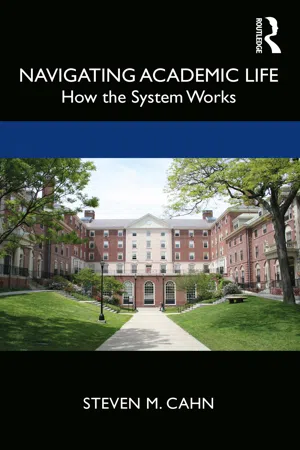
This engaging collection of recent essays reveals how a professorial career involves not only pursuit of a scholarly discipline but also such unwelcome features as the tribulations of graduate school, the trials of teaching, and the tensions that develop from membership in a department. The author, who enjoyed a distinguished career as a professor of philosophy and senior university administrator, draws on his extensive experience to offer candid advice about handling the frustrations of academic life. Combining philosophical principles, practical concerns, and personal observations, this book serves as a reliable guide for both new and veteran academics as well as for anyone seeking to understand the inner workings of colleges and universities.
- 134 pages
- English
- ePUB (mobile friendly)
- Available on iOS & Android
eBook - ePub
About this book
Information
Part I
Graduate School
Chapter 1
Orientation
Most graduate departments offer entering students an orientation session, but if my former department’s approach is typical, the meeting is too often a lost opportunity.
Here is the scene I witnessed every September for many years. Most newcomers arrived unsure or even apprehensive, but all were eager to understand more fully the situation they faced. Few faculty participated in the session, however, and those who did treated the occasion lightly, engaging in banter with one another and evincing little concern for the anxieties of the beginners.
The chair started by inviting the newcomers to introduce themselves and indicate their specialty. Those who replied with uncertainty received patronizing smiles, while the response that invariably caused derisive laughter was, “I plan to teach”.
Subsequently the faculty were asked to describe their current scholarly work. The audience listened attentively, nodding as if comprehending every word while struggling to understand any of what was said.
Next, the students were invited to ask about the program but, being unfamiliar with it, did not have much to contribute. The message they received, though, was clear and emphatic: Find an area of research and publish as much as possible. Although nearly all the doctoral students were eventually expected to teach undergraduates, not a word was said about this responsibility. Nor was any advice given about how best to survive the hoops and hurdles of doctoral study. Instead, the session concluded early, when the chair announced that the essentials had been covered and the time had come for wine and cheese.
Perhaps this approach to orientation is unique to my program, but I presume other departments engage in similar practices. I would suggest, however, that we can do better. Here is advice that should prove useful to those heading into academia:
- Read widely. As a college student you were responsible only for works the instructor assigned, but as a scholar you create your own reading lists. The more literature you master, the less reliant you are on faculty.
- Write frequently. Putting one’s ideas into written form aids precise thinking. If you doubt the effectiveness of your style, consult an appropriate handbook.1
- Don’t delay. Do not allow lack of confidence to lead you to put off fulfilling requirements, taking examinations, or submitting papers. The longer you wait, the more the pressure mounts. Postponement is not progress.
- Meet the professors. Eventually you will need to choose an advisor to guide your dissertation. Whether by attending a lecture, conversing at a departmental function, or visiting during office hours, seek a professor whose interests and personality are in sync with your own.
- Meet other students. They can offer helpful advice about professors and strategies. Furthermore, discussion with colleagues is one of the pleasures of the profession. Granted, solitude may stimulate creativity, but scholars do not flourish in isolation. Rather, they rely on publishers, librarians, and one another.
- Meet professional colleagues. Those at other institutions who share your interests can offer valuable contacts. You can encounter such individuals at scholarly conferences, whether you merely attend or, better yet, serve as a speaker, commentator, or session chair. By the way, volunteers are often sought for these positions. Furthermore, because almost all the attendees will be active scholars in your field, they will be as eager to meet you as you are to meet them.
- Seek a dissertation topic. As you proceed, be alert for a potential project that engages your interest, is of appropriate scope, and is original without being eccentric. Choosing your subject wisely is a crucial step toward finishing your work in a reasonable time and maximizing your chances for a desirable academic position. Publishing along the way is a plus, but finding a winning dissertation topic is invaluable.
- Diversify your interests. Don’t be a one-trick pony, a scholar with only one area of expertise who offers endless variations on the same theme. At an interview, you may well be asked about your interests apart from your dissertation. You should have a couple you can discuss.
- Plan to teach. Before long you will be expected to assume the obligations and challenges of teaching undergraduates. Not all your students will have an immediate attraction to your subject. Thus as you proceed, consider how you might motivate students to explore central issues in your discipline.
- Maintain your dignity. Unfortunately, graduate professors occasionally take advantage of students in various ways, including destructive criticism, inordinate delays in returning work, inaccessibility, or failure to separate professional and personal concerns. Even worse, professors have been involved in countless scandals involving sexual harassment or abuse. In all these instances, students should not abide mistreatment but should immediately report any incidents to the appropriate administrator, whether the department chair or a dean. Thereafter inaction from the authorities should be met with forceful protest.
An orientation meeting that explained these points might take a couple of hours but would be worth attending, even in the absence of refreshments. Furthermore, the session would emphasize to all that the primary aim of doctoral education is not to enhance faculty interests or prerogatives but to support students in their efforts to succeed as scholars and teachers.
Note
1 See, for example, Steven M. Cahn and Victor L. Cahn, Polishing Your Prose: How to Turn First Drafts into Finished Work (New York: Columbia University Press, 2013).
Chapter 2
Choosing a Dissertation Topic
Much has been written about the challenges of completing a dissertation and avoiding the status of an “ABD”, that ironic acronym that refers to someone who has finished All the requirements for a doctoral degree But the Dissertation.1 My concern here, however, is with an often overlooked aspect of choosing a dissertation subject: In the search for an initial faculty position, the thesis will be regarded as the essence of an individual’s academic identity. Thus the topic needs to suit both earning a diploma and finding a position. Yet ironically, a topic that helps to reach the first objective may in fact hinder success in achieving the second. (The following examples come from my own discipline of philosophy, but the concerns presented apply to all other fields in the humanities and social sciences and perhaps to other areas as well.)
Consider a hypothetical student, Pat, who seeks a position in political philosophy but, having become interested in John Dewey’s aesthetics, decides to write a dissertation on that subject. The faculty in Pat’s department approves the thesis with enthusiasm, yet when Pat is considered for a post in political philosophy, the appointing department not surprisingly prefers a candidate whose dissertation is in political theory, not the theory of art.
Next, consider a student, Chris, who specializes in ethics and decides to write on the moral theory of the nowadays relatively neglected metaphysician Nicolai Hartmann (1882–1950), who viewed values as unchanging ideal entities. This subject may work as a dissertation because few faculty members are likely to be familiar with the details of Hartmann’s position and may see the area as worth exploring. But when Chris seeks positions in ethics, most other applicants will have written dissertations devoted to subjects far more likely to be seen as useful in teaching standard undergraduate ethics courses.
A third student, Sandy, wishes to be distinctive by choosing a topic that is outré, such as supporting the morality of severe corporal punishment in order to reduce crime. Perhaps a couple of faculty members in Sandy’s department judge the topic as bold, though odd, and pass the thesis. At interviews, however, when asked to explain the work, Sandy faces a skeptical audience, uncomfortable appointing a faculty member who holds such a strange view. In short, most interviewers seek candidates with topics that are innovative, not idiosyncratic.
A fourth student, Leslie, has two major research interests: the history of modern philosophy from Descartes to Kant and the history of Russian philosophy. The former subject is taught in virtually every department, whereas the latter is offered in hardly any; hence many positions call for a specialization in modern philosophy, while virtually none seeks expertise in Russian philosophy. Thus even if Leslie’s doctoral faculty includes a specialist in Russian philosophy who encourages students to make that area the focus of their dissertations, Leslie would be well advised to resist such urgings and choose a topic in the history of modern philosophy.
N...
Table of contents
- Cover
- Half Title
- Title Page
- Copyright Page
- Dedication
- Table of Contents
- Acknowledgments
- Preface
- Part I Graduate School
- Part II Teaching
- Part III Departments
- Part IV Finale
- Sources
- Works by Steven M. Cahn
- About the Author
- Index
Trusted by 375,005 students
Access to over 1.5 million titles for a fair monthly price.
Study more efficiently using our study tools.
Frequently asked questions
Yes, you can cancel anytime from the Subscription tab in your account settings on the Perlego website. Your subscription will stay active until the end of your current billing period. Learn how to cancel your subscription
No, books cannot be downloaded as external files, such as PDFs, for use outside of Perlego. However, you can download books within the Perlego app for offline reading on mobile or tablet. Learn how to download books offline
Perlego offers two plans: Essential and Complete
- Essential is ideal for learners and professionals who enjoy exploring a wide range of subjects. Access the Essential Library with 800,000+ trusted titles and best-sellers across business, personal growth, and the humanities. Includes unlimited reading time and Standard Read Aloud voice.
- Complete: Perfect for advanced learners and researchers needing full, unrestricted access. Unlock 1.5M+ books across hundreds of subjects, including academic and specialized titles. The Complete Plan also includes advanced features like Premium Read Aloud and Research Assistant.
We are an online textbook subscription service, where you can get access to an entire online library for less than the price of a single book per month. With over 1.5 million books across 990+ topics, we’ve got you covered! Learn about our mission
Look out for the read-aloud symbol on your next book to see if you can listen to it. The read-aloud tool reads text aloud for you, highlighting the text as it is being read. You can pause it, speed it up and slow it down. Learn more about Read Aloud
Yes! You can use the Perlego app on both iOS and Android devices to read anytime, anywhere — even offline. Perfect for commutes or when you’re on the go.
Please note we cannot support devices running on iOS 13 and Android 7 or earlier. Learn more about using the app
Please note we cannot support devices running on iOS 13 and Android 7 or earlier. Learn more about using the app
Yes, you can access Navigating Academic Life by Steven M. Cahn in PDF and/or ePUB format, as well as other popular books in Education & Education General. We have over 1.5 million books available in our catalogue for you to explore.