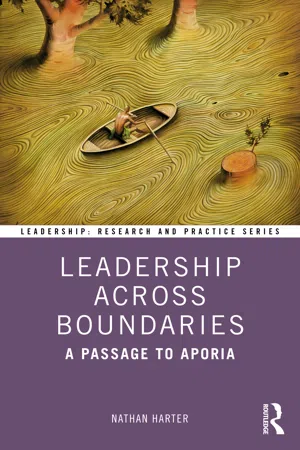
Leadership Across Boundaries
eBook - ePub

Leadership Across Boundaries

A Passage to Aporia

  1. 302 pages
  2. English
  3. ePUB (mobile friendly)
  4. Available on iOS & Android
eBook - ePub

Leadership Across Boundaries

A Passage to Aporia

About this book

Leadership Across Boundaries: A Passage to Aporia theorizes on leadership in an unprecedented manner by stepping outside of conventional leadership theory and importing into leadership studies the implications of certain innovations in the social sciences, such as pluralism, complexity theory, and the dialogical turn, to change the way scholars discuss and study leadership.

Leadership Across Boundaries anchors theoretical passages that generate a new way of imagining what it means to lead and follow with concrete examples about Martin Luther, the Common Law, dialogue as a practice, a painting by Diego Velázquez, synchronized fireflies, and the strange career of Francis of Assisi. This book acknowledges the limitations of existing leadership research as being too leader-centric, simplistic, static, and in many cases oblivious to the power of images to shape our understanding. To rectify these limitations, Leadership Across Boundaries examines alternative images of leadership grounded in concrete examples that present leadership in an unprecedented light. The book includes a discussion of invigorating ideas of homeward leadership (looking backward), extra-ordinary leadership (going forward), and what will be defined as the perennial need for aikido politics.

An interdisciplinary text, Leadership Across Boundaries: A Passage to Aporia will appeal not only to scholars, instructors, and students of leadership, but also to those in the many fields in which leadership theory applies, such as history, economics, sociology, archetypal psychology, the law, political philosophy, applied mathematics, and the martial arts.

Frequently asked questions

Yes, you can cancel anytime from the Subscription tab in your account settings on the Perlego website. Your subscription will stay active until the end of your current billing period. Learn how to cancel your subscription.
No, books cannot be downloaded as external files, such as PDFs, for use outside of Perlego. However, you can download books within the Perlego app for offline reading on mobile or tablet. Learn more here.
Perlego offers two plans: Essential and Complete
  • Essential is ideal for learners and professionals who enjoy exploring a wide range of subjects. Access the Essential Library with 800,000+ trusted titles and best-sellers across business, personal growth, and the humanities. Includes unlimited reading time and Standard Read Aloud voice.
  • Complete: Perfect for advanced learners and researchers needing full, unrestricted access. Unlock 1.4M+ books across hundreds of subjects, including academic and specialized titles. The Complete Plan also includes advanced features like Premium Read Aloud and Research Assistant.
Both plans are available with monthly, semester, or annual billing cycles.
We are an online textbook subscription service, where you can get access to an entire online library for less than the price of a single book per month. With over 1 million books across 1000+ topics, we’ve got you covered! Learn more here.
Look out for the read-aloud symbol on your next book to see if you can listen to it. The read-aloud tool reads text aloud for you, highlighting the text as it is being read. You can pause it, speed it up and slow it down. Learn more here.
Yes! You can use the Perlego app on both iOS or Android devices to read anytime, anywhere — even offline. Perfect for commutes or when you’re on the go.
Please note we cannot support devices running on iOS 13 and Android 7 or earlier. Learn more about using the app.
Yes, you can access Leadership Across Boundaries by Nathan Harter in PDF and/or ePUB format, as well as other popular books in Business & Leadership. We have over one million books available in our catalogue for you to explore.

Information

Publisher
Routledge
Year
2020
Print ISBN
9780367863265
eBook ISBN
9781000260472
Subtopic
Leadership

1
SURROUNDED BY ICONS

Seeing Through Images

Introduction to the Chapter

Nobody understands leadership completely. Nobody ever will. I begin with a premise that nobody can understand any phenomenon completely. Whatever we study is in principle inexhaustible (Patočka, 1998, p. 92; see Simon, 2000; Simon, 1982).
This chapter explains the importance of being mindful of the images one uses when studying any complex phenomenon, but especially when studying leadership. Joanne Ciulla recently insisted that leadership is a creation of the imagination (2019, p. 118). Images are literally intermediate; they convey meaning. (But beware: they can also mislead.) For simplicity, the chapter begins with the image of splitting that which is compact into two, by an act of differentiating. Accordingly, it explains what I mean by dichotomies as products of the process of differentiation that students undergo in order to select what it is that they intend to study. That is, one needs to have some idea about that which is X and that which is Y. Frankly, my book (like most of leadership studies) is full of dichotomies.1 Dichotomies help to orient us in an inchoate world, like separating the map into north and south and east and west. Having said that, one will have to guard against becoming trapped in dichotomies, as victims of either/or thinking.2 Dichotomies are useful, but they are not the reality itself.
1. The term “dichotomies” at this point includes distinctions, polarities, dualities, antinomies, tensions, and the like. More precision will be supplied as it is needed.
2. Either/or thinking is also known as disjunctive thinking.
One of the simplest dichotomies familiar to students of leadership is the leader as protagonist, the one person (figure) who made a difference in the world (ground), i.e. who changed things for the better. This image, by which we single out the leader as the focus of our attention, belongs to the troubadour tradition of leadership, where leaders are celebrated in story and song (Hogan & Kaiser, 2005).3 Mats Alvesson calls this the Hollywoodization of leadership (2019, p. 29f). In casual conversation, we say that Abraham Lincoln freed the slaves and Rosa Parks launched the bus boycott, Columbus discovered the new world and Julius Caesar subdued Gaul. (He even said so himself.) Those heroic accounts can be useful images. They are often entertaining and instructive. They are also simplistic. They certainly will not suffice for the study of leadership. Such imagery might suffice for what Howard Gardner (1995) called the five-year-old mind; yet expertise requires that we see past this limited image (pp. 24–30). Alvesson issues equivalent warnings against idealization and idolization (2019, p. 34). The next chapter, which is about one of the most consequential characters in European history—namely the Protestant reformer Martin Luther of Saxon Germany—attempts to do just that. One should want to get past the crude models of social action that unduly valorize a lone champion. As experts, though, we have to acknowledge that leadership studies as a field of academic interest originated with this image of the Great Man and has not completely outgrown it (Harter & Heuvel, 2018).
3. Don’t get me wrong: studies of prominent leaders will continue to be legitimate contributions to the field of study (see e.g. Rustow, 1970).
Once one differentiates into X and Y, of course, you have to investigate the relationship between X and Y. What are they to each other? Are they polar opposites? Are they locked in rivalry or in symbiosis? Beware the possibility of a false dilemma! Often, good thinking proceeds from an apparent duality (X and Y) to a point transcending them both (Z). If we succeed, though, one moves along from (a) a compact reality to (b) differentiation and then to some kind of (c) integration. In this way, one passes through either/or thinking toward both/and thinking (see e.g. Cabrera & Cabrera, 2015, ch. 7). In the history of leadership studies, accordingly, we took up considerations of the leader in relationship with the follower and in relationship with the organization and in relationship with the culture and so on. As William James put it, “The full truth about anything involves more than that thing. In the end nothing less than the whole of everything can be the truth of anything at all” (1909/1996, p. 90). We in leadership studies have properly tried to grow beyond what is known as a leader-centric approach to show how it all fits together.
This chapter considers the extent to which images disclose something about the reality we wish to understand. Images also shape how we construct that reality, so it pays to become mindful of the images by which we operate in leadership studies. One of the most basic images is dividing or splitting something into two (or more) parts, then figuring out how those parts might be related. To what extent, however, do such images limit our understanding?

Images as Intermediate Symbols

Signs are small measurable things, but interpretations are illimitable….
George Eliot, Middlemarch (1871–1872)
Kenneth E. Boulding wrote The Image: Knowledge in Life and Society in 1956. There, he made the case for a new integrative study of what he called eiconics, which is the character and life of images. He illustrated its utility for such fields as organizational studies, biology, anthropology, sociology, economics, politics, history, and culture—tying it together in the last chapter with a review of its philosophical implications. Throughout, he found opportunities to mention mythology and religion, as well.4 He treated images almost in the same fashion as subsequent attempts to characterize genes (Dawkins, 1976/2006) and memes (Distin, 2005). In one sense, I hope to contribute to Boulding’s project.
4. See generally Eliade (1991). Ironically, Boulding did not emphasize the value of his new idea to psychology, although he later complained when psychology had not paid due attention to his work (1989, p. 378).
Forty years after The Image, Gareth Morgan was to write Images of Organization (2nd edition, 1997/2006). There, Morgan wrote about organizations as machines, organisms, brains, cultures, political systems, psychic prisons, domination, and flux—in the process making each metaphor at least plausible. What you and I conceive as a single, unitary entity (the organization) can be viewed profitably in any one of several guises. So much of what one thinks about it depends on the imagery you choose.5 In a similar vein, George Lakoff and Mark Johnson came out with Metaphors We Live By (1980). Then, in 2011, Mats Alvesson and André Spicer decided to edit a volume of Metaphors We Lead By, in which leadership itself is viewed by means of multiple, alternative images, such as saint, gardener, buddy, commander, cyborg, and bully.
5. Impairing the capacity to do this would be an uncritical commitment to literalism. For a sustained critique of literalism, see e.g. Hillman (1975).
The following work also relies on a series of images. These images are meant to capture or represent something about reality. They are not representations of reality as one sees it with your eyes, like a portrait intended to look like the Duchess of Alba; instead, they are conceptual in nature and might not look at all like the reality one sees. As Boulding explained, you are not meant to focus on the image itself (idol), except as it conveys meaning of some sort (icon).6 There is something behind the image, something far more elaborate and surprising than you could ever hope to include in any single image. Nevertheless, some meaning can be said to pass through the image. The classic organizational chart, for example, is supposed to convey the order and flow of authority. To be clear, such a chart is only one way to depict this. There can be others.7
6. Religion gave us the distinction between the icon, which is transparent to a deeper reality, and the idol, which is opaque (see Spoelstra, 2018, p. 95). Klenke (2008) credits Pandofsky (1970) with formalizing iconography as a method in the social sciences, in which the researcher asks (a) what is seen (focal awareness), (b) what it symbolizes, and (c) what that all says to the observer (p. 272f). Semiologist Ferdinand de Saussure (1959) would concur that the image (or signifier) is associated in the mind with a concept (or signified). Each “recalls” the other. However, he denied that the sign comprised of signifier and signified has any necessary association with the real world. Instead, he argued, these associations are completely a matter of convention, as part of a comprehending language system (see generally, pp. 65–70).
7. The image is only an image and not the reality itself. The map is not the territory. A failure to make this distinction leads to the Fallacy of Misplaced Concreteness (see Harter, 2007a, crediting Alfred Lord North Whitehead).
The image is like an impression one has of the surface of reality. The Spaniard José Ortega y Gasset, in his first book Meditations on Quixote (1914/1961), wrote about the dichotomy between surface and depth, which is what we are talking about. He wrote that “depth is fatally condemned to become a surface if it wants to be visible” (p. 59). Yet it cannot exhibit or display itself entirely. We all know this. Which is why in every encounter, we sense something that is not apparent, he wrote, something fugitive. “Everything has within it an indication of its possible plenitude” (1914/1961, p. 32). Later, he wrote, “Impressions form a superficial tapestry from which ideal paths seem to lead us toward a deeper reality” (1914/1961, p. 74). Part of the problem is that the same thing can present itself in different ways (1914/1961, p. 63), so that it will appear in one form to person A and in another form to person B. Or in different forms to the same person who looks again. This is largely why interpretation is necessary. Accordingly, critics interpret works of art, jurists interpret passages in a constitution, and lovers interpret furtive glances. With our conceptual powers, we penetrate past “the barbarous, brutal, mute, meaningless reality of things” (1914/1961, p. 145). An image is what one gets with your focal awareness using SFI. Whatever your flashlight reveals, it belongs to a reality that you cannot presently see (i.e. the subsidiary knowledge). Surface and depth is a basic dichotomy.
Sometimes, of course, one gets things wrong as to what an image means, or you go too far, seeing things that are not even there.8 Sometimes, what you discover hidden in the dark heart of reality will retaliate, like a boar in the underbrush. But, no matter how far you take your interpretations, you never exhaust reality.
8. By adulthood, we engage in perpetual hermeneutics, reading into things, seeing shapes in the clouds and constellations in the stars. Critics of revelation often complain about this tendency to take phenomena for which there is a natural explanation and insist that God meant something by it (see Guthrie, 1993). The phenomenon of finding meaning where there is none is known as pareidolia (see Liu, Li, Feng, Tian, & Feng, 2014)—a term that actually has the word “idol” as its root. Leonardo da Vinci famously recommended to painters that they gaze upon stains, because shortly their minds will “see” any number of interesting images (Zwijnenberg, 1999, p. 60). Our minds are meaning-making machines, even when—to be honest—there is no meaning.
In light of these thoughts, we might depict leadership as an invitation, with (a) the leader serving as the surface and (b) some shared adventure as the depth. The leader presents himself or herself to prospective followers in such a way as to intimate, if not explicitly regale them about what awaits them beyond (Ortega, 1914/1961, ch. 17). If the leader is successful, together, they set themselves upon the living flux.
Sadly, as Ortega admitted, we all tend to resist the call to adventure, for we become too familiar with our habitation. We know the circle that bounds our daily activity. We lack genuine curiosity. We come to accept the world as we experience it. Subsidiary knowledge will suffice. Mostly, looking inward we penetrate our selves only so far, accepting what we see in the mirror (1914/1961, p. 157). We do not believe in ourselves, that we were ever made for anything more. Yet Ortega also wrote that in our depth, in the plenitude of each person’s being, we bear what he called “the rudiments of the hero” (1914/1961, p. 156). In my opinion, the leader is the one who summons that potential from out of the depths of followers, literally evoking it, so that it might break through the encrustations of habit, appetite, convention, and sloth. And then, calling to the archetype in each of us, the leader says, “Let us away.”
Archetypal psychologists will contend that certain images are already freighted with meanings—meanings of which one may not be aware, even as you use them (see generally Sells, 2000; Peterson, 1999; contra de Saussure, 1959, pp. 65–70). Our brains are so organized that these archetypes say something about the enduring structures of human experience. For instance, pools of water suggest the unconscious; mountaintops and the sky, heaven. It does not seem to matter when or where you live. Claude Lévi-Strauss (1963) marveled at “the astounding similarity between myths collected in widely different regions… [H]ow are we going to explain the fact that myths throughout the world are so similar?” (p. 208; see Vico, 1744/2001, pp. 41, 80). He took it as his mission “to derive constants which are found at various times and in various places from an empirical richness and diversity that will always transcend our efforts at observation and description” (1963, p. 82f). Mythology, madness, dreams, and the arts traffic in these archetypes. Interestingly, systems thinking also finds them significant in conveying the reality we encounter (e.g. Kim, 1993).9 Once again, these images or icons are like transfer functions, where meaning is converted into understanding. A well-chosen image can be said to “transport” a thought or idea into one’s mental enclosures; images are literally inter-mediate, the in-between. One must “unpack” them. This is what Poincaré was calling for...

Table of contents

  1. Cover
  2. Half Title
  3. Series Page
  4. Title Page
  5. Copyright Page
  6. Dedication Page
  7. Brief Contents
  8. Contents
  9. Series Foreword
  10. Acknowledgments
  11. A Preface in Four Parts
  12. Introduction
  13. 1 Surrounded by Icons: Seeing Through Images
  14. 2 Leader in Context: Martin Luther Translating the Bible Into German
  15. 3 Studying the Whole Within Which Leadership Takes Place: Social Action and Spontaneous Order
  16. 4 The Emergent Order of the Common Law
  17. 5 Macro/Micro Perspectives: A Basic Dichotomy Holding Us Back
  18. 6 Being at the Center of Tensions: Las Meninas
  19. 7 Leadership as a Mode of Participation in History: A Peregrinal Image
  20. 8 Dialogue as a Mode of Participation
  21. 9 Oscillations, Chaos, and Sync (Oh My!)
  22. 10 Turbulence as the Shape of Things to Come
  23. 11 Making Sense in the Turbulence: Leadership Homeward
  24. 12 Making Use of the Turbulence: Extra-Ordinary Leadership
  25. 13 Embracing Aporias, Suffering, and Death: The Leadership of St. Francis
  26. 14 Arriving at Port: Mediation and Aikido Politics
  27. Appendices
  28. References
  29. Index of Names
  30. Index