Human Thinking: The Basics provides an essential introduction into how we develop thoughts, the types of reasoning we engage in, and how our thinking can be tailored by subconscious processing.
Beginning with the fundamentals, the book examines the mental processes that shape our thoughts, the trajectory of how thought evolved within the animal kingdom and the stages of development of thinking throughout childhood. Robertson insightfully explains the effectiveness of political slogans and advertisements in engaging shallow information processing and the effortful, analytical processing required in critical thinking. Delving into fascinating topics such as magical thinking in the form of religion and superstition, fake news, and motivated ignorance, the book explains the discrepancy between reality and our internal mental representations, the influence of semantics on deductive reasoning and the error-prone, yet adaptive nature of biases.
Containing student-friendly features including end of chapter summaries, demonstrative puzzles, simple figures, and further reading lists, this book will be essential reading for all students of thinking and reasoning.
It is important to realize that the world we live in is ‘out there’. Our minds are separated from it and gain knowledge about it through our senses. Shock waves propagate through the air, strike our ears, are recoded into electrical impulses, and passed on into the rest of the brain which interprets them as sounds, words, and music. Parts of the electromagnetic spectrum strike our eyes and various subsystems in the retina convert this light into electrical impulses that get passed on to various centres in the brain generating ‘vision’ which, in turn, is an interpretation of our surroundings. Other sensors in the skin and deeper in the body detect touch, cold, heat, pain, various tastes, smell, proprioception (the sense of body movement and position such as where your right leg is right now) and others – a great deal more than five. These electrical impulses in the neurons (nerve cells) of the brain and central nervous system generate our internal model of the external world – a virtual reality model. In the words of Deutsch (1997), ‘All reasoning, all thinking and all external experience are forms of virtual reality’ (p. 121). It has to be a pretty accurate and extremely useful model otherwise you would not be able to navigate through the world and we would not have survived so long as a species. That said, it can differ in some respects from person to person. Some might see a snake and feel fear and flee whereas someone else might recognize the snake as a pet. These are different interpretations of the same stimulus. Furthermore, our senses and our memories can, under certain conditions, be deceptive.
Conscious vs unconscious thinking
Human thinking manifests itself in many ways. It’s what goes on in our heads when we:
Try to solve a problem;
Daydream;
Plan what to do;
Make a decision;
Develop an opinion or belief;
React to an event or person;
Categorize something or someone;
Consider what might have been;
Learn a complex sequence of behaviours;
Perform a complex sequence of behaviours without thinking.
That last example might seem self-contradictory but it’s there as a reminder that some of our thinking is conscious and some unconscious, and that conscious thought is subject to influences that we are not always aware of. For example, repeating a sequence of actions over and over can lead to automaticity. Learning to read is effortful but once learned it becomes automatic. You can’t, for example, stop yourself from reading the first word in next sentence. Automatic behaviour, including habits, is very useful as it allows you to engage in a complex sequence of actions without the necessity of thinking about each individual action in the sequence. Thus, you can drive a car while paying attention to the news or make a cup of tea while daydreaming about that nice young man you met the other day. The knowledge gained from habitual or automated sequences of actions such as riding a bike is known as procedural knowledge (‘knowing how’ to do something). Procedural knowledge isn’t really correct or incorrect but rather it is more or less useful in attaining a goal. Knowing how to ride a bike or how to find a TV channel can be useful. Procedures also include rules for attaining a goal. For example, a procedural rule might be; ‘if the goal is to determine whether someone is female, then check to see if their hair is long’. It might be useful much of the time but that’s not guaranteed.
A second way in which our conscious thinking is influenced is through innate pressures. Some of them tend to be reflex actions: blinking when something approaches the eye, babies suckling and grasping objects, and their intuitive knowledge of physics such as the effects of gravity. Other examples of seemingly innate knowledge or automatic responses include smiling, cooperation, child rearing, and the ‘four Fs’: feeding, fighting, fleeing, and mating. Third, feelings and emotions in general can influence conscious thought including: fatigue, illness, mood, the effects of drugs, stress, fear, excitement, pain, and embarrassment. Finally, you can’t think unless you have something to think about – your thoughts have some content. We are influenced not only by the situation we find ourselves in but also by the information stored in our memories. Some of this information is general knowledge (2 × 6 = 12) or semantic knowledge and can be contrasted with episodic knowledge (I recall sitting in a restaurant in Dubrovnik at this time last year). Episodic knowledge is remembering what you had for breakfast this morning, semantic knowledge is knowing what ‘breakfast’ means. Together these two constitute what is known as declarative knowledge (‘knowing that’ something is the case). Furthermore, declarative knowledge can be either correct or incorrect. You might ‘know that’ the earth is flat, but you would be wrong.
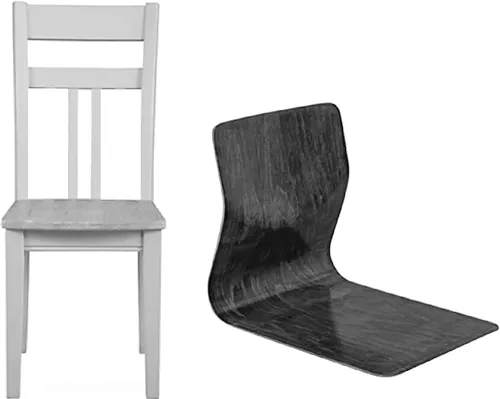
Thinking is therefore an interplay between what you perceive to be going on in your immediate environment and the knowledge you have allowing you to predict and interact with that environment. Recognizing the chair on the left in Figure 1.1 is almost immediate for people brought up in a western culture. However, unless you are familiar with Japan, it might take a little time to recognize the object on the right as a chair.
Figure 1.1 Chairs: Immediate recognition depends on the culture you are familiar with.
Thinking has its limits
Have a look at Box 1.1.
Although I asked you to add 2 + 4, you didn’t. You just said ‘6’ because it is over-learned, and the answer is pre-stored in our heads. 2 + 4 triggers the answer 6. This is an example of simple stimulus-response learning – you don’t know where the answer came from, it just appeared in your consciousness triggered by the stimulus ‘2 + 4’. You know the answer came from your memory, but you were not aware of the process by which you accessed it. ‘It is the result of thinking, not the process of thinking, that appears spontaneously in consciousness’ (Miller, 1962, p. 56).
Box 1.1 Simple problems
Here are a number of simple problems. Go through each one and try to solve them, while at the same time trying to assess where the information you are using is coming from.
Add 2 + 4
Add 28 + 43
Multiply 43 × 28
Multiply 433 × 288
When asked to add 28 and 43, you were probably aware of something going on consciously in your mind. There are various ways in which you could come to an answer but in each of them you would trigger partial answers without obvious calculation (e.g., 2 + 4 and 8 + 3), and then you would have to store those answers temporarily before combining them. You have 2 + 4 in the ‘tens column’ if you like, giving 6 tens (60) and 8 + 3 gives 11 which you then add to 60 to give 71. Here, you are using the unconsciously accessed information that popped into your head and then consciously manipulating that information. But then again, some of you might have come up with 71 without much conscious thought at all.
The third sum is likely to be more taxing and involves processing the figures and storing several temporary answers or sub-goals. For example, one sub-goal might be to find the result of 3 × 8. Another might be to decide the best way to tackle the problem in the first place. There are strategies you might choose from such as attempting long multiplication in your head while trying to keep the results of the sub-goals in mind at the same time. You might try 40 × 28 first, then 3 × 28 and add them, and so on. If it’s not the kind of activity you are used to, you may even find that your mind seems to run out of space to complete the calculation.
As for the fourth sum, if you were trying to do it in your head using the method of long multiplication you learned at school you would be struggling.
The point of that little exercise is that:
over-learned items or behaviours can come to mind automatically;
some activities require conscious manipulation of information;
we need to be able to store information temporarily;
finally, and perhaps most importantly, our thinking takes place in a kind of workspace known as working memory (WM) and WM has a limited capacity – there’s only so much information it can manipulate at any one time, so this kind of thinking is effortful and slow.
Our thinking can also be affected by failing to access the memory we are looking for even though we know we have it (the so-called tip-of-the-tongue phenomenon). Or we may access information that is not actually helpful to solve our current problem. When we are sitting an exam, we may remember that the bit of information we need is at the bottom of the left-hand page of the textbook, but we can’t remember what it actually says. We had no intention of remembering which part of the page it was on yet that’s what has stuck. Context can have a big influence on what we can recall (Godden & Baddeley, 1975).
Undirected thinking
Unlike other forms of thinking, daydreaming is not directed towards a goal (although one can daydream intentionally). We all do it. Allowing our mind to wander is easier than concentrating. While it is possible to talk aloud while solving a problem – essentially describing the current active contents of WM – you can’t do that with daydreams. You can express what you have just thought about but not what you are currently thinking as that would disrupt your daydream. When you ask someone ‘what are you thinking about?’ you are asking them to tell you about the topic they are thinking about, not usually about what goal-directed sequence of mental operations they are currently consciously aware of.
When people are given demanding tasks to do, certain areas of the brain ‘light up’, particularly in the frontal lobe. At the same time, there appears to be another network of regions in the cortex whose activity reduces when we concentrate on a task. When it is over, and there is nothing further requiring attention, this ‘default’ network comes back online, hence its name: the default mode network (DMN; Raichle & Snyder, 2007). It seems to be able to jump between one mental state to another without much effort and to link to personal episodic memories in particular, allowing us to think about the past and use it to predict the future in the form of daydreams. However, when we concentrate on something, we are using an executive control network that is not so richly connected. To get anything demanding done, the executive control network has to make an effort to submerge the default network. There are therefore these two contrasting types of thinking that appear to be mediated by different brain regions: focussed thinking directed towards a task, and undirected, the kind that takes over when we are trying to get some work done and we find ourselves staring out the window daydreaming instead.
Inattentional blindness
A different phenomenon can occur when your attention is closely directed towards some activity, such as trying to keep track of an object in a constantly changing scene. When your attention is engaged in this way, you might not notice something out of the ordinary such as a gorilla walking past beating its chest. Simons and Chabris (1999) asked people to watch a now famous video in which there were three basketball players in black T-shirts and three in white T-shirts. While watching, they were asked to count the number of times the players wearing white shirts passed a ball between them as they moved around and among the players wearing black shirts. Only about half noticed a woman wearing a gorilla suit walking on, beating her chest, and walking off again. The authors referred to this as inattentional blindness. Focussing attention can also lead to change blindness where people don’t notice that some aspect of the scene in front of them has changed or is changing right in front of them. For example, someone might watch a video of a jogger who stops and bends over to tie her shoelaces. She stands back up and continues to run and the viewer is completely unaware that she is now wearing different shorts.
Thinking as information processing – some historical background
Thinking involves the manipulation – the processing – of information. To take a very simple example, a woodlouse will walk on its 14 legs until it reaches an obstacle. Using mainly its right legs, it might then turn left and carry on until it reaches another obstacle. Because its right legs are the last ones to move when an obstacle was reached, it’s now the turn of the left legs to move to enable it to turn right. By doing this, it ends up zig-zagging in one general direction rather than, say, wandering around in a circle. The woodlouse is using a simple algorithm, a rule, that makes use of information from the environment – it can’t go any further, so it tries to turn 90 degrees. When it encounters another obstacle, it uses information from motor memory – its right legs moved last time this happened so the left legs move this time.
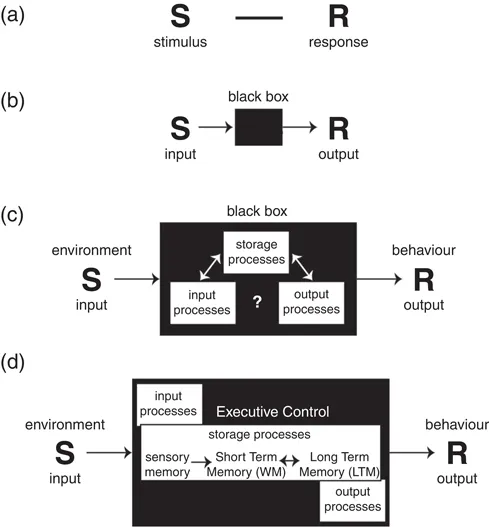
Human beings obviously have a much, much larger and vastly more complicated structure (our brain) to deal with much more complicated kinds of information processing. However, when we look at the history of the psychological study of thinking and behaviour, the first half of the 20th century was dominated by behaviourist psychology which saw no reason to study actual thinking. Behaviourists were more interested in overt behaviour under specific external circumstances. So, faced with a particular stimulus (S), an organism would produce a specific response (R) (see (a) in Figure 1.2). The likelihood of an organism producing such a response would increase over time through operant conditioning (Skinner, 1988) – principally using some sequence of rewards known as positive reinforcement. Skinner used animals such as pigeons and rats in cages where there was either a button or lever that the animal would peck or pull as it moved around the cage, and a pellet of food would appear. The animal would then learn that pecking the button or pulling the lever would produce a food pellet. In these cases, the animals are exhibiting naturally occurring behaviours in that rats can press things and pigeons can peck things, and those naturally occurring behaviours were ‘shaped’ by the experimenter.
Figure 1.2 The development...
Table of contents
Cover
Half Title
Series Page
Title Page
Copyright Page
Contents
Preface
Part 1 Thinking: what is it and where does it come from?
Part 2 Thinking as reasoning
Part 3 When thinking goes awry
Part 4 Motivated cognition
Afterword
References
Index
Trusted by 375,005 students
Access to over 1.5 million titles for a fair monthly price.
Study more efficiently using our study tools.
Frequently asked questions
Yes, you can cancel anytime from the Subscription tab in your account settings on the Perlego website. Your subscription will stay active until the end of your current billing period. Learn how to cancel your subscription
No, books cannot be downloaded as external files, such as PDFs, for use outside of Perlego. However, you can download books within the Perlego app for offline reading on mobile or tablet. Learn how to download books offline
Perlego offers two plans: Essential and Complete
Essential is ideal for learners and professionals who enjoy exploring a wide range of subjects. Access the Essential Library with 800,000+ trusted titles and best-sellers across business, personal growth, and the humanities. Includes unlimited reading time and Standard Read Aloud voice.
Complete: Perfect for advanced learners and researchers needing full, unrestricted access. Unlock 1.5M+ books across hundreds of subjects, including academic and specialized titles. The Complete Plan also includes advanced features like Premium Read Aloud and Research Assistant.
Both plans are available with monthly, semester, or annual billing cycles.
We are an online textbook subscription service, where you can get access to an entire online library for less than the price of a single book per month. With over 1.5 million books across 990+ topics, we’ve got you covered! Learn about our mission
Look out for the read-aloud symbol on your next book to see if you can listen to it. The read-aloud tool reads text aloud for you, highlighting the text as it is being read. You can pause it, speed it up and slow it down. Learn more about Read Aloud
Yes! You can use the Perlego app on both iOS and Android devices to read anytime, anywhere — even offline. Perfect for commutes or when you’re on the go. Please note we cannot support devices running on iOS 13 and Android 7 or earlier. Learn more about using the app
Yes, you can access Human Thinking by S. Ian Robertson in PDF and/or ePUB format, as well as other popular books in Psychology & Decision Making. We have over 1.5 million books available in our catalogue for you to explore.