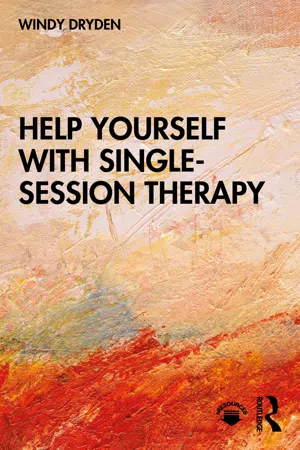
Help Yourself with Single-Session Therapy
eBook - ePub

Help Yourself with Single-Session Therapy

  1. 138 pages
  2. English
  3. ePUB (mobile friendly)
  4. Available on iOS & Android
eBook - ePub

Help Yourself with Single-Session Therapy

About this book

Help Yourself with Single-Session Therapy provides an outlook on how you can help yourself with your emotional problems by using insights from single-session therapy.

Single-session therapy draws upon the skills and strengths of both the therapist and the client. The book will encourage you to develop your own solutions to your problems. Broken down into fourteen accessible chapters, it will help you to identify the problem before guiding you to provide your own goals and solutions. The importance of how to maintain change is also a key part of the process.

Help Yourself will be useful for all those who wish to help themselves with their emotional problems and for those who wish to support them. It will also be relevant for counsellors, psychotherapists and students in these disciplines who are interested in the application of very-brief therapy to self-help.

Tools to learn more effectively

Saving Books

Saving Books

Keyword Search

Keyword Search

Annotating Text

Annotating Text

Listen to it instead

Listen to it instead

Information

Chapter 1

Why self-help?

Overview

In this chapter, I will consider the reasons why you might choose to help yourself with your psychological problem or problems, rather than seek help from another person. I discuss two types of reasons why you might choose self-help. The first is when you would prefer to be helped by another person, but for one or more reasons this is not possible. I call this ā€˜self-help by default’. The second is when you prefer to help yourself rather than be helped by another person. I call this ā€˜self-help by design’. However, I will begin the chapter by considering the three major settings in which you can be helped by another person if you live in Britain.

The contexts of being helped

If you have a psychological problem with which you have been grappling, there are several things you could do.
•You could decide to continue as you have been doing, struggling on, hoping that your problem will go away.
•You might speak to a non-professional about your problem. This will probably be someone you know, a trusted friend or family member perhaps.
•You could consult a trained professional (see below).
•You could embark on a programme of self-help which is the subject of this book.

Consulting a non-professional

If you decide to speak to a non-professional about your problem(s), and assuming that you have chosen somebody sympathetic, this person may respond in one of two ways. First, they may listen to you without interruption and give you the space to sort out the problem for yourself. I call this type of help ā€˜listening-based help’. Second, they may listen to you and then give you advice based on their understanding of your problem and based on some ideas of what you can do to address the problem. I call this type of help ā€˜listening plus advice-based help’. There is nothing wrong with either type of help and if you find what the other person has done helpful, then all well and good.

Consulting a professional

You may have spoken to one or more trusted people in your life, but not found the help they offered to you useful. As a result, you may want to consider consulting a trained mental health professional, such as a counsellor or a psychotherapist. There are three major ways of consulting such a helping professional in Britain.

Consulting a professional in the National Health Service

First, you may decide to see a trained professional who works in the National Health Service (NHS). After all, you have probably contributed to the upkeep of this service through paying taxes and making National Insurance (NI) contributions, and therefore you may feel entitled to get some help when you need it. Again, this is a perfectly valid route to seeking help for your problems, and you may wish to take it. If so, you can contact your GP who may offer you medication and/or refer you to one of the talking therapies provided by a service known as IAPT, which stands for ā€˜Improving Access to the Psychological Therapies’. Increasingly, you can refer yourself directly to an IAPT service. You will be assessed and offered help based on that assessment of the nature of your problem(s). There will be a waiting list for that help depending upon how severe your problem is and the locality in which you live. However, there will be a limit to how much help you will be offered.

Consulting a professional in a charitable or non-profit organisation

Second, you may refer yourself to a counselling service run by a charitable or non-profit organisation. Once again, it is likely that you will be assessed and there will be a waiting list for help, again dependent upon an assessment of your need. While ongoing help may be offered in such a service, increasingly this is less likely now than it used to be. Why is this? In my view, one of the contributory factors, paradoxically, is that people in Britain are becoming more accepting of psychological problems in themselves and in others than was previously the case. We are increasingly being encouraged to see that it is not shameful to struggle emotionally and to come forward for help. As we are heeding this message, more and more of us are seeking help from trained mental health professionals, but unfortunately there are insufficient counsellors and therapists in place to offer help to those who are now seeking it. Consequently, NHS services and charitable, not-for-profit agencies are having to cap services, and even then waiting lists are growing.

Consulting a professional in private practice (going private)

The third way of accessing therapeutic services in Britain is by seeking a therapist or counsellor privately. If you take this route, you will either pay for counselling or therapy yourself or have it paid for you if you have private health insurance which covers you for such services. Private practitioners will tend not to put a cap on how much therapy they will offer you, and as such it is useful to agree a set number of sessions with the therapist at the outset to determine such issues as how you get on with the practitioner and how much progress you are making.

All help ultimately is self-help

Having outlined the contexts in which a person in Britain can seek therapeutic help, let me make a point which you may not have appreciated fully. It is this: all help is ultimately self-help.
I practise a form of therapy known as Rational Emotive Behaviour Therapy (REBT) and I will share insights from REBT as appropriate throughout the book. REBT is a therapeutic approach which is best placed within the tradition of psychotherapy known as Cognitive Behaviour Therapy (better known as CBT). I am sometimes asked if CBT is effective. My response is: ā€˜Probably, yes, if you use it, but definitely no if you don’t.’
When a drug company researches the efficacy of a drug, the only way it can know its effect is if it is sure that the people in the drug trial have taken the drug. In the same way, the only way to judge how effective CBT is if we know that the person has used it in their own life. Thus, if someone is referred for CBT and does not put it into practice in their life, then this is hardly a fair test of the efficacy of the therapy. This is why I say that, ultimately, all therapy is self-therapy.

Two forms of self-help

In the overview at the beginning of the chapter, I distinguished between self-help by default and self-help by design. Let me now discuss each type more fully.

Self-help by default

If you have decided to help yourself by default, you want to be helped by a mental health professional, but for one or more reasons such help is not available. Here is a list of such reasons:
•You have to wait too long for the person to offer you help. Here, you want to be helped by a mental health professional, and you seek help from such a person, but you are placed on a very long waiting list for such help and the estimated waiting time is too much for you. Consequently, you decide to help yourself instead, but you do so with reluctance.
•Help from a mental health professional is not available. It may be the case that you want to consult a therapist or counsellor for your problem(s), but one is not available where you live, and you cannot afford to go private. Again, in this case, somewhat reluctantly, you decide to help yourself.
•You cannot afford the help that you want. Another situation occurs sometimes where help from a mental health professional who works in the NHS or non-profit sector is available to you, but it is not the kind of help that you are seeking. Here, the desired help is only available in the private sector, and you cannot afford to access such help. Faced with the choice between seeking undesired help from a mental health professional and helping yourself, you, again with reluctance, decide to help yourself.
•Practicalities. You may prefer to be helped by another person, but practicalities may interfere with this. For example, your working hours may preclude you from having therapy sessions, and thus you choose to help yourself, again reluctantly.
You will have seen from the above that when you seek self-help by default, you do so with reservations. I will discuss how to deal with this situation presently.

Self-help by design

By self-help by design, I mean a situation where you choose to help yourself with your psychological problem(s) even though help from others, particularly mental health professionals, is available. There are several reasons why you may favour self-help.
•Autonomy. If you have an autonomous personality style, you prefer to rely on your self-helping resources rather than be helped by another person. You may decide to consult a therapist, but it will be with the expressed intention of taking what you learn from the therapist and then helping yourself with it.
•Self-empowerment. Helping yourself may give you a sense of empowerment which you may not experience if you seek help from a therapist.
•Self-help better fits your schedule. You may be the kind of person who prefers to structure your time so that you can do things when it suits you rather than another person. If so, self-help is for you because you can choose to help yourself at any time rather than fit into the schedule of a therapist or counsellor.
The above three factors represent positive reasons for self-help. What follows is a situation where you might decide to help yourself to avoid experiencing a problem if you consulted a mental help professional.
•Shame. You may need help, but you prefer to help yourself because you feel ashamed about seeking help from another person. In this case, the first thing you may want to address is your feelings of shame about such help-seeking. Once you have done this, you will be in a better position to choose whether to seek help from a therapist or from yourself. I will expand on this subject in the following chapter.
Whether you have chosen to help yourself by design or by default, you will get the most from self-help if you apply what I call the self-help mindset, which I discuss in Chapter 4.

David Muss’s suggestions for self-help

Before closing, I will offer my extrapolations from suggestions for helping yourself made by David Muss (2012) in his excellent self-help book on dealing with post-trauma stress entitled The Trauma Trap.1 Drawing upon Muss’s views, my position is that self-help may be particularly useful for the following people:
•those who fear that going for therapy will jeopardise their jobs if others find out about it
•those who have had therapy and did not find it helpful
•those who can see the sense of ...

Table of contents

  1. Cover
  2. Half Title
  3. Title Page
  4. Copyright Page
  5. Contents
  6. Preface
  7. Chapter 1 Why self-help?
  8. Chapter 2 Do you need help?
  9. Chapter 3 What is single-session therapy (SST)?
  10. Chapter 4 Use the single-session self-help mindset
  11. Chapter 5 Prepare yourself for change
  12. Chapter 6 Engage in the ā€˜reflect–digest–act–wait–decide’ process
  13. Chapter 7 Develop a problem focus
  14. Chapter 8 Understand and formulate emotional problems based on people’s responses to adversity
  15. Chapter 9 Understand and formulate problems based on avoidance
  16. Chapter 10 Set goals
  17. Chapter 11 Address your problem by searching for a solution
  18. Chapter 12 Develop and implement an action plan related to your chosen solution
  19. Chapter 13 Identify and deal with obstacles to change
  20. Chapter 14 Maintain your gains and generalise your learning
  21. Index

Frequently asked questions

Yes, you can cancel anytime from the Subscription tab in your account settings on the Perlego website. Your subscription will stay active until the end of your current billing period. Learn how to cancel your subscription
No, books cannot be downloaded as external files, such as PDFs, for use outside of Perlego. However, you can download books within the Perlego app for offline reading on mobile or tablet. Learn how to download books offline
Perlego offers two plans: Essential and Complete
  • Essential is ideal for learners and professionals who enjoy exploring a wide range of subjects. Access the Essential Library with 800,000+ trusted titles and best-sellers across business, personal growth, and the humanities. Includes unlimited reading time and Standard Read Aloud voice.
  • Complete: Perfect for advanced learners and researchers needing full, unrestricted access. Unlock 1.4M+ books across hundreds of subjects, including academic and specialized titles. The Complete Plan also includes advanced features like Premium Read Aloud and Research Assistant.
Both plans are available with monthly, semester, or annual billing cycles.
We are an online textbook subscription service, where you can get access to an entire online library for less than the price of a single book per month. With over 1 million books across 990+ topics, we’ve got you covered! Learn about our mission
Look out for the read-aloud symbol on your next book to see if you can listen to it. The read-aloud tool reads text aloud for you, highlighting the text as it is being read. You can pause it, speed it up and slow it down. Learn more about Read Aloud
Yes! You can use the Perlego app on both iOS and Android devices to read anytime, anywhere — even offline. Perfect for commutes or when you’re on the go.
Please note we cannot support devices running on iOS 13 and Android 7 or earlier. Learn more about using the app
Yes, you can access Help Yourself with Single-Session Therapy by Windy Dryden in PDF and/or ePUB format, as well as other popular books in Psychology & Mental Health in Psychology. We have over one million books available in our catalogue for you to explore.