- 416 pages
- English
- ePUB (mobile friendly)
- Available on iOS & Android
eBook - ePub
The Complete Guide to OSHA Compliance
About this book
The Complete Guide to OSHA Compliance is an easy-to-understand, one-stop resource designed to help safety professionals, industrial hygienists, and human resources personnel ensure compliance with existing and upcoming OSHA regulations. This essential book explains employer and employee rights and responsibilities, and it provides everything you need to know about employer standards and standards for specific operations.
The Complete Guide to OSHA Compliance describes the process of injury/illness recordkeeping and the reporting system required by OSHA. It also explains how to conduct a self-audit to determine whether a company is in full compliance. Furthermore, it informs companies of their rights in an inspection and explains how to handle citations and appeals, should they arise.
Information
Chapter 1
UNDERSTANDING OSHA—AN OVERVIEW
The concern for workers’ well-being has extended over many years. The English Parliament enacted landmark labor legislation in 1833 called the Factory Act, which focused on the hours children were permitted to work and provided for inspections of workplaces. Additional legislation was passed in other countries in Europe.
In the U.S., legislation surrounding worker protection began to be enacted in the late 1800s by several states, including New York, Michigan, Massachusetts, and New Jersey. The legislative activity grew considerably after the turn of the century. The Bureau of Mines was created in 1910 and the federal Department of Labor was created in 1913.
State regulations moved faster than the federal programs. State and local government programs and safety standards continued to proliferate until the 1960s. Establishing a national program seemed to be an impossible task. However, the passage of three major pieces of legislation had a significant impact on establishing a national occupational health and safety program. These major pieces of legislation are:
• Metal and Nonmetallic Mine Safety Act of 1966
• Federal Coal Mine Health and Safety Act of 1969, and
• Occupational Safety and Health Act of 1970.
The Occupational Safety and Health Act has had the greatest impact on worker safety and health regulations as we know them today. It was passed at a time when the federal government believed that worker and environmental protection were of utmost importance. About the same time the Occupational Safety and Health Act was passed, the Federal Hazardous Substances Act of 1966, the National Environmental Policy Act of 1969, the Coal Mine Health and Safety Act of 1969, the Clean Air Act of 1970, the Clean Water Act of 1972, The Environmental Pollution Control Act of 1972, the Safe Drinking Water Act of 1974, and the Toxic Substances Control Act of 1976 were also enacted.
Obviously, the attitude to establish a national piece of legislation to protect workers was strong. At the time the Occupational Safety and Health Act was being discussed, Congress was given the following facts:
• 14,000 deaths were due to job-related accidents
• Nearly 2-1/2 million workers were disabled
• Ten times as many person-days were lost from job-related disabilities as were from strikes
• It was estimated that there would be 300,000 new cases of occupational disease.
The principal tenet of the Occupational Safety and Health Act is to “assure so far as possible every working man and woman in the Nation safe and healthful working conditions and to preserve our human resources.” The goals of the Act were to:
• Encourage employers and employees to reduce workplace hazards and to implement new or improve existing safety and health programs.
• Provide for research in occupational safety and health to develop innovative ways of dealing with occupational safety and health problems.
• Establish separate but dependent responsibilities and rights for employers and employees for the achievement of better safety and health conditions.
• Maintain a reporting and recordkeeping system to monitor job-related injuries and illnesses.
• Establish training programs to increase the number and competence of occupational safety and health personnel.
• Develop mandatory job safety and health standards and enforce them effectively.
• Provide for the development, analysis, evaluation and approval of state occupational safety and health programs.
The Occupational Safety and Health Act created several distinct government entities. Most of the power of the Occupational Safety and Health Act resides with the Occupational Safety and Health Administration (OSHA) which is located in the executive branch of the government under the Department of Labor. The specific actions that can be taken by OSHA will be discussed later.
The Occupational Safety and Health Act also established the National Institute for Occupational Safety and Health (NIOSH). NIOSH is the research arm of OSHA and is responsible for workplace investigations, training and educational programs, recommendations for new health standards, and other related activities. NIOSH is under the Department of Health and Human Services, which was previously called the Department of Health, Education and Welfare.
Other government entities created by the Occupational Safety and Health Act include the Occupational Safety and Health Review Commission, the National Advisory Committee on Occupational Safety and Health, and the National Commission on State Workers’ Compensation Laws.
Not all employers are affected by the Occupational Safety and Health Act. The Act covers employers “engaged in business affecting commerce who have employees.” This specifically exempts federal workers. Federal agencies are responsible for establishing their own programs that are to be consistent with those established by OSHA. Where rules do not exist, OSHA standards apply. OSHA provisions also do not apply to state and local government employees. Last, federal workers who are under the jurisdiction of another federal agency’s rules for health and safety are exempt from the OSHA rules. For example, OSHA’s standards and regulations do not apply to those workers who are employed in nuclear power facilities and as longshoremen. These two industries are under the jurisdiction of the Department of Energy (DOE) and the Longshoremen’s and Harbor Workers’ Compensation Act, respectively. Other groups like railroad workers and miners are also exempt. The Occupational Safety and Health Act also does not cover self-employed persons and farms at which only immediate members of the farm employer’s family are employed.
Although federal agencies are exempt from OSHA standards, the Agency conducts workplace inspections in response to worker complaints and for federal workplaces with high hazard jobs. Federal agencies are also required to maintain injury and illness statistics, conduct self-inspections, etc.
The Occupational Safety and Health Act gave power to the states, District of Columbia, and U.S. territories to establish and manage their own occupational safety and health program as long as their rules were “at least as effective” as those enacted by the federal government. States must also cover state and local government workers in their program. States wishing to administer their own program must submit their plans to the Department of Labor for approval. The plan must demonstrate that the state has the ability to provide for:
• Standard-setting
• Enforcement
• Appeals
• Public employee protection
• Sufficient personnel for enforcement
• Training, education and technical assistance programs
There are currently 25 states with approved plans. Although all of these states have established their own enforcement arm, not all states have opted to write their own regulations. Some states have decided to enforce the federal standards as they are written. Other states have decided to establish their own safety and health standards. This is acceptable to the Department of Labor as long as the state’s rules are identical to, or at least as stringent as, the federal government’s regulations. As the federal government promulgates its regulations, states that establish their own regulations must do so within 6 months following the passage of a federal OSHA regulation. States that have approved plans are shown in Figure 1.1. The plans in Connecticut and New York cover public employees only. In these two states, private sector employees are covered under federal jurisdiction. Contacts for the state plans are shown in Appendix 1A.
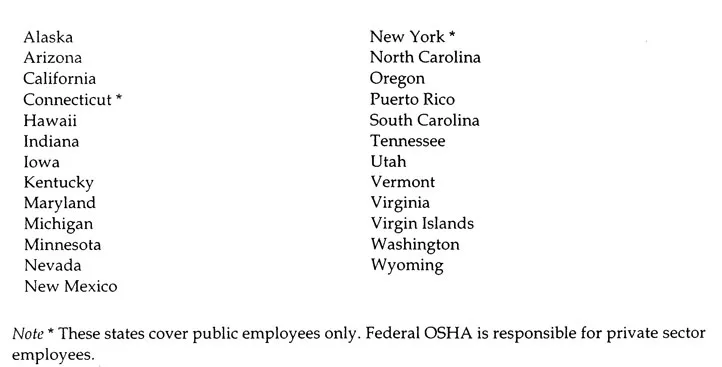
States with approved plans.
Chapter 2
OSHA RECORDKEEPING
This chapter covers OSHA recordkeeping requirements for occupational injuries and illnesses. This chapter is not all-inclusive, and you are well-advised to review the applicable federal regulations as they are extremely detailed. The applicable federal regulations are set forth in 29 CFR § 1904, et. seq. You should also review the U.S. Department of Labor, Bureau of Labor Statistics, booklet entitled Recordkeeping Guidelines for Occupational Injuries and Illnesses. You may obtain a copy of the booklet from one of the regional offices of the Bureau of Labor Statistics. The addresses of the regional offices are set forth in Appendix 2A. An abbreviated guide is also available for your use from the Department of Labor, Bureau of Labor Statistics and is entitled A Brief Guide to Recordkeeping Requirements for Occupational Injuries and Illnesses. A copy of the abbreviated guide is set forth in Appendix 2B.
With few limited exceptions, you must complete and maintain the forms discussed in this chapter. This chapter also discusses reporting requirements of a death or a serious injury or illness of a company employee. This chapter is divided into three parts:
• First, recordkeeping requirements for injuries and illnesses
• Second, how to keep OSHA records, including: The Log and Summary of Occupational Injury and Illnesses and The Supplementary Record of Occupational Injuries and Illnesses
• Third, reporting a death or serious injury.
I. RECORDKEEPING REQUIREMENTS FOR INJURIES AND ILLNESSES
If an employee suffers an occupational injury or illness, most employers must complete the documents discussed below. The coverage of the OSHA Act is extensive and covers nearly all employers in the private sector. There are certain limited exceptions to these recordkeeping requirements, which are discussed directly below.
A. No Employees
The following are examples of circumstances where OSHA recordkeeping requirements would not apply as there are no employees covered by the Fed/OSHA Act.
• Two or more partners operating a small company with no employees would not be covered by the Fed/OSHA Act. Partners are not considered employees.
• Activities of self-employed individuals are not covered by the Fed/OSHA Act. Self-employed individuals are not considered employees under the Act.
• Employers of domestic help in the employer’s private residence for the usual purposes of housekeeping and/or child care are not required to keep records for the domestic help.
There are also exemptions from the recordkeeping requirements of OSHA for the following types of employers:
• Small employers
• Employers in low hazard industries
B. Small Employers
Although subject to the overall coverage of the Fed/OSHA Act, employers who had no more than 10 employees (10 or less) at any point in time during the calendar year immediately preceding a current calendar year need not comply with the recordkeeping requirements of the Act for the current year. For example, if your company employed no more than 10 employees at any point in time in 1994, you need not maintain the OSHA Log in 1995.
In determining your possible classification as a small employer, the total number of employees your company may have employed during the calendar year is not the determining factor. Rather, it is whether the company employed more than 10 employees at any one time during the previous calendar year.
For example, if two partners operate an automotive repair shop throughout the year ...
Table of contents
- Cover
- Title Page
- Copyright Page
- About the Authors
- Introduction
- Table of Contents
- Chapter 1 Understanding OSHA — An Overview
- Chapter 2 OSHA Recordkeeping
- Chapter 3 Regulations that Apply to All Employers
- Chapter 4 Regulations that Apply to Some Employers
- Chapter 5 Accident Prevention Plan
- Chapter 6 Worker Information and Training
- Chapter 7 OSHA Inspections
- Chapter 8 OSHA Citations and Proposed Penalties
- Chapter 9 General Duty Clause
- Chapter 10 Avoiding OSHA Inspections and Conduct of Such Inspections
- Chapter 11 Appeal or Not? and Appealing a Citation or Penalty
- APPENDICES
- Index
Trusted by 375,005 students
Access to over 1.5 million titles for a fair monthly price.
Study more efficiently using our study tools.
Frequently asked questions
Yes, you can cancel anytime from the Subscription tab in your account settings on the Perlego website. Your subscription will stay active until the end of your current billing period. Learn how to cancel your subscription
No, books cannot be downloaded as external files, such as PDFs, for use outside of Perlego. However, you can download books within the Perlego app for offline reading on mobile or tablet. Learn how to download books offline
Perlego offers two plans: Essential and Complete
- Essential is ideal for learners and professionals who enjoy exploring a wide range of subjects. Access the Essential Library with 800,000+ trusted titles and best-sellers across business, personal growth, and the humanities. Includes unlimited reading time and Standard Read Aloud voice.
- Complete: Perfect for advanced learners and researchers needing full, unrestricted access. Unlock 1.5M+ books across hundreds of subjects, including academic and specialized titles. The Complete Plan also includes advanced features like Premium Read Aloud and Research Assistant.
We are an online textbook subscription service, where you can get access to an entire online library for less than the price of a single book per month. With over 1.5 million books across 990+ topics, we’ve got you covered! Learn about our mission
Look out for the read-aloud symbol on your next book to see if you can listen to it. The read-aloud tool reads text aloud for you, highlighting the text as it is being read. You can pause it, speed it up and slow it down. Learn more about Read Aloud
Yes! You can use the Perlego app on both iOS and Android devices to read anytime, anywhere — even offline. Perfect for commutes or when you’re on the go.
Please note we cannot support devices running on iOS 13 and Android 7 or earlier. Learn more about using the app
Please note we cannot support devices running on iOS 13 and Android 7 or earlier. Learn more about using the app
Yes, you can access The Complete Guide to OSHA Compliance by Joel M. Cohen,Robert D. Peterson in PDF and/or ePUB format, as well as other popular books in Technology & Engineering & Medical Law. We have over 1.5 million books available in our catalogue for you to explore.