A book which sets out the latest national law relating to time bars on the most common maritime claims in over 30 countries. It includes new jurisdictions and additional information. It provides the answers to such questions as what is the time-bar period for a particular type of claim, when does a time-bar period for a claim begin, how can the time-bar period be interrupted, extended or ended and what are the consequences of the time-bar period running out?
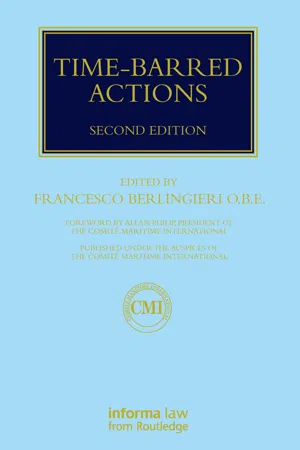
- 252 pages
- English
- ePUB (mobile friendly)
- Available on iOS & Android
eBook - ePub
Time-barred Actions
About this book
Information
II
TIME-BAR PERIODS IN RESPECT OF VARIOUS TYPES OF MARITIME CLAIMS
A. INTRODUCTION—WHEN THE TIME-BAR PERIOD COMMENCES TO RUN
Finland
The general time limit provided for enforcing a claim or a debt is 10 years. This period of limitation applies whenever there is no special statute to bar the right of action earlier than after 10 years. The date from which time begins to run is normally the day on which a claim arises (e.g. damage occurs).
Maritime claims are subject to special time limits.
Germany
If there are no special rules, time-bar periods commence to run when the claim has arisen and has fallen due. In the case of contractual claims the period begins to run from the end of the year when the claim has arisen. For certain types of contract claims, special rules exist. In the case of damages the period of three years begins to run when the claim has arisen, i.e. when the damage occurs; in the case of tort claims the injured party’s knowledge of the damage is an additional requirement.
India
As a general rule, time limits commence to run from the time when the cause of action arises.
Italy
Pursuant to Article 2935 of the Civil Code the prescription periods commence to run when the right may be enforced. This is a general rule applicable in all cases unless otherwise expressly stated.
Spain
While time-bar periods for maritime claims arising out of commercial contracts are mainly specified in the Commercial Code, collision is a special case which is also contained in the same Code. But the general rule for tort claims is contained in the Civil Code.
Further, the special rules contained in private maritime conventions which have been ratified by Spain also have to be taken into account and are part of the Spanish body of law.
Turkey
Generally prescription periods commence to run when the claim has fallen due. The extinction period applies only for cases of loss of or damage to, goods which are the subject of the contract of carriage by sea.
B. TORT CLAIMS
China
The general prescription period is two years. No prescription operates in respect of claims of the State for damage to, or loss of, its property caused through the operation or management by an unauthorized person (Article 170 of the Opinions of the People’s Supreme Court).
India
The general time limit is three years.
Israel
Under the Limitation Act, 1958 the time bar for all the tort claims enumerated hereunder is seven years and the limitation period starts from the accrual of the cause of action.
Italy
The general rule, which is applicable unless otherwise expressly stated, is that tort claims are prescribed after five years from the date when the event has occurred (Article 2947 of the Civil Code). If, however, the occurrence is considered by the law as a crime and for such a crime a longer period is provided, the longer period also applies to the civil action.
Malta
The general rule is that actions for damages, which do not arise out of contractual obligations are barred after the lapse of two years (section 2153 of the Civil Code.) With regard to the prescription of civil actions for damages arising from criminal offences, the rules laid down in the Criminal Code relating to the prescription of criminal actions shall be observed. Nevertheless, any person who has stolen a thing, or who has become the possessor thereof by means of fraud, or who has received or bought such thing, knowing it to have been stolen or fraudulently acquired, cannot plead this defence, notwithstanding any lapse of time (section 2154 of the Civil Code).
Poland
According to Article 442, section 1 of the Civil Code, claims for repairs of damage caused by a tort are prescribed after a lapse of three years from the day on which a person who had suffered damage learned of it and of a person obliged to repair it.
In any event, however, a claim is prescribed after a lapse of 10 years from the day on which the event causing the damage occurred.
Under section 2 of Article 442, if damage results from a crime or offence, the claim for repair of damages is prescribed after a lapse of 10 years from the day when the crime was committed regardless of when the person who had suffered damage learned of it and of the person obliged to repair it.
Regarding tort claims the Maritime Code contains no specific provisions except for collision cases.
Spain
Unless otherwise provided for, the specific casualties contemplated below and actions for damages which do not arise out of contractual obligations (except Article 1902 and subsequent articles of the Civil Code) are barred after the lapse of one year. Time counts as of the day in which the tortious act or omission came to the knowledge of the person suffering damage (Article 1968.2 of the Civil Code). Once the liability has been established by a judgment, prescription for actions for execution starts as of the date of such judgment (Article 1971 of the Civil Code).
If, however, the occurrence amounts to a crime and the person suffering damage chooses not to claim damages in the criminal proceedings, the time begins to count only once such proceedings are terminated by judgment or by stay of proceedings (Articles 111 et seq. of the Ley de Enjuiciamiento Criminal).
Except as above, civil liability arising out of a criminal offence follows the general rules of extinctive prescription contained in the Civil Code (Article 117 of the Codigo Penal).
Turkey
The general prescription period is one year from the time when the person who sustains the damage becomes aware of the damage and of the person who caused it. The maximum period is 10 years from the day when the damage occurred (Article 60 of the Code of Obligations).
1. COLLISION
Uniform Rules
Article 7 of the 1910 Brussels Convention for the Unification of Certain Rules of Law with Respect to Collision between Vessels (1910 Collision Convention) provides that actions for recovery of damages are prescribed after two years from the date of the casualty. It also regulates the prescription period for action of recovery of the owner of one of the ships involved in the collision against the owner of the other ship, in case the former has paid in respect of claims for death and personal injuries a larger part than that which he ought to bear on the basis of the proportion of the fault of his ship. In such a case, the prescription period is one year from the date of payment.
In the unofficial English translation of the Convention, the words “se prescrivent” (are prescribed) have been translated by the words “are barred” and the word “prescriptions” (prescription periods) in the third paragraph have been translated by “periods of limitation”.
The accuracy of this translation has been confirmed in more recent multilingual conventions such as the 1974 Athens Convention Relating to the Carriage of Passengers and their Luggage by Sea (1974 Athens Convention), article 16 and the United Nations Convention on the Carriage of ...
Table of contents
- Cover
- Half Title
- Title Page
- Copyright Page
- Foreword
- Questionnaire
- Table of Contents
- Introduction
- Editor’s Note
- Table of Cases
- Table of International Conventions
- Table of Legislation
- I. Legal Nature of the Time-Bar Period
- II. Time-Bar Periods in Respect of Various Types of Maritime Claims
- III. Time-Bar Periods for Securities
- IV. Suspension or Interruption of the Time-Bar Periods
- Index
Trusted by 375,005 students
Access to over 1.5 million titles for a fair monthly price.
Study more efficiently using our study tools.
Frequently asked questions
Yes, you can cancel anytime from the Subscription tab in your account settings on the Perlego website. Your subscription will stay active until the end of your current billing period. Learn how to cancel your subscription
No, books cannot be downloaded as external files, such as PDFs, for use outside of Perlego. However, you can download books within the Perlego app for offline reading on mobile or tablet. Learn how to download books offline
Perlego offers two plans: Essential and Complete
- Essential is ideal for learners and professionals who enjoy exploring a wide range of subjects. Access the Essential Library with 800,000+ trusted titles and best-sellers across business, personal growth, and the humanities. Includes unlimited reading time and Standard Read Aloud voice.
- Complete: Perfect for advanced learners and researchers needing full, unrestricted access. Unlock 1.5M+ books across hundreds of subjects, including academic and specialized titles. The Complete Plan also includes advanced features like Premium Read Aloud and Research Assistant.
We are an online textbook subscription service, where you can get access to an entire online library for less than the price of a single book per month. With over 1.5 million books across 990+ topics, we’ve got you covered! Learn about our mission
Look out for the read-aloud symbol on your next book to see if you can listen to it. The read-aloud tool reads text aloud for you, highlighting the text as it is being read. You can pause it, speed it up and slow it down. Learn more about Read Aloud
Yes! You can use the Perlego app on both iOS and Android devices to read anytime, anywhere — even offline. Perfect for commutes or when you’re on the go.
Please note we cannot support devices running on iOS 13 and Android 7 or earlier. Learn more about using the app
Please note we cannot support devices running on iOS 13 and Android 7 or earlier. Learn more about using the app
Yes, you can access Time-barred Actions by Francesco Berlingieri in PDF and/or ePUB format, as well as other popular books in Law & Time Management. We have over 1.5 million books available in our catalogue for you to explore.