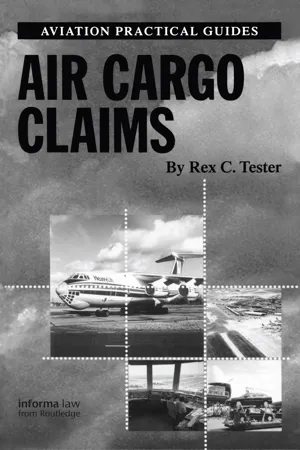
The structure of air cargo claims is highly complex. Claimants may often have difficulty in establishing against whom they should make their claim. With the emphasis on practicality, this text is aimed at the entire air cargo industry from airlines and their insurers to freight forwarders, and importers and exporters. It illustrates the demarcation of responsibilites and liabilities of the various key players in the aviation market, and the contractual responsibilites and the liability implications between the various parties.
- 230 pages
- English
- ePUB (mobile friendly)
- Available on iOS & Android
eBook - ePub
Air Cargo Claims
About this book
Information
CHAPTER 1
INTRODUCTION
ABOUT THIS WORK
First and foremost, this book must be regarded as a guide and not a definitive rule-book.
While many of the principles and procedures set down herein are undoubtedly accurate and true, other commentators and learned practitioners will have different ideas on procedure for claims handling, and indeed on interpretation of applicable rules and regulations. Accordingly, no matter how experienced you become in claims handling, and although your own judgement and experience are of great importance, do not be reluctant to seek other’s views.
Finally, you must treat every case as a fresh one, considering it apart from all foregoing ones.
THE WORK WHICH HAS TO BE DONE
A claims handler, fully developed in his function, is using theoretical knowledge tempered with experience, extreme judgement, initiative, and administrative skills of no less merit than those of any other highly skilled professional. This is seldom recognised.
Examine the processing of a single claim. Detailed analyses of the paper trail and operational trail may be needed in order to reach an understanding of the incidents giving rise to the claim. Inquiries of varying complexity may be triggered. Analysis and verification of liability, entitlement to claim, and the claimed amount will be necessary, and each of these aspects is subject to complex rules of law, and each can generate further inquiries. Having completed the foregoing, the handler moves on to a decision (more usually a recommendation to superiors) on settlement or commitment to pursuit of the claim.
Settlement decisions range from outright repudiation of liability to full payments without demur. Decisions of less certainty are also necessary, where there seems to be a chance of forcing claimants to accept less than they are asking. The converse is also true and sometimes more poignant, because a cargo owner—having lost money already—must commit resources certainly, and more money probably, to achieve compensation. For the respondent, it is different: he has probably received his freight or other fees, and if he can sit tight without settling, he can preserve his profit, of course.
Overall, the claims handler must keep a crystal-clear file in case of litigation.
Does this cover all the functions of a claims handler operating at full potential? It does not. Over all the foregoing functions, our claims handler, more than likely, will have to liaise with the company’s insurer. Not far away at any time from the exigency of pursuing or defending the claim will lurk the anxiety about the effect the claim may have on insurance premiums.
What follows from all these duties and concerns is an ever-growing fund of experience and knowledge, putting our claims handler in a unique position to advise on risks in order to avoid claims in the future, and to advise on losses to ensure that individual claims do not run out of control. This is an idealised job description for a claims handler, of course; some companies recognise this and accord claims handlers their dues, others demote the task, and occasionally suffer painful consequences unnecessarily.
THE BREADTH OF THE INDUSTRY
A claimant must determine against whom he should act and in what legal context, and, because the airfreight process is no less complex than any other, the claimant, whoever he is and wherever he is in the contract chain, can be severely challenged in identifying the correct “target”.
* * *
The figure opposite illustrates the movement of cargo from shipper to consignee and the key illustrates the contractual relationships. Of course, it is illustrative only, and there are routinely many variations on this scheme.
KEY TO THE FIGURE
1 The shipper has a choice of acting against the forwarding agent, consolidator, or airline, depending on what went wrong.
2 The trucker collecting goods from the shipper is contracted to the forwarding agent to collect the goods, and thus is generally liable only to the forwarder and not directly to the shipper.
3 The forwarder is responsible to the shipper for any mistakes it makes, but usually finds itself attempting to pursue claims against a third party on behalf of the shipper.
4 The consolidator is liable to the shipper (and on rare occasions to the consignee).
5 At the outbound airport the cargo handling agent acting for the airline is generally liable only to the airline.
6 The airline is liable to the shipper or consignee.
In this case, the cargo is being trucked to a secondary airport, e.g. London Heathrow Airport to Manchester Airport.
7 The airline’s cargo handling agent is liable generally only to the airline.
8 The airline’s trucker is liable generally only to the airline.
9 At the secondary airport the cargo handling agent acting for the airline is generally liable only to the airline.
10 The consolidator’s break-bulk agent is generally liable only to the export consolidator, although it may choose to assume liability to others.
11 The customs/import agent is responsible to the consignee for any mistakes it makes, but usually finds itself attempting to pursue claims against a third party on behalf of the consignee.
12 The trucker acting for the customs/import agent is generally liable only to the customs/import agent.
13 The importer can claim against the customs/import agent, the consolidator, or the airline, depending on what went wrong.

It is by no means the most complex arrangement that exists: although rare, it is certainly not unknown for four forwarders to be interposed between shipper and consolidator. Each forwarder is probably acting as a contracting carrier and will wish to avoid his or her immediate customer knowing of the next one “down the lines”—so the problems become more and more involved. Thus, if you are either the consignee whose vegetables are delayed, or at the other extreme—but rarely—the airline which has suffered a very expensive delay caused by a pallet collapse within the hold, probably brought about by a consolidator failing to stow correctly, you must think seriously about who is your opponent and why.
An attempt is made herein to show how the various contractual elements interlock. The system can appear to claimants to be a maze, seriously discouraging attempts at compensation, but with calm analysis ways forward can often be found.
The shipper should now be able to see who should be its target and in what legal context; the forwarder—as a pure agent—can see where it fits in, the consolidator can be sure of its location in the chain, and the actions it should take, and the airline can understand why a claim seems to have arrived on the claims handler’s desk from an odd quarter.
THE INTEGRITY AND STATURE OF THE WORK
I must address a few words to the people to whom claims handlers report within commercial organisations. This book is aimed at the importer and exporter who tries to do the job himself, as well as organisations large enough to be able to deputise a clerk to handle the work. It is also aimed at the forwarder who feels that he must do everything possible to handle his clients’ liability claims against third parties, even though there is seldom, if ever, written anywhere into the contract with the client that the forwarder must deal with such claims. Finally, this book is aimed at airlines whose claims work is almost exclusively concerned with claims against themselves.
Responsible executives have different approaches to the work, according to their perceptions of it. Some regard it as a necessary evil and a drain on resources; bosses in this frame of mind will probably put a junior in the role and give some vague instructions for overall administration of the task. It becomes unavoidable sooner or later for the boss to step in and do his best when the “chips are down”—this can be thoroughly uncomfortable. The other extreme is the boss who feels customers’ complaints so keenly that he will not allow his staff to handle the claims at all: and this is such a waste of his revenue-earning time. These are repeated scenarios, but with a little calm thought and consideration, managers into whose lap the responsibility for claims handling falls can ease the burden on themselves and their staff—not least because, for forwarders and airlines, undeniably it has strong customer-relations implications.
Exporters and importers
The customers of carriers and forwarders sustain losses when something untoward happens while cargo is being carried; in the absence of insurance cover, some large organisations can withstand the impact on cash flow that such problems bring, but the viability of smaller operations can be seriously threatened. Always seek to insure your goods if you perceive a real chance of transit loss, damage or delay, causing you real hardship. Under normal circumstances, your insurance cover will alleviate the potentially serious problems which may follow a claim incident. In the absence of insurance, you must face the possibility that the carrier or forwarder will simply not settle quickly, and may seek to avoid settling at all.
The reality of the situation is that unless you are a regular client providing steady profitable business to the carrier or forwarder, then the carrier or forwarder will likely perceive the problem as a simple financial exercise. The question he will ask is: is the profit I am making out of this claimant sufficient in a reasonable period of time to make it attractive to me to settle his claim if I do not have to? If you do not do regular business with him, then he can simply delay until you lose interest or resort to legal proceedings: the decision to litigate can be excruciating, and it often discourages claimants from pursuing their claims, even when they seem strong.
Help can be at hand in the form of recovery agents—sometimes known as loss assessors. Most of these people work exclusively for insurance companies. They are reluctant to work directly for importers and exporters because such work is perceived as full of pitfalls and difficulties compared to insurers’ work. However, there are a few assessors or recovery agents who will willingly act for you. Even when employing such people, do not expect early results. They are more likely to be able to bring about an eventual result—where you will probably not know how to proceed with confidence—rather than an early one.
Forwarders (and consolidators)
Forwarders often face exporters and importers refusing to pay their charges1 if their claims are not settled immediately—and nearly always it is a third party who is responsible for the loss. The forwarder is hit from both sides: not only will his customer take the soft option and refuse to pay his charges but he will also feel duty-bound to carry out th...
Table of contents
- Cover
- Half Title
- Title Page
- Copyright Page
- Acknowledgements
- Preface
- Table of Contents
- Glossary
- Table of Cases
- Table of Legislation
- Table of Conventions
- Table Trading Conditions
- Chapter 1—Introduction
- Chapter 2—The Concept of Liability
- Chapter 3—About Insurance
- Chapter 4—Risk and Loss Control
- Chapter 5—Creating and Administering the Claim File
- Chapter 6—Legal Framework
- Chapter 7—Civil Regulation—RHA AND BIFA
- Chapter 8—Statutory Regulation—Air Carriage
- Chapter 9—The Warsaw System
- Chapter 10—Non-Warsaw
- Chapter 11—Air Waybill Conditions
- Chapter 12—Airline Handling Agreements
- Chapter 13—Claims Decisions
- Appendix 1—Road Haulage Association Limited Conditions of Carriage 1991
- Appendix 2—Bifa Standard Trading Conditions 1989
- Appendix 3—The Unamended Warsaw Convention 1929
- Appendix 4—The Warsaw Convention as Amended at the Hague, 1955, and by Montreal Additional Protocol No. 2, 1975
- Appendix 5—The Unamended Warsaw Convention as Amended by Montreal Additional Protocol No. 1, 1975
- Appendix 6—The Warsaw Convention as Amended at the Hague in 1955 and by Protocols Nos. 3 and 4 Signed at Montreal in 1975
- Appendix 7—Guadalajara Supplementary Convention (1961)
- Appendix 8—Air Waybill Conditions
- Index
Trusted by 375,005 students
Access to over 1.5 million titles for a fair monthly price.
Study more efficiently using our study tools.
Frequently asked questions
Yes, you can cancel anytime from the Subscription tab in your account settings on the Perlego website. Your subscription will stay active until the end of your current billing period. Learn how to cancel your subscription
No, books cannot be downloaded as external files, such as PDFs, for use outside of Perlego. However, you can download books within the Perlego app for offline reading on mobile or tablet. Learn how to download books offline
Perlego offers two plans: Essential and Complete
- Essential is ideal for learners and professionals who enjoy exploring a wide range of subjects. Access the Essential Library with 800,000+ trusted titles and best-sellers across business, personal growth, and the humanities. Includes unlimited reading time and Standard Read Aloud voice.
- Complete: Perfect for advanced learners and researchers needing full, unrestricted access. Unlock 1.5M+ books across hundreds of subjects, including academic and specialized titles. The Complete Plan also includes advanced features like Premium Read Aloud and Research Assistant.
We are an online textbook subscription service, where you can get access to an entire online library for less than the price of a single book per month. With over 1.5 million books across 990+ topics, we’ve got you covered! Learn about our mission
Look out for the read-aloud symbol on your next book to see if you can listen to it. The read-aloud tool reads text aloud for you, highlighting the text as it is being read. You can pause it, speed it up and slow it down. Learn more about Read Aloud
Yes! You can use the Perlego app on both iOS and Android devices to read anytime, anywhere — even offline. Perfect for commutes or when you’re on the go.
Please note we cannot support devices running on iOS 13 and Android 7 or earlier. Learn more about using the app
Please note we cannot support devices running on iOS 13 and Android 7 or earlier. Learn more about using the app
Yes, you can access Air Cargo Claims by Rex Tester in PDF and/or ePUB format, as well as other popular books in Law & Financial Law. We have over 1.5 million books available in our catalogue for you to explore.