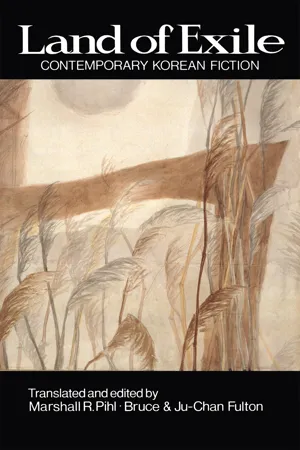
eBook - ePub
Land of Exile: Contemporary Korean Fiction
Contemporary Korean Fiction
- 304 pages
- English
- ePUB (mobile friendly)
- Available on iOS & Android
eBook - ePub
Land of Exile: Contemporary Korean Fiction
Contemporary Korean Fiction
About this book
An anthology of contemporary Korean fiction including: "The Wife and Children"; "The Post Horse Curse"; "Mountains"; "Kapitan Ri"; "The Winter"; and "A Dream of Good Fortune."
Information
Land of Exile
Cho Chŏngnae
Cho Chŏngnae (b. 1943) is a prolific writer who made his debut with "Calumny" (Numyŏng) in Hyŏndae munhak magazine in 1970. He received the twenty-seventh Modem Literature Award in 1981 for "Land of Exile" (Yuhyŏng ŭi ttang, first published in Hyŏndae munhak the some year) and the Republic of Korea Literature Award for "Door to Humanity" (Ingan ŭi mun) in 1982. As a writer, Cho expresses a belief in the value and dignity of human life and strives to relate the life of the individual to the flow of history. He is particularly concerned with the twin impacts of war and division on the Korean spirit and with the connection between such events and Korea's social history. Like the main character Mansŏk in "Land of Exile," Cho Chŏngnae's people are frequently the unfortunate victims of Korea's history, both ancient and recent. From 1983 to 1989 Cho devoted himself to a ten-volume, 1.25-million-word roman fleuve, The T'aebaek Mountains (T'aebaek san-maek), named after the three-hundred-mile chain that runs from Kang-wdn Province in central Korea south to the city of Pusan, forming the backbone of the peninsula. Critics have hailed the work as "the masterpiece of the 1980s." Cho states that the work "deals with the tragedy of Korea's division with a mind to overcoming that division." "Unification is impossible," he adds, "unless we strip away our postwar anticommunism and form a more objective, balanced judgment whereby we criticize the historical blunders and distortions of the right wing and affirm the historical sincerity and meaning of the left."
"Please, mister . . . I'm old and worthless, and my only wish is to close my eyes in peace. I beg you, look on me with pity."
The old man rervently rubbed his palms together. He could scarcely have been more ardent before the Buddha himself. And, as if that were not enough, he knelt on the floor.
"This really isn't necessary, sir," said the director. "I fully understand your difficulty. Here, now, won't you have a seat?" He made an awkward attempt to help the old man up.
"Please, mister, promise you'll take him," the old man pleaded, bending even lower.
"All right. I'll see that he's admitted," the director managed to answer, revealing his contradictory feelings.
"Oh, thank you, mister! I'll never forget your heavenly grace, even when I've passed on to the next world."
Still kneeling, the old man bowed two or three times, palms pressed tight against his chest. His eyes misted over with tears.
"Sir, please take a seat."
Why didn't he just leave boy at the gate and disapear without all this pleading? I'd have taken him in anyway, thought the director.
The old man reseated himself with some reluctance in the chair, then groped in his pocket, sniffing continuously.
"Here, mister—it's all the money I've got. Take it, will you? It's not much but it's a token of my gratitude."
There in the old man's rough hand were two creased ten-thousand-wŏn notes.
"Noa, no, no. Keep it, sir, and use it for medicine or something. We'll take care of the boy."
"Take it, I'm begging you. The last expression of the heart of a useless father. If you won't accept it, then how will I be able to turn and leave? Please, mister, take it."
The old man's tear-filled eyes spoke many times more fervently than his words.
"Well, if you insist."
The director accepted the money from the old man's trembling hands.
"And here's some underwear for him."
The old man briefly rubbed his eyes with the back of his hand and then proffered a small bundle.
"Oh, yes."
As the director took the bundle, he heard a groan of paternal emotion.
"I would have bought an extra change of clothes, but after I got him the underwear I didn't have enough money, you see."
The old man spoke as if to assuage his guilt, biting back tears that worked the comers of his mouth.
"There's no cause for concern."
"And please take good care of this."
The old man carefully produced an old scrap of paper. The director read at a glance the six syllables laboriously drawn on the paper: "Father is Ch'ŏn Mansŏk."
"This is my name. 'Mansŏk' means 'ten thousand bushels.' They say my grandfather gave it to me. The life of a poor commoner is nothing but hopes and sorrows, and he wanted me to have this name so I'd become a rich man with ten thousand sacks of rice. But look at me now."
The old man heaved a deep sigh of despair.
"I know I'm a poor excuse for a father, but I thought he should at least know my name."
"Yes, of course. Every son must have a father. It's only natural that he should know."
As he spoke, the director examined the old man anew, Here before him was a man with a pitiful fate, worn out by life and withered like a fallen leaf.
The old man called his son back in from the hallway. Though he had said his son was six, the boy looked thin and scrawny like a wild melon vine in a drought—he was probably malnourished. The child's wretched appearance prompted new pangs of sorrow in the old man.
It'd be a mistake to stay with him to the bitter end, the old man thought suddenly. A father's remorse, rehearsed countlessly before his visit here.
"No matter how hard your life is, you're not helping yourself by neglecting your health like this. You'll have to be more careful. Don't slack off or you'll be in trouble."
The doctor's words had shattered Mansŏk's belief that he would be with Ms son until the end. That ugly picture showing a jumble of bones—what the doctor called an X-ray—seemed to say that his life was like a candle burning low.
Even before the old man had talked himself into visiting the hospital, he suspected how sick he was. Even before he began bleeding from the mouth, there had been other symptoms. His body would shake strangely if he drank, and as the days passed, he had found it increasingly difficult to exert himself. His co-workers, who worked hard and so ate heartily, were aware of the decline in his health even before the doctor.
He began to fear he might breathe his last on the job or on the street. Either way, it would have amounted to abandoning his son as an orphan. Would he live another year? Another two years? He had no way of knowing. Entrusting the child to an orphanage was the only way, he thought, to maintain the family line.
"Ch'ŏlsu, from now on you'll be living here with the director. I want you to do what the man says. Understand?"
As he spoke, the old man bent down and searched the child's small face.
"And you, daddy?" the child asked briefly, looking into his old father's eyes.
"There you go again. I keep telling you I'll find your mother and bring her back!"
The old man deliberately used a sharp voice.
"When?" countered the child anxiously, all the while staring directly into his father's eyes.
"The moment I find her. . . ."
"What if you don't find her?" the child persisted.
The old man was speechless for a moment. Cold sorrow filled his heart.
"I'll be back. I'll find your mom and bring her back . . . honest," said the old man confidently.
"Daddy, you promise."
The boy stuck out his little finger. But instead of hooking it with his own to seal the promise, the old man stared intently at his son.
Poor little kid. Why did you have to be born to the likes of me and end up this way? I want you to grow up strong and healthy, well fed. . . . Poor little kid.
"Daddy, promise!"
"Okay, okay."
The old man stuck out his finger, suppressing the massive sobs that surged and tore at his throat.
A small, slender finger linked in midair with a thick, rough finger.
"Daddy, you've got to find Mom and bring her back," said the boy, squeezing and shaking his father's finger as he spoke.
"Okay, okay."
"I'm going to pray every night that you find Mom quick."
"Okay, okay."
The old man fought back his tears.
My sweet little boy. How are you going to make it all alone? If I had only known, I wouldn't have let you be born. What a useless fuckup I've been. . . . Poor little kid. . . .
"Ch'ŏlsu be sure to mind the director, now. He won't let you go hungry or make you sleep on straw sacks. It's going to be a lot better here than living with Daddy. Now, you mind what the director says. Understand?"
The boy, perhaps anticipating the impending separation, nodded sullenly.
"Now then, Ch'ŏlsu, come along," said the director, signaling that the time had come.
The old man unhooked his finger from his son's and straightened up, then nudged the boy toward the director. The boy's thin back resisted the prodding with a pressure that passed through the old man's hand and spread hotly through his body.
"No cause for concern," said the director, precipitating the farewell.
"I hope . . . you . . . ."
The old man bowed deeply several times, but in the end he couldn't get the words out. He seemed to hesitate over his threadbare satchel, but then hurriedly turned and left the office.
"Daddy!"
The old man didn't look back.
He went down the hallway, and as he shuffled out onto the playground the tears finally gushed forth.
"Daddyyy! You've got to find Mother and bring her back!"
Across the playground, at the main entrance to the orphanage, he could still hear the boy's ringing cries. The old man had intended not to turn around, but that simply was not to be.
He turned. His son, the director's hands on his shoulders, was standing in the vestibule, waving.
"Daddyyy! You'd better come back."
The old man turned away as tears welled up once again.
"That bitch should be drawn and quartered! Abandoning the poor little kid and running off . . ."
The old man trembled and angrily clenched his teeth.
His wife's face, laughing mindlessly, appeared before his tear-blurred eyes.
"Worthless bitch!"
He hurled insults as if somebody were actually there in front of him. Then he wiped his eyes quickly with the back of his hand. The illusion of his wife disappeared without a trace.
Hatred raged again like fire in his heart. He had spent two years searching the countryside, carrying his young boy on his back, determined to spare neither of them once he caught up with the pair.
"What a stupid fool I was!"
The old man released a despondent sigh. He was tormented as much by the undying hatred he felt for his wife as he was by feelings of remorse.
What notion of glory had possessed him, a homeless common laborer, to set his sights on such a blossom? Though he had been a party to the affair, it still made no sense to him at all. The only thing it had brought was regret. It vexed the old man beyond endurance to know that if he had steered clear back then, he would not now be putting his son into a stranger's hands.
"Why do you still live alone, Mr. Ch'ŏn? Aren't you lonely?"
When a woman began to make advances like this he knew he should reject them outright. But he felt agitated, like a cat that had caught the smell of fish.
"Why do you ask such questions when you live alone, yourself? Aren't you lonely?"
But even as he parried, his nose began to tingle at the woman's smell, which made him feel so odd.
"Since no one will have me, I live by myself, facing this hard life alone. I was bom to be lonely—what can I do about it?" she said, suddenly dispirited.
The old man found he was pitying her, but he could feel ms heart hammering at the same time.
How stupid can you get? I've spent half my life on the run or else hiding out. How could I be suckered by the smell of a woman?
He had to steady his throbbing heart. He had to hold out. If he couldn't, he'd have to leave this construction job for another.
This construction project provided plenty of work—unusual for winter. The industrial complex was to begin operating by spring, and before then they had to finish not only the buildings themselves but the workers' apartments, too. So, jobs were abundant and the daily pay was not only generous but always on time.
For over thirty years he had wandered from one construction project to another, but he had never come across one as lucrative as this. And it was winter. If a lucrative job can lead to problems, then this one sure had.
"Life is so short, Mr. Ch'ŏn. What do you do for fun?"
"What sort of crap is this?"
"Is this your idea of a good time, drinking soju every night?"
The woman stared directly at him as she poured him a drink.
"Does anyone drink for fun? If I was having fun, I wouldn't be swilling this stuff."
"Then we'll have to find some real fun for you."
"What sort of 'real fun'? I just work and eat, one day at a time."
He tossed down his drink and crunched on some pickled radish.
"Who says you have to 'just work and eat, one day at a time' without the pleasures of a wife and kids? What kind of life have you had, Mr. Ch'ŏn, living this long without a family? Maybe you think you'll live forever, but you'll get old, and what if you suddenly get sick? Think about it. And who's going to bury you when you die? Who'd offer even a bowl of cold water to your memory after you're dead and gone? You drift through this world following construction jobs. In the next world, do you intend to be a wandering ghost?"
"What is this shit? Why the hell are you running off at the mo...
Table of contents
- Cover
- Half Title
- Title Page
- Series Page
- Copyright Page
- Contents
- Foreword
- Preface
- Introduction
- The Wife and Children (Ch'ŏja, 1948)
- The Post Horse Curse (Yŏngma, 1948)
- Mountains (San, 1956)
- Kapitan Ri (Kkŏppittan Ri, 1962)
- Seoul: 1964, Winter (Soul, 1964 nyŏn kyŏul, 1965)
- The Boozer (Sulkkun, 1970)
- A Dream of Good Fortune (Twaeji kkum, 1973)
- Winter Outing (Kyŏul nadŭri, 1975)
- The Man Who Was Left as Nine Pairs of Shoes (Ahop k'yŏlle ŭi kudu ro namŭn sanae, 1977)
- Land of Exile (Yuhyŏng ŭi ttang, 1981)
- The Bronze Mirror (Tonggyŏng, 1982)
- A Shared Journey (Tonghaeng, 1984)
Trusted by 375,005 students
Access to over 1.5 million titles for a fair monthly price.
Study more efficiently using our study tools.
Frequently asked questions
Yes, you can cancel anytime from the Subscription tab in your account settings on the Perlego website. Your subscription will stay active until the end of your current billing period. Learn how to cancel your subscription
No, books cannot be downloaded as external files, such as PDFs, for use outside of Perlego. However, you can download books within the Perlego app for offline reading on mobile or tablet. Learn how to download books offline
Perlego offers two plans: Essential and Complete
- Essential is ideal for learners and professionals who enjoy exploring a wide range of subjects. Access the Essential Library with 800,000+ trusted titles and best-sellers across business, personal growth, and the humanities. Includes unlimited reading time and Standard Read Aloud voice.
- Complete: Perfect for advanced learners and researchers needing full, unrestricted access. Unlock 1.5M+ books across hundreds of subjects, including academic and specialized titles. The Complete Plan also includes advanced features like Premium Read Aloud and Research Assistant.
We are an online textbook subscription service, where you can get access to an entire online library for less than the price of a single book per month. With over 1.5 million books across 990+ topics, we’ve got you covered! Learn about our mission
Look out for the read-aloud symbol on your next book to see if you can listen to it. The read-aloud tool reads text aloud for you, highlighting the text as it is being read. You can pause it, speed it up and slow it down. Learn more about Read Aloud
Yes! You can use the Perlego app on both iOS and Android devices to read anytime, anywhere — even offline. Perfect for commutes or when you’re on the go.
Please note we cannot support devices running on iOS 13 and Android 7 or earlier. Learn more about using the app
Please note we cannot support devices running on iOS 13 and Android 7 or earlier. Learn more about using the app
Yes, you can access Land of Exile: Contemporary Korean Fiction by Marshall R. Pihl, Marshall R. Pihl,Bruce Fulton,Ju-Chan Fulton, Marshall R. Pihl, Bruce Fulton, Ju-Chan Fulton in PDF and/or ePUB format, as well as other popular books in Literature & Literature General. We have over 1.5 million books available in our catalogue for you to explore.